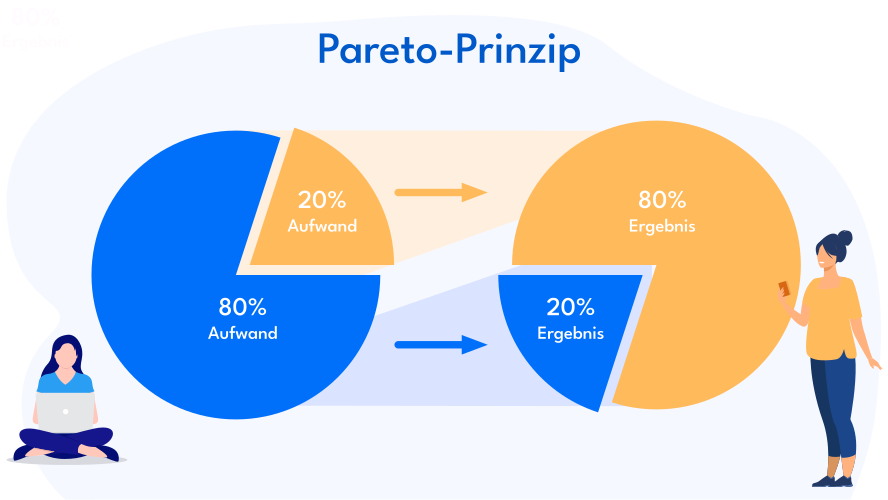
Summary: The Pareto Principle, also known as the 80/20 rule, is a method for advantageously prioritizing tasks and activities. It shows that in many cases, 20% of the effort yields 80% of the results, and the remaining 20% of results require 80% of the effort. The principle suggests focusing first on what has the best effort-to-result ratio.
The Pareto Principle, also known as the 80/20 rule, is one of the most well-known time management techniques. It states that 80% of results can be achieved with only 20% of the effort. This rule goes back to the Italian economist Vilfredo Pareto and has proven itself in many areas of life, particularly in time management. In this article, we’ll explain the origins of the Pareto Principle, provide some examples, and show how it can be successfully applied in everyday life, studies, and professional settings. We’ll also introduce the ABC analysis, which is based on the Pareto Principle. Finally, we’ll shed light on the criticisms and potential pitfalls of this method.
The Economist Vilfredo Pareto Examines Land Ownership Distribution in Italy
Vilfredo Pareto, an Italian engineer, sociologist, and economist, discovered a striking pattern in Italy’s income and wealth distribution in 1906: 20% of the population owned 80% of the land. This finding led to the development of the so-called 80/20 rule, which shows that a small number of causes influence the majority of results.
The Pareto Principle can be applied to various fields. For instance, Pareto observed that 20% of his pea plants in his garden produced 80% of the pea pods. This discovery could also be applied to economics, where it became apparent that a small share of investments often generates the majority of profits.
Examples of the 80/20 Rule
The Pareto Principle can be observed in many areas of life. Here are some well-known examples:
- Business: 80% of a company’s revenue often comes from 20% of its customers.
- Time Management: 20% of tasks lead to 80% of results.
- Traffic: 80% of traffic is concentrated on 20% of roads.
- Technology: 80% of internet data volume comes from 20% of websites.
- Communication: 80% of your calls are made to 20% of your saved contacts.
These examples illustrate that the Pareto Principle is a valuable method for using resources and time efficiently by focusing on the most important 20% that have the greatest impact.
Warning: Misconception #1: Resting on the 20%: The Pareto Principle merely states that 20% of the effort can yield 80% of the results. If you want to achieve 100%, you still need to put in the full 100% effort.
The Pareto Principle in Everyday Life
In everyday life, the Pareto Principle can help you focus on the essential tasks to work more efficiently. For example, if you have limited time to tidy up your apartment, you can concentrate on the most important areas that are immediately visible, such as making the bed and putting away dishes that are lying around. By focusing on these 20% of tasks, a large portion of the impression your mother-in-law has of you is already improved when she comes to visit.
The 80/20 Rule in Studies
The 80/20 rule can also be a valuable tool in academic settings. Students may find that 20% of the study material often accounts for 80% of exam success. Through targeted learning and prioritizing the most important topics, they can optimize their study time and focus on the essentials. Rather than studying everything, it pays to filter out the most important points and focus on those. Ultimately, what counts is passing the exam, and what’s actually tested often differs considerably from the scope of material presented in lectures.
Warning: Misconception #2: Classifying all tasks: The 80/20 rule is about leveraging the 20% most efficient portion. However, there are activities that yield little return yet still need to be completed promptly. These should be excluded from the 80/20 consideration.
The Pareto Principle at Work
In professional life, the principle can also be applied to work more efficiently. Often, 20% of activities lead to 80% of success. Employees should identify and prioritize their most important tasks to boost their productivity. An example could be working on key projects that deliver the greatest business value.

The ABC Analysis
The ABC analysis is a method closely related to the Pareto Principle. This analysis is used to categorize tasks, customers, or products by their importance:
- A elements: These elements are not large in quantity, but they represent the greatest value share for the company.
- B elements: These elements have a roughly equal ratio between value and quantity.
- C elements: These elements are the most numerous in terms of quantity but have a comparatively lower value.
Through this categorization, companies and individuals can focus their resources on A elements to achieve maximum efficiency. It shows, for example, which customer groups or products are most significant and which elements can be more neglected. This indicates where to focus efforts and where it would be worthwhile to intensify them. This method is particularly useful in project management, sales, and materials management; an overview of project management tools helps with implementation, setting priorities, and distributing resources efficiently.
Successful Time Management with the Pareto Principle
The Pareto Principle is an effective time management method that helps set priorities and focus on the most important tasks. By identifying the 20% of most important tasks that account for 80% of success, you can not only work more productively but also reduce stress and increase your own efficiency.
Example project portfolio: A typical professional example is focusing on key projects that deliver the greatest benefit to the company.
Example customer management: A manager might find that 20% of customers are responsible for 80% of revenue. Accordingly, they can direct their attention to these customers and delegate or deprioritize the rest.
Example complaint management: You discover that 80% of customer complaints relate to products delivered damaged. You concentrate your problem-solving capacity on this issue and design better packaging.
Warning: Misconception #3: Excuse for lack of thoroughness: The Pareto Principle should not be an excuse for lack of thoroughness. For 20 percent of the work to produce 80 percent of the output, you need to approach the task in a focused and planned manner during that time.
Common Problems and Criticism of the Pareto Principle
Despite its advantages, the Pareto Principle also faces criticism. Some of the most common misconceptions and challenges are:
-
Misunderstanding of the 80/20 distribution: Many people believe that 80% of results can be achieved with 20% of effort. However, this is not always the case. The 80/20 distribution refers to causes, not effort.
-
Risk of neglecting important tasks: By focusing only on the 20%, there’s a danger of neglecting less important tasks that still need to be done, such as emails or administrative work.
-
Perfectionism and attention to detail: The Pareto Principle can also lead people to work less thoroughly, which can be problematic in some situations. It’s important to find a balance between efficiency and attention to detail.
Summary
The Pareto Principle, like the ALPEN method and the Eisenhower Matrix, is a valuable method for time management and task prioritization that can be applied in many areas of life. It helps focus on the most important 20% of tasks that deliver 80% of results, thus enabling more efficient work. At the same time, one should be aware that not all tasks can be handled this way and that it’s important to find a balance between efficiency and completeness.
With the right application, the Pareto Principle can help optimize the workday, reduce stress, and boost personal productivity.
Frequently Asked Questions
What does the Pareto Principle state?
The Pareto Principle, also known as the 80/20 rule, states that in many cases, 20% of inputs are responsible for 80% of outputs. It was formulated by the Italian economist Vilfredo Pareto. This principle shows that a small amount of resources achieves the majority of results.
Who is the Pareto Principle suitable for?
The Pareto Principle is suitable for both executives with personnel responsibility and career starters. It’s a simple and effective time management method that’s widely used in many companies. By focusing on the 20% of tasks that produce 80% of results, you can boost your productivity and achieve better outcomes.
How does the 80/20 rule work?
The 80/20 rule, also known as the Pareto Principle, states that you should dedicate 80 percent of your nutrition to healthy foods like vegetables, salad, fresh fruit, quinoa, brown and wild rice. The remaining 20 percent can include less healthy products.
What is another name for the Pareto Principle?
The Pareto Principle is also called the “80/20 rule.” It originates from Italy and is named after its discoverer. In this article, learn how you can use the Pareto Principle to boost your success.

Christoph Friedrich
CEO Alltena GmbH
Christoph Friedrich is a computer scientist and certified Project Management Professional. He has extensive experience in the introduction and integration of project management tools as well as the analysis and definition of processes in project and service management.