Summary:
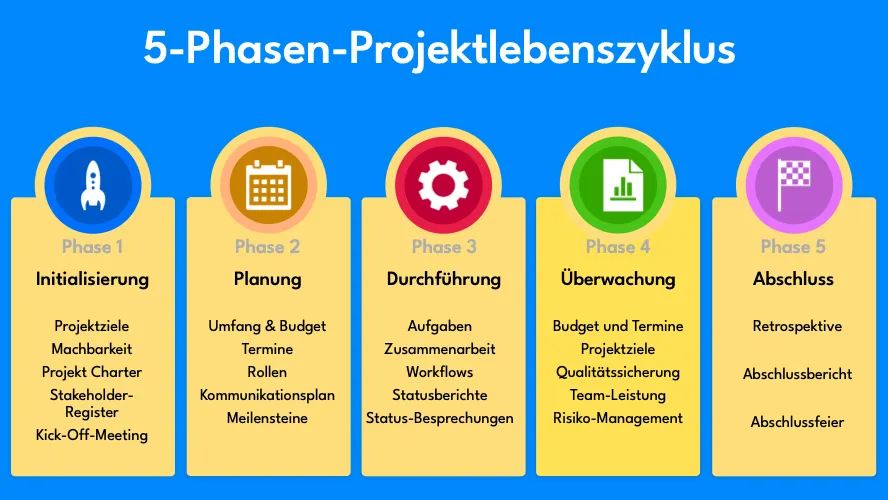
Project management phases divide the project lifecycle into typically 5 time segments: 1. Initiation, 2. Planning, 3. Execution, 4. Monitoring, and 5. Closure. Depending on the industry, there are also models with more or fewer phases.
This structuring improves clarity and establishes fixed exit points in case declining profitability becomes apparent. It thus contributes to executing projects effectively and efficiently.
In project management, the project is structured into project phases during project planning. This allows better risk management, improved project control, and easier integration of the project into the ongoing operations of the executing organization. These project management phases are collectively referred to as the project lifecycle. Their end is typically represented by a milestone and accompanied by the delivery of typical work results (deliverables). They simultaneously mark important project decision points.
The use of phases as a project management method is not limited to the traditional Waterfall Model. In agile project management, for example, iterations can be understood as relatively short phases that are cyclically repeated until a product is completed.
Note: This article references documents such as "project plan," "project manual," or "requirements specification." We have followed the terminology of the V-Model XT, which defines the content and structure of these documents.
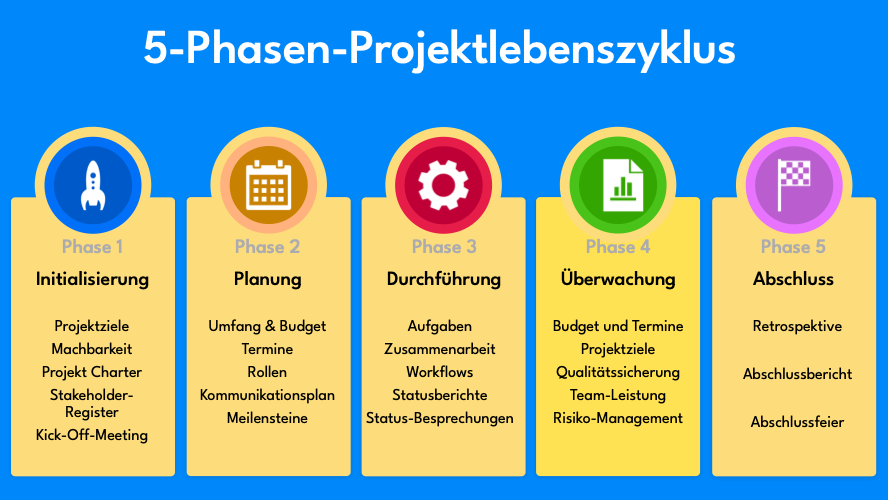
The 5 Phases of the Project Management Process
The 5-phase project lifecycle is widely used as a textbook example. Due to its general nature, it also serves well as a starting point for defining more specific project management processes.
1. Project Management Phase: Initiation
In the initiation phase, the project’s foundation is laid. The project organization is established. Based on a project proposal or project idea, the project’s objectives are defined and the project scope is established, for example using SMART goals. It is clarified what the project should achieve and what resources are available. Stakeholders are identified, and a rough plan as well as a business case (cost-benefit analysis) are created and evaluated, for example using a SWOT analysis or an ABC analysis, to assess the project’s feasibility and value.
| Input Deliverables | Output Deliverables | Notes |
|---|---|---|
| Project proposal | Project manual | with project objectives |
| Motivation | Commercial project calculation | Business case, cost-benefit analysis |
| Solution concept | Functional specification, system specification | |
| Estimate | Effort estimation | |
| Project charter | with project charter | |
| Project progress decision |
2. Project Management Phase: Planning
In the planning phase, the project is elaborated in detail. Specific tasks, schedules, and resources are defined to achieve the project objectives. The project manager will create a project plan that defines the time frame, budget, task distribution, and required resources. Risk management strategies are developed to identify and address potential problems early on.
| Input Deliverables | Output Deliverables | Notes |
|---|---|---|
| Project charter | Project plan | with project objectives |
| Project manual | Updated solution concept | Functional specification, system specification |
| Solution concept | QM plan | |
| Estimate | CM plan | |
| Risk register | ||
| Project progress decision |
This phase also includes establishing quality standards and communication plans to ensure all participants are informed and coordinated. The planning phase is crucial to ensuring the project can be carried out in an organized and goal-oriented manner.
3. Project Management Phase: Execution
In the execution phase, the project plan is put into action. Planned tasks and activities are carried out to achieve the project objectives. Project resources are deployed, and the team works on assigned tasks. Constant coordination and communication take place between team members and stakeholders to ensure the project stays on track.
| Input Deliverables | Output Deliverables | Notes |
|---|---|---|
| All deliverables from planning phase | Updated deliverables | e.g., project plan, risk register |
| System design | System architecture, etc. | |
| Execution deliverables | Software, hardware, etc. | |
| Test reports | ||
| Project progress decision |
During this phase, progress is also monitored and adjustments to the plan are made to respond to unexpected challenges. This project phase drives the project forward decisively and helps achieve the planned results.
4. Project Management Phase: Monitoring
In the monitoring phase, the project is continuously monitored and controlled to ensure it proceeds according to plan. This project phase runs parallel to execution and involves tracking progress, reviewing performance, and ensuring project objectives are met.
| Input Deliverables | Output Deliverables | Notes |
|---|---|---|
| Project plan | Project status report | Management overview |
| Meeting minutes | QA report | Quality issues |
| Test reports | Commercial project status report | Profitability deviations |
| Risk register | Project journal | |
| Metrics (KPIs) |
Deviations from the project plan are identified, for example using the Earned Value Method or Milestone Trend Analysis, and corrective actions are taken when necessary. Monitoring also includes risk management, quality control, and communication with stakeholders about project status. This phase is crucial to ensuring the project is completed successfully and meets requirements.
5. Project Management Phase: Closure
In the closure phase, the project is officially concluded. All tasks are completed, project results are finalized, and deliverables are handed over to the client or stakeholders. A final project evaluation is conducted to verify whether objectives were achieved and the project was successful. Project resources are released, and closing documentation is prepared that captures all important information and lessons learned from the project.
| Input Deliverables | Output Deliverables | Notes |
|---|---|---|
| Project status reports | Project closure report | Retrospective, lessons learned |
| Project journal | Acceptance report | |
| Metrics |
This phase is crucial for properly closing the project, gathering insights for future projects, and ensuring all participants are satisfied.
Note: Many articles give the impression that only the 5-phase model exists. Some authors also mention a 4-phase model. In the real project world with its diversity of industries, project sizes, and requirements, there are far more phase models than just these two.
Visualizing Project Management Phases
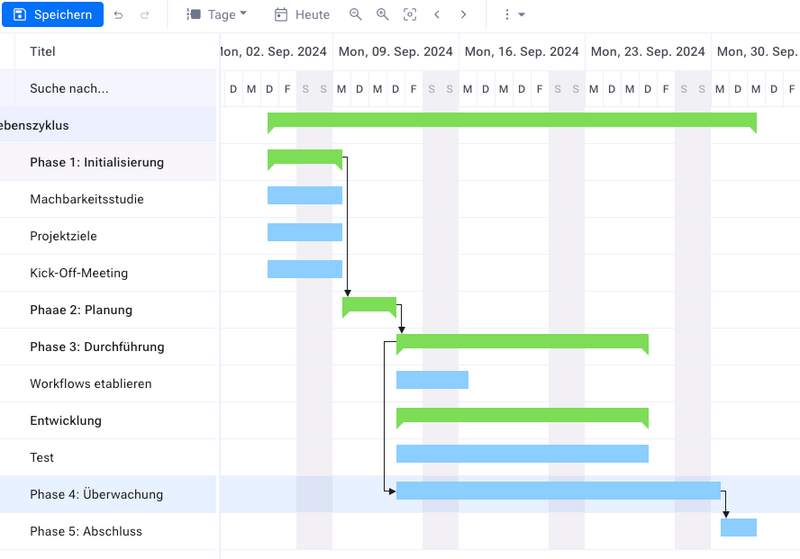
Visualizing project phases is an important component of project management, as it provides a clear and understandable representation of project progress. A well-structured visualization helps simplify complex processes and improve communication between team members and stakeholders. Typical visualization methods include Gantt charts, project timelines, and milestone charts.
A Gantt chart in good project management software is particularly useful, as it displays individual project phases in a temporal context. It shows at a glance which tasks are running in parallel, which are completed, and which are still pending. The length of the bars in the chart indicates the duration of each phase.
Milestone charts offer another effective way to visualize important events or results in a project. These milestones mark critical points in the project that signify the transition from one phase to the next.
Additionally, project timelines can be presented in the form of tables or lists to clarify the sequence of tasks and their dependencies. These visualizations help maintain an overview of project progress, detect bottlenecks early, and use resources efficiently.
Characteristics of Project Phases
According to the PMBOK, each project phase is characterized by the completion of one or more deliverables. A deliverable can be:
- any tangible, verifiable work product
- a feasibility study
- a detailed design
- a functional prototype.
Which deliverables are relevant for a given project is documented in the project manual. The completion of a project phase is generally marked by a review of both the key deliverables and project performance to:
- determine whether the project should proceed to its next phase, and
- detect and correct errors cost-effectively.
These reviews at the end of a phase are often called phase exits, stage gates, quality gates, or kill points.
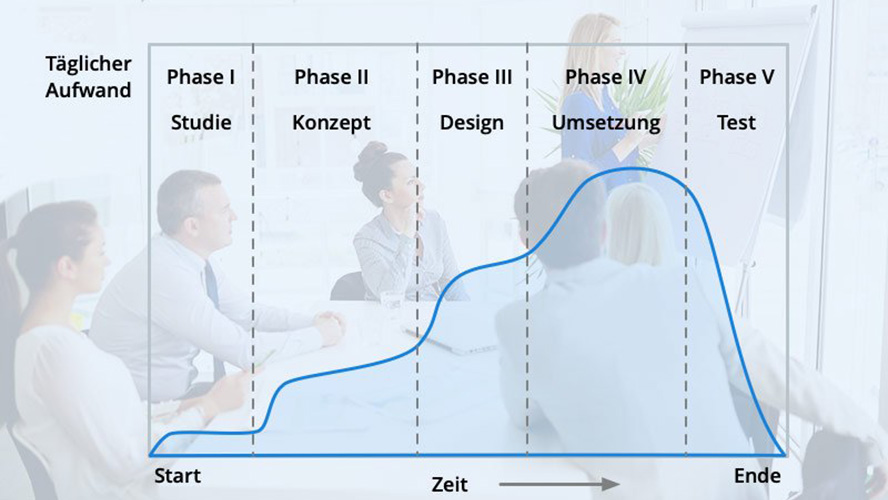
Each project phase typically includes a set of defined work products as primary deliverables. Most of these elements relate to the deliverable to be produced in the corresponding phase, and phases are usually named after these elements: requirements, design, build, test, deployment, operations, and possibly others. Several representative project lifecycles are described below.
Characteristics of the Project Lifecycle
The project lifecycle describes the entire course of a project from start to finish, including all phases and activities. A feasibility study is often conducted before a project begins. This study can be treated as the first phase of the project or as a separate endeavor.
Most project lifecycles involve a sequence of phases that typically include a handover, such as requirements to the design department, construction to production, etc. Approval of one phase’s deliverables usually occurs before the next phase begins. In exceptional cases, sub-phases may start without prior approval if the risks are acceptable (fast tracking).
Project lifecycles define:
- The technical work of each phase (e.g., architecture in the definition or execution phase).
- Who is involved in each phase (e.g., implementers in requirements and design).
- Costs and staffing levels. These are low at the beginning, increase toward the end, and then drop quickly.
- Risk and uncertainty. These are greatest at the beginning of the project. As the project progresses, the probability of successful completion increases.
- Stakeholder requirements. Stakeholders’ influence on the final product is highest at the beginning and decreases as the cost of changes increases.
The project lifecycle should be distinguished from the product lifecycle. A project that brings a new computer to market, for example, is only one phase of the product lifecycle.
Project lifecycles can vary as needed, even within an application area. Even sub-projects can have their own specific project phases, such as in the planning and support of building construction.
Alternative: The 4-Phase Project Management Process
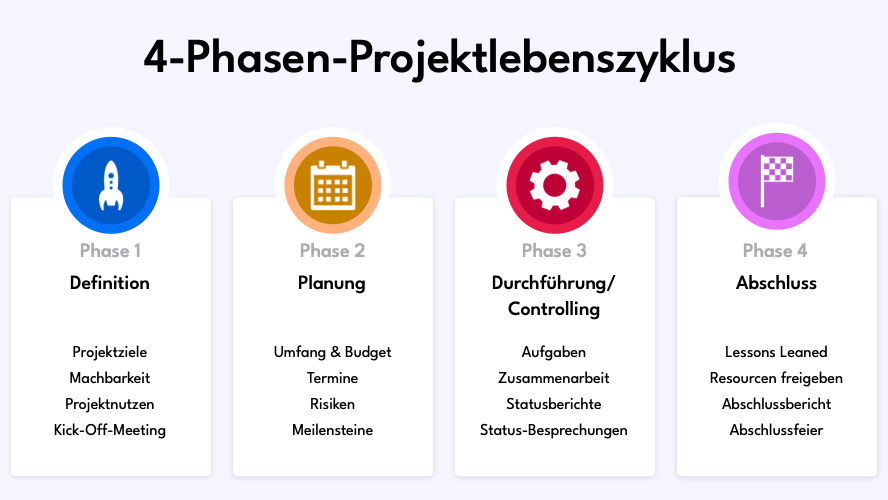
The 4-phase project lifecycle is a general process commonly used by projects that do not wish to give further thought to this topic.
1. Definition Phase
In the definition phase, the project framework is established. Goals, scope, and requirements are defined. Stakeholders and project participants are identified, and decisions are made about which resources are needed. This phase often ends with a project charter that officially launches the project. A clear definition is important to ensure all participants share the same expectations and the project begins on a solid foundation.
2. Planning Phase
In the planning phase, a detailed project plan is developed. It contains tasks, schedules, and resources required to achieve the project objectives. Risks are assessed, and risk mitigation measures are established. Communication plans are also created to ensure smooth collaboration. Careful planning is essential for carrying out the project in a structured and efficient manner.
3. Execution Phase/Controlling
In the execution phase, planned tasks are implemented, while controlling encompasses the monitoring and management of the project. Work is carried out while simultaneously checking whether the project stays within its time and budget framework. Adjustments and corrections are made to ensure project objectives are achieved. This phase requires constant communication and coordination to secure progress.
4. Closure Phase
In the closure phase, the project is officially concluded. Results are reviewed and handed over to stakeholders. A final evaluation is conducted to assess the project’s success and draw lessons for future projects. Finally, all project documentation is completed, and resources are released. This phase is important for cleanly closing the project and creating a solid foundation for future endeavors.
Industry-Specific Project Lifecycles
The following project lifecycles with their project phases were selected to illustrate the diversity of approaches used. The examples shown are typical; they are neither recommended nor preferred. In each case, the phase names and key deliverables are those described by the respective author.
Embedded Systems
U.S. Department of Defense Directive 5000.2, as revised in February 1993, describes a series of acquisition milestones and phases.
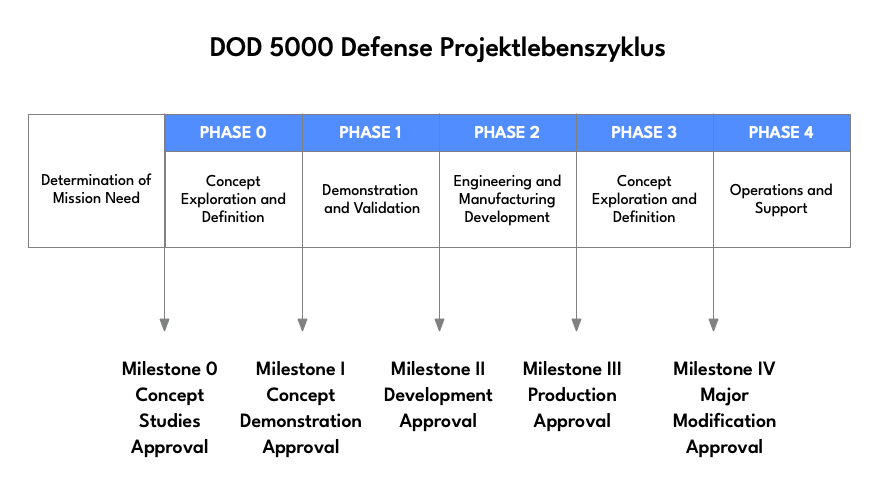
- Determination of mission need with approval of concept studies.
- Concept Exploration and Definition – endpoints with concept demonstration.
- Demonstration and Validation – ends with development approval.
- Engineering and Manufacturing Development – ends with production approval.
- Production and Deployment – overlaps with ongoing operations and support.
Construction
Morris describes the lifecycle of a construction project:
- Feasibility – project formulation, feasibility studies, and strategy design and approval. A go/no-go decision is made at the end of this phase.
- Planning and Design – base design, cost and schedule, contract terms and conditions, and detailed planning. Major contracts are awarded at the end of this phase.
- Production – manufacturing, delivery, construction, installation, and testing. At the end of this phase, the facility is essentially completed.
- Turnover and Startup – final testing and maintenance. The facility is fully completed. Operations begin at the end of this phase.
Project Phases in Pharmaceutical Development
Murphy describes the project phases for developing new pharmaceutical products in the United States:
- Discovery and Screening – includes basic and applied research to identify candidates for preclinical testing.
- Preclinical Development – includes laboratory and animal testing to determine safety and efficacy, as well as preparation and submission of an Investigational New Drug application (IND).
- Registration(s) Workup – includes Phase I, II, and III clinical trials, as well as preparation and submission of a New Drug Application (NDA).
- Post-Submission Activity – includes additional work required to support the Food and Drug Administration’s review of the NDA.
Project Phases in Software Development
For software development, following the original “Waterfall” model and the Spiral model, the spread of agile methods has produced a large number of lifecycle models and corresponding project phases. Here is an example:
- The Proof-of-Concept cycle captures business requirements, defines proof-of-concept objectives, creates the conceptual system design, designs and builds the proof-of-concept, creates acceptance test plans, conducts risk analysis, and makes recommendations.
- First Build Cycle – derives system requirements, defines first build objectives, creates logical system design, designs and builds the first build, creates system test plans, evaluates the first build, and makes recommendations.
- Second Build Cycle – derives subsystem requirements, defines second build objectives, creates physical design, builds the second build, creates system test plans, evaluates the second build, and makes recommendations.
- Final Cycle – unit requirements, final design, construction of the final build, execution of unit, subsystem, system, and acceptance tests.
Frequently Asked Questions
What are the 5 project phases?
The 5 project phases are initiation, planning, execution, monitoring, and closure. In each phase, specific tasks are completed to successfully finish the project. It is important that all phases are carefully planned and monitored to ensure the efficiency and success of the project.

Christoph Friedrich
CEO Alltena GmbH
Christoph Friedrich is a computer scientist and certified Project Management Professional. He has extensive experience in the introduction and integration of project management tools as well as the analysis and definition of processes in project and service management.