Summary: A project schedule is a structured representation of the individual phases, tasks, and milestones of a project. It shows the sequence of activities, dependencies, and the timeframe for each task to ensure efficient execution.
Project management can be overwhelming. Many tasks, tight timelines, countless stakeholders — without a clear structure, chaos looms. This is where the project schedule comes in. It ensures that you maintain an overview, set the right priorities, and can react flexibly to changes.
In this guide, you will learn what a project schedule is, what elements it contains, and how to create one step by step. Whether you are leading a project for the first time or are already an experienced professional — with the right methods, tools, and best practices, you will achieve precise and actionable scheduling.
What Is a Project Schedule and Why Is It So Important?
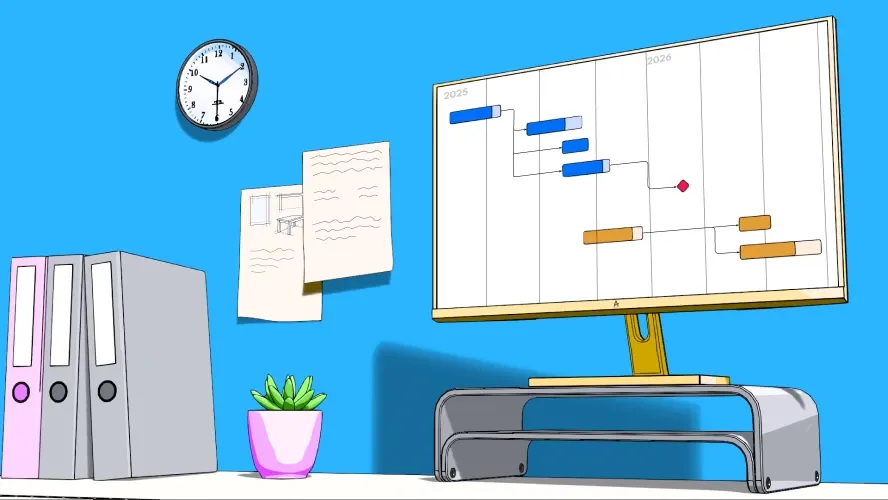
A project schedule describes the logical sequence of tasks and milestones within a project. It shows which steps are required, when they take place, and how they are interconnected.
Why Do You Need a Project Schedule?
Without a clear workflow structure, a project can quickly stall. Too many teams work on too many things simultaneously, dependencies are overlooked, and delays or budget overruns loom.
With a well-thought-out schedule, this doesn’t happen. It helps you:
- Maintain an overview: You always know where the project stands.
- Work efficiently: Every participant knows their tasks and deadlines.
- Deploy resources effectively: Time, budget, and personnel are optimally utilized.
- Stay flexible: Changes can be meaningfully integrated.
Distinction from Other Planning Methods
Many people confuse the project schedule with other planning tools. However, there are clear differences:
| Planning Tool | Focus |
|---|---|
| Work Breakdown Structure | Breaks the project into small work packages but shows no chronological sequence. |
| Milestone Plan | Shows only important events but no detailed workflows. |
| Gantt Chart | Visually represents the project schedule but is only one form of scheduling. |
A project schedule combines several of these approaches and ensures detailed, practical implementation.
Example:
Imagine you are building a house. Before the roof goes on, the foundation must be in place. Before the interior finishing, you need electricity and water. Without a schedule, there would be confusion. In projects, it’s no different — some steps must be completed before others can begin.
What Elements Belong in a Project Schedule?
An effective project schedule consists of several core elements. These ensure that all participants know what needs to be done when and what dependencies exist.
1. Project Phases: The Common Thread
Projects can be divided into four central project phases:
Initiation
- Definition of goals, stakeholders, and requirements
- Initial feasibility analysis and risk assessment
- Roughly outline resources
Example: You are developing a new app. In the initiation phase, you define what problem it solves, who the target audience is, and what budget is available.
Planning
- Define detailed workflow structure and milestones
- Role distribution and resource allocation
- Select appropriate tools (e.g., Gantt chart, Kanban board)
Best Practice: Work with a backward timeline. Start with the desired end date and work your way back. This way, you can identify bottlenecks early.
Execution
- Complete tasks, regularly check progress
- Communication and coordination between teams
- Initial tests and feedback loops
This is where your schedule proves itself. Hold regular review meetings and adjust the plan as needed.
Closing
- Final review and handover of results
- Evaluation: What worked well? Where is there room for improvement?
- Documentation for future projects
2. Tasks, Milestones, and Dependencies
Every project schedule is based on a structured task list — the work breakdown structure. But not all tasks are equally important or stand alone.
- Tasks: Specific work steps that must be completed.
- Milestones: Important intermediate results that must be achieved.
- Dependencies: Some tasks can only begin once others are completed.
Tip: Use a Critical Path Analysis to identify which tasks have the greatest impact on project progress.
3. Time and Resource Planning
A realistic timeline is critical. Overly ambitious schedules often lead to overwork and poor quality. You determine the effort for individual activities through effort estimation. Then, in capacity planning, you assign available resources to tasks.
- Estimate time realistically — use methods like Three-Point Estimating (optimistic, pessimistic, and realistic assessment).
- Avoid overbooking — nobody can give 100% in two projects simultaneously.
- Plan buffer times — unforeseen problems arise in every project.
Successful Example: Toyota uses the so-called Just-in-Time method in its production processes. They optimize not only the workflow but also resources and costs. In projects, this means: Only as much effort as necessary, but enough room for the unexpected.
How Do I Create an Effective Project Schedule?
A project schedule is not a rigid document — it is your navigation system for the project. Thoughtful planning helps you use resources efficiently, minimize risks, and complete the project successfully.
Here is a step-by-step guide you can implement immediately:
1. Clarify the Project Goal and Framework
Before you begin scheduling, you must precisely define the project goal. The SMART goals method is well suited for this. Questions you should answer:
- What exactly should be achieved at the end?
- Who are the stakeholders, and what are their expectations?
- What resources (budget, personnel, time) are available?
Example:
A company plans a new website. The goal: An SEO-optimized, user-friendly site within four months. Stakeholders: Marketing team, IT department, external agency. Challenge: Limited budget and scarce developer capacity.
2. Define Main Phases and Milestones
Now break the project into meaningful phases with clear milestones.
Tip: Use the Work Breakdown Structure (WBS) to divide large tasks into smaller, manageable work packages.
Example for website development:
- Phase 1: Concept (define target audience, create wireframes)
- Phase 2: Design (mockups, UX optimization)
- Phase 3: Development (programming, backend, CMS integration)
- Phase 4: Testing and launch (bug fixing, performance optimization)
Each of these phases should conclude with a milestone, e.g., “Website design approved” or “Beta version online”.
3. Define Tasks, Dependencies, and Timeline
Now it gets concrete: Each phase consists of individual tasks that must be completed in the correct order.
Use these methods:
- Gantt chart: Perfect for visual representation of tasks, dependencies, and deadlines.
- Network planning technique: Reveals critical paths and bottlenecks.
- Kanban boards (e.g., in Trello, Allegra, Jira): Great for agile teams that want to work flexibly.
Important questions:
- Which tasks must be completed first before others can start?
- Are there critical paths (tasks that directly affect project completion)?
- Where should buffer times be planned?
Best Practice: Use the 80/20 rule or the Pareto principle: 20% of tasks determine 80% of project success. Focus on the most important tasks and don’t waste time on secondary matters.
4. Assign Responsibilities
Every task needs clear accountability — otherwise misunderstandings arise. The project organization, documented in the project manual, defines roles and responsibilities. Use the RACI matrix:
- R = Responsible (Who does the task?)
- A = Accountable (Who bears the responsibility?)
- C = Consulted (Who should have input?)
- I = Informed (Who needs to be kept in the loop?)
Example: When launching new software, the development team is “Responsible,” the project manager is “Accountable,” the marketing department is “Consulted,” and the CEO is “Informed.”
5. Documentation and Regular Monitoring
A project schedule is a living document. Plan regular reviews and updates to identify changes and risks early.
Monitoring tools:
- Burndown charts (ideal for agile projects)
- Milestone trend analysis (for traditional projects)
- Status reports and dashboards (for management and clients)
- Retrospectives (for learning for future projects)
Expert Tip: Use Lessons Learned meetings at the end of each project. Document what worked — and what didn’t — to improve future planning.
Which Tools and Software Are Suitable for Creating a Project Schedule?
There are many project management tools for project planning — but not every one is suitable for every purpose. Here you will find an overview of the best programs for different project sizes and requirements.
1. Traditional vs. Agile Planning — Which Software Fits?
Traditional Planning (e.g., Waterfall model)
- Gantt charts, schedules, structured planning
- Suitable for projects with clearly defined workflows (e.g., construction projects, software releases)
Agile Planning (Scrum, Kanban)
- Flexible methods with iterative improvements
- Perfect for startups, IT development, creative projects
2. The Best Tools for Project Scheduling
| Tool | Use Case | Advantages |
|---|---|---|
| Allegra | Small to large agile or traditional projects | Perfect for hybrid project management, on-premise |
| MS Project | Large, complex projects | Powerful Gantt charts, resource planning |
| Trello | Small to medium projects | Intuitive Kanban boards, ideal for agile teams |
| Asana | Medium-sized teams | Clear task assignment, timeline view |
| Jira | Software development, Scrum teams | Perfect for agile sprints and bug tracking |
| Monday.com | Creative projects, marketing | Versatile, customizable, simple automations |
| Smartsheet | Hybrid approach | Combination of spreadsheets and project management |
| ClickUp | All-in-one solution | Task management, mind maps, Gantt charts |
Tip: Many of these tools offer free trial versions. Try out what works best for your team.
3. Excel vs. Specialized Software — Which Is Better?
Many teams still rely on Excel for project scheduling. But is it really the best choice?
Excel Advantages:
- Simple and widely available
- No additional software needed
- Ideal for small, one-off projects
Excel Disadvantages:
- No automation
- No real-time collaboration
- Error-prone for complex projects
Better: Use a combination of Excel for simple lists and a tool like Allegra or Asana for real-time planning.
How Can I Adapt the Project Schedule Flexibly?
No project runs exactly according to plan. Changes, new requirements, or unforeseen challenges are part of everyday life. The art lies in staying flexible without losing the overview.
1. Why Is Flexibility Critical?
A schedule that is too rigid can do more harm than good. When changes aren’t planned for, it leads to stress, delays, or even project cancellations. Especially in dynamic industries like software development or marketing, requirements often change at short notice.
Best Practice: Plan for 10–20% buffer time. This allows you to respond to the unexpected without upending the entire project.
2. Agile vs. Traditional Adaptation — Which Approach Suits You?
| Approach | Characteristics | Suitable for… |
|---|---|---|
| Agile (Scrum, Kanban) | Short sprints, rapid adaptation, flexible priorities | Dynamic projects (e.g., IT, startups) |
| Traditional (Waterfall, Gantt) | Fixed plan, milestones, fewer changes | Structured projects (e.g., construction, mechanical engineering) |
| Hybrid (mix of both) | Fixed base, but room for adjustments | Projects with known goals but variable paths |
Tip: Combine both methods! For example, you can use a traditional Gantt plan for the major milestones and an agile Kanban board for short-term adjustments.
3. How Do I Integrate Changes Without Chaos?
- Regular status meetings: Check weekly whether the plan still fits.
- Re-prioritize: Does everything really need to be done immediately?
- Introduce change management: Define processes for new requirements.
Example: A software startup is developing a new app. Shortly before launch, customers request additional features. Instead of overhauling the entire schedule, the team prioritizes: “Which changes deliver the greatest value and are realistically achievable?” This keeps the project on track.
What Best Practices Improve the Implementation of a Project Schedule?
Planning is half the battle — execution determines success or failure. Here are the best strategies to make your project schedule work in practice.
1. Clear Communication as the Key to Success
A perfect schedule is useless if nobody understands it. Ensure that all team members know who is doing what and when.
- Use clear, simple language — no complicated jargon.
- Visualize the plan with diagrams, checklists, or dashboards.
- Hold regular project updates for all participants.
Example: Google uses OKRs (Objectives and Key Results) for large projects. Every team member knows exactly which goal is being pursued and how success is measured.
2. Monitoring and Controlling: Keeping Progress in Sight
A good schedule adapts — but how do you identify problems early?
Use the following methods:
- Burndown charts (show whether you’re on schedule)
- KPIs for progress tracking (e.g., number of completed tasks per week)
- Risk analyses (identify bottlenecks early)
Best Practice: Set up early warning systems! For example, a traffic light system in Allegra, Asana, or Jira automatically alerts you when tasks fall behind schedule.
3. Keeping Team Motivation High
No project runs smoothly. Motivation dips are normal — what matters is how you handle them.
- Celebrate successes: Make even small milestones visible.
- Avoid micromanagement: Give teams the freedom to find their own solutions.
- Build in regular feedback loops: What’s going well? What can be improved?
Example: Spotify uses “Squads” — small, self-organizing teams with high autonomy. This keeps employees motivated and gives them more creative freedom.
What Common Mistakes Are Made When Creating a Project Schedule?
Even experienced project managers make mistakes in scheduling. Many projects fail not due to a lack of expertise but because of poor planning and communication. Here are the most common pitfalls — and how to avoid them.
1. Underestimated Time and Resource Planning
Mistake: Tasks take longer than expected, or important resources are missing.
Solution: Use realistic time estimates (e.g., Three-Point Estimating: optimistic, pessimistic, and realistic assessment).
Example:
A marketing team plans a major campaign. Content production is estimated at three weeks — without planning for delays. In reality, it takes six weeks because graphics need revisions. With buffer time, the schedule would not have been jeopardized.
2. Lack of Stakeholder Alignment
Mistake: The schedule is created without involving all stakeholders. Later, there is resistance or unexpected change requests.
Solution: Involve all relevant stakeholders early (e.g., through kickoff meetings and regular status updates).
3. Overly Complex or Rigid Plans
Mistake: The schedule is so detailed that small changes throw everything off.
Solution: Plan flexibly and pragmatically — with clear priorities but without excessive detail.
Best Practice:
Work with a core structure for the entire project and supplement it with detailed plans for individual phases. This maintains the overview without having changes upset the entire system.
Why a Well-Thought-Out Project Schedule Is the Key to Success
A good project schedule is more than a list of tasks and deadlines — it is the foundation for efficient, transparent, and successful project execution.
Summary of the key insights:
- Clear structure: A well-thought-out plan gives your team direction.
- Flexibility: Changes are inevitable — a good schedule can integrate them.
- Transparency: All participants always know what comes next.
- Effective execution: With the right tools and methods, your project stays on track.
Recommendations for different project sizes:
- Small projects: Use simple tools like Trello or Asana for quick visual planning.
- Medium projects: Combine Gantt charts with agile methods for flexibility.
- Large projects: Use Allegra, MS Project, or Smartsheet with automated reports and real-time updates.
Frequently Asked Questions
What is a project schedule?
A project schedule is a structured representation of all tasks, milestones, and dependencies within a project. It shows which steps are required, when they are executed, and how they are related. This helps teams work efficiently and monitor project progress.
How do I create a project schedule?
A project schedule is created in five steps: 1) Define the project goal and framework conditions. 2) Break the project into phases and milestones. 3) Create a task list with dependencies. 4) Set realistic timelines and responsibilities. 5) Use an appropriate tool (e.g., Gantt chart, Kanban board) for visualization.
Which tools are suitable for creating a project schedule?
There are various tools for creating a project schedule, depending on project size and requirements. Among the most popular are: Microsoft Project (for large, complex projects), Trello (simple, agile planning), Asana (medium-sized teams with task management), Jira (Scrum and agile teams), and Smartsheet (hybrid solution for traditional and agile projects).
How does a project schedule differ from a work breakdown structure?
A project schedule represents the temporal progression of a project, while a work breakdown structure divides the project into work packages without defining chronological sequences. The work breakdown structure provides an overview of the total scope, while the project schedule establishes the order of tasks.
What common mistakes are made when creating a project schedule?
Typical mistakes in project scheduling include: 1) Overly optimistic time planning without buffer times. 2) Failure to consider dependencies between tasks. 3) Unclear responsibilities within the team. 4) Planning that is too complex or rigid, making changes difficult. 5) Lack of regular review and adjustment of the plan.

Christoph Friedrich
CEO Alltena GmbH
Christoph Friedrich is a computer scientist and certified Project Management Professional. He has extensive experience in the introduction and integration of project management tools as well as the analysis and definition of processes in project and service management.