Goethe wrote approximately 15,000 letters during his lifetime and received around 20,000. That amounts to roughly one letter per day. Phone calls and chats, as far as we know, were not part of his routine.
A well-known lawyer recently told me that he receives about 400 emails a day. The average number of emails in a professional inbox, as surveyed by the industry association bitkom, is 26 per day. Statista found that every user of messaging services receives between 10 and 20 messages per day (lol).
The constant stream of notifications can lead us around by the nose, dictating what we spend our time on. We end up hopping like a dancing bear from one task to another, rushing from meeting to meeting.
These constant context switches are a major cause of low productivity. The busyness initially gives us the feeling of being hardworking and diligent. But when we look at the actual results, a nagging suspicion creeps in: we’re spending a lot of time unproductively switching back and forth between different topics.
Why Time Management?
The author of Ecclesiastes in the Old Testament already knew around 400 BC:
“To every thing there is a season, and a time to every purpose under the heaven:”
Ecclesiastes 3:1, King James Version
Time management is therefore not a modern invention, but an old hat. Time is a resource that is only available to each person in limited supply. Many books have been written exploring the question of how to make the best use of one’s time.
Here we focus on working time. And it makes a difference which activities we pursue and when. A well-known author in relevant circles is said to have stated:
“A 40 hour time-blocked work week, I estimate, produces the same amount of output as a 60+ hour work week pursued without structure.”
Cal Newport, author of “Deep Work”
In a 2018 survey of 100 productivity hacks, Time Boxing — a time management strategy closely related to Time Blocking — was rated as the most effective.
Methodical time management can help shift from unproductive busyness toward greater productivity. A suitable time management strategy can give us a much greater sense of control over our workday. We decide for ourselves what we want to do and when, turn off all distractions for that period, and then get it done.
The benefits of time management, and Time Blocking in particular, are numerous, diverse, and extremely powerful. The practice improves how we feel (control), our individual performance (personal productivity), and the performance of the team we work in (improved collaboration). This may be the most important skill or practice we can develop as modern professionals, as it gives us so much time to achieve everything else. Moreover, it’s easy to implement and costs nothing.
What is Time Blocking?
With Time Blocking, each day is divided into defined time blocks. Instead of reacting to emails throughout the entire day, we set a specific time block — for example, from 8:00 to 8:30 AM — to clear our inbox and respond to messages. Once our inbox is empty, we move on to the next task.
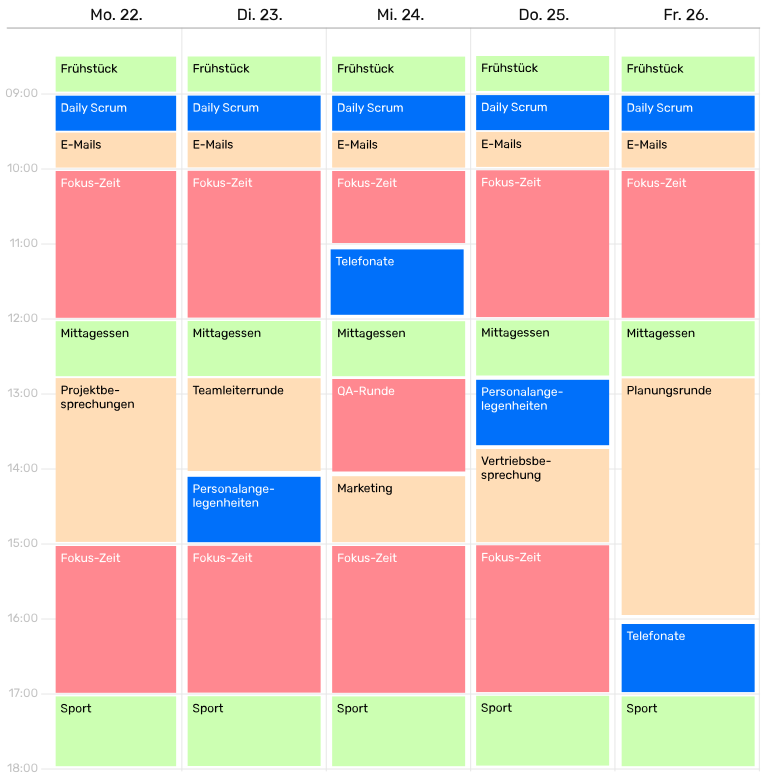
A key element of Time Blocking is setting aside blocks for “Deep Work” — concentrated work on one type of task. New tasks are categorized and assigned to the next available time block designated for that purpose. This helps us avoid unproductive multitasking and prevents interruptions from dictating our day. We complete pending tasks faster and are more productive.
What’s often forgotten is scheduling time for yourself. Whether it’s five minutes or an hour, Time Blocking forces us to put this desperately needed “Me-Time” on our calendar. During this time, we reflect, exercise, read, or do other things that make us happy. S. R. Covey calls this “sharpening the saw” in his famous book “The 7 Habits of Highly Effective People.”
What Time Blocking Variations Exist?
Under the umbrella term “Time Blocking,” there are a number of variations. We should not view these variations as strict rules — after all, we’re not joining a monastic order. Rather, the methods presented can be flexibly adapted to individual needs and work styles, or, as Frederick the Great put it, through appropriate combination and adaptation, everyone can “find happiness in their own way.”
The following table provides an overview of common Time Blocking variations, which are discussed in more detail below.
| Method | What is it? | Example |
|---|---|---|
| Time Blocking | Dividing the day into time blocks, where each block is dedicated to completing a specific task or activity — and exclusively that task or activity. | "I will write every day from 9 AM to 11 AM." |
| Task Batching | "I will answer all my emails at 3 PM." | |
| Time Boxing | "I will write 1,000 words tomorrow between 9 AM and 11 AM." | |
| Day Structuring | "At 9:00 AM I meet with the team for the Daily Scrum. From 9:30 to 10:30 AM I answer emails. After that until lunch I have personal conversations. The afternoon is reserved for creating documents and software. The last hour of the day is again reserved for answering emails. | |
| Day Theming | "Every Monday I will focus on content creation. Every Tuesday I will focus on content promotion. Every Wednesday I will focus on research and ideation." |
Task Batching
With Task Batching, similar or related tasks are grouped together and completed in a contiguous time block. Instead of completing tasks individually and independently, we concentrate on a specific type of task during the batching time block.
The purpose of Task Batching is to increase efficiency by completing similar tasks in one go. This allows us to minimize the switching of mental resources and the context switches that come with constantly jumping back and forth between different tasks.
For example, we might only check and respond to emails at specific times. This time block is our “email batching time block.” By bundling email-related tasks, we prevent constant email notifications from distracting us. Other possible categories include phone calls, research, reports, or creative tasks. This structured approach allows us to better focus on the specific requirements of a task category and potentially achieve higher quality work as well.
Time Boxing
With Time Boxing, fixed time intervals are set for individual tasks or projects. We define a specific period during which we work exclusively on one task and try to complete it within this limited timeframe.
Time Boxing means that we schedule a dedicated time block in our calendar for each task or activity. During this block, we devote ourselves exclusively to that task and do everything possible to complete it within the given timeframe.
The idea behind Time Boxing is that a time limit leads to better focus and more productive work. By setting a clear time limit, we force ourselves to concentrate on what’s essential and minimize distractions. It also helps reduce procrastination, as we are aware of the available time and motivated to complete the task within that period.
Day Theming
Day Theming is a time management method where specific days of the week are dedicated to particular themes or task categories. Instead of filling every day with various tasks and activities, specific days are devoted to a particular purpose or type of task.
The concept of Day Theming is based on the idea that different types of tasks are better handled in separate time blocks or days rather than being spread across the entire period. By designing our days thematically, we create a clear structure and promote better focus on the respective tasks.
For example, we could reserve Mondays for strategic planning and business development. Tuesdays could be designated for client conversations and collaboration. Wednesdays could be used for creative tasks or project work. Thursdays could be reserved for administrative tasks and office organization. Fridays could be dedicated to professional development, learning, or personal projects.
Through day theming, we can ensure that we have enough time for important task areas and don’t neglect them. We can concentrate better on the respective topics because we are mentally already attuned to them and don’t have to move back and forth between different tasks and contexts.
An advantage of Day Theming is that it allows us to plan our day in advance and prepare for the specific requirements of each day. It also creates a certain predictability and clarity about the tasks that need to be completed on a given day, helping to avoid overload.
Day Theming can be adapted to our individual needs and work styles. We can vary the number of themed days per week or reserve half days for specific tasks, depending on our work environment and commitments.
Day Structuring
Day Structuring in the context of Time Blocking refers to dividing the day into different time blocks or phases to organize specific activities or task categories.
We determine in advance how we want to divide our day into sections. Each section is dedicated to a specific purpose or type of task. For example, we could reserve the morning for concentrated work or Deep Work, the afternoon for meetings and collaboration, and the evening for lower-priority tasks or relaxation.
Day Structuring within the Time Blocking framework allows us to better plan our schedule and use our resources more efficiently. We can direct our energy and concentration specifically toward the relevant task areas and ensure that we have enough time for high-priority activities.
Why is Time Blocking So Effective?
Greater Focus on What Matters
Time Blocking enables us to focus on one task by minimizing distractions and interruptions. It creates the optimal environment for Deep Work — a state of deep concentration and productivity. In contrast, a lack of focus and constant jumping between different tasks leads to inefficient work and diminished output.
Groups Together Time-Consuming Tasks
By grouping similar tasks, we can save time and energy. While “Shallow Work” activities that require little mental effort can be completed quickly, “Deep Work” requires longer uninterrupted time to dive into complex tasks. Time Blocking allows us to bundle multiple tasks that require similar levels of concentration.
Develops a Better Sense of Time Spent
We often underestimate the time we need for certain tasks and feel frustrated when we don’t reach our goals on time. Time Blocking helps develop a realistic understanding of how much time is needed for specific activities. By dividing our tasks into time blocks, we get a better idea of how much we can accomplish in a given period and can adjust our planning accordingly.
Helps Against Perfectionism
Perfectionism can cause us to spend too much time on a single task and neglect other important ones. Time Blocking creates clear boundaries and forces us to focus on what’s essential. By setting time blocks for individual tasks, we can control perfectionism and remind ourselves that good results are often more important than perfect ones.
Avoids Unnecessary Context Switching
A 2020 study from Cornell University investigated the widespread assumption that quick responses to work emails are a sign of hard work and that employees must be constantly available to succeed. The authors found that recipients of work emails overestimate senders’ expectations for response speed, especially for non-urgent emails sent outside regular working hours.
The study found that this misjudgment of expectations led to increased stress among recipients and was associated with lower subjective well-being due to the experienced stress. However, the authors found that a simple adjustment from senders can mitigate the email urgency bias. For example, a brief note can be added to emails to clarify expectations for response time on non-urgent matters.
This study illustrates that for many messages, it is possible to batch their processing and thereby avoid unnecessary mental resource consumption from context switching.
Planning Tasks Helps Achieve Goals
In a 2015 Harvard University study “Beyond Good Intentions: Prompting People to Make Plans Improves Follow-Through on Important Tasks,” the effects of planning tasks on goal achievement were examined. The study shows that people are more likely to achieve their goals when they have concretely planned action plans.
The authors conducted a series of experiments to test their hypothesis. In one experiment, participants were asked to complete a specific task, either with or without a specific plan. The results show that those who had created a detailed plan had a higher probability of successfully completing the task.
Another experiment showed that the quality of the plan matters. Participants who specified exact details about time, place, and approach were more likely to achieve their goals than those who created vague plans.
The authors explain that planning tasks creates a cognitive framework that enables people to better control their actions and overcome obstacles. By thinking through the process in advance, one can better prepare for task execution and identify potential stumbling blocks.
The study’s results have important implications for practice. By encouraging people to create concrete plans, their likelihood of achieving goals can be increased. This can be achieved through simple interventions like creating checklists or setting reminders.
Overall, the article shows that creating concrete action plans is an effective strategy for improving the execution of important tasks. It emphasizes the importance of planning and provides practical guidance on how to help people successfully achieve their goals.
Time Blocking offers a structured method to integrate our goals into the calendar — similar to how the ALPEN Method structures the daily routine — and to ensure we schedule enough time to pursue them. By concretely defining our tasks, we increase the likelihood of achieving our goals.
Who Benefits Most from This Time Management Method?
Time Blocking is especially useful for people whose work requires intense concentration, such as writers, researchers, programmers, or creatives. But anyone who wants to boost their productivity and make their day more efficient can benefit from Time Blocking.
Time Blocking cannot be applied effectively when our calendar is overloaded with meetings or recurring appointments. Other time management methods such as Timeboxing or setting priorities complement Time Blocking. Project management tools support calendar planning. However, when we regularly keep periods free in our calendar, this technique can help us direct our attention to the things that truly matter. Parkinson’s Law states that “work expands so as to fill the time available for its completion.”
Time Blocking proves especially helpful when:
- We tend to multitask
- We want to focus on a specific task and avoid distractions
- We want to regain control over our time and energy at work
- We want to develop a better understanding of how we spend our time
- We regularly feel overwhelmed
To apply Time Blocking effectively, we treat each time block as a phase during which we are undistracted and can fully concentrate on our work. This approach is also known as “Deep Work.” For focusing on individual tasks, setting priorities or the Pomodoro Technique are also suitable.
The Most Common Time Blocking Misconceptions and How to Avoid Them
Time Blocks Are Estimated Incorrectly
It’s important to plan realistic time blocks for your tasks. Don’t overload your calendar with too many activities that aren’t realistically achievable in the available time. Make sure to build in enough buffer time to account for unexpected events or longer tasks.
Over time, you’ll get better at estimating how long tasks take, but until you’ve sharpened your instincts, it’s better to schedule slightly more time for tasks than too little. Pad your schedule with extra time to finish tasks and manage the transition between them. You can even create “conditional time blocks” that you can fall back on when you’re behind schedule.
Tip: Consider buffer times and try not to overestimate your own capacity — this gets easier with practice.
Rigid Structures, Little Flexibility
Although Time Blocking is a structured approach, you should still maintain flexibility. Sometimes unforeseen events require adjustments to your schedule. Be prepared to shift or modify time blocks to respond appropriately to these situations.
The Right Duration for Time Blocks is Crucial
It’s important to set the right duration for your time blocks. A block that’s too long can lead to fatigue and declining concentration, while one that’s too short may not be enough to complete a task. Experiment with different time intervals and find out which ones work best for you.
Tip: You’re not a robot and don’t need to calculate your workday down to the minute. A blocked time window for “free time” offers more room for various activities — what those are isn’t necessarily important.
In conclusion: Time Blocking is an extremely effective method for dividing your calendar into time blocks and boosting productivity. By concretely planning your tasks and assigning them dedicated time blocks, you can improve your focus, handle complex tasks more effectively, and develop a better understanding of how you allocate your time. Whether you’re a writer, a business owner, or a student, Time Blocking can help you use your time more efficiently and achieve your goals more effectively. Give it a try and observe how your productivity increases and your calendar gains clarity.

Christoph Friedrich
CEO Alltena GmbH
Christoph Friedrich is a computer scientist and certified Project Management Professional. He has extensive experience in the introduction and integration of project management tools as well as the analysis and definition of processes in project and service management.