awork: Simple Work Management Software
awork is a simple software for general task management in teams. With awork, tasks can be structured, assigned, and tracked. awork has features for simple project management but does not count among the true project management tools.
Pros and Cons
General Functionality
Operation
awork is offered exclusively as Software as a Service (SaaS) in the vendor’s cloud. The vendor guarantees compliance with European data protection standards. Data is stored exclusively within the EU.
Projects and Project Types
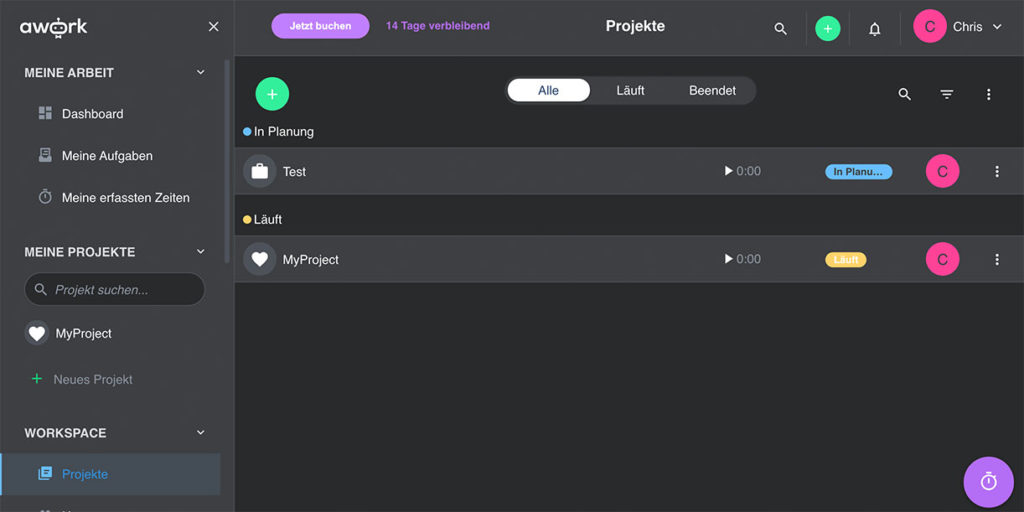
In awork, items are managed in projects or workspaces. Workspaces have types, so that settings can be applied centrally to all workspaces of a given type.
Templates for projects or workspaces can be created in awork.
Items and Item Types
In task and project management, almost everything revolves around “items.” In awork, item types are fixed and cannot be supplemented or modified.
Item Hierarchies
awork offers exactly one hierarchy level. These “sub-tasks” are partially treated and displayed differently from “real” items. A hierarchical structuring of work packages cannot be achieved with this.
The type of subordinate items cannot be restricted depending on the type of the parent item. This means, for example, it cannot be prevented that an item of type “car” is subordinated to an item of type “engine.”
Notifications
awork has a well-configurable notification system. When, what, and to whom notifications are sent can be configured.
There is an @-mention function and a reminder function.
Access Permissions
Custom roles with corresponding permissions can be defined.
Attributes
In awork, there is no support for customer-specific attributes.
Input Forms
In awork, no custom input forms can be defined.
Dependencies
In project management and task management, items are often related to each other. For example, a task cannot be started before another one is completed. Or an item cannot be closed before a dependent item has been completed.
In awork, there is no support for defining dependencies or links.
Dashboards
The system offers its users an overview page (cockpit, dashboard).
Each user has the ability to use pre-configured dashboards or assemble their own dashboard from an extensive list of dashboard tiles. However, there are no dashboard templates, and dashboards cannot be centrally assigned to users by system administrators. The following dashboard elements are available, among others:
- My items
- Number of items in state X over time
- Activity stream
- Predefined filters
Reporting
Reports in awork cannot be created based on report templates or through direct export to Excel or PDF. Report templates do not exist.
User Management
Synchronization of awork with a directory server is not available.
awork does not offer integration with common single sign-on systems.
There is no support for two-factor authentication.
User Interface and Usability
The software offers a beautiful, well-organized, and modern-looking user interface. Regular users can get started relatively quickly even without training. Context-sensitive help provides support when something is not immediately obvious.
For configuration, you need to familiarize yourself with the basic concepts of awork. Training material is available in the form of tutorials, videos, slide sets, and user manuals. Training sessions are also offered.
The user interface can be adapted to user requirements. For each user or user group, the available menu items can be individually configured.
Interfaces and Extensibility
Through an extensive REST interface, nearly all functions available in the user interface are also accessible in awork. For example, users can be managed, projects created, modified, and deleted, or queries executed.
awork can be extended by the user through corresponding interfaces.
Task Management
Delegation
The software does not support delegation of items. It is not possible to mark an item as delegated after forwarding it to someone else.
Substitute Function
In awork, it is not possible to assign substitutes to users.
Recurring Tasks
Some tasks and appointments repeat cyclically, e.g., every first Monday of the month. Handling such item series can be very helpful and time-saving in task management.
awork allows the creation of recurring items just as you would expect from good calendar applications.
Time Tracking
awork allows tracking effort (time and cost) for each item and assigning them to accounts. Accounts can be grouped into cost centers and released for projects.
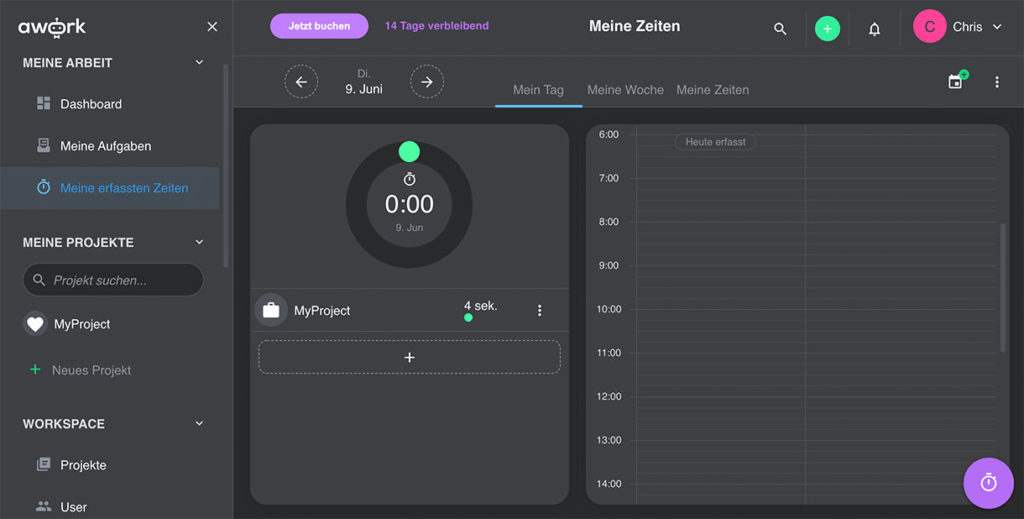
There is the option to use timers in the application to automatically log time spent. Reports provide an overview of who was occupied with which activities during any past time period.
Getting Things Done Method Support
The Getting Things Done method is a proven approach to personal work organization. It allows personal categorization of items such as personal follow-up dates or personal marking of items as favorites.
awork does not support the GTD method.
RACI Matrix Support
For task management and project management, the RACI method defines four item-specific roles through which project stakeholders can be related to a task. Normally, roles are assigned for a project, not for an item. For example, there is a project manager or a Scrum Master for the entire project. RACI, on the other hand, allows roles to be assigned on a per-item basis (see /de/blog/projektmanagement/methoden/raci-matrix/).
awork unfortunately does not offer the ability to model a RACI matrix.
Workflows
Workflows are typically represented in two forms in task management systems. The first method always refers to the workflow of an item that passes through various stages. The second method consists of defining sets of tasks and then working through them.
awork offers a workflow editor.
Project Management
Programs and Portfolios
In many organizations, projects run within the framework of programs, portfolios, or product areas. Here, groups of projects must be able to be consolidated to maintain an overview.
A basic prerequisite for program or portfolio management is the ability to group and hierarchically arrange projects.
awork unfortunately does not offer support for program and portfolio management.
Sub-Projects
Larger project initiatives with many items cannot be sufficiently structured solely through item hierarchies but must be split into sub-projects. Sub-projects may require different processes, e.g., for hardware and software development.
Multi-Project Reports
All queries and reports can span multiple projects and sub-projects, which can be freely defined through corresponding filters.
Work Breakdown Structure
Before a project plan can be created, the activities to be performed or the work products to be created must be structured. To represent such a product structure or Work Breakdown Structure (WBS), items must be able to be arranged hierarchically to any depth.
awork only supports one hierarchy level with sub-tasks. This means WBS or project plans cannot be created.
Interactive Gantt Chart
Gantt charts allow you to define and display the timeline of project activities as well as predecessor-successor relationships. awork offers a simple, interactive Gantt component. It is not possible to display the critical path. There are also no project progress bars, and you cannot compare the current plan with a baseline plan.
Resource Planning
Resources of different types can be managed and assigned to items. There is a view in which resource utilization over time is displayed, making overload or underload immediately visible. Resources can be organized by project or department affiliation.
Employee Availability
Each employee has a personal calendar showing their availability. Availability is taken into account by the system during resource planning.
Project Progress
In awork, it is possible to measure project progress through the ratio of completed tasks to total tasks. Additionally, for still open tasks, it is possible to specify the estimated remaining effort to completion.
This means awork offers a rudimentary, low-effort form of progress monitoring, which is, however, insufficient for more demanding project management.
Agile Project Management
The software supports agile project management to some extent with a taskboard view. Important agile process elements such as epics, user stories, backlogs, and sprints are not available or only insufficiently supported.
For software developers, integrations with source code management systems such as Git and Subversion, as well as with CI/CD servers such as GitLab and Jenkins, are missing.
Alternative Solutions
Besides Allegra, Jira is certainly also a powerful alternative to awork.
See for yourself what the comprehensive project management software Allegra has to offer and book a free live demo.

Gabriella Martin
Editor and Writer
Gabriella Martin is a Yale University graduate and holds a Master's degree in German Literature from the University of Tübingen. She loves explaining complex things in simple terms.