Allegra as an Excellent Trello Alternative
Trello and the Trello alternative Allegra are two powerful, highly configurable project management tools for team-oriented task management and project management. While Trello in its basic version initially works with flat “boards” on which “lists” of tasks can be placed, Allegra fundamentally allows workspaces and items to be structured hierarchically to any depth. With the help of so-called “Power-Ups,” Trello can be functionally expanded considerably, enabling classic project management as well.
Trello Only as a Cloud Solution
When looking for task management software for teams, Trello ranks quite high on the list in terms of feature scope and market adoption. It offers a clean, well-organized, and modern user interface along with a wide range of functions. Configuring and customizing the system requires thorough familiarization, which is facilitated by corresponding documentation.
Trello is offered exclusively as Software as a Service (SaaS) in the vendor’s cloud. The vendor guarantees compliance with European data protection standards.
Extensive Feature Set, but No Projects
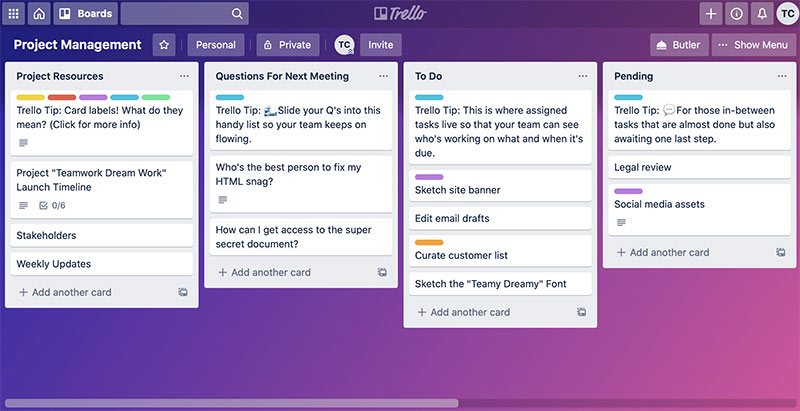
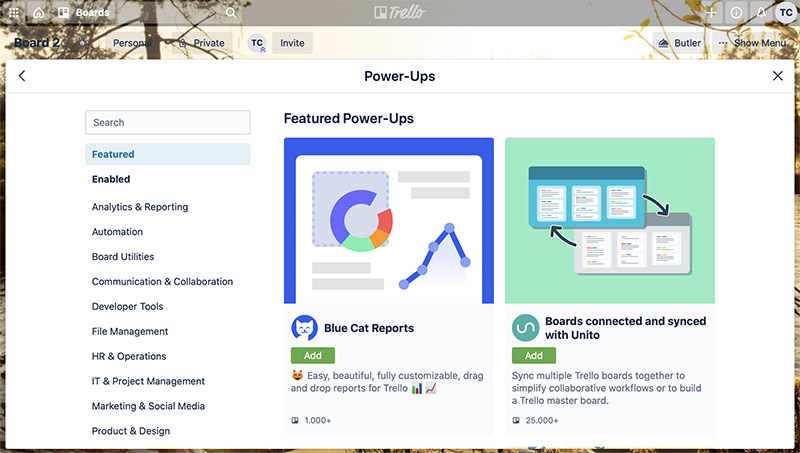
Trello is particularly well suited for smaller projects thanks to the “board with lists” approach. The system is extensively configurable. Many so-called “Power-Ups” are available that can be activated on a per-board basis. There are Power-Ups with functions for hierarchical structuring, news, time tracking, files, repository, forums, calendar, and an interactive Gantt view, among others.
In Trello, items are called “cards.” These are organized in lists, which in turn belong to a “board.” There are board templates, and with corresponding Power-Ups, cards can also be arranged hierarchically. However, there are no board types that would allow centrally configuring derived boards and their properties.
Items and Item Types
In task and project management, almost everything revolves around “items.” In Trello, items or cards belong to a list that can influence the behavior of corresponding items. Lists can be created freely, e.g., for “tasks,” “action items,” and “issue reports,” or sorted by other criteria.
Lists can have their own workflows and different attributes. For example, an action item optionally has a due date, while a task requires both a start and end date.
Item Hierarchies
Trello offers the ability to organize cards in a fully hierarchical manner via Power-Ups. The type of subordinate items can be restricted depending on the type of the parent item through so-called “Rules.”
Trello Summary
Here is a brief summary of the key differentiating features of Trello compared to the Trello alternative Allegra:
- Trello is not available as an on-premises solution, only as SaaS in the vendor’s cloud
- Trello is well suited for smaller projects with a manageable number of items
- Trello only supports simple, non-graphical workflows
- Trello offers only limited hierarchical structuring capabilities
- Trello can be expanded into a project management tool with the help of Power-Ups, but loses coherence in usability in the process
- The Gantt view is rudimentary (no critical path, no baseline plan)
- There are no sub-projects
Trello Alternative Allegra
The project management software and Trello alternative Allegra by Steinbeis comprehensively supports agile, classic, and hybrid project management models. Through the inherent ability to structure workspaces and items hierarchically to any depth, you maintain an overview even with very large numbers of tasks and projects.
Proven methods such as the Eisenhower Principle, Earned Value, Getting Things Done, and RACI Matrix are consistently applied to ensure clarity in both small and large endeavors.
Functionally Complete and Well-Designed
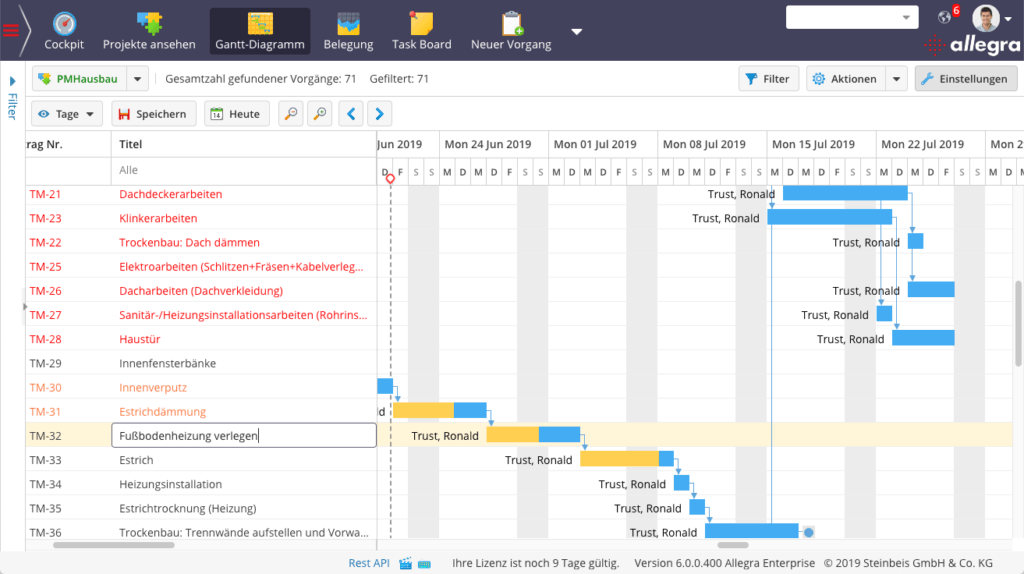
The Trello alternative Allegra supports virtually all important features one would expect from professional project management and task management software. The user interface is modern and appealing. The configuration options can be somewhat intimidating at first but prove to be logical and well thought out after brief familiarization. The Gantt chart, the resource view, and the graphical workflow editor are all interactive.
Powerful Role and Permission System
The role and permission system of the Trello alternative makes a well-thought-out impression and is based on the RACI Matrix principle. Access permissions can be set down to individual fields. All important methods such as Earned Value, Milestone Trend, Eisenhower Principle, and Getting Things Done are supported. Drag & drop operations can be performed virtually everywhere.
Projects and Project Types
In Allegra, workspaces have a workspace type that significantly determines the configuration and behavior of items in that workspace. Workspaces can be arranged hierarchically to any depth and can be used, for example, for projects or sub-projects. Through workspace types, derived workspaces can still be centrally configured even after creation.
Items and Item Types
In task and project management, almost everything revolves around “items.” In Allegra, items belong to an item type that influences the behavior of corresponding items. Item types can be created freely, e.g., for “tasks,” “action items,” and “issue reports,” or sorted by other criteria.
Item types can have their own workflows and different attributes. For example, an action item optionally has a due date, while a task requires both a start and end date.
Item Hierarchies
Allegra offers the ability to organize items in a fully hierarchical manner. The type of subordinate items can be restricted depending on the type of the parent item. This can, for example, prevent an item of type “car” from being subordinated to an item of type “engine.”
Notifications
Allegra has an extensive, configurable notification system. Email notifications are based on templates that can be customized. There is an @-mention function and a reminder function.
The notification system is, for example, capable of sending emails only to the manager of the affected item when the item was completed and has now been reopened.
Access Permissions
Custom roles with corresponding permissions can be defined. Permissions extend down to individual attributes of an item.
Attributes
In Allegra, customer-specific attributes can be configured via the web interface without programming.
An extensive selection of attribute types is available, such as labels, person selectors, or date fields. Additionally, the behavior of standard attributes can be meaningfully customized, e.g., the default value for a start or end date.
For example, you can create a selection list field that offers all users belonging to a specific group.
Different default settings for attributes can be configured for different projects.
Input Forms
Any number of input forms can be defined in Allegra.
Input forms can be structured with tabs and panels. A different input form can be assigned for creating a new item than for subsequent editing.
For the same item type, different input forms can be specified in different workspaces or projects.
Trello Alternative Allegra with Dependencies
In project management and task management, items are often related to each other. For example, a task cannot be started before another one is completed. Or an item cannot be closed before a dependent item has been completed.
In Allegra, there is simple support for defining dependencies or links.
Custom link types can be added via plug-ins.
Dashboards
The system offers its users an overview page (cockpit, dashboard).
Each user has the ability to use pre-configured dashboards or assemble their own dashboard from an extensive list of dashboard tiles. Dashboards can be saved as templates and centrally assigned to users by system administrators. The following dashboard elements are available, among others:
- Average response time
- Average processing time
- Number of items in state X over time
- Activity stream
- Predefined filters
Reporting
In the Trello alternative Allegra, there is an extensive, self-expandable collection of report templates. Reports can be created in Allegra in all common formats.
User Management
To manage users, Allegra can be connected to an LDAP system. Users and groups can be synchronized with an LDAP server manually or automatically.
Multiple directory servers can also be connected.
Allegra can be integrated with CAS and Shibboleth for true single sign-on.
The system supports two-factor authentication.
The user interface can be adapted to user requirements. For each user or user group, the available menu items can be individually configured.
Task Management
Delegation
The software supports delegation of items including follow-up. The delegator maintains the relationship to the item, and the follow-up date is their personal one. The delegator has an overview of items they have delegated.
Substitute Function
In Allegra, it is possible to assign substitutes to users.
Recurring Tasks
Some tasks and appointments repeat cyclically, e.g., every first Monday of the month. Handling such item series can be very helpful and time-saving in task management.
Allegra allows the creation of recurring items just as you would expect from good calendar applications.
Time Tracking
Allegra allows tracking effort (time and cost) for each item and assigning them to accounts. Accounts can be grouped into cost centers and released for projects.
There is the option to use timers in the application to automatically log time spent. Reports provide an overview of who was occupied with which activities during any past time period.
Getting Things Done Method Support
The Getting Things Done method is a proven approach to personal work organization. It allows personal categorization of items such as personal follow-up dates or personal marking of items as favorites.
Allegra does not directly support the GTD method.
RACI Matrix Support
For task management and project management, the RACI method defines four item-specific roles through which project stakeholders can be related to a task. Normally, roles are assigned for a project, not for an item. For example, there is a project manager or a Scrum Master for the entire project. RACI, on the other hand, allows roles to be assigned on a per-item basis (see /de/blog/projektmanagement/methoden/raci-matrix/).
Allegra unfortunately does not offer the ability to model a RACI matrix.
Workflows
Workflows are typically represented in two forms in task management systems. The first method always refers to the workflow of an item that passes through various stages. The second method consists of defining sets of tasks and then working through them.
Allegra supports the first variant without a graphical editor.
Project Management
Programs and Portfolios
In many organizations, projects run within the framework of programs, portfolios, or product areas. Here, groups of projects must be able to be consolidated to maintain an overview.
A basic prerequisite for program or portfolio management is the ability to group and hierarchically arrange projects.
Allegra allows workspaces to be arranged hierarchically to any depth, thus supporting simple, pragmatic program and portfolio management.
Sub-Projects
Larger project initiatives with many items cannot be sufficiently structured solely through item hierarchies but must be split into sub-projects. Sub-projects may require different processes, e.g., for hardware and software development.
Multi-Project Reports
All queries and reports can span multiple projects and sub-projects, which can be freely defined through corresponding filters.
Work Breakdown Structure
Before a project plan can be created, the activities to be performed or the work products to be created must be structured. To represent such a product structure or Work Breakdown Structure (WBS), items must be able to be arranged hierarchically to any depth.
In Allegra, WBS can be fully represented. The order of items can be freely defined at each level.
Interactive Gantt Chart
Gantt charts allow you to define and display the timeline of project activities as well as predecessor-successor relationships. Allegra offers a powerful, interactive Gantt component. It is possible, for example, to display the critical path. There are also project progress bars, and you can compare the current plan with a baseline plan.
Resource Planning
Resources of different types can be managed and assigned to items. There is a view in which resource utilization over time is displayed, making overload or underload immediately visible. Resources can be organized by project or department affiliation.
Employee Availability
Each employee has a personal calendar showing their availability. Availability is taken into account by the system during resource planning.
Project Progress
In the Trello alternative Allegra, it is possible to measure project progress through the ratio of completed tasks to total tasks. Additionally, for still open tasks, it is possible to specify the estimated remaining effort to completion. Progress can be precisely determined using the Earned Value method, which is fully and robustly implemented in Allegra.
Agile Project Management
The software fully supports agile project management according to Scrum and Kanban. There are not only the corresponding views such as a taskboard or burn charts, but at the core of the system, all elements necessary for agile work such as epics, user stories, backlogs, and sprints are implemented.
Backlog priority, sprint capacity, and team velocity are supported by corresponding application logic. Tasks remaining from a previous sprint can be automatically carried over to the next sprint. Sprints can be created automatically in advance.
For software developers, there are integrations with source code management systems such as Git and Subversion, as well as with CI/CD servers such as GitLab and Jenkins.
Allegra supports common database systems and runs on virtually all operating systems. It is written in Java and JavaScript, has been on the market for over ten years, and is used by approximately 10,000 users.
Servers Located in Germany
Allegra Cloud is operated on servers located in Frankfurt am Main, Berlin, and Karlsruhe. Allegra Cloud is fully GDPR-compliant. There is a personally accessible support team available via email, phone, and web conference.
Further topics:
Task management, task management software, comprehensive project management software comparison.
See for yourself what the comprehensive project management software Allegra has to offer and book a free live demo.

Christoph Friedrich
CEO Alltena GmbH
Christoph Friedrich is a computer scientist and certified Project Management Professional. He has extensive experience in the introduction and integration of project management tools as well as the analysis and definition of processes in project and service management.