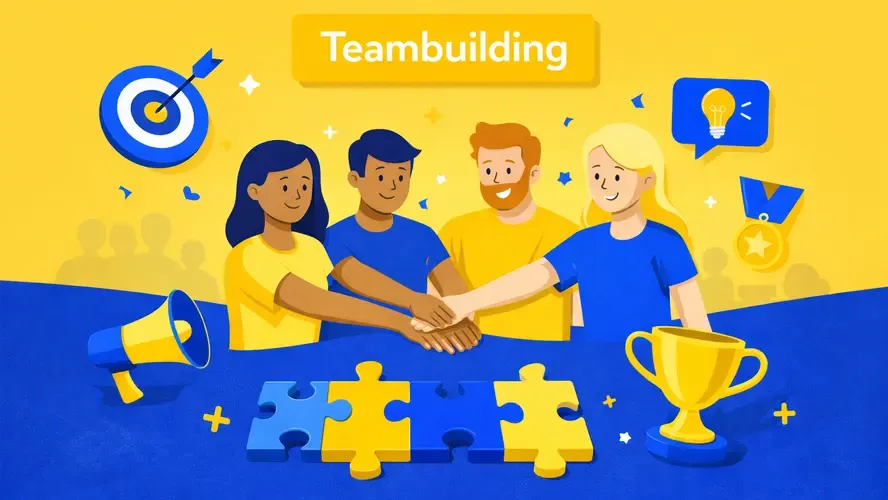
The saying “A pile of cucumbers is still not a salad!” applies equally well to people working together in a team. Team building turns individuals into something shared — a whole whose combined ability exceeds the sum of its parts. The recipe for efficient and engaged collaboration among team members is:
- clearly defined roles and responsibilities
- personal commitment
- a shared goal
- team spirit
- motivation
- a suitable task management tool
It is up to project leadership to pave the way for these prerequisites as much as possible. Through a variety of measures, colleagues and employees can develop into true team players.
Clearly Defined Roles and Responsibilities
When working together on an assignment or project, tasks should be distributed through clear and open communication so that every team member knows what to do, when to do it, and how. This should really go without saying today.
A Shared Goal
How can a team work toward a common goal? The answer lies in each team member becoming aware that “I need the others and the others need me!” or “My contribution is indispensable so that everyone benefits!” How can this be practiced? The project manager proposes a team evening — but no one organizes it alone; everyone does it together. The planning meeting, of course, takes place during working hours for one to two hours, so that all team members are motivated and ready to contribute to the organizational planning. The organization is carried out in such a way that each team member takes care of only one piece of the puzzle. Taking independent responsibility for a task is the first “milestone.” The project manager distributes the responsibilities and sets the final deadline by which all tasks must be completed. Responsibilities include things like the venue, music, drinks, games, salads, and snacks. If something is missing, everyone feels it. If everything is there, everyone benefits. To wrap up, there is an evaluation and follow-up discussion in the office or conference room over coffee and cookies.
Team Spirit
Team spirit is a positive social quality of a group of people or a team, most commonly seen in sports. The team works together to accomplish a specific task. The “we” takes center stage, not the “I.” Team spirit is a powerful form of the sense of togetherness.
How can a project manager strengthen the team spirit of colleagues and employees? The possibilities are numerous and range from simple activities like board games and group games, to team sports, to joint survival workshops. What matters is that all employees take part in such activities. The focus is on gathering shared experiences — and every participant should not only receive help and appreciation, but also signal it toward others.
Motivation
How can a project manager motivate the people around them? Anyone who is enthusiastic about something should show it! This means communicating openly and honestly: What is it about the work on an assignment or project that is so motivating? What makes the individual tasks so exciting from your own perspective? Where do the dangers for the project lurk? Team building requires the team to exchange views regularly. Here, too, mutual respect and appreciation for contributions, ideas, and activities are essential. Other team members will automatically catch your own enthusiasm.
Personal Commitment
How can a project manager increase the personal commitment of individual team members? Team building is strongly encouraged when enthusiasm for the project work is passed on to colleagues. The solution lies in “WE-experiences” rather than approaching individual employees in isolation. If the focus is on achieving the shared goal together and on mutually supporting and encouraging each other, personal commitment can be positively influenced.
The Right Tool
The last — yet, in today’s digital age, indispensable — ingredient for efficient and engaged collaboration in the context of team building is web-based task management software that connects team members in the cloud and visibly promotes and simplifies collaboration. The resulting transparency means that every team member is always up to date on everything that matters — bringing the shared goal closer within reach!
How can a project manager find the right software? The features of the software should match the requirements of the team. In practice, requirements can be highly individual and varied. Common evaluation criteria for software include — beyond price and follow-on costs for customization and maintenance — network capability, updates, technical requirements, standards, guidelines, certifications, data protection/information security, interfaces, and domain-specific criteria. Once the right task management software has been found, working as a team becomes truly enjoyable — and success is guaranteed!

Editor and Writer
Gabriella Martin is a Yale University graduate and holds a Master's degree in German Literature from the University of Tübingen. She loves explaining complex things in simple terms.