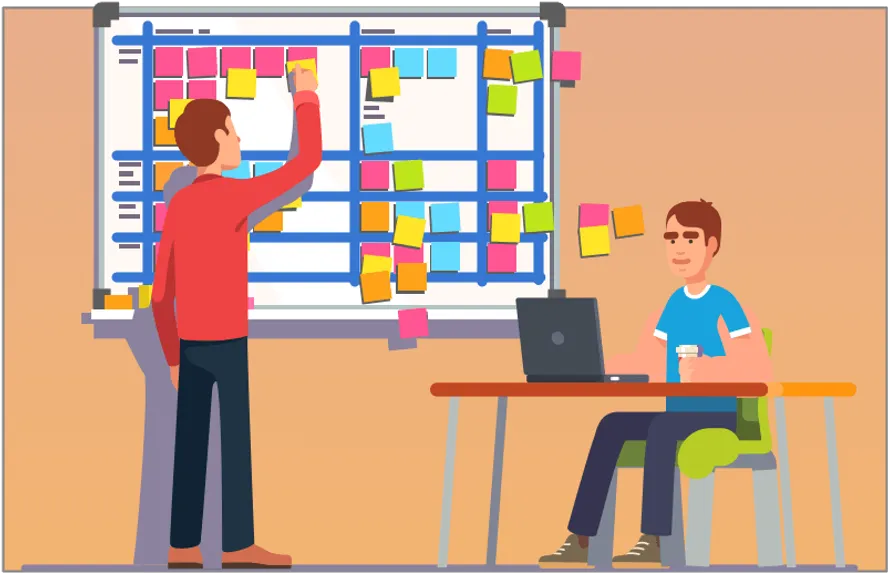
If you are a Scrum project manager, Scrum has some bad news for you: you no longer have anything to say! Liberty, equality, fraternity — your role in a Scrum project calls you to humility. According to the Scrum Guide:
- You may not assign tasks to the team
- You may not decide what gets implemented
- You may not instruct the team on how to work
- You may not demand status reports
But there are things you are allowed to do. You may:
- ensure good working conditions — for example, by providing a good Scrum software 😉
- represent and shield the team from the rest of the organization
- take care of resource provisioning
In Scrum, the tasks and responsibilities of a traditional project manager are distributed across three roles: the Product Owner, the Scrum Master, and the Team. The Product Owner represents the customer’s interests and decides what is to be delivered and in what order. They also determine whether what has been delivered meets the requirements.
The Scrum Master is responsible for ensuring that the rules the team has set for running the project are followed. They make sure everything runs according to Scrum. They are also responsible for removing anything that might prevent the team from performing at its best. The Scrum Master is not overall responsible for achieving the project goals.
So who bears overall responsibility? The answer is: everyone — and therefore no one! It is similar to a soccer team, where every individual contributes to the overall result, but when there are too many losses, it is not the team but the coach who gets fired. Only in this way can Scrum work in practice as well.
The role of Scrum Master lends itself naturally to taking on the traditional tasks and responsibilities of a manager. If you have already cultivated a collaborative leadership style, it will not be difficult for you to give your team as much freedom as possible and to communicate with your employees as equals. You have already drawn on the expertise of team members and taken their opinions, assessments, and feedback seriously.
You have certainly heard of certified Scrum Masters. Through such a certification program, you may learn a thing or two. Otherwise, such a certification is perhaps best compared to the crowning of medieval kings by the Pope — after the ceremony they were no wiser, just poorer and better legitimized. If you can dispense with such an ordination on the basis of your technical and interpersonal competence, your common sense and some engagement with the core ideas of Scrum will guide you on the right path even without a certificate.
Further Information
If you are interested in reading more about Scrum, you can do so here. In this article you can find an overview of agile project management.

Editor and Writer
Gabriella Martin is a Yale University graduate and holds a Master's degree in German Literature from the University of Tübingen. She loves explaining complex things in simple terms.