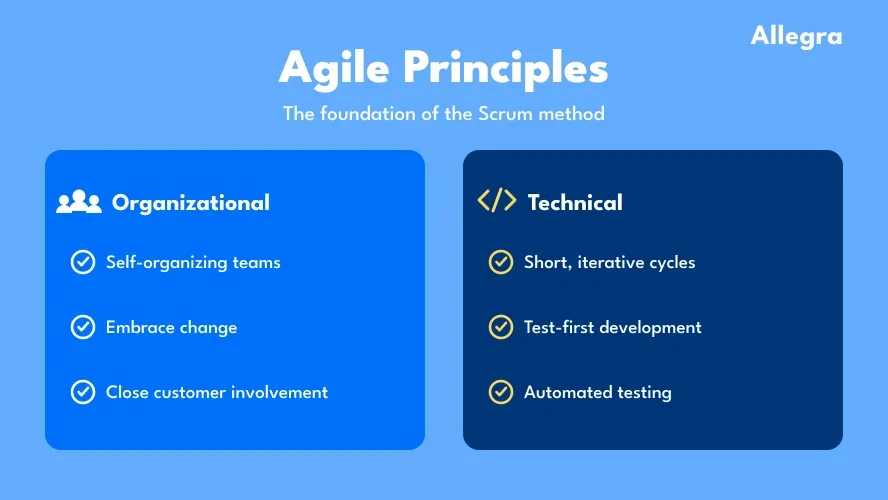
Agile principles form an important foundation of the Scrum method alongside agile practices. They build on the overview of agile project management. We divide the principles further into organizational and technical agile principles, which can largely be derived from the “Agile Manifesto”. The agile principles are grounded in the agile values.
Organizational Principles
Self-Organizing Teams
Scrum calls for “self-organizing teams” and requires that traditional managers largely stay out of the development production cycle. The team is given as much say as possible and communication takes place at eye level. The expertise of team members is leveraged and their opinions, assessments, and suggestions are taken seriously.
Change Is the Rule, Not the Exception
Scrum assumes that customers often don’t know — or can’t know — what they truly need. It therefore takes for granted that the customer’s requirements and expectations will change over the course of the project. Requirements are frozen only for the duration of a “Sprint,” that is, for one development cycle.
The Customer Is Closely Involved in the Development Process
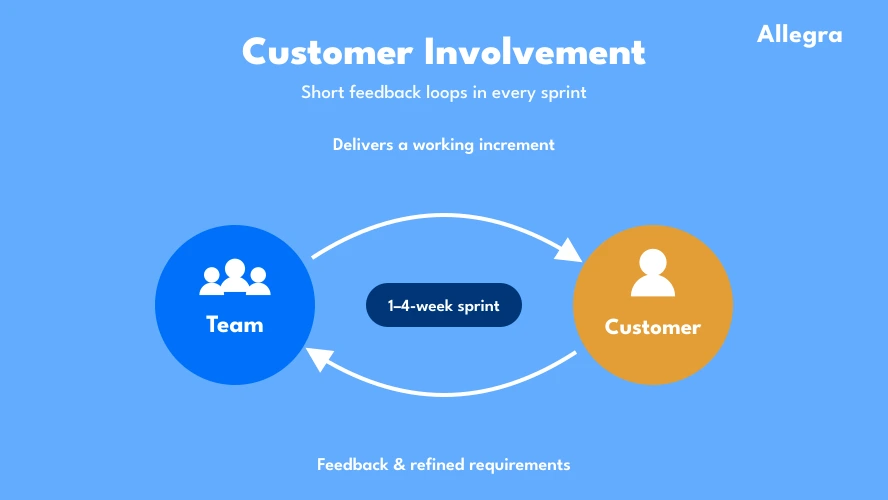
Customers are brought into development early. Solutions developed in short intervals are presented to them. The customer can then quickly give feedback on whether the solution meets their expectations.
Avoiding Overtime
Scrum seeks to avoid a situation where the promised delivery date is met at the end of a project through overtime. Scrum’s proposed solution is straightforward: the deadline is kept, but the scope of delivered functionality is reduced if necessary. However, this approach is not always feasible, especially when a particular piece of functionality must be delivered by a specific date. Overtime often arises from unforeseen disruptions or from effort estimation errors. Experienced managers therefore plan with buffer time rather than overtime.
Development Effort Is Minimized
Scrum requires that only what is necessary be implemented, based on the assumption that users only use a fraction of the features a system provides. To keep development effort low, Scrum focuses on creating tests and writing software code, and invests little time in elaborating requirements and design.
Technical Principles
Develop Iteratively in Short Cycles
Scrum divides the software production process into equal-length phases of approximately one to four weeks, called “Sprints.” After each Sprint, a working product increment should have been produced — something the customer can review and give feedback on. This approach is intended to prevent misdevelopment and better fulfill the customer’s expectations. Requirements may not be changed during a cycle.
Automated Tests Are a Key Element
Among the most important agile principles in Scrum are executable tests. The testing focus is on so-called “unit tests,” in which individual modules or classes are verified. Regression tests are used to ensure that code changes do not introduce bugs into an already working software module. No new software should be developed as long as existing tests still reveal errors.
Write Tests First
The idea is to create the associated test cases before developing a feature and to add them to the regression test suite. This approach encourages thinking about how to demonstrate that requirements have been implemented, thereby supporting the requirements engineering process. Developing tests first is therefore a valuable principle.
Scenario-Based Requirements

Scrum questions whether requirements can be gathered in large volume upfront. However, it is impossible to develop something without having documented what it should be. In Scrum, requirements are therefore documented in the form of so-called “User Stories” or “Epics.” User Stories are typically scenario descriptions. Describing requirements in the form of scenarios is particularly effective where a large proportion of the functionality is visible at the user interface. The scenario method has one key advantage over other methods: it is easy to derive the corresponding test cases from the scenarios.
Agile Principles in Practice
In practice, agile principles are supported by suitable project management tools and agile project management software as well as continuous integration tools. The first category includes, for example, Allegra project management software; the second includes Gitlab. Unfortunately, the agility in the process comes at a cost. Agile project management faces some challenges when scaling, and some of the agile principles and values must be sacrificed in favor of better scalability and a functional project organization. The guidelines set out in the Agile Manifesto are therefore adopted in many organizations only to the extent that they prove useful in practice.
Further Information
If you are interested, you can find out here how your team organizes itself. Also read our articles on Scrum roles and Scrum artifacts, as well as on the Kanban board and the comparison of Agile vs. Waterfall.

CEO Alltena GmbH
Christoph Friedrich is a computer scientist and certified Project Management Professional. He has extensive experience in the introduction and integration of project management tools as well as the analysis and definition of processes in project and service management.