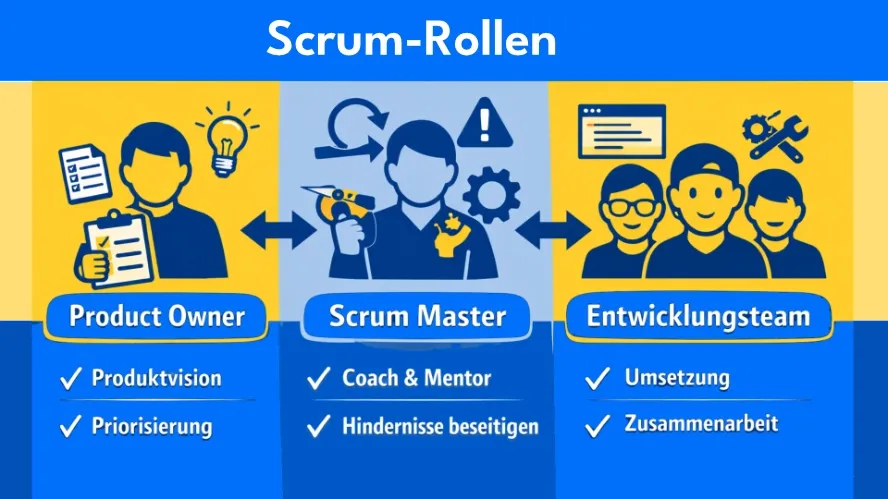
There are only three Scrum roles: Product Owner, Scrum Master, and Scrum Team. Customers are represented by the Product Owner, who closely involves them in the development process. Managers have little decision-making authority in the Scrum process and are primarily responsible for providing resources. Agile project management software and project management tools are well suited for putting this into practice.
Product Owner
Developing a product is an investment that must pay off. The Product Owner, as one of the three Scrum roles, bears responsibility for the profitability of the product they oversee. They also represent the interests of the customers. The Product Owner can positively influence the return on investment by tasking the team first with features that deliver high value while requiring little development time. The Product Owner controls the order and prioritization in which features are worked through by the team. And only the Product Owner is authorized to commission work or change the order of features.
The Product Owner is not a project manager in the classical sense, nor are they responsible for the outcomes of the development team. They are not involved in the actual development work. In many companies, the role of the Product Owner corresponds to that of the product manager.
Scrum Master

The Scrum Master should act as a coach to help the team organize itself and become more effective. The team commits to delivering a product, and the Scrum Master is responsible for collaboration within the team and the overall result of the teamwork. The Scrum Master should be a Scrum expert — helping the team learn the Scrum methodology and apply it as advantageously as possible. They should assist the team in removing organizational and methodological obstacles. The Scrum Master is not the team’s supervisor but works with the team as an equal.
The Scrum Master is not a project manager. They do not take on responsibility for the development outcome.
Scrum Team

In Scrum, the members of a development team work closely together and are expected to self-organize. They determine how they collaborate. The team alone decides which tools and techniques it uses and which team members work on which tasks. Effort estimations are created by the team members themselves.
A Scrum team should possess all the skills required to build the desired product. The team therefore consists of specialists, each contributing their expertise toward the desired outcome. However, a team member’s role is not limited to contributing in a specific area of expertise — everyone contributes overall to producing a working product with each Sprint. The mindset should not be “that’s not my job,” but rather “I’ll do what needs to be done.”
Scrum teams have between five and nine members. With fewer members, the team may no longer have sufficient capabilities to complete all the work. With more members, the communication overhead increases disproportionately.
No individual team member bears overall responsibility for the development outcome. Commitments regarding scope and delivery date always extend only to the next iteration cycle, not across the entire project period.
Further Information
The article “Agile Project Management Explained” provides further background knowledge on this topic. The article “Agile Project Management: Principles” explains additional fundamentals. For deeper reading: Scrum Artifacts, agile values, agile practices, Kanban board, Scaled Agile Framework, and Agile vs. Waterfall. For day-to-day implementation: project management tools and agile project management software; for contrast with classical leadership: the project manager’s role and project management methods.

Editor and Writer
Gabriella Martin is a Yale University graduate and holds a Master's degree in German Literature from the University of Tübingen. She loves explaining complex things in simple terms.