What Are Project Management Methods?
Project management methods define how you carry out a project. Each method serves a specific purpose and helps implement projects in a structured and efficient way. Fundamentally, we distinguish between
- Process models (e.g., V-Model XT, Scrum)
- Supporting methods (e.g., milestone trend analysis, Critical Path Method)
Process models describe the necessary steps and deliverables — such as documents or prototypes — needed to develop a project idea into a finished result. Supporting project management methods typically address only a single aspect of the overall project workflow.
It quickly becomes apparent that two fundamental approaches dominate:
- Classical project management with careful, step-by-step planning
- Agile project management with a flexible and iterative approach
Process Models
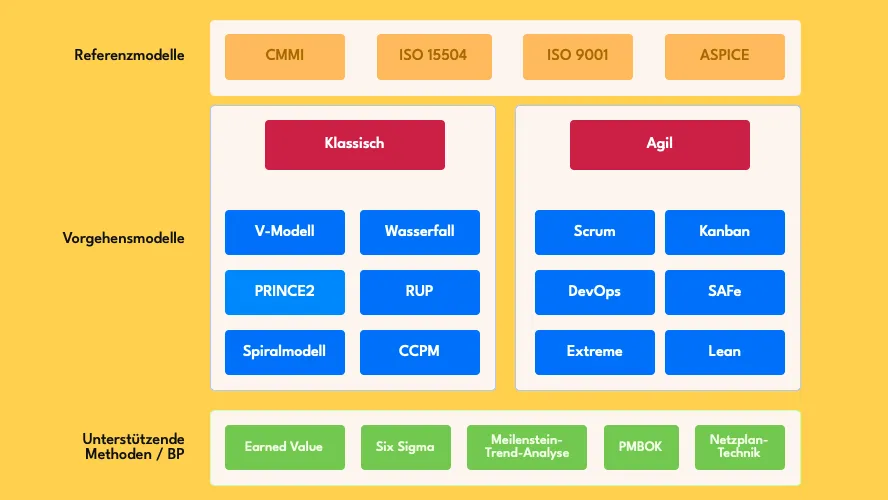
Process models can generally be assigned to one of these two approaches. The classical camp includes primarily the waterfall model, the V-Model, PRINCE2, the Spiral Model, and the Rational Unified Process. The agile approaches include primarily Scrum, Kanban, DevOps, and Extreme Programming.
Reference Models
In addition to process models, there are reference models that define quality criteria for project processes — describing what good project management looks like. The most well-known include CMMI, ISO/IEC 15504, ISO 9001, and Automotive SPICE.
Why Are There So Many Methods?
The reason is simple: projects differ greatly from one another. Depending on the industry, objectives, or team structure, one method suits better than another. An approach that works well for small, creative projects may be entirely unsuitable for large infrastructure endeavors.
Different industries have their own requirements and standards. In IT, flexible and iterative methods like Agile or Scrum are widespread, while in construction, clearly structured, classical process models tend to be used.
Companies also differ from one another. Their culture and organization shape which methods they prefer: some like working with flexible, self-organized teams, while others rely on fixed processes and clearly defined responsibilities. Since in practice many methods are implemented in project management tools, there is a corresponding diversity of tools as well.
The Schools of Thought: Classical or Agile?
The main difference between classical (traditional) and agile project management lies in how projects are planned, executed, and controlled. The table below shows the key differences.
| Classical | Agile | |
|---|---|---|
| Planning and flexibility |
|
|
| Phases and iterations |
|
|
| Customer involvement |
|
|
When Is Classical Better?
- When you must deliver something well-defined by a fixed deadline
- When you need more than 10 people to implement your project
- When changes are costly — e.g., tooling development or hardware
- When requirements can largely be clarified upfront
When Is Agile Better?
- When you can determine what you deliver at a given point in time
- When you need fewer than 10 people to implement your project
- When changes are easy to make (refactoring)
- When you only need to deliver increments to something already existing
- When requirements are difficult to clarify upfront
How Do You Find the Right Method?
Choosing the right project management method for your project depends on several factors. Here are some steps that can help:
- Consider industry and organizational requirements: Industry standards and company culture play a major role. In heavily regulated industries such as construction or pharmaceuticals, classical methods like the waterfall model or PRINCE2 are often preferred. In creative or technology-based companies, agile approaches like Scrum or Kanban may fit better — supported by appropriate agile project management tools. Often there is no choice at all: you simply use the same approach as the last project, since introducing new methods can be expensive.
- Consider your team: The composition and experience of the project team are also important factors. Agile methods often require a high degree of self-organization and direct communication, which works well in small, cross-functional teams. Larger, hierarchically organized teams may benefit from the clearer structures found in traditional methods. Team building has a major influence on the later effectiveness and productivity within the project.
- Think about project requirements and goals: First, the specific requirements, goals, and scope of the project should be clearly defined. A large, complex project with many stakeholders might require a structured method like PRINCE2 or the classical waterfall model, while a dynamic, innovative project might be better managed with agile methods like Scrum or Kanban. For developing goals, the SMART goals method is recommended.
- Assess project complexity and scope: Complex projects with many dependencies and risks often require detailed planning and control, which argues for traditional methods. Simpler or rapidly changing projects can benefit from the flexibility and adaptability of agile methods.
- Check resources and timelines: When resources are scarce or timelines are tight, a method that enables fast iterations and delivers regularly reviewable results — like Scrum — can be advantageous. Projects with fixed deadlines and clear milestones may benefit from a linear method like the waterfall model.
- Evaluate flexibility and openness to change: When the project environment is uncertain and requirements change frequently, an agile method may be more appropriate. Projects with stable, clear requirements that are not expected to change can benefit more from traditional methods.
Through a careful assessment of these factors, you can select the method that best fits the specific needs and goals of your project. In many cases, a hybrid approach that combines elements from different methods can also make sense.
Classical Project Management Methods
Classical project management methods follow a comprehensive and holistic approach. At the start of the project, a clearly defined end state is established and planned. Costs, deadlines, resources, quality, and benefits are considered from the very beginning. This enables effective project control and a solid foundation for successful project delivery.
Classical methods are based on experience from many projects and are, like classical music, timelessly valuable. With the rise of agile methods, they have sometimes been cast as outdated or old-fashioned. It is easy to overlook the fact that not everything good need be new, and not everything new need be good.
The best-known classical project management method is the waterfall model, which is why it often serves as a synonym for classical project management. The original V-Model is a further development of the waterfall model. The highly useful V-Model XT (development standard) extends the generic V-Model and permits, within certain limits, an agile approach. The Spiral Model and IBM’s Rational Unified Process (RUP) have been placed in the classical category, although both already display many ideas that would justify classifying them within the agile school of thought.
Classical methods are particularly suited to projects
- that require more than 10 people to implement
- in which changes to requirements are costly
- in which binding commitments on schedule and deliverables must be made
Waterfall Method
The waterfall method is a traditional project management approach that has been in use since the 1970s. It is a linear and sequential method in which the project is divided into phases. Each phase must be completed before the next can begin. The phases include requirements gathering, design, implementation, testing, and deployment. The waterfall method is suitable for all types of projects in which late requirement changes would be costly.
Advantages:
Strengths
- Well-defined structure: The waterfall method is structured, which can make it easier for teams to understand what they need to do and when.
- Clear deliverables: Deliverables are defined for each phase, providing an objective measure of project progress.
- Document-oriented: The waterfall method places great emphasis on thorough project documentation, which is especially important for large project teams where not everyone can communicate directly with everyone else.
Disadvantages:
Weaknesses
- Inflexible: Once a phase is complete, making changes to the produced deliverables is costly. This requires good project planning and robust requirements management.
- Less direct collaboration: The waterfall method promotes the flow of information primarily through documentation rather than direct exchange.
- High risk: Since each phase depends on the successful completion of the previous one, problems that arise can lead to significant delays.
V-Model XT
The term “V-Model” refers both to a general process model designed for software development and to a development standard. The latest version of this standard is called the V-Model XT and supports not only the approach of the general process model, but many other approaches as well. In what follows, we refer not to the general V-Model but to the V-Model XT development standard.
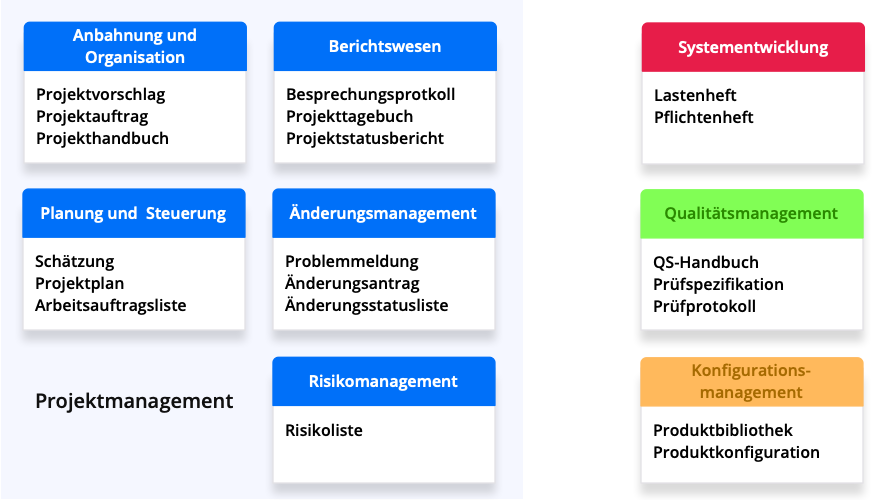
This standard is a framework for systems engineering and project management. It is an extension and concretization of the waterfall model and is often applied in safety-critical and complex projects.
The V-Model XT proposes a concrete approach. To that end, all necessary activities along with their respective results — the “products” — are named and defined. For many products, templates are available that can be used directly.
The V-Model XT is also suited to smaller organizations and projects through adaptation. This “tailoring” is explicitly permitted and supported by tooling.
Critical Chain Project Management
Critical Chain Project Management (CCPM) helps with the prioritization of work packages and with handling the unavoidable variation in effort estimates. The method avoids harmful multitasking and reduces project duration through clever buffer management. The CCPM approach works as follows:
- Identify critical resources: In the first step, the “critical resources” that are scarce in the project and could cause bottlenecks are identified. These resources can be both people and physical items.
- Create the critical chain: After identifying the critical resources, the critical chain is created. This involves identifying the work packages or tasks that depend on these resources and have the longest duration in terms of resource utilization. This chain represents the longest path in the project.
- Estimation and buffer management: In CCPM, estimates for work packages are created such that they will be met with approximately 50% probability. The difference between this estimate and a conservative estimate is used as a buffer for the project. This buffer is shared across all work packages on the critical chain to offset early completions and delays.
- Operational prioritization: Resources work on tasks on the critical chain, prioritized based on the ratio of progress to buffer consumption. This ensures that critical tasks are prioritized to minimize project duration.
- Ongoing monitoring and adjustment: CCPM requires continuous monitoring of project progress and resource utilization. Adjustments are made as needed to ensure the project is completed on time.
In regular projects, team members estimate the duration of work packages and provide a buffer for each. Due to Parkinson’s Law — which states that buffers are always used and never reduced — the student syndrome — which states that work begins as late as possible — and combined with Murphy’s Law — which states that something will always go wrong — early completions are never passed on while delays always are. CCPM effectively counters this phenomenon as well as harmful multitasking.
Agile Project Management Methods
Agile project management methods are characterized by flexibility, iteration, and a collaborative way of working. These methods are particularly effective in smaller projects where requirements are unclear, and in uncertain or rapidly changing environments.
The core of agility is dividing projects into small, well-plannable units referred to as iterations or Sprints. During each iteration, a portion of the project is developed, tested, and evaluated. The most important agile methods are Scrum, Kanban, and Extreme Programming (XP).
Agile project management is best suited for projects that require high real-time communication within small, motivated teams and need less formal control. This approach enables rapid adjustments during the project lifecycle and fosters interactivity among project stakeholders. Agile project management is the optimal choice for such projects.
Agile approaches have gained significantly in popularity in recent years and are applied across various industries — from software development to product management and marketing.
Scrum
Scrum is a framework for agile project management. It was originally designed for software development but is now used in other industries as well. It is based on a set of agile principles and agile practices, along with clearly defined roles, artifacts, and events.
1. Roles:
- Product Owner: Responsible for defining and prioritizing requirements and maximizing the value of the product.
- Scrum Master: Serves as a coach for the Scrum team, promotes adherence to Scrum practices, and removes impediments.
- Development Team: The group of professionals who build the product. They are self-organized and cross-functional.
2. Artifacts:
- Product Backlog: A list of all requirements and tasks that need to be fulfilled for the project.
- Sprint Backlog: A selection of items from the Product Backlog to be implemented during a Sprint.
- Increment: The product or product functionality created at the end of a Sprint.
3. Events:
- Sprint: A time-box of typically 2–4 weeks during which the development team works on the increment.
- Sprint Planning: The team plans which tasks are to be completed during the Sprint.
- Daily Scrum: Short daily meetings where the team discusses progress and any impediments.
- Sprint Review: A review of the increment produced at the end of the Sprint.
- Sprint Retrospective: A meeting where the team reflects on the Sprint and discusses improvements.
Scrum enables quick responses to changes in requirements and priorities. It emphasizes the continuous delivery of products and close collaboration between team members, the Product Owner, and stakeholders. Scrum is especially suited for smaller projects with unclear requirements.
Kanban
Kanban is an agile framework for project management and task management, with its origins in lean manufacturing. The word “Kanban” comes from Japanese and means “visual signal.” The primary goal of Kanban is to visualize the flow of work, identify bottlenecks, prioritize tasks, and promote continuous improvement.
In a Kanban system, tasks, work steps, or projects are represented on physical or digital Kanban boards. These boards consist of columns corresponding to the various stages of the work process, and cards or tickets representing individual tasks. Each column can be limited to control the flow of work, so that only a certain number of tasks can be in progress at the same time.
The core principles of Kanban are:
- Visualization: Work is visible to all team members, creating greater transparency and a shared understanding.
- Limiting Work in Progress (WIP): Each column on the Kanban board has a limited capacity to prevent overload and make bottlenecks visible.
- Continuous flow: Kanban promotes a smooth and continuous flow of work, where tasks enter and exit the process as needed.
- Pull system: Tasks are pulled by the team based on capacity and demand, rather than being pushed or assigned.
- Improvement: By continuously monitoring the flow of work and identifying bottlenecks, ongoing improvements and adjustments to the process are encouraged.
Kanban is flexible and can be used in various industries and contexts, not just software development. It helps optimize work processes, increase efficiency, and improve the quality of results by keeping the focus on highest-priority work and minimizing waste.
Scrumban
Scrumban is a hybrid project management method that combines the principles of Scrum and Kanban. It was developed to unite the flexibility of Kanban with the structure of Scrum, enabling an efficient way of working in agile projects.
In Scrumban, tasks are represented on a visual Kanban board, similar to the pure Kanban approach. Tasks move through various columns to display their progress. Unlike pure Kanban, however, Scrumban also includes time-boxes called Sprints, as used in Scrum. During a Sprint, a selected set of tasks from the Kanban board is worked on within a defined timeframe.
The key characteristics of Scrumban are:
- Continuous delivery: Scrumban allows tasks to be processed in a continuous workflow while still benefiting from the Sprint planning and reviews of Scrum.
- Flexibility: The team can respond to unforeseen changes during a Sprint and add or remove tasks from the workflow without jeopardizing the entire Sprint.
- Visualization and WIP limiting: As in Kanban, work steps are represented visually and the limitation of work in progress (WIP) is maintained to minimize bottlenecks.
- Improvements: Scrumban promotes continuous improvements through retrospective meetings and adjustments in the work process.
Scrumban is particularly useful in situations where requirements or priorities change frequently while some structure and planning are still required. It offers the flexibility of Kanban and the planning capabilities of Scrum to meet the demands of agile projects.
DevOps
DevOps aims to improve collaboration between the development (Dev) and IT operations (Ops) areas within an organization. The primary goal of DevOps is to accelerate software delivery, improve application quality, and increase the efficiency of deployment and maintenance.
DevOps is based on the following key principles and practices:
- Collaboration: DevOps promotes close collaboration between developers and operations teams. This means teams work together on planning, developing, deploying, and maintaining software.
- Automation: The automation of processes — such as builds, tests, and deployments — is essential for achieving repeatable and consistent results. Automation tools like GitLab, GitHub, Ansible, and Docker are an integral part of DevOps.
- Continuous Integration (CI): Developers regularly integrate their code into the main codebase, and automated tests are run to detect errors early.
- Continuous Delivery (CD): Continuous delivery allows software changes to be automatically deployed to the production environment after passing CI tests.
- Monitoring and feedback: DevOps relies on comprehensive monitoring to ensure the performance and availability of applications. Feedback loops enable problems to be identified and resolved quickly.
- Scalability: DevOps enables applications to scale rapidly and respond to changes in demand.
DevOps can reduce time-to-market, increase reliability, and improve efficiency. It promotes an agile and iterative approach to software development and operations — which is critically important in today’s fast-paced IT world.
Lean
Lean in the context of project management refers to the application of Lean principles and methods — originally developed in the manufacturing industry — to the efficient, waste-free execution of projects. The goal of Lean project management is to maximize project success, minimize the waste of resources, and optimize the delivery of value to the customer.
The key Lean principles in project management are:
- Customer focus: Lean places great emphasis on putting the needs and requirements of the customer at the center and ensuring that customer value is maximized.
- Waste elimination: Lean aims to reduce or eliminate all forms of waste in the project — whether in the form of excessive work, unnecessary waiting times, or resource waste.
- Continuous improvement: The concept of Kaizen — continuous improvement — is a central element of Lean. Teams are encouraged to constantly rethink and optimize their processes and ways of working.
- Pull system: Similar to Kanban, Lean project management is based on a pull system where tasks are only executed when they are needed, rather than being planned and stacked in advance.
- Flow optimization: Lean strives for a smooth workflow in which tasks are completed continuously and without interruption.
- Reduction of variability: Managing uncertainty and variation is an important aspect of Lean to ensure predictability and stability.
Applying Lean in project management leads to more efficient use of resources, shorter lead times, better quality control, and overall higher customer satisfaction. It is particularly useful in projects with changing requirements and complex workflows, where optimizing the flow of work and eliminating waste are crucial.
Supporting Methods
A number of methods cover only one very specific aspect of project management, or are collections of terminology, principles, and practices — such as PMBOK. For this reason, we do not list them here as full project management methods, but only as “supporting methods.” They are typically used as a supplement to the more comprehensive methods.
PMBOK
“PMBOK” stands for “Project Management Body of Knowledge.” It is a set of standards and guidelines for project management published by the Project Management Institute (PMI). PMBOK is not a method in the strict sense, but serves as a framework and guide for project managers across various industries. It encompasses proven practices, processes, and terminology in project management.
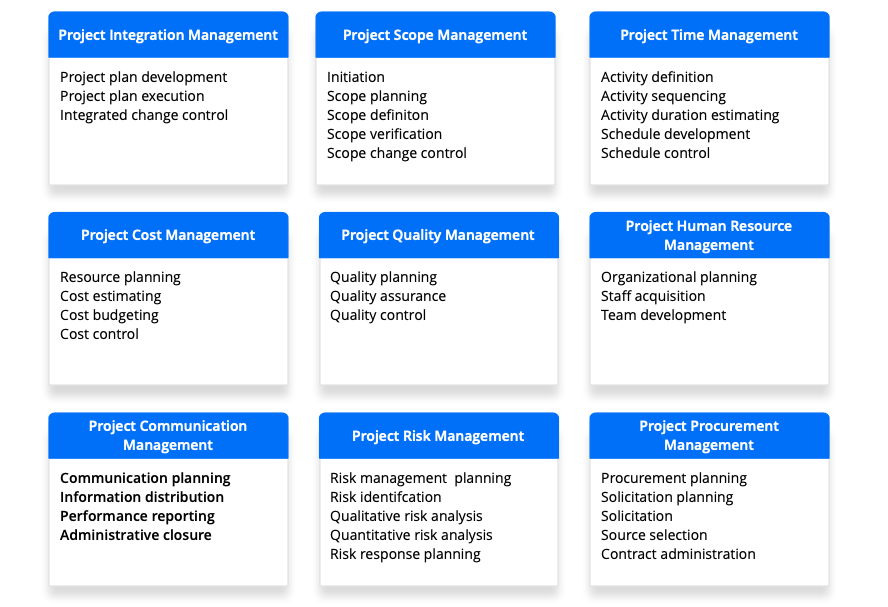
The main aspects of PMBOK include:
- Process groups: These divide the project management cycle into five groups: initiating, planning, executing, monitoring and controlling, and closing.
- Knowledge areas: PMBOK defines ten knowledge areas important for project management, such as project integration, scope, schedule, cost, quality, resources, communications, risk, procurement, and stakeholder management.
- Best practices and guidelines: It provides guidelines and proven practices that can be applied in various project situations.
- Ethical principles: PMBOK also emphasizes the importance of ethics and professionalism in project management.
Anyone who works professionally with project management should be familiar with the PMBOK.
Earned Value Method
The Earned Value Method (EVM) is a project management technique that makes it possible to assess the actual project progress and compare it against planned expectations. EVM is based on three main parameters:
- Planned Value (PV): The value of the planned work up to a specific point in the project, often referred to as the budget.
- Earned Value (EV): The value of the work actually completed up to a specific point in the project, measured in terms of the budget.
- Actual Cost (AC): The actual cost incurred up to a specific point in the project.
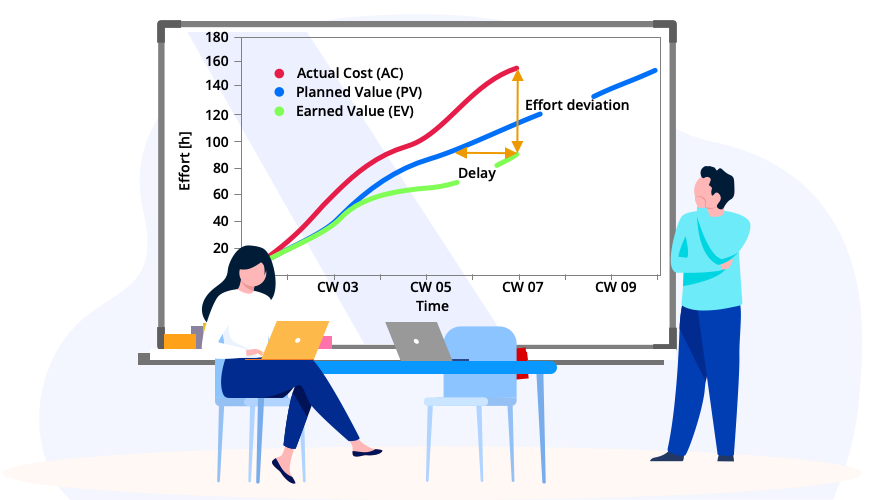
Based on these values, various important key metrics can be calculated:
- Cost Performance Index (CPI): Indicates how efficiently costs are being controlled in the project (CPI = EV / AC). A value above 1 indicates that the project is under budget.
- Schedule Performance Index (SPI): Shows the efficiency of scheduling (SPI = EV / PV). A value above 1 means the project is progressing faster than planned.
- Cost Variance (CV) and Schedule Variance (SV): These values show the difference between the planned and actual value (CV = EV − AC, SV = EV − PV).
EVM enables the early detection of effort and schedule deviations, helping to initiate countermeasures in a timely manner. This allows projects to be completed with greater budget and schedule adherence.
Network Diagram Technique
The network diagram technique is a project management method for planning, controlling, and monitoring projects. It enables the representation of activities, their dependencies, and the timeline in a network diagram. Two main approaches are used in network diagram techniques: the activity-on-node approach (PERT) and the activity-on-arrow approach (CPM).
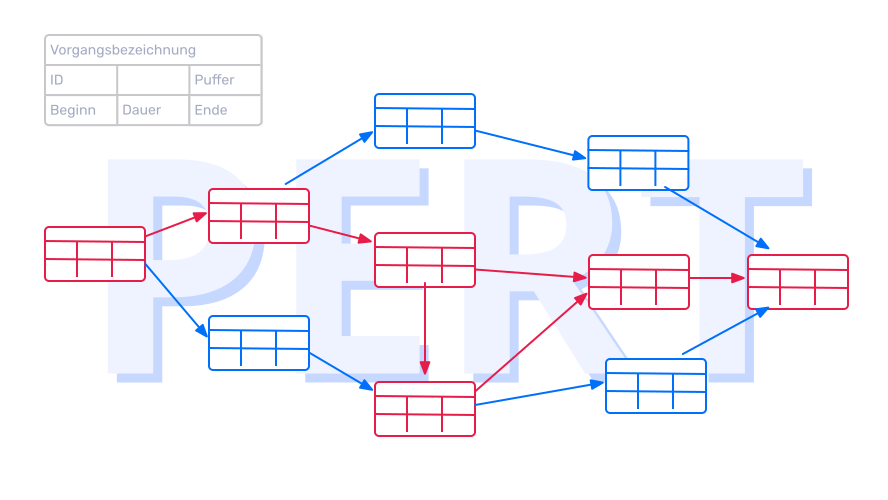
In the PERT approach, activities are represented as nodes connected on a diagram. Each activity has an estimated duration and a probability of being completed within that duration. PERT allows the calculation of the most likely project duration and the identification of critical paths.
In the CPM approach, activities are represented as arrows connecting events such as milestones. CPM uses fixed durations for activities and focuses on identifying the critical path to determine the earliest possible project completion date.
Both approaches enable detailed planning, resource allocation, and scheduling to achieve project goals on time and identify bottlenecks. The network diagram technique is particularly useful for complex projects with many activities and dependencies.
Milestone Trend Analysis
The milestone trend analysis (MTA) is a project management technique in which project progress is tracked by milestones. It compares the planned milestone progress with the actual progress and identifies deviations.
For visualization, the milestone dates are plotted on the Y-axis at the start of the project. The dates of planned project status meetings are marked on the X-axis. At each status meeting, the milestone dates are updated and entered into the diagram. If milestones move upward over time, this indicates a delay. If milestones remain on a horizontal line, the project is on track.
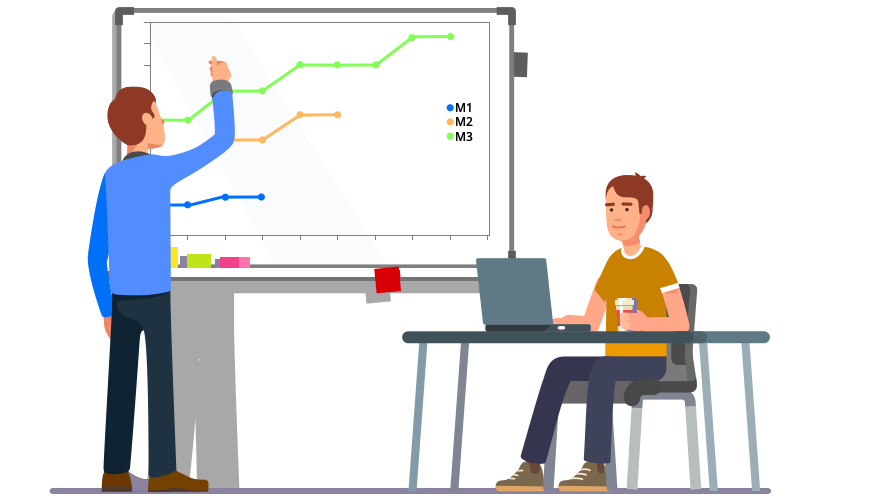
Through MTA, project managers can identify potential problems early and take action to get the project back on track. This method provides insights into the schedule and financial status of a project and enables proactive responses to delays or deviations.
Six Sigma
Six Sigma is a quality management method aimed at improving process quality in organizations and reducing errors and defects to a minimum. The method was developed by Motorola in the 1980s and has since spread across many industries.
The name “Six Sigma” refers to a statistical term and means that a process is so precise it produces only 3.4 errors or defects per million opportunities. The goal is to design processes that are nearly error-free and maximize customer satisfaction.
Six Sigma uses a structured, data-driven approach often referred to as the DMAIC cycle:
- Define: In this phase, customer requirements and project goals are established.
- Measure: Relevant data is collected and analyzed to understand the current state of the process.
- Analyze: Using the data, possible causes of problems or defects are identified.
- Improve: Based on the analysis, improvements to the process are implemented.
- Control: Measures are introduced to ensure that the improvements are maintained.
Six Sigma uses various tools and techniques, including statistical analyses, process mapping, and quality control charts, to optimize processes. It is a systematic and data-driven method aimed at reducing costs, improving quality, and increasing competitiveness. Companies that successfully apply Six Sigma often achieve impressive improvements in their business processes and customer satisfaction.
Additional Methods
Beyond the methods described above, there are numerous further practices:
- The practice of jour fixe ensures regular synchronization of all project participants and promotes communication.
- Defining goals is a prerequisite for effective action and high productivity. The SMART goals method and the SMART rule lead to clear, useful, and realistic goal formulations.
- From the planning phase onward, the Gantt chart provides a visualization of the product structure, dependencies, and the timeline of all tasks in a project.
- The work breakdown structure (WBS) provides an overview of all deliverables in a project, hierarchically structured.
- A kick-off meeting helps at the start of a project to communicate project goals and role assignments to all stakeholders.
- The RACI matrix ensures clear responsibilities and targeted information flow for every task in the project.
- The project management triangle illustrates the tension every project faces between scope and quality, schedule, and effort.
- The SWOT analysis (Strengths, Weaknesses, Opportunities, Threats) helps with the strategic direction of the company.
Summary
In this article we have presented the most important project management methods. The first decision is whether the classical approach or an agile method is better suited to your particular task. Within those two categories, you can then select the appropriate method.
If you want to become productive as quickly as possible, the recommended entry point is PMBOK, followed by either V-Model XT or Scrum. Once you have gained some experience, you can evaluate whether to supplement the chosen method with other methods or elements thereof. Over time, this produces a project management style tailored to your own needs.
Finally, it is worth noting that personal time management methods such as time blocking and the Pomodoro Technique can also be helpful in a project management context.
The use of good project management tools is indispensable when implementing a stable process.
Frequently Asked Questions
What project management methods are there?
There are various project management methods such as Agile, milestone trend analysis, the waterfall method, Scrum, Kanban, Scrumban, PRINCE2, and Six Sigma. These models offer different approaches to effectively executing projects. It is important to understand the methods and select the one that best fits the requirements of the project and the team. Compare the various models to make the right decision.
What are classical project management methods?
Classical project management methods follow a comprehensive and holistic approach. At the start of the project, a clearly defined end state is established and planned. Costs, deadlines, resources, quality, and benefits are considered from the very beginning. This enables effective project control and forms a solid foundation for successful project delivery.
Which project management method is the best?
Agile project management is best suited for projects that require high real-time communication within small, motivated teams and need less formal control. This approach enables rapid adjustments during the project lifecycle and fosters interactivity among project stakeholders. Agile project management is the optimal choice for such projects.
What project management tools are there?
There is a wide range of project management tools to choose from, including Factro, monday.com, Trello, Meistertask, Asana, Bitrix24, Hive, and Wrike. Each of these tools offers different features and advantages for organizing and managing projects efficiently and successfully.

CEO Alltena GmbH
Christoph Friedrich is a computer scientist and certified Project Management Professional. He has extensive experience in the introduction and integration of project management tools as well as the analysis and definition of processes in project and service management.