The milestone trend analysis is an important tool for keeping projects on track. As a project manager, you know how quickly deadlines can shift when original plans — with their often ambitious targets and neatly defined milestones — collide with harsh reality. Predictable and unforeseen problems alike — such as the unavailability of planned resources, frequently changing requirements, and other friction — lead to delays.
As a project manager, you would love to know where your project will ultimately land in terms of its completion date. That is precisely where the milestone trend analysis (MTA) comes in: a precise, visual tool for detecting schedule deviations early and taking corrective action. Let’s take a closer look at this interesting method together.
Why Is the Milestone Trend Analysis So Important?
The milestone trend analysis gives you — in any form of project organization — the ability to examine your project schedules not just as static snapshots but in terms of their development over time. It is in the nature of projects that original deadlines shift — and in the vast majority of cases, they shift later. To avoid alarming clients, project managers often claim at the first sign of delays that they can still make up the time. But delays frequently reveal a trend — caused, for example, by overly optimistic planning. The MTA makes these trends visible early, giving you the opportunity to take countermeasures before you’re left empty-handed at the end.
A real-world example from my own experience: In a development project for a technical system, we once had a problem with the delivery of critical components. After just two weeks, the milestone trend analysis made it crystal clear that we were heading for trouble. Thanks to the analysis, we were able to find an alternative supplier in time — and the delay remained minimal.
Advantages of the Milestone Trend Analysis
- Early warning system: You can see at a glance where deadlines are slipping and where things are stable.
- Decision-making foundation: The MTA provides you with solid data for discussions with stakeholders.
- Transparency: Trends and patterns become visible to everyone involved.
- Continuous improvement: You learn from past projects how realistic your planning actually is.
What Is the Milestone Trend Analysis?
The milestone trend analysis is a method that graphically represents how milestone forecasts develop over time in a project. It uses two axes:
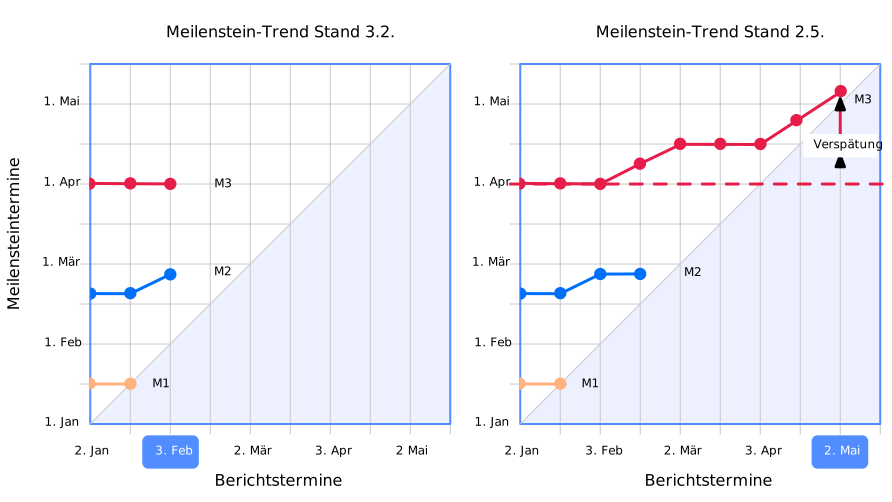
- The X-axis shows the reporting dates — the points in time at which you carry out the analysis. The first date is typically the kick-off meeting.
- The Y-axis shows the planned dates for the milestones.
The resulting lines reveal whether a milestone will be reached on time, is running late, or remains stable.
Typical Patterns in the MTA
- Stable lines: The milestone remains constant and will be reached as planned.
- Declining lines: You are gaining time — a rare but welcome scenario.
- Rising lines: A clear indication that delays are occurring.
An example: In one of our software development projects, we once saw a steep upward line. It turned out that a critical milestone depended on the integration of an external tool that was not delivered on time. The MTA alerted us early enough to implement an alternative solution.
Creating a Milestone Trend Analysis: Step by Step
Step 1: Define Milestones
As the name suggests, the foundation of every MTA is a set of clearly defined milestones. These are typically part of a more detailed project plan and should:
- Describe concrete deliverables (e.g., “Prototype complete”).
- Use SMART goals: specific, measurable, achievable, relevant, and time-bound.
In technical projects, typical milestones include, for example:
- Completion of design phases
- Sign-off on test phases
- Release for production
I remember a project where we kept running into misunderstandings because of vague milestone descriptions. Once we agreed to use only approved deliverables and documents that met the SMART criteria as milestones, things ran much more smoothly.
Step 2: Regular Data Collection
To make trends visible, you need to review and document milestone dates at regular intervals. An interval of one to two weeks is recommended, depending on the dynamics of your project.
Use suitable project management tools like Allegra to access the data you need for the MTA. Such tools often already offer the option to create an MTA for your project with no additional effort. Alternatively, you can use Excel. Here you can find Excel templates to download:
- Milestone Trend Analysis | Excel Template (projektmagazin.de)
- Milestone Trend Analysis | Free Template (projekte-leicht-gemacht.de)
Step 3: Create the Chart
Enter the collected data into a chart. This produces trend lines for each milestone. A glance at these lines immediately tells you and all stakeholders about the state of the project. If you use a good project management tool, the data for the MTA is generated automatically.
Common Mistakes and How to Avoid Them
There are pitfalls in milestone trend analysis too. Here are some of the most common mistakes — and how to sidestep them:
1. Too Many Milestones
Milestones are not tasks. If you define every small project step as a milestone, the analysis becomes unwieldy. Focus on the essential, decisive points — such as the end of a project phase, the achievement of an interim goal, or the sign-off of a major deliverable.
2. Milestones Defined Imprecisely
You should always associate a milestone with a concrete, verifiable result. This can be a physical product, but also a formally approved document.
3. Inconsistent Data Collection
If data is not collected regularly, gaps arise that undermine the validity of the analysis. Stick to the intervals — even during stressful phases.
4. Misinterpreting Trends
A rising line does not automatically signal a problem. Sometimes minor delays are non-critical or can be compensated for. Always analyze the underlying cause.
5. Different Time Scales for Reporting Dates and Milestone Dates
Use the same origin and the same scale for the milestone date axis as for the reporting date axis. Otherwise you will create confusion.
Practical Example: Milestone Trend Analysis in an IT Project
Imagine you are managing an IT project to introduce a new ERP system. In your project plan, you have defined the following milestones and dates:
- Completion of requirements analysis (M1, date: January 15)
- Completion of system design (M2, date: February 18)
- Completion of the test phase (M3, date: April 2)
- Go-live (M4, date: May 12)
As reporting dates, you have set the first and third Monday of each month. Shortly before the project kick-off on January 2, you carry out the first status assessment. You enter the above dates into the chart for January 2.
The next reporting date is January 16. At this point, milestone M1 has been completed on time and no longer needs to be tracked. The other milestones have also been maintained, so no action is required.
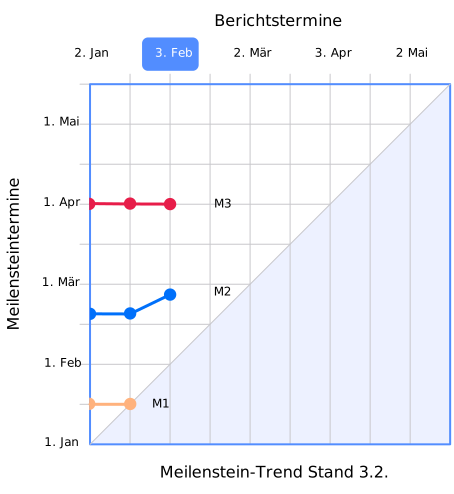
At the reporting date on February 3, it is reported that milestone M2 is shifting back by one week. Milestone M3 reportedly does not need to be moved.
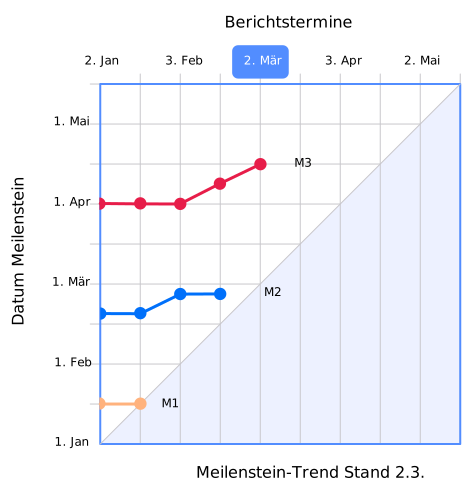
On March 2, a lot has happened. M2 was completed successfully, but milestone M3 had to be pushed back by one week two weeks prior. On March 2, it emerged that M3 needed to be pushed back by yet another week.
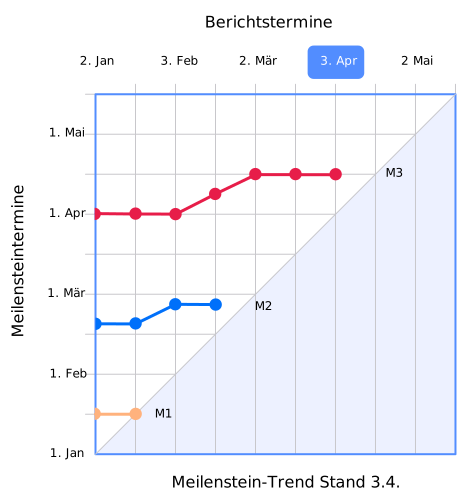
At the reporting date in mid-April and again on May 2, M3 has to be pushed back by one more week each time.
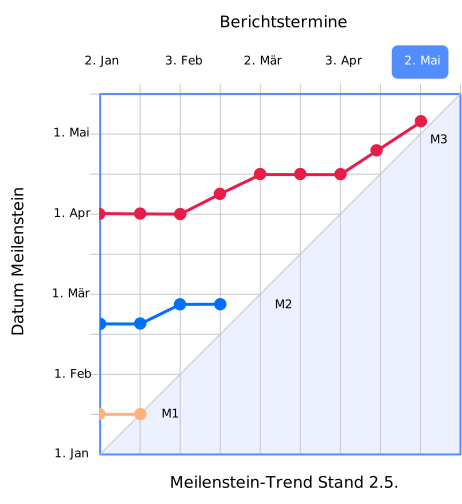
Through the regular recording of forecasts, you discover that the test phase is being continuously delayed. The cause: there are too few testers available. Thanks to the MTA, you recognize this early and can bring additional testers onto the team — before the go-live date is seriously jeopardized.
Integrate the MTA into Your Projects
The MTA is not a standalone tool — it should be part of your comprehensive project controlling. Combine it, for example, with:
-
Risk management: Use the results of the MTA to identify risks at an early stage.
-
Earned Value Analysis: While the MTA focuses primarily on the time dimension of projects, the EVA combines time, cost, and performance into a comprehensive analysis. The MTA is excellent for detecting milestone deviations, while the EVA helps you assess budget overruns and performance deficits. Together, they provide a complete picture of project status.
-
Gantt charts: You can extract the milestones and their dependencies from the Gantt chart. Your project’s Gantt chart contains all the data needed for the milestone trend analysis.
-
Burndown charts: Especially in agile project management, burndown charts provide a quick overview of the remaining workload relative to time. The MTA, by contrast, focuses on concrete milestones and their development over time. Both methods complement each other by visualizing both the granular detail of milestones and overall progress.
By combining these methods, you can ensure that your project is optimally managed both at a granular level and in the big picture.
Conclusion: Why You Should Rely on the MTA
In your project management toolbox, the milestone trend analysis is an extremely valuable method for any project manager who wants to detect schedule deviations early and bring their projects safely to the finish line. It makes project status transparent to all involved, provides a solid foundation for decision-making, and improves your planning accuracy over the long term.
Checklist: Successful Milestone Trend Analysis
- Define milestones clearly and according to SMART criteria
- Ensure regular data collection — for example, via a standing meeting
- Create the chart and interpret the trends
- Communicate results and derive action items
- Learn from experience and continuously improve your planning
With these steps, you are well equipped to steer your projects safely even in challenging situations. If you want to learn more about the fundamentals, read our articles on milestones in project management and milestone planning. May your trend lines always stay flat!
Frequently Asked Questions
What is the milestone trend analysis?
The milestone trend analysis is a method for graphically representing how milestone dates develop over time in a project. It helps detect deviations early.
Why is the milestone trend analysis important?
It enables project managers to identify delays and take proactive measures. This makes projects more efficiently managed.
How does the milestone trend analysis work?
Milestone data is collected at regular intervals and displayed graphically as trend lines. These lines show whether a milestone is stable, delayed, or will be reached ahead of schedule.
What are the advantages of the milestone trend analysis?
The advantages include transparency, a solid foundation for decision-making, early detection of problems, and improved planning accuracy.
What tools are suitable for the milestone trend analysis?
Common tools include Allegra, Microsoft Project, Excel, and specialized project management tools with charting capabilities.

CEO Alltena GmbH
Christoph Friedrich is a computer scientist and certified Project Management Professional. He has extensive experience in the introduction and integration of project management tools as well as the analysis and definition of processes in project and service management.