What is agile project management?
Agile project management describes a class of values, methods, principles and practices that originated in software development. Since then, this approach has been successfully transferred to other types of projects.
The need for agile project management
Agile project management is necessary because traditional, non-agile methods are often rigid and inflexible, which creates difficulties when adapting to changing requirements. While classic approaches rely on detailed, long-term planning, agile project management enables an iterative and incremental approach — allowing teams to respond faster to feedback and market changes.
This reduces the risk of projects failing because they no longer meet current needs. Agility also promotes closer collaboration between teams and customers, something that traditional methods often neglect. In an increasingly dynamic and uncertain world, agile project management provides the flexibility and adaptability that rigid methods simply cannot offer.
The Agile Manifesto
The “Agile Manifesto” describes the principles of agile project management as follows:
- Individuals and interactions over processes and tools: The success of a project depends first and foremost on the people working on it and how well they communicate with one another. Processes and tools are important, but they should support interpersonal interactions, not replace them.
- Working software over comprehensive documentation: The primary goal is to deliver a working product that meets the requirements. Documentation is useful, but it should not be more important than the actual product.
- Customer collaboration over contract negotiation: Close and continuous collaboration with the customer is essential to ensure that the final product meets their needs. This is considered more important than rigid contractual terms.
- Responding to change over following a plan: Flexibility and adaptability are key characteristics of agile methods. Rather than rigidly adhering to an original plan, the focus is on being able to respond quickly to changes in requirements or the surrounding environment.
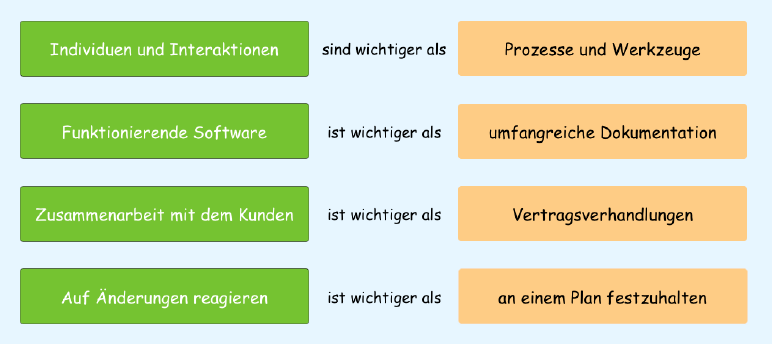
Placing individuals and interactions above processes and tools does not mean the latter are unimportant. It simply makes clear that even the best tools are worth little if they are not used by appropriately capable people. Documentation is not devalued, but the focus is on customer benefit rather than process quality as an end in itself. As for contracts: in the end, the customer must be satisfied and the supplier must make a profit. That is better achieved through collaboration than through supposed safeguards in contracts. And acknowledging that a plan is never static is something that life and project experience demands of us.
The agile project methodology
The agile project methodology is a flexible and iterative approach to project management based on continuous adaptation and close collaboration. It works by dividing projects into smaller, manageable units (Sprints), in each of which a functional product increment is developed. For context within overall planning, see also project planning. These Sprints enable regular feedback and rapid adjustments to changing requirements.
How does agile project management work?
Agile project management relies on a set of agile methods, agile principles and agile practices. These first emerged in software development projects. Today there are many fields of application outside the software development context.
What agile methods are there?
An overview of how agile approaches fit into the broader landscape of project management methods can be found in our methods article. The most commonly used methods in agile project management are shown in the illustration below. Scrum and Kanban — as well as combinations of the two — are the most widely adopted in many organizations.
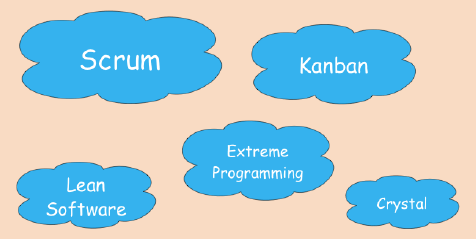
The methods describe a general approach, while agile practices (or techniques) each represent one of many elements within a methodology. Examples of agile practices include:
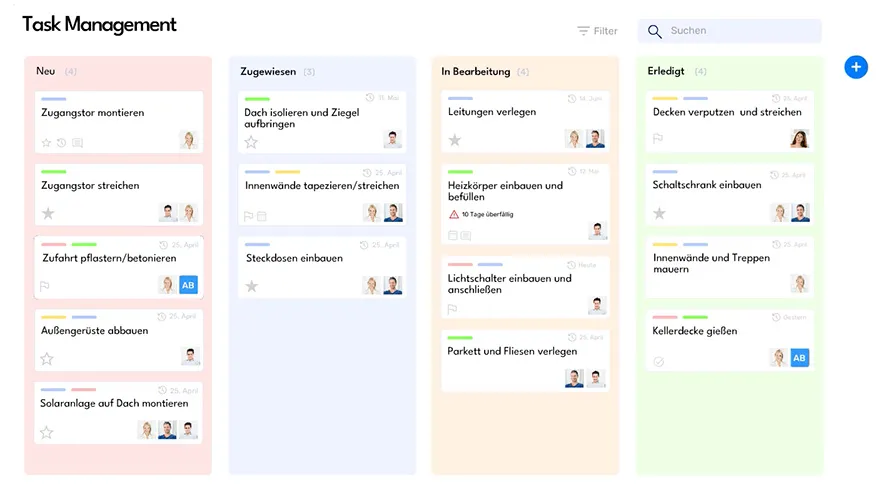
- Task Boards (an overview of current tasks, divided into to-do / in progress / done)
- Daily Standup Meetings (brief daily meetings on the current status)
- Definition of Done (clear criteria for when a task is considered complete)
- User Story (describing product requirements from the customer’s perspective)
- Burn-Down Charts (visualization of project progress)
Scrum
Scrum is a widely used agile project management method designed to help teams tackle complex projects efficiently and flexibly. Developed in the 1990s, Scrum has established itself as one of the most popular agile methods because it promotes iterative and incremental development processes. A central element of Scrum is the Sprint — a fixed time period of one to four weeks during which a functional product increment is created.
Scrum teams typically consist of a Product Owner, who defines and prioritizes requirements, a Scrum Master, who facilitates the process and removes obstacles, and the development team members, who carry out the work. Daily Stand-up Meetings promote communication so that the team can quickly identify and address impediments. At the end of each Sprint, a Review takes place in which the increment is presented and feedback is gathered, followed by a Retrospective in which the team reflects on the process and identifies opportunities for improvement.
Kanban
Kanban is an agile project management method that was originally developed in the automotive industry and has since become established in many sectors. Unlike other agile methods such as Scrum, Kanban does not work with fixed iterations; instead, it uses a continuous flow principle to guide tasks through the development process. The heart of Kanban is the Kanban Board, on which tasks are visualized as cards that move through different columns representing the phases of the work process (e.g., “To Do”, “In Progress”, “Done”).
A key principle of Kanban is the limitation of Work in Progress (WIP). This ensures that the team does not work on too many tasks at once, which increases efficiency and makes bottlenecks visible. Kanban promotes continuous improvement (Kaizen) by having teams regularly analyze their workflow and make adjustments to optimize the process.
Because there are no fixed Sprints, Kanban is particularly well suited to projects with a continuous flow of work, or to teams that require high flexibility in prioritizing tasks. It is an effective method for optimizing workflow and reducing the cycle time of tasks.
Scrumban
Scrumban is a hybrid project management method that combines the benefits of Scrum and Kanban to enable a flexible and efficient way of working. This method was developed to bridge the rigid structure of Scrum with the fluid flexibility of Kanban, making it particularly useful for teams that need both iterative and continuous work processes.
In Scrumban, elements from Scrum such as Sprints, Stand-up Meetings and Retrospectives are retained, while simultaneously integrating Kanban’s visualization and flow management. The central tool is a Kanban Board — used as in Kanban to track work progress, but within the time-bound structure of Scrum Sprints. Scrumban allows teams to limit the number of tasks in progress while preserving the flexibility to dynamically prioritize tasks.
The main advantage of Scrumban is the ability to draw on the best of both worlds: the structure and regular inspection of Scrum, combined with the flexibility and continuous flow of Kanban. This method is particularly well suited to teams working in an environment where priorities change frequently but who still want to maintain a certain structure to manage their work processes.
Design Thinking
Design Thinking is a user-centered method for problem-solving and product development, applied especially in creative and entrepreneurial contexts. The approach is based on an iterative process that enables teams to understand complex problems, develop creative solutions, and continuously test and refine them. Design Thinking places the user at the center of the development process and aims to create solutions that are both functional and user-friendly.
The Design Thinking process typically consists of five phases: Empathize, Define, Ideate, Prototype and Test. In the first phase, intensive research is conducted to understand users’ needs and problems. Clear problem statements are then defined and creative ideas developed. These ideas are turned into prototypes and tested in practice — feedback is gathered, and the process is iteratively repeated.
Design Thinking offers, among other benefits, a stronger focus on the needs of users, the promotion of creativity and innovation, and an iterative approach that allows teams to respond to feedback early and continuously improve solutions. This method is particularly effective in the development of new products, services, or business models that are aligned with the actual needs of users.
Lean
Lean is a management philosophy that aims to create maximum value for the customer through the continuous elimination of waste and the optimization of processes. Originally developed in the automotive industry — particularly at Toyota — Lean has established itself as a widely used method across many industries. The core principles of Lean focus on maximizing efficiency by minimizing unnecessary steps and resources in the production process.
Lean rests on several core principles, including value creation from the customer’s perspective, the elimination of waste (Muda), continuous improvement (Kaizen), and empowering employees to directly address problems and find solutions. Another important concept is the pull process, in which products and services are provided based on actual demand rather than forecasts.
The benefits of Lean lie in increased efficiency, reduced costs, and improved quality, as resources are directed toward value-adding activities. Lean enables organizations to respond faster and more flexibly to market changes by making processes leaner and more agile. This method is particularly suitable for organizations that want to optimize their production or service processes and place a focus on continuous improvement.
Extreme Programming
Extreme Programming (XP) is an agile software development method aimed at delivering high-quality software quickly and efficiently. XP places particular emphasis on technical excellence, continuous collaboration, and rapid feedback in order to optimize development processes and minimize risks. This method is characterized by a set of practices that are emphasized even more strongly than in other agile methods.
The most important XP practices include Pair Programming, in which two developers work together at one computer, as well as Test-Driven Development (TDD), in which tests are written before the actual code to ensure that the code meets the requirements. Further central concepts include Continuous Integration, where code changes are frequently integrated into the main repository, and continuous planning, which allows teams to respond flexibly to changing requirements.
The benefits of Extreme Programming lie in high code quality, rapid adaptability, and close collaboration between developers and customers. XP promotes a tight feedback loop that allows problems to be identified and resolved early. This method is particularly suitable for projects in a dynamic environment where requirements change often and fast, reliable software delivery is required.
Agile Principles and Practices
Agile project management is based on a set of principles and practices. In essence, these are summarized in the so-called “Agile Manifesto.”
Agile Principles
Agile project management is based on a set of technical and organizational principles derived from the “Agile Manifesto.” The most important technical and organizational agile principles are shown in the illustration below.
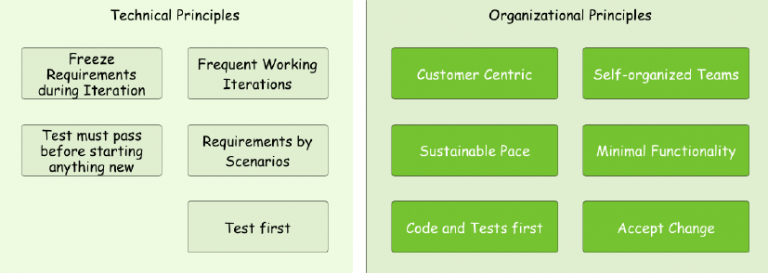
We distinguish between organizational and technical principles. Self-organizing teams are the defining characteristic of the agile approach. It gives project teams the greatest possible freedom of action and decision-making authority with respect to planning and the approach to implementation.
The other principles are partly based on approaches from earlier methodologies and are not all inventions of the agile community. It is worth noting, however, that by making these principles explicit, a number of things that should really be self-evident are now clearly stated. These include accepting change, placing the customer at the center of your efforts, and avoiding so-called “death marches.”
On the technical side, the guiding principle is cadenced work in iterations spanning a few weeks. During an iteration, changes to requirements are not permitted; however, they are possible at the transition to a new iteration.
Linked to this iterative approach is the practice of writing tests first and then writing the code for the actual feature. This enables a flexible response to change requests, since automated tests can ensure that unaffected functionality is not impacted by the changes. In practice, however, some tests can only be meaningfully developed once you have already delved some way into the implementation.
Developing requirements using scenarios is not an invention of the agile community — it was already practiced before. It should be noted, however, that this type of requirements creation is often insufficient for safety-critical applications. It is particularly well suited to systems that expose a large part of their functionality at the user interface. This is frequently not the case for embedded systems — think of an engine control system with the accelerator pedal as the user interface.
Agile Practices
In addition to the principles, agile project management includes a number of technical and organizational practices. Some of these also existed before agile methodology emerged. The most important agile practices are shown in the illustration below.
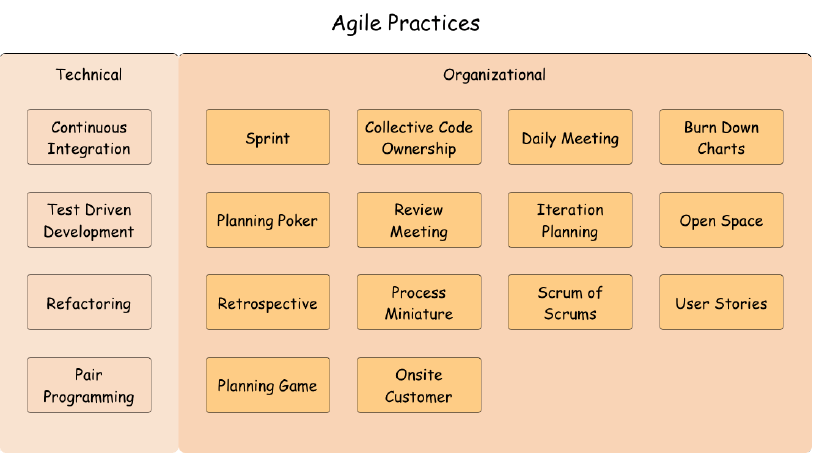
Like the principles, the practices can be divided into those of a technical and those of an organizational nature. The three most important technical principles are Test-Driven Development, which forms the basis for Refactoring and Continuous Integration. This allows new versions of software with growing functionality to be released at short intervals.
Refactoring makes it possible to respond quickly to requirement changes and reduces the effort needed for planning and documentation. Continuous Integration is followed by Continuous Delivery — i.e., the release of new versions in rapid succession.
How does classical project management differ from agile project management?
The following table compares classical project management with agile project management across a number of characteristics. A detailed comparison is provided in our article Agile vs. Waterfall Project Management.
| Classical | Agile |
|---|---|
| Requirements known at the outset | Requirements unclear at the outset |
| Changes to requirements during the project are difficult | Changes to requirements during the project are planned for |
| High cost of late requirement changes | Moderate cost of late requirement changes |
| Requirements described from a technical perspective (features) | Requirements described from the customer's perspective (use cases) |
| Sequential development process | Iterative development process |
| Rigid project management process | Continuous process improvements |
| Customer only sees the final result | Customer evaluates interim results |
| When things get tight, prefer to push milestones | When things get tight, prefer to reduce scope |
| Large teams possible | Relatively small teams required |
| Clear hierarchy | Self-organizing teams |
| Many specialists on the team | Much shared responsibility |
| Team is distributed and works on multiple projects | Team is co-located and focused on one project |
| Tasks assigned from above | Tasks taken on autonomously |
| Much communication via documents and long meetings | Much informal communication and stand-up meetings |
| Effort estimation by the project manager or experts | Effort estimation collaboratively as a team |
Advantages of agile project management
- Flexibility and adaptability: Agile methods enable teams to respond quickly to changes in requirements or the market environment, which is critical in dynamic projects.
- Customer focus: Regular iterations and feedback loops ensure that the product is continuously aligned with customer needs, which increases customer satisfaction.
- Improved team communication: Agile promotes close collaboration and open communication within the team and with stakeholders, which minimizes misunderstandings and increases efficiency.
- Early and regular delivery of results: The iterative approach makes it possible to deliver functional product versions early, making the value for the customer visible more quickly.
- Reduced project risk: Through continuous review and adjustment, problems are identified early and can be addressed promptly, reducing the risk of misguided development.
Disadvantages of agile project management
- Difficulties with long-term planning: Because agile project management prioritizes flexibility, it can be difficult to create long-term schedules and resource plans, which can be problematic in projects with fixed deadlines.
- Lack of documentation: Agile methods often place less emphasis on comprehensive documentation, which can create challenges in later project phases or for maintenance work.
- Required discipline and experience: Working in an agile way requires a high degree of self-organization and discipline within the team. Inexperienced teams may find it difficult to apply the principles effectively.
- Higher communication overhead: Constant interaction and coordination within the team and with stakeholders can be time-consuming and often requires more meetings and discussions than traditional methods.
- Unsuitable for heavily regulated projects: In projects that must meet strict regulatory requirements or where precise upfront planning is necessary, agile methodology can be difficult to apply.
Agile project management certifications
Agile project management certifications are formal qualifications that help professionals demonstrate their knowledge and skills in agile methods. The best-known certifications include the
- Certified ScrumMaster (CSM)
- Professional Scrum Master (PSM)
- Agile Certified Practitioner (PMI-ACP)
These certificates provide a solid introduction to agile principles and practices and are recognized by organizations worldwide. They help professionals improve their career prospects and deepen their ability to apply agile methods.
Tools for agile project management
The range of tools for agile project management may seem quite large at first glance. An overview of project management tools in general is provided in our article on project management tools. Looking more closely, you will find a number of tools that treat a task board as a synonym for agile project management. If you want full support with backlogs, epics, user stories, tasks, burn charts, Sprints, etc., the selection becomes considerably smaller.
Here are three popular tools for agile project management:
- Jira: A widely used tool developed specifically for managing agile projects in software development, particularly for Scrum and Kanban.
- Allegra: Allegra is a versatile project management tool that supports various agile methods such as Scrum, Kanban, and hybrid approaches. It offers features for planning, managing, and monitoring projects and is particularly useful for teams looking for a flexible and adaptable solution for their agile processes.
- ClickUp: An all-in-one tool that supports various agile methods and offers extensive customization options to optimize team collaboration.
Further reading on the topic:
Frequently asked questions
What does agile project management include?
Agile project management encompasses various methods such as Extreme Programming (XP), Feature Driven Development (FDD), Scrum, and Kanban. Scrum and Kanban in particular are becoming increasingly widespread in organizations.
What defines agile project management?
Agile project management is characterized by dynamism and flexibility. Unlike fixed structures, agile projects are continually adapted and adjusted to meet current requirements. These diverse approaches share a common foundation: a focus on adaptability.
What agile project management methods are there?
There are various agile project management methods such as Scrum, Kanban, and Lean Management, which have been optimizing and simplifying the development of software projects for years. These methods are effective across different project phases — from planning through execution to evaluation.
What five phases does agile project management comprise?
Agile project management comprises five phases: initiation phase, planning phase, execution phase, monitoring phase, and closing phase. You can read more about this in our article on project management phases. Each phase has its own tasks and objectives to ensure project success. Effective management and flexibility are essential to succeed in the various phases.

Senior Advisor
Jörg Friedrich is the original author of the project management software Allegra and continues to accompany its development to this day. He has many years of industry experience as a project and department manager. He also serves as a professor in the Faculty of Computer Science and Information Technology at Esslingen University of Applied Sciences.