What Is Project Management?
A project is a time-limited endeavor with a defined budget, undertaken to achieve a clearly specified goal. The term comes from the Latin “projectus,” meaning “thrown forward,” which underscores the forward-looking, planning-oriented nature of the discipline. Projects are carried out by project teams whose tasks and collaboration must be coordinated — and that is precisely what project management is for.
History of Project Management
The roots of project management reach back to antiquity, when complex construction projects such as the pyramids in Egypt, the aqueducts in Rome, and the Great Wall of China required extensive planning and organization. In the 20th century, modern project management began to emerge as an independent discipline, driven in particular by the Industrial Revolution, which introduced new levels of complexity in manufacturing and construction. A significant milestone was the introduction of Gantt charts in the 1910s, which made it possible to represent project plans visually and track tasks more effectively.
In the 1950s, large infrastructure projects — such as the construction of highways and dams in the United States — spurred the development of new techniques like the Critical Path Method (CPM) and the Program Evaluation and Review Technique (PERT). These methods revolutionized how projects were planned and monitored by identifying dependencies and enabling more efficient use of resources.
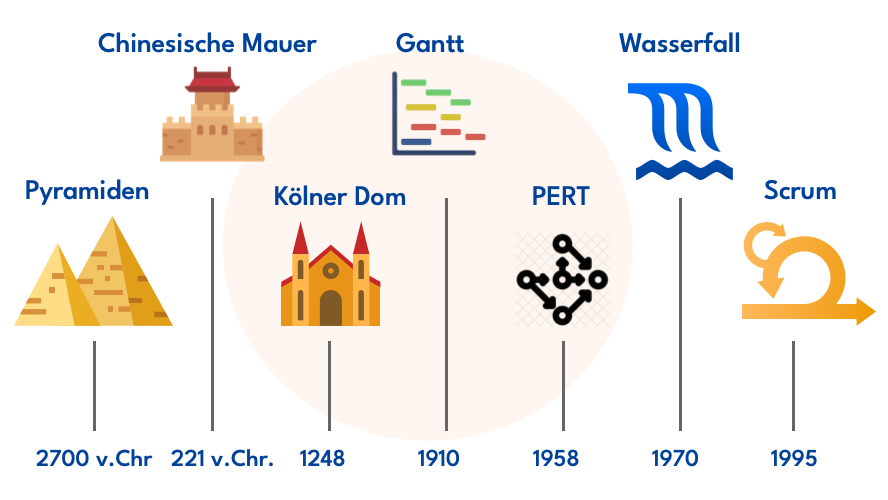
With advancing digitalization and globalization, project management has continued to evolve in recent decades. Agile methods such as Scrum and Kanban gained prominence — especially in software development — and came to complement traditional project management. Today, project management is a central discipline in almost every industry, enabling organizations to plan, execute, and close complex projects effectively. Project management software simplifies project execution considerably. Many organizations run numerous projects in parallel; coordinating these is what project portfolio management is designed to help with.
Project Life Cycle and Project Phases
Every project passes through a project life cycle from the initial idea to the completion of all project activities, structured into project phases. Which project phases exist depends heavily on the industry and the type of project.
A commonly used project life cycle consists of four project phases:
| Phase | Activities and Deliverables |
|---|---|
| 1: Preparation |
|
| 2: Planning |
|
| 3: Execution |
|
| 4: Closure |
|
The 10 Knowledge Areas of Project Management
One of the most influential project management standards, the PMBOK, divides project management into 10 knowledge areas. Not all aspects are equally relevant to every project, and this model can be adapted to suit your own needs.
| Knowledge Area | Core Processes (excerpt) |
|---|---|
| 1: Integration Management |
|
| 2: Scope Management |
|
| 3: Schedule Management |
|
| 4: Cost Management |
|
| 5: Quality Management |
|
| 6: Resource Management |
|
| 7: Communications Management |
|
| 8: Risk Management |
|
| 9: Procurement Management |
|
| 10: Stakeholder Management |
|
Integration management is a key area in the PMBOK guide and emphasizes the coordination of all project aspects. It ensures that processes and activities are aligned with the project objectives and that resources are used efficiently.
Scope management ensures that a project includes only the work necessary for successful completion, by defining what is in scope and what is not.
Schedule management aims to complete the project within the defined timeframe by creating a realistic project schedule that aligns with objectives and resources.
Cost management focuses on planning, budgeting, and controlling costs to ensure the project stays within the approved budget.
Quality management ensures the project meets defined requirements and standards in order to guarantee customer satisfaction.
Resource management deals with the efficient planning and administration of all resources required for the project, such as personnel and materials.
Communications management encompasses the planning and execution of all communication processes to ensure the project’s information needs are met.
Risk management identifies, assesses, and controls risks in order to minimize the impact of unexpected events.
Procurement management handles the acquisition of goods and services from external suppliers that are required for the project.
Stakeholder management aims to take the interests of project participants into account and meet their expectations. The foundation is a systematic stakeholder analysis.
The Most Common Methods
Project management methods are structured approaches to planning, executing, monitoring, and closing projects. Project management methods provide specific techniques and processes intended to help carry out projects efficiently and effectively.
There are two major schools of thought, each advocating a different fundamental approach to project management. These methods are:
- Classical project management with thorough planning and a sequential approach
- Agile methodology with flexible planning and an iterative approach
Within these schools there are a number of differently characterized process models. For traditional methodology, the main ones are the waterfall model, the V-Model, PRINCE2, the spiral model, and the Rational Unified Process. For the agile school of thought, the main ones are Scrum, Kanban, DevOps, and Extreme Programming.
Above all of these stand the reference models, which provide criteria for the quality of specific process implementations and thereby imply what constitutes good project management. The best-known reference models are CMMI, ISO/IEC 15504, ISO 9001, and Automotive SPICE.
Classical Project Management Methods
Classical project management methods follow a comprehensive and holistic approach. A clearly defined end state is established and planned at the start of the project. Costs, deadlines, resources, quality, and benefits are taken into account from the very beginning.
The best-known classical project management method is the waterfall model, which is why it is often used as a synonym for classical project management. The original V-Model is a further development of the waterfall model. The highly useful V-Model XT (development standard) extends the generic V-Model. The spiral model and IBM’s Rational Unified Process (RUP) can also be assigned to the classical project management methods.
Waterfall Method
The waterfall model is a project management approach that has been in use for decades. It is a linear and sequential method in which the project is divided into phases. Each phase must be completed before the next one can begin. The phases include requirements gathering, design, implementation, testing, and deployment.
V-Model XT
The term “V-Model” refers both to a general process model designed for software development and to a development standard. The latest version of this standard is called the V-Model XT and supports not only the approach of the general process model but also many other approaches.
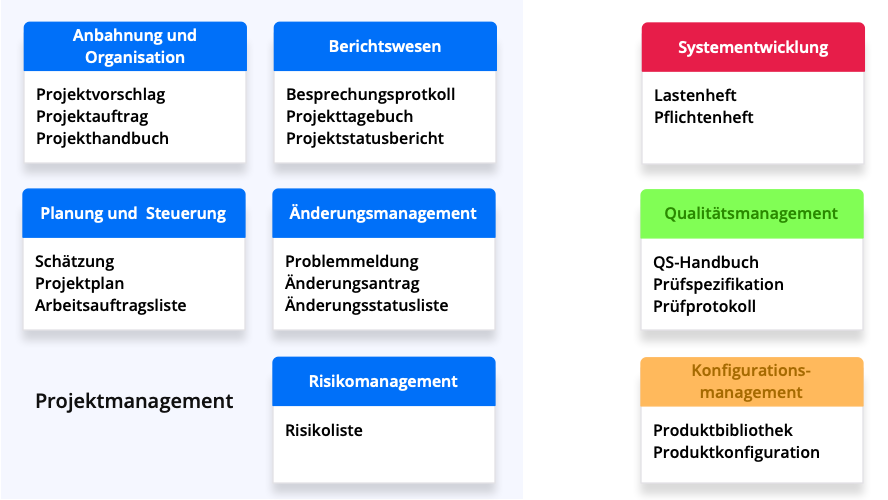
This standard is a framework for systems engineering and project management. It is an extension and concretization of the waterfall model and is often applied in safety-critical and complex projects.
The V-Model XT proposes a concrete approach. To this end, all necessary activities and their respective results — the “products” — are named and defined. For many products there are templates that can be used directly.
Critical Chain Project Management
Critical Chain Project Management (CCPM) prioritizes work packages and minimizes multitasking as well as project duration through buffer management. The approach is as follows:
- Identify critical resources: First, resources that could create bottlenecks are identified.
- Build the critical chain: After identification, tasks that draw on these resources and form the longest path are grouped together into the critical chain.
- Estimation and buffer management: Estimates are created with a 50% probability, and the difference compared to conservative estimates serves as a buffer for all tasks on the critical chain.
- Operational prioritization: Tasks on the critical chain are processed with priority, based on progress and buffer consumption.
- Ongoing monitoring and adjustment: Progress is continuously monitored and adjusted as needed to ensure on-time completion.
CCPM incorporates buffers into estimates to minimize delays and optimize overall project duration.
Agile Project Management Methods
Agile project management divides projects into small, manageable units referred to as iterations or Sprints. During each iteration, a portion of the project is developed, tested, and evaluated. The most important agile methods are Scrum, Kanban, and Extreme Programming (XP).
Agile approaches have gained considerable popularity in recent years and are applied across a wide range of industries — from software development to product management and marketing.
Scrum
Scrum is an agile project management method used primarily in software development to manage complex projects efficiently and flexibly. It is usually supported by specialized project management tools and is based on an iterative and incremental approach that enables teams to deliver working pieces of a product in short cycles known as Sprints. These Sprints typically last two to four weeks and end with a potentially shippable product increment.
A Scrum team consists of three main roles: the Product Owner, the Scrum Master, and the development team. The Product Owner manages the Product Backlog — a prioritized list of requirements and tasks — and ensures the team is working on the most valuable items. The Scrum Master supports the team in applying the Scrum process and removes obstacles that might impede progress. The development team, which works in a self-organizing manner, is responsible for implementing and delivering the tasks.
Each Sprint begins with a Sprint Planning session, during which the team selects the tasks for the upcoming Sprint. Throughout the Sprint, the team meets daily for a short Daily Scrum to discuss progress and identify any obstacles. At the end of each Sprint, a Sprint Review takes place in which the team presents the product increment and gathers feedback. The team then reflects on the work process in the Sprint Retrospective and identifies opportunities for improvement.
Through these regular iterations, Scrum promotes transparency, continuous improvement, and close collaboration within the team — enabling projects to be carried out efficiently and flexibly.
Kanban
Kanban is an agile method for optimizing work processes, originally developed in manufacturing and now used in many industries — particularly in software development. The primary focus of Kanban is on visualizing the flow of work and enabling continuous improvement.
The method uses a Kanban board on which tasks are visualized as cards and moved through various columns representing different phases of a process. Typical columns include “To Do,” “In Progress,” and “Done.” This allows teams to see the current status of each task at a glance and quickly identify bottlenecks.
A central element of Kanban is the limitation of tasks in progress at any one time (Work in Progress, WIP). This limit prevents overload and keeps the focus on completing tasks.
Kanban promotes continuous improvement through regular review of the workflow and adjustment of processes to increase efficiency. Since Kanban is flexible and does not use fixed iterations like Scrum, it is particularly well suited to teams that work in dynamic environments and need to constantly adapt their way of working.
Scrumban
Scrumban is a hybrid project management method that combines elements of Scrum and Kanban, joining the flexibility of Kanban with the structure of Scrum. This method is particularly well suited to teams that work in a dynamic environment and want to benefit from both the iterative planning of Scrum and the continuous improvement of Kanban.
In Scrumban, tasks are displayed on a visual board — similar to Kanban — showing the workflow. Tasks are moved through various columns representing different phases of the project. The number of tasks in progress at any one time (Work in Progress, WIP) is limited to prevent overload and maintain focus on completion.
Scrumban retains Scrum elements such as Sprints, Daily Standups, and Retrospectives to ensure regular review of progress and team dynamics. At the same time, it allows for the flexibility of Kanban to respond to changes in prioritization and work requirements without being tied to fixed Sprint cycles.
By combining Scrum and Kanban, Scrumban offers an adaptable structure that promotes both efficiency and agility. This method is particularly well suited to teams seeking incremental improvements while continuing to deliver regularly and respond to change.
DevOps
DevOps is a methodology that unites development and operations in software development with the aim of improving the efficiency, quality, and speed of software delivery. It seeks to foster collaboration between development and operations teams, thereby breaking down the silos that traditionally exist between these departments.
A central aspect of DevOps is the automation of the software development process, including testing, deployment, and monitoring. By automating recurring tasks, error rates are reduced and lead times from code development to production are shortened. Continuous Integration (CI) and Continuous Delivery (CD) are key DevOps practices that enable code to be continuously integrated into a shared codebase and quickly moved into production.
DevOps also emphasizes the importance of continuous feedback and monitoring to ensure software performance and stability. This fosters a culture of continuous improvement in which teams can react quickly to problems and implement solutions.
Overall, DevOps enables faster, more reliable, and more efficient software delivery, making it easier for organizations to respond to changing market conditions and customer requirements while maintaining software quality and stability.
Supporting Methods
A number of methods cover only a very specific aspect of project management, or are collections of terminologies, principles, and practices — such as the PMBOK. Others belong primarily to the category of “time management” or “productivity.” We therefore do not list them here as project management methods, but only as “supporting methods.” They are usually used as a complement to the more comprehensive methods.
Earned Value Method
The Earned Value Method (EVM) is a project management technique used to measure project progress and performance. It compares the planned progress of a project with the progress actually achieved and the costs incurred. EVM uses three core metrics: Planned Value (PV), Earned Value (EV), and Actual Costs (AC).
Planned Value (PV) indicates what was planned at a given point in time, while Earned Value (EV) represents the actual value of work performed. Actual Costs (AC) are the real costs incurred for the work delivered.
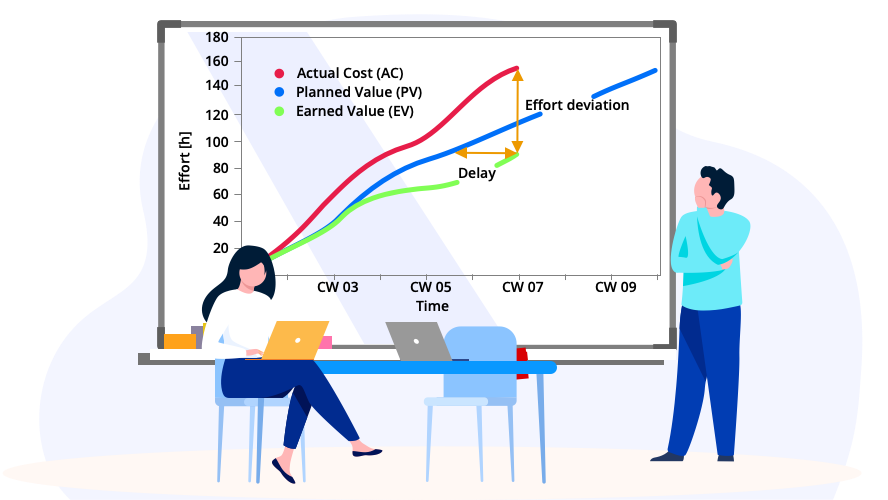
By calculating variances between these values — such as the Cost Performance Index (CPI) and Schedule Performance Index (SPI) — project managers can monitor the financial and schedule status of the project, identify trends, and take early corrective action to bring the project back on track. The better project management tools support this method.
Network Diagram Technique
The network diagram technique is a project management method for planning, controlling, and monitoring projects. It enables the representation of activities and their dependencies, as well as the progression over time, in a network diagram. Two main approaches are used in network diagram technique: the activity-on-node approach (PERT) and the activity-on-arrow approach (CPM).
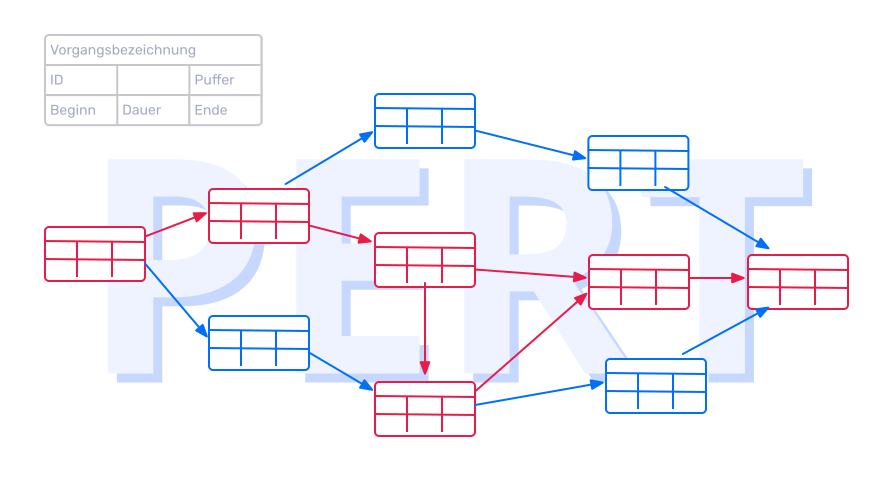
In the PERT approach, activities are represented as nodes connected on a diagram. Each activity has an estimated duration and a probability of being completed within that duration. PERT enables the calculation of the most likely project duration and the identification of critical paths.
In the CPM approach, activities are represented as arrows connecting events such as milestones. CPM uses fixed durations for activities and focuses on identifying the critical path to determine the earliest possible project completion date.
Both approaches enable detailed planning, resource allocation, and time management in order to meet project objectives on schedule and identify bottlenecks. The network diagram technique is particularly useful for complex projects with many activities and dependencies.
Milestone Trend Analysis
Milestone Trend Analysis (MTA) is a project management technique in which project progress is tracked against milestones. It compares planned milestone progress with actual progress and identifies deviations.
For visualization, the milestone dates are plotted on the Y-axis at the start of the project. The dates of scheduled project status meetings are marked on the X-axis. At each status meeting, the milestone dates are updated and entered into the diagram. If milestones move upward over time, this signals a delay. If milestones remain on a horizontal line, the project is on schedule.
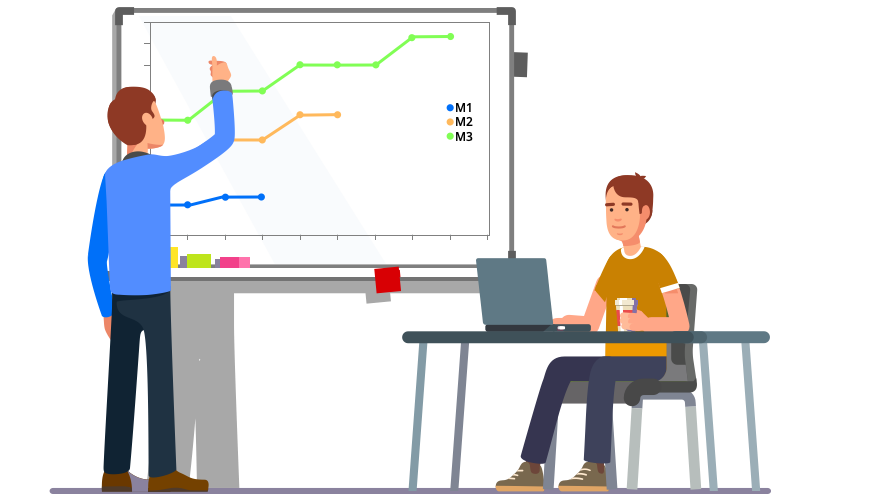
Through MTA, project managers can identify potential problems early and take action to bring the project back on track. This method provides insight into the schedule and financial status of a project and enables proactive responses to delays or deviations.
Six Sigma
Six Sigma is a data-driven method for process improvement that aims to minimize errors and variation in business processes. The method uses statistical analysis to identify the root causes of problems and systematically eliminate them in order to achieve high quality and efficiency.
Six Sigma follows the DMAIC cycle, which consists of five phases: Define, Measure, Analyze, Improve, and Control. In the Define phase, objectives and problem statements are defined. Measure involves collecting and analyzing data to understand the current state. In the Analyze phase, the root causes of problems are identified. Improve targets the development and implementation of solutions, while in the Control phase, measures are taken to permanently sustain the improvements.
Six Sigma aims to reduce process variability and achieve near-defect-free production, leading to cost savings and higher customer satisfaction.
Key Components and Terms in Project Management
Below is a list of important project management terms.
| Term | Explanation |
|---|---|
| Project Management Triangle | The project management triangle describes the three central success factors of a project: time, cost, and quality. These factors are interrelated, so changes to one element affect the others. |
| Milestone | A milestone is an important event or intermediate point in the project that marks progress. It serves as a checkpoint to ensure the project remains within its time and budget constraints. |
| Project Scope | The project scope defines all the work and tasks required to achieve the project objectives. It determines what is included in the project and what is not, establishing clear boundaries for the work. |
| SMART Goals | SMART goals are specific, measurable, achievable, realistic, and time-bound goals used in project management to define clear and actionable targets. This project management method helps to steer and evaluate the success of a project in a focused way. |
| Timeline | A timeline is a visual plan that displays the chronological sequence of tasks and milestones within a project. It helps track progress and ensure the project is completed on time. |
| Work Breakdown Structure | The work breakdown structure (WBS) is a hierarchical decomposition of project tasks that breaks the entire project down into manageable units. It serves as the basis for planning, resource allocation, and control. |
| Roles | A role in project management describes the specific responsibilities and tasks of a person or team within the project. Clear role assignments provide structure and accountability in the project. |
| Milestone | A milestone is an important event or intermediate point in the project that marks progress. It serves as a checkpoint to ensure the project remains within its time and budget constraints. |
| Budget | The budget in project management comprises the financial resources allocated to carry out a project. It covers all expenditure, including personnel, materials, and other costs, to achieve the project objective. |
| Dependencies | Dependencies in project management describe the relationship between tasks in which one task cannot begin or be completed until another task is finished. They significantly affect the project schedule, since delays in one task can have a knock-on effect on subsequent tasks. |
How Do I Become a Project Manager?
There are many paths to becoming a project manager. Typically, you first complete a training program — depending on your industry, either vocational training or an academic degree. After that, you work in projects for a period of time. Eventually, one of your supervisors notices you and proposes you as a project lead. Up until now you have been a technically proficient specialist. Now you are suddenly expected to know project management as well. Here is one of many possible approaches:
- Buy yourself a copy of the PMBOK
- Download a copy of the V-Model XT
- If possible, complete a recognized project manager certification
- Use a good project management software like Allegra
- Create your own project handbook from a project handbook template
- Follow the approach you have defined in your project handbook
If you also
- communicate well
- involve your team in project management
- trust your team
- document everything thoroughly
then nothing stands in the way of your success!
Frequently Asked Questions
What exactly does project management mean?
Project management deals with the planning, execution, and monitoring of projects. Two main approaches are distinguished: classical project management with sequential planning, and agile methodology with a flexible, iterative approach.
What is project management and what methods are there?
Project management deals with the planning, execution, and monitoring of projects. There is classical project management with sequential planning and agile methodology with a flexible, iterative approach. Within these approaches there are various models such as the waterfall model and Scrum, each offering specific techniques and processes. Above all these sit reference models such as CMMI and ISO 9001, which define quality criteria for good project management.
What paths are there to becoming a project manager?
There are many paths to becoming a project manager. To be successful, you need a) industry knowledge, b) leadership competence, and c) project management knowledge. You have acquired industry knowledge through a degree or vocational training and years of experience in a field. Leadership competence is either something you already bring with you or supplement through suitable courses. Project management knowledge is best acquired by preparing for a recognized certification.

Senior Advisor
Jörg Friedrich is the original author of the project management software Allegra and continues to accompany its development to this day. He has many years of industry experience as a project and department manager. He also serves as a professor in the Faculty of Computer Science and Information Technology at Esslingen University of Applied Sciences.