What is the Project Life Cycle?
Every project has a beginning and an end. In between lies a sequence of phases that build on one another, each with its own focus, and each ending with a decision: Do we continue? Does something need to be corrected? Or do we stop?
This sequence is the project life cycle. It is not a rigid set of rules, but a framework that ensures projects proceed in a goal-oriented, efficient, and transparent manner. The phases are always the same — the specific design depends on the industry, project size, and methodology.
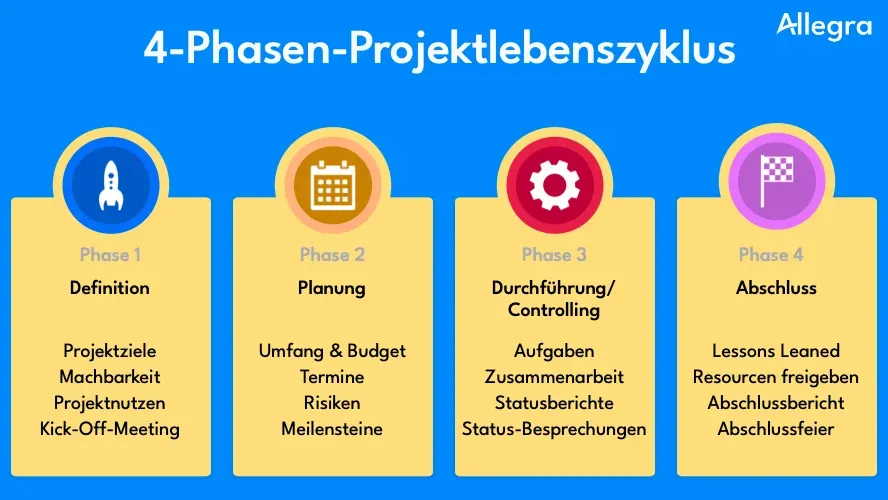
The most common breakdown distinguishes four phases:
- Initiation — The project is born.
- Planning — The path to the goal is defined.
- Execution — The plan is put into action.
- Closure — The project is completed and evaluated.
At the end of each phase stands a milestone — a checkpoint at which it is decided whether the project can move into the next phase. These transitions are referred to in many organizations as Quality Gates or Stage Gates.
One important distinction: the project life cycle describes the flow of the project. The product life cycle, on the other hand, covers the entire lifespan of a product — from the idea through market launch to retirement. A project can be a single phase within a product life cycle.
A detailed presentation of the individual phases with inputs and outputs can be found in our article on project phases overview.
The Four Phases in Detail
Phase 1: Initiation
Projects begin with a need: a problem to be solved, an opportunity to be seized, or a requirement to be implemented. In the initiation phase, an idea becomes a concrete undertaking.
The key tasks:
- Define project goals: What exactly needs to be achieved? Clearly formulated goals are the foundation for everything that follows.
- Check feasibility: Is the undertaking technically, economically, and organizationally achievable?
- Identify stakeholders: Who is affected, who decides, who supports?
- Create the project charter: The project charter captures the goal, scope, timeline, and budget on a single page. It is the starting signal.
Initiation is a strategic step. It lays the guiding thread that all parties involved will follow in the subsequent phases. A project that starts without a clear initiation easily loses direction.
Typical deliverables: Project charter, feasibility assessment, stakeholder analysis.
Phase 2: Planning
In the planning phase, the path to the goal is worked out. This is where it is determined whether a project will be structured and manageable — or whether it will drift into chaos.
The key tasks:
- Define work packages: The work breakdown structure (WBS) breaks the undertaking down into manageable units.
- Create a schedule: A project schedule puts tasks in a logical sequence. Gantt charts make the schedule visible.
- Allocate resources: Who does what? What resources are available?
- Calculate the budget: Effort estimation forms the basis for a realistic budget.
- Identify risks: What dangers are lurking? Early risk management prevents unpleasant surprises.
- Plan communication: Who informs whom, when, and how?
Planning is not a one-time act. In practice, the plan is refined and adjusted as the project progresses. But the more thorough the initial planning, the less often major course corrections are needed.
Typical deliverables: Project plan, schedule, budget, risk analysis, communication plan.
Phase 3: Execution
Execution is the most resource-intensive phase. Here, the plan is put into action — and here it becomes clear whether the planning holds up.
The key tasks:
- Work through tasks: The team carries out the planned work and delivers results.
- Monitor progress: Regular status meetings and metrics show whether the project is on track. Milestone trend analysis or the Earned Value method make deviations visible early.
- Steer and adjust: When the actual state deviates from the plan, project controlling steps in — through re-prioritization, additional resources, or schedule adjustments.
- Ensure quality: Interim results are reviewed before they feed into the next steps.
- Communicate: Everyone involved — from the team to the stakeholders — stays on the same page.
Experienced project management builds in buffer time. Anyone who designs the schedule too optimistically will run into trouble at the first disruption. The project lead is permanently active during execution — even when the operational work lies with the team.
Typical deliverables: Deliverables, status reports, updated project plan.
Phase 4: Closure
The project life cycle does not simply end because the work is done. It ends when the project is formally closed. This phase is often neglected in practice — undeservedly so.
The key tasks:
- Hand over deliverables: The product is handed over to the client and accepted.
- Create the project report: What was achieved? How did it go? Where were there deviations?
- Conduct a lessons learned session: What went well, what didn’t? This retrospective is invaluable for future projects.
- Release resources: Team members, budgets, and infrastructure are released.
- Archive documentation: All project documents are secured and made accessible.
A clean closure creates clarity — for the team, for the client, and for the organization. The lessons learned are the most valuable part: they transform experience into knowledge that makes a difference in the next project.
Typical deliverables: Acceptance record, project closure report, lessons learned.
Practical Example: Introducing Project Management Software
A mid-sized company with 120 employees wants to introduce project management software. Here is what the project life cycle looks like:
| Phase | Duration | Key Activities | Milestone |
|---|---|---|---|
| Initiation | 2 weeks | Capture requirements at a high level, define the goal (a unified tool for 5 departments), sign the project charter | Project charter approved |
| Planning | 4 weeks | Detail requirements, evaluate vendors, create schedule and rollout concept, select pilot department | Project plan released |
| Execution | 10 weeks | Configure software, train and onboard pilot department, evaluate feedback, staged rollout to all departments | Rollout complete |
| Closure | 2 weeks | Client acceptance, create closure report, lessons learned session with the team | Project closed |
The example shows: even a manageable project benefits from a clear phase structure. The milestones force decisions and prevent the project from drifting along aimlessly.
Classical, Agile, or Hybrid?
The project life cycle is not an exclusive model of classical project management. Agile and hybrid approaches also have phases — they just design them differently.
Classical (Waterfall): The phases are traversed sequentially. Each phase is largely completed before the next begins. This approach is suitable when requirements are clear from the start and change very little.
Agile (Scrum, Kanban): The project goes through the initiation and planning phases at a high level. Execution then takes place in short iterations (Sprints), in which planning, implementation, and review are repeated cyclically. The agile approach is particularly suitable when requirements evolve as the project progresses.
Hybrid: Many teams combine both worlds. The framework — goals, budget, schedule — is planned classically. Implementation takes place agilely in iterations. This approach combines reliability with flexibility.
Regardless of the methodology, the basic idea remains the same: a project needs an initiation phase, a planning phase, an execution phase, and a closure. The sequence never changes — only the way the phases are traversed does.
Tips for Practice
-
Take the project charter seriously. Initiation defines the corridor for everything that follows. A vague project charter leads to vague results.
-
Use milestones as decision points. Each phase should end with a deliberate Go/No-Go. This takes time but saves money — because problems are identified early.
-
Don’t forget closure. Projects that fizzle out instead of being formally closed leave loose ends: unresolved responsibilities, missing documentation, lost knowledge.
-
Make the life cycle visible. A simple overview — which phase are we in, what comes next? — gives the team and stakeholders orientation.
-
Stay flexible. The project life cycle is a framework, not a straitjacket. Adapt the phases to your project — not the other way around.
Frequently Asked Questions
How is the project life cycle defined?
The project life cycle describes the sequence of all phases that a project passes through from initiation to closure. It gives project management a temporal and substantive structure and ensures that projects proceed in a goal-oriented and transparent manner.
What phases does the project life cycle have?
The classic project life cycle consists of four phases: initiation, planning, execution, and closure. Depending on the industry and methodology, there are also models with five or more phases — for example, with a separate monitoring phase. A detailed overview can be found in our article on project phases.
What is the difference between the project life cycle and the product life cycle?
The project life cycle covers the flow of a single project from start to finish. The product life cycle describes the entire lifespan of a product — from conception through market launch to retirement. A project can be a phase within the product life cycle, such as development or market launch.
Does the project life cycle also apply to agile projects?
Yes. Agile projects also go through phases — they just design them differently. Initiation and closure are similar to the classical approach. During execution, agile teams work in short iterations (Sprints), in which planning, implementation, and review are repeated cyclically.
Why is the project life cycle important?
It provides structure, transparency, and controllability. Without a clear phase structure, project teams easily lose the overview — especially for complex undertakings. The phases create decision points at which it is checked whether the project is on the right track. This reduces risks and increases the chances of success.

Senior Advisor
Jörg Friedrich is the original author of the project management software Allegra and continues to accompany its development to this day. He has many years of industry experience as a project and department manager. He also serves as a professor in the Faculty of Computer Science and Information Technology at Esslingen University of Applied Sciences.