Your Project at a Glance
Thousands of years ago, people already knew they could master large systems through hierarchical structuring. This is how monumental structures like the pyramids were built and how empires like ancient Egypt, China, and the Roman Empire were governed.
A work breakdown structure is the hierarchically structured collection of all plannable project activities. At the highest hierarchy level, it provides a complete overview of all work involved in the project. A work breakdown structure as the result of a project structure planning process only shows WHAT needs to be done — not when or by whom. It is the foundation of good project planning.
What Is a Work Breakdown Structure and Why Do You Need One?
A project plan must answer the following four questions:
- WHAT needs to be done?
- WHO takes care of it?
- WHEN does it need to be completed?
- HOW MUCH effort does it require?
A work breakdown structure broadly answers the “WHAT” question with a structured collection of activities or deliverables. Depending on the project management method, this structuring of a project into individual elements is called a Projektstrukturplan (DIN 69901-5), product breakdown structure (PRINCE2), or Work Breakdown Structure (PMBOK® Guide).
All of these plans contain all plannable elements of a project and their structural relationships to one another. The elements are arranged hierarchically in a tree structure, without making any statement about the chronological order of execution. Over the course of the project, many activities will arise that were not foreseeable. Such non-plannable activities are not part of the work breakdown structure.
On the basis of this “plan of plans,” the project schedule, resource planning, and cost planning are developed in later planning stages following an effort estimation. Modern project management tools typically display the WBS in the form of Gantt charts, network diagrams, or a tree diagram.
Is It Worth Creating a Work Breakdown Structure?
Before you can say what something costs or how much time it requires, you need to be clear about what that “something” actually is. That is precisely one of the key purposes of the work breakdown structure: describing that “something” in the form of a tree structure. This plan is therefore an important foundation for all subsequent planning — including cost, scheduling, and resource planning.
Advantages of Project Structure Planning
The work breakdown structure (WBS) is the “plan of plans” and forms the foundation for all further planning, such as cost and scheduling. In projects running in parallel, it also plays a central role in project portfolio management. It is typically created first during the project management phase of “planning.” Here is an overview of the benefits:
- Maintaining the big picture: A hierarchical breakdown of the project into increasingly smaller sub-areas reduces complexity and makes it easier to keep an overview. Ideally, the WBS can fit on a single page. This creates transparency for all project stakeholders — ideally from the kick-off meeting onward — especially in a matrix organization.
- Foundation for task assignment: Because the WBS defines what needs to be done, it becomes possible to plan who will take care of it.
- Creates the basis for cost control: The WBS forms the foundation for a cost structure, making controlling easier down the line.
- Identifies all work packages belonging to the project: The WBS and its nomenclature make it possible to refer specifically to sub-projects or concrete work packages when communicating within the project. This reduces the risk of misunderstandings and creates clarity.
- Foundation for subsequent planning: Depending on the nature and scope of project planning, the work breakdown structure (WBS) serves as the basis for all further plans. As a reminder: the WBS defines WHAT needs to be accomplished in the project — but not when, in what order, or how long tasks will take. These elements still need to be structured and scheduled — which is considerably easier when you have a WBS in place.
The Structure of the Work Breakdown Structure
To create a project or product breakdown structure, the relevant elements must first be identified within the associated project. Two points in time are considered: the starting situation and the end situation. If the end situation can be described by objects that are to be created during the project, these objects are broken down into sub-objects. The sub-objects are further split unless they are to be purchased externally or are primitive in nature. In this case, the plan is created in a product-oriented manner.
For projects with a strongly activity-oriented character — such as a relocation — the activities are collected and organized into categories. For a relocation, for example, the rooms make a natural top-level category. The work breakdown structure will then be activity-oriented.
Collecting the elements for the project or sub-project can be supported by methods such as mind mapping or brainstorming.
What Elements Does a Work Breakdown Structure Consist of?
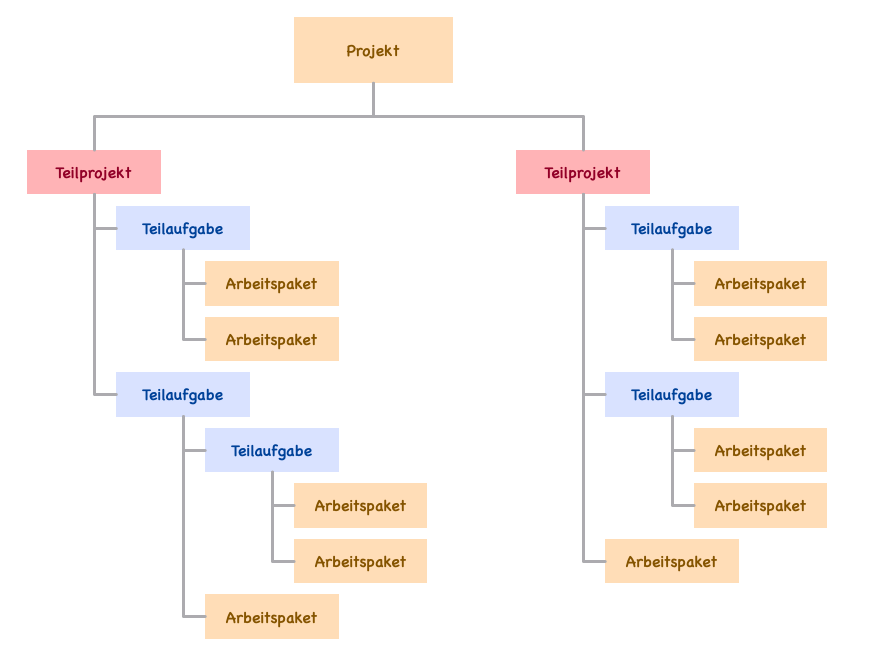
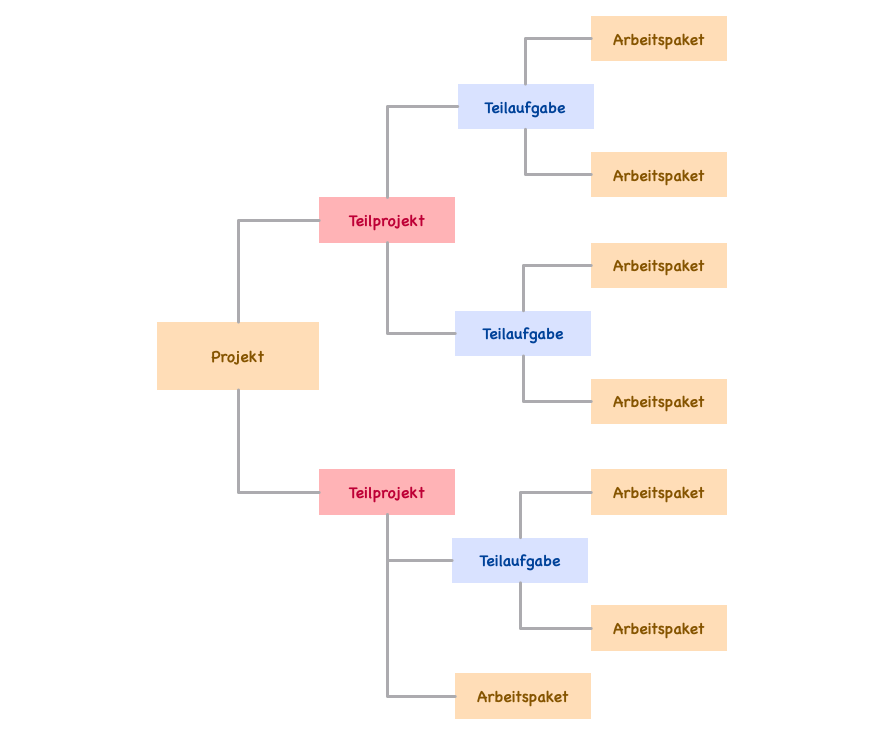
According to DIN 69901-5, a work breakdown structure (WBS) is structured using three types of elements:
- Sub-projects
- Sub-tasks
- Work packages
Sub-projects make it possible to use different process models within a single overall project. For example, it may make sense to use a classic waterfall method for developing electronics in one sub-project and to work with agile methods for the associated software development in another sub-project.
Sub-tasks are elements that can be broken down further within the work breakdown structure.
Work packages represent the lowest level of a work breakdown structure and can be further divided into operations or tasks in the subsequent planning process.
In this form, the work breakdown structure appears activity-oriented, with a focus on activities rather than outcomes. A product breakdown structure emphasizes outcomes, while a Work Breakdown Structure requires a combination of activity and verifiable result.
Organization Principles for Project Structure Planning
How should the elements be organized for the structure plan? According to DIN 69901, there are three approaches to developing a suitable structure depending on the type of project:
- Object-oriented organization
- Function-oriented organization
- Phase-oriented organization
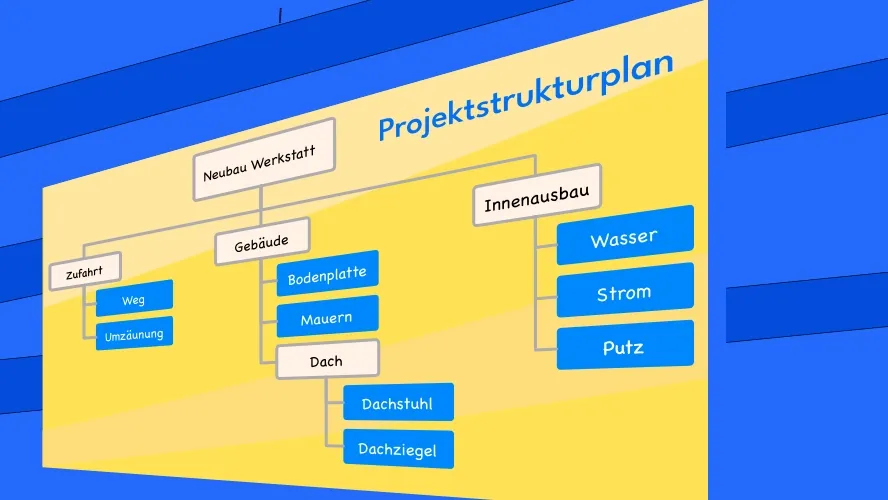
The following sections explain these principles using a small example: building a small workshop.
Object-Oriented Organization
This approach works best when the project goal is a concrete object — such as a garage, an office building, or a gas burner. Object-oriented structuring produces a plan very similar to a product breakdown structure in PRINCE2.
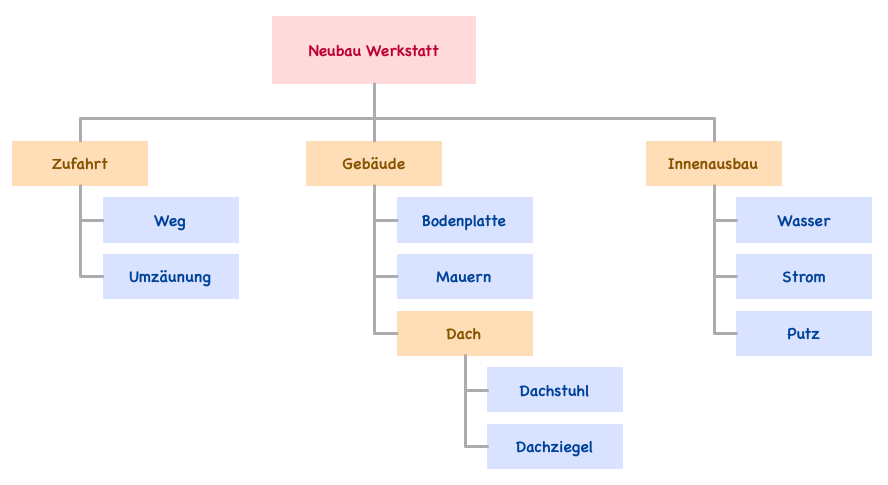
The advantage over a function-oriented approach lies in the greater traceability during project execution. A result is easier to verify than activities. Process verification essentially requires real-time monitoring of the project, whereas verification based on process results can easily take place much later.
An object-oriented work breakdown structure is essentially a product breakdown structure when not only the final products but also intermediate products such as design documents or inspection reports are taken into account.
Function-Oriented Organization
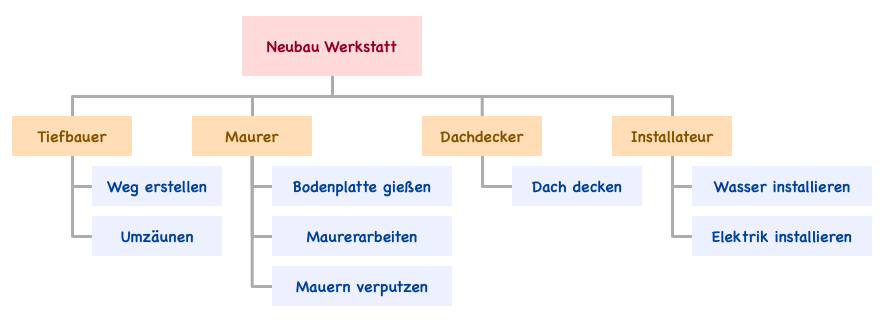
The function-oriented approach is ideal when the project can be better described by the activities or work packages to be carried out than by the results of those activities. For example, in a relocation project, one could describe the desired arrangement of the new premises — but this would overlook the essential element: the physical move of objects from the origin to the destination.
The next figure illustrates a function-oriented work breakdown structure for building a new garage. Unlike a relocation project, a function-oriented approach is also feasible in this case.
Phase-Oriented Organization
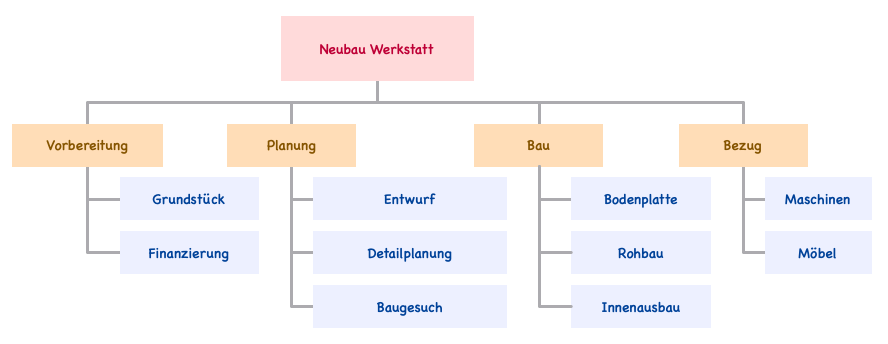
With a phase-oriented structure, the plan is derived directly from the necessary tasks. This involves thinking through the sequence of the project — which steps need to be carried out one after another. These activities are written on a list or entered into a suitable project management tool. As the list grows, the workflow can be divided into phases. For a relocation, for example, a phase could be dedicated to each room, subdivided into further phases for furniture and small items.
Which Organization Principle Should You Use?
The choice of organization principle should depend on the nature of the project — provided you have the freedom to choose. The object-oriented approach is generally preferred whenever possible, with the function-oriented method applied only when it is a better fit. Function-oriented structuring makes sense when the project is better described by its activities than by the outcomes of those activities.
Coding in the Work Breakdown Structure
To uniquely identify individual elements in the work breakdown structure, it is important that they receive a code. This allows effort, resources, or changes to always be clearly assigned to a specific work package later on. The coding must reflect the hierarchical position of the element. Several types of coding are distinguished:
- Numeric coding: use of digits, e.g. 1, 1.1, 1.1.2…
- Alphabetic coding: use of letters, e.g. A, AA, AB, …
- Alphanumeric coding: mix of numbers and letters, e.g. A, A1, A.1.1 …
- Decimal coding: digits in multiples of ten, e.g. 1000, 1100, 1110 …
Finding the Elements of the Plan
There are three methods for finding the elements of a work breakdown structure:
- Top-down approach
- Bottom-up approach
- Yo-yo method
Top-Down Approach
The top-down approach moves from the whole to the detail — the WBS is formed by decomposing from the project level down to the work packages.
- Name the project
- Select the appropriate orientation method for the second level
- Break down the overall project into sub-projects or sub-tasks
- List the tasks or structural elements of the second level
- Select the appropriate orientation method for each element of the second level
- Continue decomposing until work packages are reached
This method is often chosen when there is already experience with similar projects or when the content of the project to be planned is largely known. (Source: Wikipedia)
Bottom-Up Approach
The bottom-up approach moves from the detail to the whole — the WBS is formed by assembling from individual tasks up to the project level.
- Collect the tasks to be carried out in the project
- Analyze the relationships by asking what is part of what
- Build and assemble into a tree structure
- Check for completeness and uniqueness of all tasks
This method is suitable for projects with a high degree of innovation. (Source: Wikipedia)
Yo-Yo Method
In the countercurrent method, deductive and inductive steps are alternated to take advantage of the strengths of both approaches. To use this method effectively, however, it should not be applied to too granular a section of the project.
To ensure that no tasks are forgotten and no tasks appear more than once, the following rules must be observed:
- Uniqueness: The structural elements at one level must be completely distinct from one another in terms of content.
- Completeness: The sum of the content of elements belonging to a higher-level element must match the content of that higher-level element.
Achieving the design goal of completeness and uniqueness is supported by ensuring a roughly equal level of detail when forming work packages. (Source: https://de.wikipedia.org/wiki/Projektstrukturplan)
7 Tips for Successful Project Structure Planning
Know the Requirements and Scope
At minimum, the project manager should have a rough idea of the project goal and expected outcome before creating a work breakdown structure. It is very helpful if a requirements specification has already been prepared at this point. Working out the requirements is best done in a separate project or a pre-project phase.
Create the Plan as a Team
A reliable work breakdown structure should be developed as a team. An individual can easily overlook important elements, which has a negative effect as the project progresses. It is also beneficial from a team-building and project identification perspective to involve stakeholders early on.
Sleep on It
Wherever possible, don’t finalize a work breakdown structure in a single sitting — let it rest for a while, like dough before baking. After a break of a few days, you can review your work with fresh eyes and make corrections where needed.
The 7 Times 7 Rule
A week has 7 days, hands have ten fingers — and there is a reason for that. Accordingly, arrange a maximum of 7 to 10 elements at the first organization level, and likewise no more than 7 to 10 elements at the second level. The total should not exceed 50 elements. Too much detail harms readability and increases the workload.
Plannable and Controllable
The work breakdown structure should be detailed enough that the resulting work packages and sub-tasks are plannable and controllable. Many projects fail because work packages were defined too broadly during planning.
The WBS Must Fit on One Page
Bringing clarity to a project or sub-project with its many tasks is one of the key purposes of the work breakdown structure. It should therefore not be spread across many pages — it should be representable on a single page.
Put the WBS on the Wall
Print the work breakdown structure on a large sheet and hang it in a prominent location. This turns it into a central communication tool for the project and keeps the team focused on what matters.
Tools
The Card Wall
Writing cards and pinning them to a board is a tried-and-tested approach, especially in the early planning phase. This keeps plan creation simple. The whole team can be involved, and sorting and restructuring is very easy.
Dedicated WBS Tools
There are not many tools dedicated specifically to creating WBSs. Most project management software does not offer this function as such. This is probably because the task can be handled almost equally well by modern diagramming tools, or because the structuring can be done directly in the form of a Gantt chart.
Diagramming Tools
Diagramming tools such as Visio or OmniGraffle make it quick and easy to create tree structures — which is essentially what WBSs are — graphically. These tools even offer automatic layout functions and the ability to define custom shapes. This allows WBS codes in the elements to be formatted consistently.
Mind Mapping Tools
Organizing a project and the corresponding plan into hierarchically arranged elements is the core function of mind mapping. Tools such as MindManager or MindGenius are therefore well suited, especially for the collection phase.
Frequently Asked Questions
What belongs in a work breakdown structure?
A work breakdown structure contains the entire scope of a project, divided into sub-tasks and work packages. This ensures a comprehensive representation of the scope for planning, controlling, and monitoring the project. The work breakdown structure is supplemented by information on the person responsible and the deadlines for each task. The structuring makes effective project execution easier.
What is meant by a work breakdown structure?
A work breakdown structure (WBS) serves to define the scope of a project and provide a comprehensive overview of it. It helps visualize the individual tasks and their interconnections, making project management easier and ensuring project success. The work breakdown structure is therefore an essential instrument for project planning and execution.
How can a work breakdown structure be organized?
One possible way to organize a work breakdown structure is to use the main phases of the project, the work packages within each phase, the resources involved, and the schedule. A clear structure enables better planning, execution, and monitoring of the project. It is important that the work breakdown structure reflects the specific requirements and goals of the project.
What types of work breakdown structures are there?
There are two types of work breakdown structures (WBS): function-oriented and time-oriented. The function-oriented approach is the most common and preferred. The main difference between the two approaches lies in which elements appear at the first level of the WBS. An effective WBS structure is crucial for successful project planning and execution.

CEO Alltena GmbH
Christoph Friedrich is a computer scientist and certified Project Management Professional. He has extensive experience in the introduction and integration of project management tools as well as the analysis and definition of processes in project and service management.