What Is a Matrix Organization?
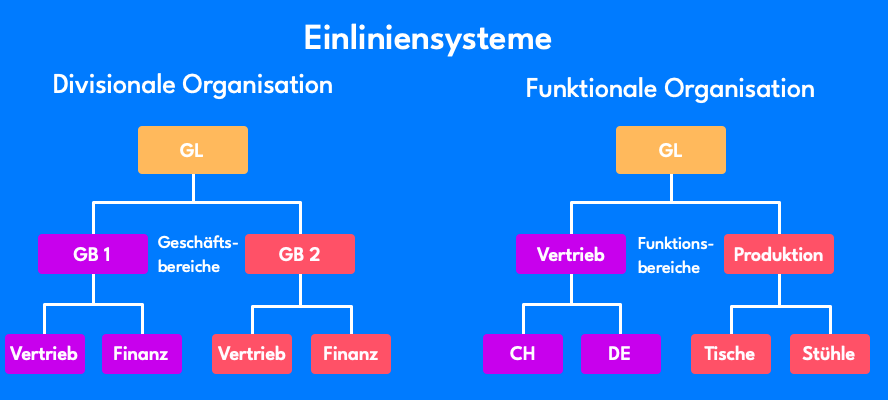
Many companies organize themselves for effective management using classical single-line structures — meaning each employee has exactly one direct supervisor.
- Divisional organizations structure themselves around their business units. These include, for example:
- Products
- Projects
- Regions
- Divisions
- Functional organizations divide themselves according to their functional areas. There you might find, for example:
- Development
- Sales
- Production
- Finance
- etc.
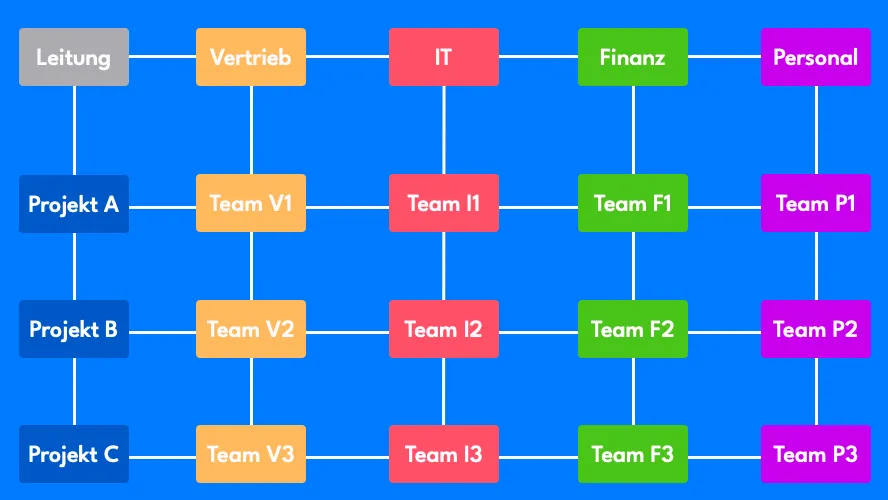
Line organization often leads to unnecessarily long communication paths and duplicated work. This is where the matrix organization comes in as a multi-dimensional organizational structure in which two or more areas of responsibility overlap. A typical variant combines
- Functional departments (for example IT, HR, Finance)
- Project-based lines (Project A, Project B, …)
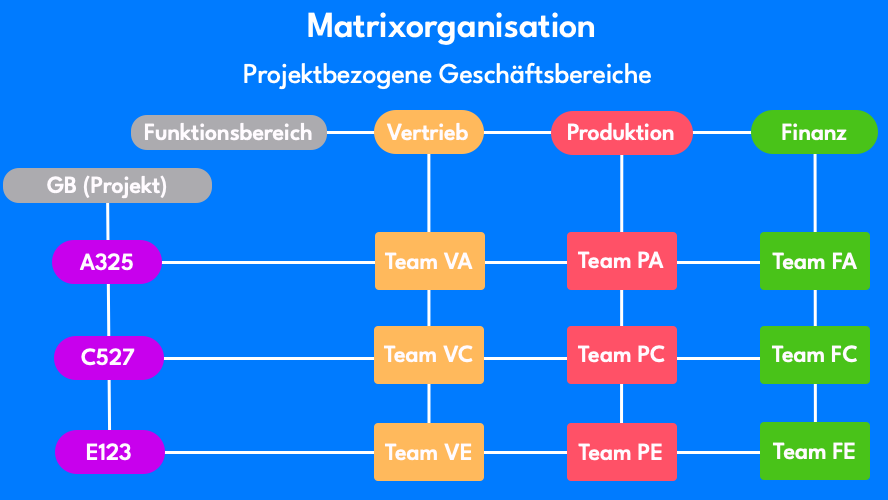
This structure is also referred to as a matrix structure.
The core idea behind this organizational structure rests on the conviction that project management can only truly succeed when all necessary competencies are brought together. This allows the functional and project perspectives to interlock. Employees share responsibility between the line and the project, which enables flexibility but requires clear coordination rules. The PMBOK Guide also describes the matrix organization as a common organizational form in project management and emphasizes the importance of clearly defined roles and decision-making authority to avoid conflicts.
- Functional responsibility: Each department — such as Marketing or Research and Development — remains responsible for technical depth and competency development. This ensures that expertise is not lost and that you always have a specialist at your side.
- Project-related responsibility: The project manager coordinates tasks, schedules resources, and controls the budget. Their focus is on the goals of the particular initiative. They ensure that milestones are met and that all team members collaborate smoothly.
This creates a kind of “dual reporting line”: project team members report both to their functional department and to the project management. In a pure project organization, you would work exclusively on a project basis, often without a corresponding connection back to a functional department.
In an ideal matrix organization, both lines of authority communicate with each other, share information through clear reporting structures, and ensure that employees are not crushed between contradictory instructions. Because that is easier said than done, good conflict management pays off.
Why Is the Matrix Organization So Relevant for Project Work?
Networked Working Instead of Silo Thinking
Companies operating internationally often have locations in different countries, speak different languages, and span numerous time zones. In a matrix structure, cross-regional teams can be formed that still work toward a shared vision.
Imagine an automotive manufacturer working on new electric models. Engineers from battery research in Germany exchange ideas with designers in the United States. In parallel, a marketing team in Japan is working on the global product launch. In a classic line organization, these experts would each report only to their department heads. Information could quickly become fragmented and the big picture could be lost.
A matrix organization, on the other hand, connects functional areas and project goals. It ensures that an engineer continues to go deep in their technical domain while also receiving feedback from the marketing team. This creates an awareness of what customers in other regions expect. This cross-departmental collaboration fuels innovation. It leads to creative impulses because different perspectives complement each other.
Resource Efficiency
Anyone managing multiple projects simultaneously often faces the challenge of deploying available specialists optimally. The matrix organization provides an answer by cleverly dividing areas of responsibility:
- Line managers focus on the further development and maintenance of their personnel base. They nurture talent, plan capacity, and ensure that the necessary expertise remains available in their department.
- Project managers take care of the specific requirements of their initiative. They know which competencies are needed at what point and coordinate closely with line managers to bring the best people into the project.
This way, you avoid personnel bottlenecks or the notorious “benching,” in which highly qualified employees wait idly for new tasks. With clear communication, you can check whether someone can be active in multiple projects during certain periods. This requires more coordination than in rigid structures, but it often produces better results.
Project Speed and Time-to-Market
Many organizations want to develop prototypes and run market tests as quickly as possible. Start-ups and technology providers in particular know how important rapid iterations are. Delays cost not only money but also a strategic advantage over the competition.
In a matrix organization, information flows faster because functional departments do not form isolated islands. Your team receives direct feedback, can resolve questions quickly, and wastes less time. This shortens the path from idea to finished product.
Imagine you are working on a smartphone app that uses artificial intelligence. The project requires expertise from software development, product design, and marketing — not just to build a functional app, but to bring a marketable one to market. In the project organization of a matrix structure, all these forces interlock seamlessly. The team can test multiple versions in parallel, refine concepts together with the functional department, and shorten feedback loops. The dual reporting line becomes a shared opportunity, because important decisions do not have to pass through numerous hierarchy levels first.
How Does a Matrix Organization Work?
Structure and Role Allocation
Central to the matrix organization is the interplay of two “axes”: a functional one and a project-related one. A project manager is responsible for the budget, the timeline, and goal achievement. The line manager ensures the quality of the technical work and takes care of personnel development.
In practice, this kind of organizational structure only runs smoothly when both managers have clearly defined decision-making authority. Who sets the overall strategy? Who evaluates individual employees and decides on vacation, bonuses, or promotions? Having a solid answer to these questions protects you from conflicts.
Leadership Models and Communication Channels
The matrix organization thrives on open, regular communication. Project teams report not only “upward” but ideally also among themselves. Short, informal check-ins save time and reduce misunderstandings.
A proven leadership model in such structures is “shared leadership.” Superiors in both the line and the project share responsibility without a power struggle emerging. This requires respect and trust. Every member knows that a conflict can only be resolved constructively when everyone pulls together.
Clear platforms and tools that keep knowledge transparent are valuable:
- Digital collaboration tools such as Microsoft Teams, Slack, or XWiki.
- Project management tools such as Allegra or Jira, to assign tasks and measure progress.
- Regular meetings (Jour Fixe), in which interim results are presented and decisions are made.
Good team communication prevents someone from inadvertently receiving two contradictory tasks. It reveals early on whether a team member is overloaded. In globally positioned companies, you should also consider time zones and cultural differences.
Day-to-Day Life in the Project Team
In your daily work, the matrix structure can be a genuine asset. You gain insight into various disciplines and build a network that extends far beyond your own department. A few tips for handling dual reporting in everyday life:
- Set clear priorities: Speak openly when deadlines in Project A and B collide. Project and line managers should decide early on what gets done first.
- Proactive communication: If you notice that you need technical support, actively reach out to the relevant functional department. The matrix lives on individual initiative.
- Establish feedback loops: Seek feedback — from the project manager as well as from your functional supervisor. This way you continuously develop your competencies.
- Conflict resolution: You don’t need to fear conflicts when the team speaks openly about goals and responsibilities. In some organizations, mediators or special training sessions for conflict management are provided.
These best practices give you and your team stability. They also increase resource efficiency, because an external specialist can answer an important question at any time without first having to overcome bureaucratic hurdles.
What Advantages Does a Matrix Organization Offer?
Promoting Expertise and Competency Development
One of the greatest strengths of the matrix organization lies in its ability to specifically expand employees’ specialist knowledge. You may have already experienced how specialists in a rigid line organization rarely get the opportunity to contribute to cross-departmental projects. This rigid separation creates knowledge silos: employees perfect their routines, but often develop no broad understanding of other areas.
In a matrix structure, this is different. Experts from the functional departments have the opportunity to continuously prove themselves in new fields. Imagine, for example, an engineer who primarily works on hardware designs. When an international project for new product development suddenly comes up, she can contribute her expertise to the technical planning — and at the same time learn from team members who specialize in software, marketing, or finance.
This competency development increases not only personal satisfaction but also each individual’s contribution to value creation. Because someone who gains a deeper understanding of adjacent disciplines becomes more creative in problem-solving and understands market dynamics better. In the long run, this networked thinking pays off for the entire company.
Coordination of Complex Projects
In many industries, products and services have become so complex that they can hardly be viewed in isolation. Think of pharmaceutical research, where scientists, physicians, market researchers, and regulatory experts must work closely together. Or the project management teams in IT that develop software across countries while simultaneously complying with strict data protection guidelines.
The matrix organization makes it possible to quickly form cross-functional teams and thereby achieve significantly higher resource efficiency. Functional departments can contribute to different projects in parallel, while the project manager requests exactly the competencies needed at each point in the project. This often even creates a kind of awareness of how decisions in one area affect others.
Example: In an industrial company, production could work with sales and logistics to plan a new plant in South America. The short line of communication between the various functional areas promotes quick problem-solving, since the relevant people are at the same table at all times. This close coordination shortens project duration and reduces error rates.
Motivation and Empowerment
Often underestimated but enormously important is the motivation of employees. Anyone who permanently moves in the same environment in a pure functional department can fall into routine despite good conditions. But when you are involved in projects within a matrix structure, you gain more decision-making freedom and learn to act with personal responsibility.
Motivation and empowerment are closely linked to the fact that employees can actively contribute their strengths. At the same time, self-confidence grows with each project involvement, as successes become immediately visible. For many people it is extremely fulfilling to see how their own specialized knowledge advances a larger initiative.
Additionally, the clear dual reporting line creates a sense of security. On one hand, there is the line manager who supports long-term career development and provides regular feedback. On the other hand, the project management ensures team communication on an equal footing, determines — in coordination with you — how you are deployed in the project, and keeps the project plan up to date.
Strategic Added Value
Finally, the matrix organization delivers a clear competitive advantage when management places value on flexibility and innovation. In times when market requirements can change rapidly, companies with cross-functional structures gain in effectiveness.
On the one hand, new business opportunities can be identified and realized more quickly because expert knowledge on various topics is available at any time. On the other hand, companies become more adaptable in their organizational development. The matrix structure can grow with expanding business areas or changing markets without everything having to be completely restructured from scratch each time.
In the long run, this results in higher agility. Instead of spending weeks or months in conceptualization, your team works on prototypes in small steps, tests ideas with customers, and adjusts as needed. This allows you to reach your goals faster and gives the company a solid foundation for future projects.
What Are the Disadvantages of a Matrix Organization?
Conflicts Through Dual Reporting
The dual reporting line is on one hand the heart of the matrix organization; on the other hand, it can be its greatest source of disruption. Consider the following scenario: a highly qualified employee is simultaneously needed by the functional department and urgently required by the project manager to reach an upcoming milestone. Both managers have their own goals and priorities — conflict is inevitable.
In such situations, only one thing helps: consistent team communication and clear role allocation. The employee must not feel pushed into contradictory tasks. Instead, transparent coordination is needed. Which task currently has the highest priority? Can a task be postponed without jeopardizing project results?
A best practice is to establish an escalation matrix. This defines who a team member can turn to when conflicts arise between project management and line responsibility. Ideally, management agrees on a common course of action rather than wearing down the employee in a power struggle.
Communication Overhead and Decision-Making Processes
Where multiple parties have a say, communication overhead increases. Regular meetings, email traffic, chat messages, and informal conversations take up more time in a matrix structure than in a linear organization. This carries the risk of overload if not managed wisely.
Moreover, decision-making processes in a matrix organization can initially seem more complex. It must be clearly defined where final responsibility lies. Who approves budget increases, for instance, when both the functional department and the project management are involved? Or who decides in a time-critical situation whether resources should be reallocated?
To keep these processes from becoming an obstacle, it is worth distributing specific task packages unambiguously. For example, financial approval could rest exclusively in the project environment, while staffing decisions belong to the functional department. The more concrete the responsibilities, the leaner the coordination rounds.
Responsibility and Priorities
Simultaneously belonging to two structures can be confusing when it is not clearly established who is responsible for which goals. Employees often have to switch abruptly between project tasks and line tasks and balance both fairly.
A further challenge is the question of performance measurement. Are you evaluated for your contribution to the project or for your functional department tasks? What happens when priorities shift spontaneously?
In successfully implemented matrix organizations, leaders clarify from the outset which goals take precedence and what the areas of responsibility look like in detail. This prevents employees from getting the impression that all projects are equally important — which is rarely feasible in practice.
Who Bears What Responsibility in a Matrix Organization?
Roles and Responsibilities in Detail
In a matrix organization, roles are typically filled twice: on one side there is leadership by the line manager; on the other side, the project manager is responsible. This leadership structure only works harmoniously when it is clearly defined who makes which decisions and how goal conflicts are resolved.
- Line managers: As experts in a particular field or department, they take care of personnel, develop their team’s professional competence, and set high quality standards. They pursue long-term goals, monitor budgets from a departmental perspective, and ensure that expertise is continuously expanded.
- Project managers: They bear responsibility for achieving specific project goals, coordinate the team, and monitor deadlines, costs, and results. In this leadership model, the project manager often has decision-making authority over operational measures within the ongoing project.
There may also be a level that functions across the organization, such as a Project Management Office (PMO). There, project standards are set, benchmarks for project success are defined, and central tools are provided. The PMO can also serve as a contact point for all project-related topics — for instance, if you have questions about budget planning or the choice of project management software.
Employee Development and Personnel Development
The dual reporting line is not only a challenge — it also offers opportunities for competency development. Employees receive feedback from two perspectives and can thereby better assess their own strengths.
- Line manager focus: Promotes the professional career. You have the opportunity to attend seminars, obtain certifications, or receive training specific to your discipline. This keeps functional departments up to date and secures the company’s innovative strength.
- Project manager focus: Aims more at immediate task completion and project success. Employees learn to find pragmatic solutions and to set priorities. Those who shine here demonstrate leadership strength and team capability — qualities that can have a positive effect on future career paths.
In this way, the knowledge in the company gradually grows into a genuine competitive advantage. At the same time, your talent feels valued because they are offered continuous development opportunities and diverse projects. This counteracts high turnover and increases motivation.
6.3 Controlling and Performance Measurement
In every organizational structure, it is important to understand the mechanisms of project control and the management of functional areas. Different metrics are used here. In the matrix organization, the measuring stick is often divided into two areas:
- Project-related KPIs: Adherence to schedule and budget, quality of deliverables, and customer satisfaction. These factors are typically the project manager’s responsibility and give information about how smoothly the project is progressing.
- Functional KPIs: Development of new technologies, internal process improvements, long-term employee satisfaction, or the level of expertise in the department. The line manager looks more closely at these.
Who is responsible for which KPI should be established from the outset. This is the only way to prevent a situation where no one feels responsible or results are captured twice. Goal-oriented reporting ensures transparency.
A regular, joint review of both KPI sets is practical. This allows project and line managers to recognize early on whether certain measures are having a positive effect on the overall company or whether adjustments are needed. Some companies use balanced scorecard systems or software that clearly visualizes reporting structures for this purpose.
Where Is the Matrix Organization Headed in the Future?
Trend Toward Agile and Hybrid Structures
In recent years, buzzwords like “agile project work” or “holacracy” have gained in significance. Companies want to act more flexibly, in a more customer-oriented way, and more innovatively. Many are therefore combining agile project management with project management methods such as Scrum or Kanban with the principles of the matrix organization.
This creates a kind of “hybrid model.” The project is planned in Sprints with close feedback from customers and stakeholders, while the functional department manages the expert pool and defines long-term standards. This combination is particularly useful when teams are advancing complex software or hardware projects that require frequent adjustments.
The challenge lies in neatly interlocking the Scrum roles (Product Owner, Scrum Master, development team) with the line functions. Whoever finds a sensible structure for this can respond quickly to market changes while still falling back on an established organizational form.
The Influence of Digitalization and Remote Work
With advancing digitalization, teams increasingly work across locations. Remote work or distributed teams are no longer the exception but often lived reality. This places new demands on the matrix structure.
- Virtual communication: Project and line managers hold conferences via online platforms. Tools like Zoom, Microsoft Teams, or Slack consolidate the most important information. You need to establish rules here so that the flood of messages does not grow uncontrollably.
- Global perspectives: Some team members are based in Europe, others in Asia or America. Time differences and cultural differences affect decision-making processes and conflict management. A successful matrix organization takes this into account and creates, for example, defined “core hours” during which everyone is present.
- Data security and the cloud: Companies that operate internationally share sensitive information via cloud systems. Correct adherence to data protection standards thus becomes a decisive topic. Here too, clear assignment of responsibilities plays a role so that there are no overlaps or gaps.
In global companies, the matrix structure often proves to be an advantage because you have direct access to experts around the world. This increased cross-departmental collaboration and resource efficiency can be leveraged even better with digital collaboration tools, provided that leaders are willing to shape their reporting and hierarchy levels flexibly.
Outlook and Recommendations for Action
If you are planning to shape your organization in a matrix form or to further develop an existing structure, the following steps can be helpful:
- Start pilot projects: Instead of immediately switching the entire company to a new structure, first try out a clearly defined project in matrix form. This gives you the opportunity to gather experience and to refine leadership principles.
- Involve top management: Successful organizational development requires backing and a role model function from the very top. When C-level management supports the matrix idea and communicates it credibly, acceptance among the workforce increases.
- Set up change management professionally: Employees and leaders need training in conflict management, team communication, and self-organization. The better prepared they are, the lower the resistance to the dual reporting line.
- Ongoing optimization: Even the best matrix structure should be reviewed regularly. Are there new markets, technologies, or products? Then adjust the resource allocation and fine-tune the interplay between functional and project managers.
While some companies are already thinking ahead and moving toward even more open network models or approaches such as holacracy, the matrix organization remains a solid foundation. It is a proven leadership model that combines flexibility with technical depth — especially in a world where projects are becoming ever more global and complex.
Summary
The matrix organization presents itself as a flexibly deployable, multi-dimensional organizational structure that combines functional expertise with project management. It creates networked working across departmental boundaries, increases resource efficiency, and promotes a culture of learning and personal responsibility. Thanks to this structure, companies accelerate the development process for new products and services and strengthen their capacity for innovation.
Of course, a matrix structure comes with certain challenges: dual reporting lines, high communication requirements, and potential priority conflicts are typical stumbling blocks. But with thoughtful conflict management, clearly assigned areas of responsibility, and a strong communication culture, they can be overcome. Provided that top management stands behind the concept and creates the necessary prerequisites, the introduction of the matrix organization can create long-term competitive advantages.
Especially in globally networked companies that serve multiple markets simultaneously, this leadership model unfolds its full strength. Modern technologies and collaborative tools facilitate collaboration across time zones and continents. This preserves the advantages of functional departments while maintaining the dynamism of project teams.
Whether you work in a large corporation, a mid-sized organization, or a growing start-up — the question of whether a matrix organization is the right instrument for organizational development can only be answered on an individual basis. Where many projects need to be coordinated, where creative synergy effects are called for, and where specialists are deployed in parallel across various areas, the matrix proves to be a powerful lever. Provided that all those involved are willing to let go of old ways of thinking and embrace a new way of working together.
In the end, what matters is that your structure is flexible enough to master the challenges of your market and to give your employees the freedom to develop their talents. With this mix of clear lines and dynamic project teams, you lay the foundation for your company to not only keep pace with the rapid pace of change, but to actively shape it.
Resources
For defining responsibilities in a matrix organization, the RACI matrix has proven its worth. A kick-off meeting helps to make the dual reporting line transparent at the start of a project.
- https://de.wikipedia.org/wiki/Matrixorganisation
Comprehensive overview with definition, advantages, and disadvantages. - Projekt Magazin – Matrixorganisation
https://www.projektmagazin.de/glossarterm/matrixorganisation
Analysis of dual reporting lines and their benefits in projects.
Frequently Asked Questions
What is a matrix organization?
A matrix organization is an organizational structure in which employees report to both a functional department and a project or product team. This dual reporting line makes it possible to combine functional expertise with the requirements of various projects, enabling the organization to respond more flexibly to change.
Why is the matrix organization useful for complex projects?
The matrix organization promotes cross-departmental collaboration and prevents retreat into isolated silos. This allows knowledge and resources to be used more efficiently, which leads to better results and faster implementation — especially for diverse and globally distributed projects.
What challenges can arise from the dual reporting line?
With a dual reporting line, conflicts can arise when project and line managers set different priorities. Communication overhead also increases because more coordination is needed. However, clear responsibilities, transparent processes, and functioning conflict management mitigate these risks.
Is the matrix organization suitable for every company?
Not necessarily. Small companies with few products or services often don’t benefit from the added complexity of a matrix structure. It is most useful in companies that handle complex or multiple simultaneous projects and place value on high flexibility and innovative strength.
How can a matrix organization be successfully introduced?
A successful introduction begins with clear communication from top management and a gradual transition, for example through pilot projects. Training in conflict management and team communication is also helpful so that employees learn to make optimal use of the advantages of the dual reporting line.

CEO Alltena GmbH
Christoph Friedrich is a computer scientist and certified Project Management Professional. He has extensive experience in the introduction and integration of project management tools as well as the analysis and definition of processes in project and service management.