What is the PMBOK?
The PMBOK Guide provides a comprehensive framework for the effective management of projects. It is published by the Project Management Institute (PMI). The PMBOK Guide outlines standardized guidelines, best practices, and terminology in project management and is one of the central project management standards. Higher-level project portfolio management is not covered.
The PMBOK is based on a concept of 49 processes distributed across 10 knowledge areas and 5 process groups. It does not describe specific project management methods or artifacts to be created, but can itself be understood as a method. No recommendations are made for the use of project management tools.
The 5 process groups essentially correspond to the classic project management phases:
- Initiating: Processes that define and authorize the project or a phase of the project.
- Planning: Processes required to establish the scope of the project, refine objectives, and define the course of action required to achieve the objectives and scope.
- Executing: Processes performed to complete the work defined in the project management plan and to meet the project specifications and objectives.
- Monitoring and Controlling: Processes required to track, review, and orchestrate the progress and performance of the project; identify areas where changes to the plan are required; and initiate the corresponding changes.
- Closing: Processes performed to formally complete all activities across all process groups and to close the project or phase.
Many activities within these process groups can be supported by project management software or less specific tools such as word processing software, spreadsheets, and calendars.
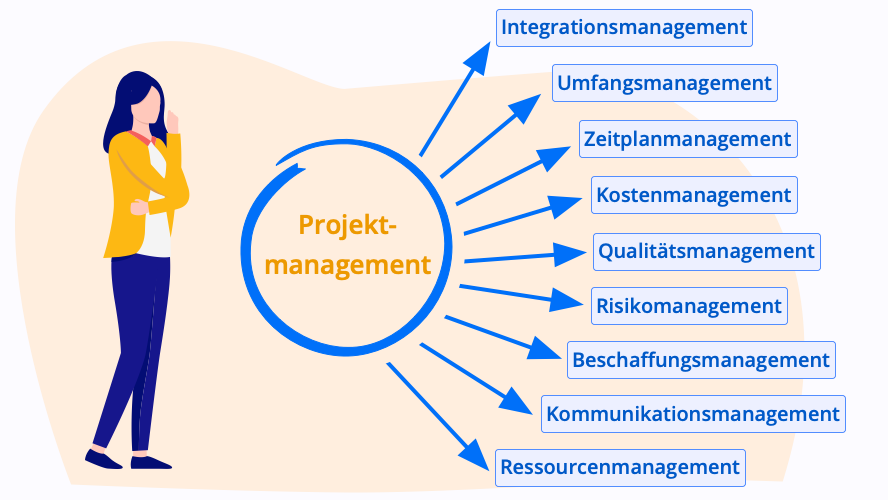
The 10 knowledge areas:
- Integration Management: Ensures that project elements are effectively coordinated.
- Scope Management: Ensures that the project includes all the work required — and only the work required — to complete the project successfully.
- Schedule Management: Involves managing the timely completion of the project.
- Cost Management: Involves planning, estimating, budgeting, financing, funding, managing, and controlling costs so that the project can be completed within the approved budget.
- Quality Management: Ensures that the project meets the needs for which it was undertaken.
- Resource Management: Involves identifying, acquiring, and managing the resources needed for the successful completion of the project.
- Communications Management: Ensures the timely and appropriate planning, collection, creation, distribution, storage, retrieval, management, control, and ultimate disposition of project information.
- Risk Management: Involves conducting risk management planning, identification, analysis, response planning, and control of risks on a project.
- Procurement Management: Involves acquiring goods and services from outside the performing organization to carry out the project work.
- Stakeholder Management: Involves engaging stakeholders in project decisions and activities.
The PMBOK Guide emphasizes the importance of adapting its processes and knowledge areas to the specific needs of the project, taking into account factors such as project size, complexity, industry, and project environment. It promotes a balanced approach to project management that integrates technical, strategic, and business management knowledge.
Adhering to the PMBOK Guide helps organizations and project managers achieve better project outcomes by providing a common language and standardized practices. In addition to the PMBOK, there are other established standards such as PRINCE2. The PMBOK Guide is widely regarded as a critical tool for project management professionals who want to improve their skills and knowledge, as well as for those pursuing PMI certifications such as the PMP (Project Management Professional).
This overview touches on the core elements of the PMBOK Guide. Each knowledge area and process group is a comprehensive topic in its own right, rich in processes, tools, techniques, and considerations specific to the discipline of project management.
1. Integration Management
Integration Management is a key knowledge area in the PMBOK Guide that highlights the importance of coordinating all aspects of a project. This area ensures that project processes and activities are seamlessly aligned with the project objectives. It involves decisions about resource allocation, balancing competing demands, and ensuring that all project components work together effectively.
The PMBOK describes several core processes within Integration Management, including:
-
Develop Project Charter: This initial step involves creating a document that formally authorizes a project, outlines its objectives, and gives the project manager the authority to apply organizational resources to project activities.
-
Develop Project Management Plan: This process compiles all subsidiary plans from various knowledge areas into a cohesive, comprehensive project management plan. In terms of content, this plan corresponds to a project handbook and serves as a roadmap guiding the execution, monitoring, and closure of the project.
-
Direct and Manage Project Work: This involves leading the team to execute the work defined in the project management plan, and ensuring that project objectives are met through the effective implementation of project activities.
-
Manage Project Knowledge: This process focuses on using existing knowledge and creating new knowledge to achieve the project objectives and foster organizational learning.
-
Monitor and Control Project Work: This involves tracking project progress, reviewing performance, and making necessary adjustments to keep the project on track.
-
Perform Integrated Change Control: This critical process reviews all change requests, approves changes, and manages changes to deliverables, project documents, and the project management plan — ensuring that changes are consistent with project objectives.
-
Close Project or Phase: The final process in Integration Management, which involves completing all project activities across all process groups to formally close the project or a project phase.
Effective Integration Management is essential to the success of any project.
2. Scope Management
Scope Management refers to the processes that ensure a project includes all the necessary work — and only the necessary work — to complete the project successfully. It is about defining and controlling what is included in the project and what is not. Scope Management involves:
-
Plan Scope Management: This is the process of creating a scope management plan that documents how the project scope or project scope will be defined, validated, and controlled. It is essentially a blueprint describing how scope will be managed throughout the project.
-
Collect Requirements: Gathering requirements from stakeholders to determine what the project must achieve. This step ensures that the needs, desires, and expectations of all parties are captured and agreed upon. This includes creating performance descriptions such as requirements specifications and functional specifications.
-
Define Scope: Based on the collected requirements, this process details the project deliverables and product deliverables, documents the project boundaries, and establishes supporting elements. A clear picture of what needs to be done is created.
-
Create Work Breakdown Structure (WBS): This is an important output that breaks down the team’s work into manageable sections. The WBS divides the project into smaller components, making management and planning easier.
-
Validate Scope: Involves the formal acceptance of completed project deliverables. This process ensures that deliverables meet the defined requirements and that stakeholders have the opportunity to accept the project outcome before it is considered complete.
-
Control Scope: The process of monitoring the status of the project and product scope and managing changes to the scope baseline. This means keeping track of what is being delivered, ensuring it aligns with the agreed project scope, and making adjustments as needed.
Scope Management plays a decisive role in preventing “scope creep” (where the project expands beyond its original boundaries) and ensuring that the project fulfills its promises within the agreed parameters, time, and budget.
3. Schedule Management
Schedule Management ensures that the project is completed within the agreed timeframe. The primary goal of schedule management is to create a realistic project schedule that aligns with project objectives, resources, and constraints — and that facilitates the timely completion of project milestones and deliverables.
The process of schedule management involves several key steps:
-
Plan Schedule Management: This initial step involves defining the policies, procedures, and documentation for planning, developing, managing, executing, and controlling the project schedule. It establishes the framework for how the schedule will be managed throughout the project.
-
Define Activities: Identifying and documenting the specific actions that must be performed to produce the project deliverables. This step breaks down the project scope into smaller, manageable tasks.
-
Sequence Activities: Determining the order of activities and identifying dependencies between them. Methods such as network diagram techniques support this process. This involves understanding which tasks must precede others and which can occur simultaneously.
This involves understanding which tasks must precede others and which can occur simultaneously.
-
Estimate Activity Durations: Estimating the work periods needed to complete each activity, taking into account the resources assigned to individual tasks.
-
Develop Schedule: Integrating activity sequences, durations, resource requirements, and schedule constraints into a comprehensive project schedule. This may involve using various planning tools and techniques to visualize and adjust the project schedule.
-
Control Schedule: Monitoring the progress of the project schedule, managing changes to the schedule baseline, and ensuring that project activities align with the project plan. This step involves regular updates and adjustments to reflect actual project progress and changes in project scope or objectives. The milestone trend analysis can be helpful here.
Effective schedule management addresses one of the three dimensions of the project management triangle and is critical to the timely and successful completion of a project — it enables project managers to allocate resources efficiently, anticipate potential delays, and make informed decisions to keep the project on track.
4. Cost Management
Cost Management is a critical process focused on planning, estimating, budgeting, financing, funding, managing, and controlling costs to ensure the project can be completed within the approved budget. It is essential for maintaining financial control over projects, minimizing cost overruns, and ensuring the profitability and sustainability of the project.
The PMBOK divides Cost Management into four key processes:
-
Plan Cost Management: This step involves developing a plan that describes how costs will be managed throughout the project, including policies, procedures, and documentation for planning, managing, spending, and controlling project costs.
-
Estimate Costs: In this process, an approximation of the monetary resources needed to complete the project activities is made. A thorough effort estimation involves identifying and considering various cost estimation options and making informed decisions to accurately predict the financial requirements of the project.
-
Determine Budget: This consolidates the estimated costs of individual activities or work packages to establish an authorized cost baseline that includes all approved budgets and contingency reserves.
-
Control Costs: This final process involves monitoring the financial performance of the project against the budget, managing changes to the cost baseline, and ensuring that all cost expenditures do not exceed the authorized funding.
This final process involves monitoring the financial performance of the project against the budget (project controlling, earned value analysis), managing changes to the cost baseline, and ensuring that all cost expenditures do not exceed the authorized funding.
Effective Cost Management is essential to the successful completion of any project, as it ensures the project is delivered within its financial constraints — contributing to the overall success of the project and stakeholder satisfaction.
5. Quality Management
Quality Management aims to ensure that the project meets the requirements and standards set by stakeholders. It emphasizes the importance of delivering a project that not only meets stakeholder expectations but potentially exceeds them — thereby ensuring customer satisfaction and delivery value.
The PMBOK describes three main processes in Quality Management:
-
Plan Quality Management: This process involves identifying the quality requirements and standards for the project and its deliverables. It encompasses planning how the quality of the project will be managed and assured throughout its lifecycle.
-
Manage Quality: This step focuses on translating the quality management plan into executable quality activities that incorporate the organization’s quality policies into the project. The goal is to prevent defects with a continuous improvement mindset, thereby raising the overall quality of the project.
-
Control Quality: This process involves monitoring and recording the results of quality activities to evaluate performance and ensure that project outcomes are complete, correct, and in accordance with customer expectations. It is critical for identifying and correcting defects and non-conformances.
Effective Quality Management ensures that the project meets the necessary quality standards and contributes to project success through the delivery of high-quality products or services.
6. Resource Management
Resource Management deals with the efficient and effective planning, allocation, and management of all resources required for the successful execution of a project. These resources include personnel, equipment, materials, and any other goods or services needed for project work. The goal of Resource Management is to ensure that the right resources are available at the right time and in the right place.
The PMBOK breaks Resource Management into four main processes:
-
Plan Resource Management: This process involves developing a plan that defines how and when resources will be acquired, deployed, and controlled for the project.
-
Acquire Resources: Identifying, recruiting, and assigning the necessary resources to carry out the planned project activities.
-
Develop Team: Developing team dynamics to create an effective and high-performing team capable of achieving the project objectives. Our article on project management team building offers practical suggestions.
-
Control Resources: Monitoring resource utilization, adjusting resource assignments as needed, and ensuring optimal use of resources throughout the project lifecycle.
7. Communications Management
Communications Management refers to the systematic planning, execution, monitoring, and revision of all communication channels within an organization and between organizations. It encompasses the processes necessary to ensure that the information needs of the project and its stakeholders are met through effective and timely communication.
According to the PMBOK, project communications management includes the following processes:
-
Plan Communications Management: This process involves determining the information needs of the project and how information will be distributed. It includes planning who needs to receive what information, what information is needed, when it is needed, and how it will be delivered. The goal is to ensure that all parties have access to the information they need to fulfill their responsibilities.
-
Manage Communications: Following planning, this process involves the actual creation, collection, distribution, storage, retrieval, and ultimate disposition of project information in accordance with the communications management plan. This step ensures that the right information is delivered to the right people at the right time.
-
Monitor Communications: This process involves tracking and reviewing project communications to ensure that the information needs of project stakeholders are being met. It includes adjusting communication strategies and plans as needed, based on project performance and stakeholder engagement.
Effective Communications Management is critical in project management, as it ensures that stakeholders are informed about project progress, decisions, and changes. This not only helps with expectation management but also with decision-making, increases transparency, and fosters a positive environment for collaboration and stakeholder engagement. Communication is often cited as one of the most critical factors for project success (Why good communication is critical to project success), and this is why the PMBOK places great emphasis on communications management processes — helping project managers convey information effectively and engage with stakeholders throughout the project duration.
8. Risk Management
Every undertaking is subject to risks, as we as humans cannot see into the future. The real world is far more creative in generating unpleasant scenarios than even the most experienced FMEA team.
Risks have three essential attributes:
- A name or description
- An impact — that is, the consequences if a risk materializes
- A probability of occurrence
The product of impact and probability of occurrence determines the level of attention that should be devoted to a risk. Classifications are often used for impact, for example based on SIL classifications.
9. Procurement Management
Procurement Management encompasses the processes and activities necessary to acquire goods and services from outside the performing organization that are required for the successful execution of a project. This area of project management deals with the selection of suppliers, contract negotiations, the purchasing of products or services, the management of contractual relationships, and the closing of contracts. The goal of Procurement Management is to ensure that the procured resources meet project requirements, are delivered on time, and are cost-effective.
The PMBOK divides Procurement Management into four main processes:
-
Plan Procurement Management: Defining the approach to acquiring goods and services, including determining what must be procured externally and how the procurement process will be managed.
-
Select Sellers: The process of soliciting bids, evaluating offers, and selecting suppliers who can provide the required products or services.
-
Conduct Procurements: Encompasses the negotiation and formalization of purchase agreements with the selected vendors.
-
Control Procurements: Monitoring supplier performance and managing relationships with suppliers throughout the course of the project to ensure that contractual terms are fulfilled.
Effective Procurement Management contributes significantly to project success by ensuring that the required resources are available at the right time, in the right quality, and at reasonable cost to support the project objectives.

CEO Alltena GmbH
Christoph Friedrich is a computer scientist and certified Project Management Professional. He has extensive experience in the introduction and integration of project management tools as well as the analysis and definition of processes in project and service management.