What are project costs?
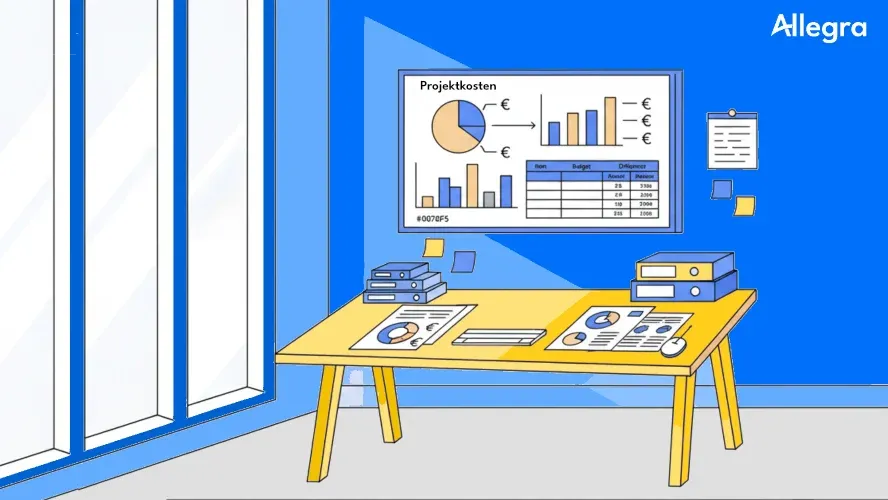
Project costs are the totality of all costs incurred for the planning, execution, and completion of a project. They encompass every financial expenditure — whether directly attributable to the project or allocated proportionally — that is necessary to achieve the defined project goals.
In the project management triangle, costs form one of the three target dimensions alongside time and scope. Anyone who doesn’t know the project costs can neither establish a solid budget nor make well-founded decisions during the course of the project.
Three terms are frequently confused in this context — but they refer to different things:
| Term | Meaning |
|---|---|
| Project costs | All actual and estimated expenditures caused by the project. |
| Cost plan | The detailed breakdown of estimated costs — per work package, resource, and time period. |
| Project budget | The approved financial framework, which is based on the cost plan and includes contingency reserves. |
Calculating project costs is therefore the first step: only once you know what the project will likely cost can a realistic budget be derived — and only then can meaningful decisions about feasibility and economic viability be made.
What types of costs exist in a project?
Project costs can be systematized along several dimensions. This may sound theoretical, but it has a very practical benefit: anyone who knows the structure is less likely to overlook items during calculation.
Direct and indirect costs
Direct costs are directly attributable to the project. They arise solely because the project exists: personnel hours of project team members, materials, licenses for project-specific software, fees for external service providers.
Indirect costs (overhead) cannot be directly assigned to a single project, but are necessary for its execution: proportional office rent, IT infrastructure, administrative effort, electricity. In many organizations they are allocated as a percentage surcharge on direct costs — typically 15–25%.
Indirect costs are the most frequently forgotten in project cost calculations. This is risky: in personnel-intensive projects they can account for a significant share of total costs.
Internal and external costs
Internal costs arise from deploying your own employees. They are often underestimated because “they get their salary anyway.” But every hour an employee works on Project A is an hour missing from Project B or day-to-day operations. Internal costs are real costs — even if no invoice is issued.
External costs are incurred for purchased services: consultants, freelancers, agencies, specialized service providers. These are generally easier to quantify because a quote or contract is available.
Fixed and variable costs
Fixed costs remain the same regardless of how the project progresses: license fees, contractual fixed prices, rents for project-specific spaces.
Variable costs change with the scope and duration of the project: personnel hours, material consumption, travel costs. When a project takes longer than planned, it is primarily the variable costs that increase — one reason why schedule delays almost always mean budget overruns as well.
One-time and recurring costs
One-time costs occur only once: purchases, setup, data migration, training.
Recurring costs arise repeatedly: maintenance contracts, SaaS licenses, support. This distinction is particularly relevant when not only pure project costs but also the Total Cost of Ownership (TCO) needs to be considered.
Overview: cost types in a project
| Dimension | Type | Examples |
|---|---|---|
| Attributability | Direct | Personnel hours, materials, licenses, external services |
| Indirect | Office rent, IT infrastructure, administration | |
| Origin | Internal | Hourly rates of own employees |
| External | Consultants, freelancers, service providers | |
| Behavior | Fixed | License fees, fixed-price contracts |
| Variable | Personnel hours, material consumption, travel costs | |
| Frequency | One-time | Purchases, migration, setup |
| Recurring | Maintenance, SaaS licenses, support |
Calculating project costs — step by step
1. Clarify project scope and goals
Without a clear scope, there is no reliable cost estimate. Define the project scope as precisely as possible: What deliverables will be produced? Which requirements are included, and which are explicitly excluded?
Scope creep — the gradual expansion of the project scope — is one of the most common reasons for cost overruns. What is not clearly delineated from the outset will be expensively renegotiated as the project progresses.
2. Break down work packages
Break the project scope down into concrete work packages. The work breakdown structure (WBS) is the proven tool for this: it decomposes the overall project hierarchically into plannable, estimable units.
The rule is: costs are estimated per work package, not as a flat figure for the entire project. The finer the breakdown, the lower the risk of overlooking hidden costs.
3. Assign resources and cost types
For each work package, clarify: who works on it and for how long? What materials, tools, or licenses are needed? What external services need to be procured?
Establish the internal hourly or daily rates. In many organizations, calculated hourly rates exist that account not only for gross salary but also for social contributions, workplace costs, and overhead share. If no such rates are available, use a rule of thumb: multiply the gross hourly wage by two.
4. Estimate costs
Estimate the costs for each work package — based on the identified resources. In addition to the amount, the timing is also relevant: when do which costs occur?
Four estimation methods have proven effective:
- Bottom-up estimation: Estimate costs per work package and sum them up — the most accurate method when a detailed WBS is available.
- Analogous estimation: Comparison with similar completed projects — pragmatic in early phases.
- Parametric estimation: Cost per unit × quantity (e.g., hourly rate × estimated hours) — good for recurring, measurable tasks.
- Three-point estimation: Best case, worst case, and most likely case yield a weighted average — useful under high uncertainty.
A detailed comparison of all methods with accuracy levels can be found in the article creating a project budget.
The most important recommendation: don’t estimate alone. Involve the experts who will actually do the work. Their assessments are, from experience, more realistic than assumptions made from behind a desk.
5. Add indirect costs and overhead
Once the direct costs per work package are established, the often-forgotten items are added:
- Project management effort: Planning, controlling, reporting, status meetings
- Administrative costs: Accounting, contract management, procurement
- Travel and workshop costs: Kick-off, coordination meetings, training sessions
- Onboarding and knowledge transfer: New team members need ramp-up time
- Overhead: Proportional infrastructure, IT, office space
Define an overhead surcharge that fits your organization. This is more accurate than hoping, and more honest than leaving it out.
6. Calculate contingency reserve
No project runs exactly according to plan. A contingency reserve absorbs the inevitable deviations without immediately blowing the budget.
The rule of thumb: 5–10% of direct project costs. The exact amount should be derived from the risk analysis: projects with high technical or organizational risks need more buffer than routine projects with proven processes.
A contingency budget is not a sign of poor planning. It is a sign of professional project management.
7. Compile and review total costs
Add up all items: direct costs per work package, indirect costs, overhead surcharge, and contingency reserve. The result is your cost plan — the foundation for the project budget.
Before sharing the figures, two checks:
- Plausibility check: Compare the total with similar projects from the past (analogous estimation as a cross-check). If your result deviates significantly, a closer analysis of the differences is worthwhile.
- Error check: Review formulas, hourly rates, units, and transposed digits. A careless mistake in the calculation can become costly as the project progresses.
Practical example: calculating project costs
A mid-sized company is planning the rollout of a new ticketing system for internal IT support. Duration: 5 months. The project team consists of two internal IT employees and a project manager, supported by an external implementation partner. The cost estimate is done bottom-up based on the work breakdown structure.
| Item | Calculation | Estimated costs |
|---|---|---|
| Internal personnel costs (IT) | 2 employees × 45 days × €550/day | €49,500 |
| Internal personnel costs (PM) | 1 project manager × 30 days × €650/day | €19,500 |
| External implementation partner | 15 days × €1,400/day | €21,000 |
| Software licenses (year 1) | 80 users × €8/month × 12 months | €7,680 |
| Data migration | Legacy system export, mapping, import (internal) | €4,500 |
| Training sessions | 3 half-day sessions, 25 participants | €5,400 |
| Travel and workshop costs | Kick-off, 2 on-site meetings with the service provider | €2,200 |
| Total direct costs | €109,780 | |
| Overhead (15%) | 15% of direct costs | €16,467 |
| Subtotal | €126,247 | |
| Contingency reserve (8%) | 8% of subtotal | €10,100 |
| Total costs | €136,347 | |
Interpretation: At just under €70,000, internal personnel costs account for more than half of direct costs — even though no invoice is issued for them. Anyone who leaves them out of the calculation underestimates the actual project costs by roughly 50%. The contingency reserve of 8% was chosen deliberately: the risk analysis had identified the data migration from the legacy system as the most critical point, since the data quality of historical tickets was unknown.
Checklist: the most common mistakes in project cost calculation
Internal personnel costs not included. “They get their salary anyway” is the most expensive argument in project management. Internal employees cost money — even if the invoice never lands on your desk. Anyone who leaves out internal costs distorts the calculation and quietly drains capacity from other projects or day-to-day operations.
Indirect costs forgotten. Project management effort, reporting, onboarding of new team members, administrative processing — all of this costs time and therefore money. When these items are missing, the estimate is systematically too low.
Contingency reserve cut. In the approval process, a budget without a buffer looks more attractive. During the project, this backfires at the first deviation from plan. Professional projects factor in risks rather than ignoring them.
Overly optimistic time estimates. Anyone who underestimates effort automatically underestimates personnel costs — the largest single item in most projects. A realistic effort estimation is the foundation of any reliable cost calculation.
No cross-check. A single estimation method has blind spots. Anyone who checks a bottom-up calculation against an analogous estimate will find discrepancies before they become a problem. Four eyes see more than two.
Costs estimated once and never revisited. Project costs are not a static document. As a project progresses, assumptions, scopes, and prices change. Anyone who doesn’t update the calculation regularly is steering by outdated figures.
Scope creep not factored in. Additional requirements that arise during the project cause additional costs. Without a clear project scope and change process, cost planning becomes meaningless.
Software for calculating and monitoring project costs
Calculating project costs in spreadsheets works — until it doesn’t. For small projects with few work packages, a spreadsheet is sufficient. As soon as multiple people are involved, costs change, and an ongoing actual-vs-plan comparison is needed, the limitations become apparent.
Modern project management software offers decisive advantages:
- Attach costs to work packages: Personnel effort, material costs, and external services are recorded directly where the work happens — not in a separate spreadsheet.
- Automatic aggregation: Changes in one work package automatically flow through to total costs. No manual formulas, no forgotten cells.
- Real-time actual-vs-plan comparison: Planned and actual costs are continuously compared. Deviations become visible as soon as they arise — not just at the next reporting date.
- Transparency for all stakeholders: Project management, team members, and clients all work with the same, up-to-date figures.
Switching from Excel to PM software is especially worthwhile when project controlling is meant to be more than a retrospective summary — namely, a genuine steering instrument.
Frequently asked questions
What are project costs?
Project costs are the totality of all financial expenditures incurred for the planning, execution, and completion of a project. They include personnel costs (internal and external), material costs, external services, travel and training costs, proportional overhead, and contingency reserves. Project costs form the foundation for the project budget.
How do you calculate project costs?
In seven steps: (1) Clarify project scope and goals. (2) Break down work packages in the work breakdown structure. (3) Assign resources and cost types per work package. (4) Estimate costs per work package — preferably bottom-up. (5) Add indirect costs and overhead. (6) Calculate contingency reserve. (7) Compile total costs and verify with a plausibility check.
What is the difference between project costs and project budget?
Project costs describe the estimated or actual expenditures for a project — what it will likely cost or has cost. The project budget is the formally approved financial framework derived from those costs. It is based on the cost plan, additionally includes contingency reserves, and has been approved by the client. Costs are the basis for calculation; the budget is the binding upper limit.
What categories of project costs are distinguished?
Project costs can be distinguished along four dimensions: direct and indirect costs (attributability), internal and external costs (origin), fixed and variable costs (behavior), and one-time and recurring costs (frequency). The complete overview with examples can be found in the cost types table earlier in this article.
How accurate do project cost estimates need to be?
The accuracy depends on the project phase. In the early phase — when no detailed plan is yet available — deviations of ±25–50% are normal and acceptable. As the level of detail increases, the range narrows: in detailed planning, accuracy should be within ±5–10%. What matters most is making the accuracy transparent — an estimate with a known level of uncertainty is more valuable than an apparently exact figure with no basis.

Senior Advisor
Jörg Friedrich is the original author of the project management software Allegra and continues to accompany its development to this day. He has many years of industry experience as a project and department manager. He also serves as a professor in the Faculty of Computer Science and Information Technology at Esslingen University of Applied Sciences.