Summary
Risk management is the systematic handling of uncertainties within a project. It consists of four core steps: identify, assess, plan responses, and monitor risks. The goal is to minimize negative impacts on time, cost, and quality — while also seizing opportunities. This guide explains the entire risk management process in practical terms and shows you how to apply it in your projects.
What Is Risk Management in Project Management?
A pilot flying a plane across the Atlantic never knows for certain how the weather along the route and at the destination airport will develop during the flight. Some flights enjoy calm skies and clear visibility; others are met by towering thunderstorm cells, turbulence that rattles the aircraft, or fog at the destination that requires a diversion to an alternate airfield.
A good pilot does not fear bad weather — but they prepare for it. They study the weather charts, check the fuel reserve, and know the alternate routes.
Risk management in project management works on the same principle. It is the systematic process by which a project team identifies potential threats early, estimates their impact, and takes appropriate action — before a possibility becomes a problem.
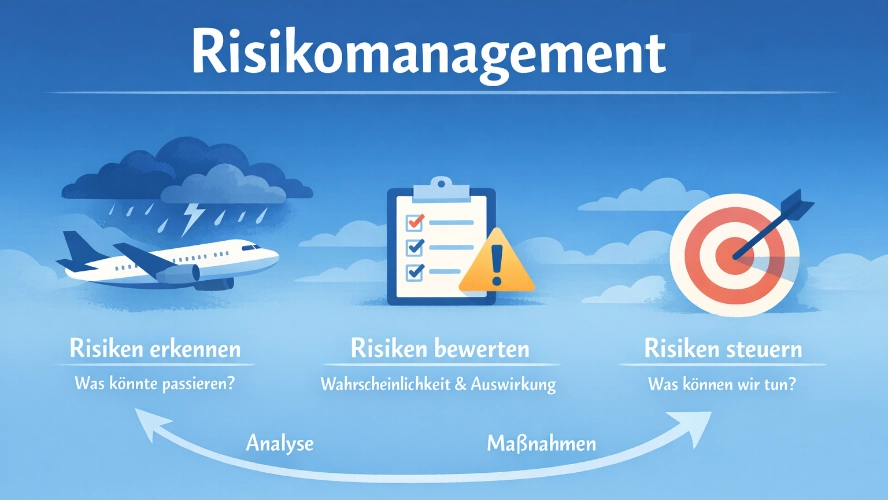
A risk is simply an uncertain event that — should it occur — can have positive or negative effects on the project objectives. Risks typically affect the three pillars of the project management triangle: time, cost, and scope.
Risk management is not a one-time step at the start of a project. It accompanies the project from the first project phase through to completion. It is an ongoing process that must be reviewed and adjusted on a regular basis.
The Risk Management Process
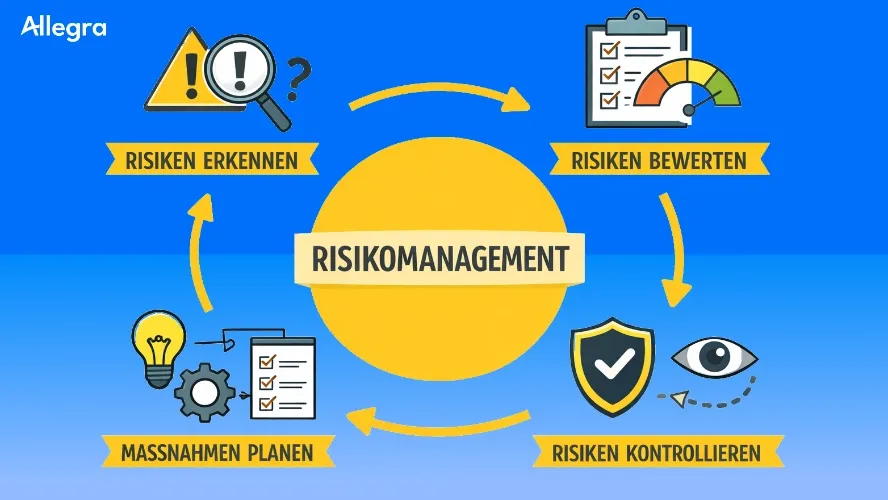
The risk management process is a recurring cycle of four steps that accompanies the project throughout its entire duration. With each iteration, risks are assessed more precisely and responses are adapted to the current situation.
1. Identify Risks
The first step is also the most important: you need to know what could come your way. That sounds obvious, yet in practice it is surprisingly often neglected. Many teams dive straight into the work and hope everything will turn out fine. Hope, however, is not a strategy.
There are proven methods for identifying project risks:
- Team brainstorming: The people executing the project know the dangers best. Create a space where concerns are welcome — not as a sign of weakness, but as a sign of professionalism.
- Checklists from previous projects: Every completed project leaves behind knowledge. Use it. What risks occurred in the past? Which ones were overlooked?
- SWOT analysis: A systematic examination of strengths, weaknesses, opportunities, and threats provides valuable pointers to potential risks.
- Expert interviews: Ask people who have already completed similar projects. Their experience is invaluable.
- Environmental analysis: Look at the project environment — technological changes, regulatory requirements, market developments. Risks don’t only come from within.
The result of this step is a risk list — a collection of all identified risks, initially unassessed and unfiltered. A list that is too long is better than one that is too short.
2. Assess Risks
Not every risk carries the same weight. A light rain delays construction by a day. An earthquake halts it for months. Assessing risks gives you the basis for setting priorities and deploying your limited resources where they deliver the greatest benefit.
Assessment is based on two dimensions:
- Probability of occurrence: How likely is it that the risk will materialize? (e.g., very low (1), low (2), medium (5), high (8), very high (10))
- Impact: How severe would the consequences be for the project? (e.g., insignificant (1), minor (2), moderate (5), severe (8), catastrophic (10))
The product of both values yields the Risk Priority Number (RPN). It determines which risks deserve immediate attention and which can simply be monitored.
RPN = Probability of Occurrence × Impact
There are two assessment approaches:
Qualitative assessment works with categories (high/medium/low) and is particularly suited to early project phases when little data is yet available. Quantitative assessment uses concrete figures — for example, probabilities of occurrence as percentages or index values, and estimated damage amounts in euros or index values. It is more precise but requires more effort and data.
For the example above, the RPN could range between 1 and 100. Small numbers indicate a low risk. Risks with large values deserve intensive attention.
3. Create a Risk Matrix
The risk matrix makes the results of the assessment visible. It is a two-dimensional representation in which each risk is positioned according to its probability of occurrence and its impact.
A typical 5×5 risk matrix looks like this:
| Insignificant | Minor | Moderate | Severe | Catastrophic | |
|---|---|---|---|---|---|
| Very High | Medium | High | Critical | Critical | Critical |
| High | Low | Medium | High | Critical | Critical |
| Medium | Low | Low | Medium | High | Critical |
| Low | Very Low | Low | Low | Medium | High |
| Very Low | Very Low | Very Low | Low | Low | Medium |
Rows = probability of occurrence, columns = impact
The color coding makes it immediately clear where action is required. Risks in the red zone demand immediate measures. In the yellow zone, measures should be planned. In the green zone, it is sufficient to monitor the risks.
4. Plan and Implement Responses
Now it gets concrete. For every relevant risk you need a strategy. There are four fundamental risk response strategies:
Avoid means eliminating the risk entirely — for example by changing the project scope, choosing a different technology, or dropping a high-risk supplier. This is the most effective strategy, but it is not always possible.
Mitigate reduces either the probability of occurrence or the impact of the risk. Example: you introduce additional quality checks to lower the risk of product defects. Or you build a time buffer into the project plan to cushion delays.
Transfer shifts the risk to another party — for example through insurance, fixed-price contracts, or the engagement of specialized service providers. The risk does not disappear, but others bear the financial consequences.
Accept is the conscious decision to tolerate a risk. This can be passive (we accept it if it occurs) or active (we prepare a contingency plan). This strategy is suited to low-priority risks or to situations where countermeasures would cost more than the potential damage.
For each risk you should define:
- Which strategy is being pursued
- Which concrete measures will be taken
- Who is responsible (the so-called risk owner)
- By when the measure must be implemented
The Risk Register
The risk register is the central document of risk management. It collects all identified risks together with their assessments, responses, and responsibilities in one place.
A good risk register contains, for each risk, at least:
- Risk ID: A unique identifier
- Description: What could happen?
- Category: Technical, organizational, external, financial
- Probability of occurrence: On a defined scale
- Impact: On a defined scale
- Risk priority: Calculated from probability × impact
- Strategy: Avoid, mitigate, transfer, or accept
- Measures: Concrete countermeasures
- Risk owner: The responsible person
- Status: Open, in progress, closed, occurred
The risk register is a living document. It is updated at every project status meeting — new risks are added, resolved ones are removed, and assessments are adjusted. A risk register gathering dust in a drawer is worthless.
Risk Management in Practice
Theory is well and good. But what does risk management look like in day-to-day project work? Let us look at the typical risks that come up again and again in projects.
Typical Project Risks
Scope creep — the gradual expansion of the project scope — is one of the most common project risks. New requirements are added without adjusting the budget or schedule. A clearly defined project scope and a formal change process are the most effective countermeasures.
Resource bottlenecks arise when key personnel leave the project, fall ill, or are tied up across multiple projects simultaneously. Countermeasures: ensure knowledge transfer, establish deputy arrangements, and avoid critical single-person dependencies.
Technical risks surface when new technologies are used, interfaces do not work as expected, or complexity is underestimated. Early prototypes, proof-of-concepts, and technical reviews help to keep these risks under control.
External dependencies — on suppliers, authorities, or partner companies — lie outside the direct control of the project team. Contractual safeguards, alternative suppliers, and adequate buffer time help here.
Communication problems sound harmless but can have devastating consequences. When stakeholders are not informed, decisions are delayed, or misunderstandings arise, even well-planned projects can go off the rails.
Example: IT Migration Project
A company is migrating its ERP system to a new platform. The project team identifies the following top-5 risks:
| Risk | Probability | Impact | Strategy | Measure | |---|---|---|---|---| | Data loss during migration | Medium | Catastrophic | Mitigate | Full backup before migration, test migration on staging system | | Key developer leaves project | Low | Severe | Mitigate | Documentation, pair programming, designate a deputy | | Interface to third-party system incompatible | High | Severe | Avoid | Early integration test in Sprint 2 | | Training time for end users insufficient | Medium | Moderate | Mitigate | Expand training concept, create e-learning modules | | Go-live date conflicts with fiscal year close | High | High | Avoid | Move go-live forward by 4 weeks |
This example shows: risk management does not have to be complicated. A simple table with clear responsibilities is often enough to keep the biggest threats under control. Our risk management example (CRM implementation) walks through the entire process — from the risk list to documented measures — using one cohesive project.
Opportunity Management — the Other Side of the Coin
Risk management is often associated exclusively with threats and dangers. Yet uncertainties also have a positive side: opportunities. Opportunity management applies the same methods — just with the opposite sign. Often, opportunities are the very reason for accepting the associated risks.
No risk, no reward.
Instead of avoiding risks, the goal is to actively exploit positive uncertainties:
- Exploit: Create the conditions that make the opportunity certain to occur
- Enhance: Increase the probability of occurrence or the positive effect
- Share: Share the opportunity with a partner who can leverage it better
- Accept: Take the opportunity if it arises, but take no active measures
An example: your project might be completed faster than planned because a new tool comes to market that accelerates development. Enhancing the opportunity means evaluating that tool early and adopting it if appropriate.
Mature risk management always looks at both sides — threats and opportunities. Because those who look only at the dangers miss the chances.
Tips for Successful Risk Management
After many years of experience in project work, a number of principles have stood the test of time:
-
Start early. Risk management begins not during execution but during project planning. The earlier you identify risks, the less expensive the countermeasures.
-
Involve the team. You don’t spot risks at a desk in isolation. The entire project team — and ideally key stakeholders as identified in the stakeholder analysis — should be involved in risk identification.
-
Keep it simple. A risk register with 200 entries that nobody maintains is worthless. Focus on the 10 to 20 most important risks and manage them consistently.
-
Update regularly. Risks change as a project progresses. New ones emerge, old ones disappear. Make the risk review a fixed agenda item in your status meetings.
-
Build an open culture. In some organizations, naming risks is seen as a sign of weakness. The opposite is true. Those who raise risks openly are acting responsibly. Actively encourage this behavior.
-
Document lessons learned. When a risk occurs — or precisely when it does not — record why. This knowledge is invaluable for future projects.
-
Use risk management as a steering instrument. The results feed directly into project controlling. High-priority risks can trigger plan changes, budget adjustments, or scope decisions.
Frequently Asked Questions
Risk management is the systematic process of identifying, assessing, and controlling potential risks in a project. The goal is to minimize negative impacts on project objectives (time, cost, quality) and to capitalize on positive opportunities.
The process consists of four core steps that repeat cyclically: 1. Identify risks, 2. Assess risks (by probability of occurrence and impact), 3. Plan responses (avoid, mitigate, transfer, or accept), 4. Monitor risks and repeat the process.
A risk matrix is a two-dimensional representation in which risks are plotted by probability of occurrence (y-axis) and impact (x-axis). The resulting color coding (green, yellow, red) shows at a glance which risks have the highest priority.
Common project risks are
- Schedule risks: When time becomes uncertain (unrealistic planning, missing buffers).
- Scope risks: When the project “grows” (unclear requirements, constant changes — scope creep).
- Communication risks: When information gets lost (poor communication).
- Technical risks: When technology does not work as expected.
- Organizational risks: When structures fail (unclear roles, missing decisions).
- Quality risks: When the outcome does not meet expectations.
- External risks: When the outside world intervenes (market changes, legal requirements).
- Opportunities (positive risks): Not every risk is negative.
A risk is an uncertain future event that could occur. A problem is a risk that has already occurred. Risk management deals with prevention; problem management deals with responding to events that have already materialized.

Senior Advisor
Jörg Friedrich is the original author of the project management software Allegra and continues to accompany its development to this day. He has many years of industry experience as a project and department manager. He also serves as a professor in the Faculty of Computer Science and Information Technology at Esslingen University of Applied Sciences.