Why SWOT Analysis Matters for Your Project Planning
Imagine you are facing an enormous task: a new project needs to get off the ground. You have an idea, perhaps even a team, but before you dive in, you ask yourself — How do I minimize risks? How do I make the most of my strengths?
That is exactly where the SWOT analysis comes in. This simple yet powerful tool helps you bring clarity to your project planning and create a solid project plan. Whether you are an experienced project manager or a newcomer — SWOT is universally applicable. It forces you to look beyond the obvious and assess the opportunities and challenges of your project realistically.
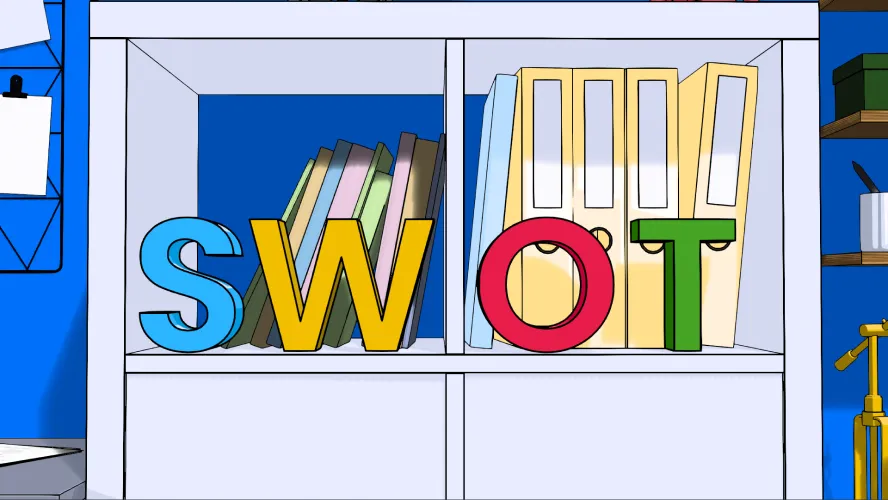
But what exactly is a SWOT analysis? The four letters stand for Strengths, Weaknesses, Opportunities, and Threats. You analyze these factors to develop a well-grounded strategy for your project. Companies use the SWOT matrix for strategic planning, but it is also useful for individuals — whether for career decisions, start-ups, or personal ventures.
In this article, we will explain step by step how to conduct a SWOT analysis for your project, avoid common mistakes, and put your insights to practical use. Look forward to a practical, easy-to-understand guide packed with examples and tips for your successful project planning.
What Is a SWOT Analysis and What Does SWOT Mean?
The SWOT analysis is a simple but effective instrument for strategic planning. The term is made up of four words:
- Strengths — What is going well? What advantages do you have?
- Weaknesses — Where are there problems or obstacles?
- Opportunities — What possibilities could you take advantage of?
- Threats — What threats could endanger your project?
These four factors are divided into internal and external aspects:
- Strengths and Weaknesses belong to the internal factors. They concern what you can directly influence — such as resources, expertise, teamwork, or financial means.
- Opportunities and Threats belong to the external factors. These lie outside your direct control, such as market developments, economic trends, or legal requirements.
1. Strengths: What Makes Your Project Special?
Here you look at the positive characteristics of your project or company. Some questions that can help:
- What makes your project better than others?
- Are there particular skills or technologies you possess?
- Do you have a strong team or special resources?
Example: A start-up for sustainable fashion has the advantage that an environmentally conscious target audience already exists and the brand comes across as authentic.
2. Weaknesses: Where Are the Deficits?
Not everything runs smoothly — and that is exactly what needs to be assessed realistically. Ask yourself:
- Where do you lack resources or know-how?
- Are there inefficient processes?
- What could competitors do better than you?
Example: A small IT company struggles to find qualified developers, as large corporations can offer higher salaries.
3. Opportunities: What Possibilities Can You Leverage?
Every industry, every market offers opportunities — you just need to recognize them. Consider:
- Are there trends that could benefit you?
- Can technology give you an edge?
- Are there new target groups or markets?
Example: An online bookstore sees an opportunity in selling second-hand books as a sustainable alternative to new books.
4. Threats: What Could Endanger Your Project?
Unforeseen developments can threaten a project. Here are some important questions:
- Are there strong competitors?
- How could economic or political changes affect your project?
- Are there technological developments that could make your business model obsolete?
Example: A software start-up for mobile payments recognizes the risk that large companies with better technologies and more capital could enter the market faster.
Through this analysis, you gain a comprehensive overview of your project. But how do you now use these insights concretely for project planning? That is exactly what we will look at in the next section!
Why Is SWOT Analysis a Valuable Strategic Tool?
You now have an idea of what a SWOT analysis is and which factors it covers. But why is it so valuable for project planning? Why do companies, start-ups, and even individuals rely on this tool?
The answer is simple: The SWOT analysis brings structure to complex decisions. It helps you consciously deploy your strengths, compensate for weaknesses, leverage opportunities, and identify risks early on.
1. SWOT as the Foundation for a Well-Grounded Project Strategy
Every successful project planning begins with an honest stocktaking. The SWOT analysis forces you to ask yourself critical questions before diving headfirst into implementation. This way, you avoid poor decisions that can become costly later.
Example:
Imagine you want to create a project plan for a new productivity app. Without analysis, you might start developing right away. But with the SWOT analysis, you recognize early on:
- Your strength lies in an innovative concept and a strong development team.
- Your weakness is the limited marketing budget.
- The opportunity is the growing demand for digital tools for remote work and self-organization.
- The risk is that large competitors dominate the market with established products.
Thanks to these insights, you can develop a clear strategy — for example, with targeted niche marketing campaigns rather than going up against the big players.
2. SWOT Analysis as a Decision Basis for Leaders and Project Managers
Not only founders or product developers benefit from SWOT — project managers and leaders rely on it too. Before major decisions, such as launching new products or entering new markets, a SWOT analysis can help weigh the risks realistically.
Example:
An automotive manufacturer plans to enter the electric vehicle market. A SWOT analysis might show that the company has large production capacities (Strength), but struggles to position itself as a sustainable brand (Weakness). The growing demand for e-mobility offers an Opportunity, yet stricter environmental regulations and high investment costs present Threats.
Based on this analysis, the company can decide whether to compensate for the weakness through targeted branding or instead enter into partnerships with established e-mobility providers.
3. SWOT Combined with Other Strategic Methods
Another advantage: SWOT can be combined perfectly with other tools to gain an even deeper analysis.
- PESTEL analysis: Examines political, economic, social, technological, ecological, and legal factors — ideal for evaluating external risks in even greater detail.
- Porter’s Five Forces: Analyzes competitive intensity and market entry barriers — particularly useful for market analyses.
- TOWS Matrix: An extended form of SWOT analysis that focuses on the interactions between strengths, weaknesses, opportunities, and threats.
By combining multiple analysis methods, you get a holistic picture of your strategic options.
The SWOT analysis is therefore far more than just a list of pros and cons — it is a powerful tool for smart decisions in project planning. But how do you actually conduct a SWOT analysis? That is exactly what we will look at in the next section!
How Do You Conduct a SWOT Analysis? Step-by-Step Guide
Now you know why the SWOT analysis is so valuable for your project planning. But how exactly do you conduct it? Simply write four lists and you’re done? It’s not quite that simple. For your SWOT analysis to actually be meaningful and help you with decision-making, you should proceed in a structured and methodical way.
Here is a step-by-step guide to SWOT analysis for your project or company.
Step 1: Define the Goal of the Analysis
Before you start, you should know exactly what you are conducting the SWOT analysis for. Because depending on the context, the strengths, weaknesses, opportunities, and threats can vary considerably.
Questions to ask yourself:
- Is this about a specific project or the entire organization?
- Is the analysis for a market strategy, a new product, or an internal restructuring?
- Who should be involved in the analysis?
Example: You want to create a project plan for a new online platform for freelancers. Then your SWOT analysis should specifically aim at identifying what advantages your concept has and what challenges you might face.
Step 2: Gather Relevant Data
The best analyses are based on solid data, not just gut feeling. The more information you have about your company, the market, and the competition, the more valuable your SWOT analysis will be.
Possible data sources:
- Internal reports: Sales figures, cost analyses, customer feedback
- Market research: Industry trends, competitive analyses
- Employee interviews: First-hand experiences and assessments
- Customer surveys: What do customers value about you? Where is there room for improvement?
Example: If your company is developing a new software tool, you could use customer surveys to find out which features are currently most in demand — and whether your competitors have weaknesses there that you can exploit.
Step 3: Create the SWOT Matrix
Now comes the heart of the analysis: the SWOT matrix. This table helps you present all factors clearly.
| Internal Factors | Positive Aspects (Strengths) | Negative Aspects (Weaknesses) |
|---|---|---|
| External Factors | Positive Aspects (Opportunities) | Negative Aspects (Threats) |
You fill in the four fields systematically with the insights from Step 2.
Example for a tech start-up:
| Internal Factors | Positive Aspects (Strengths) | Negative Aspects (Weaknesses) |
|---|---|---|
| External Factors | Positive Aspects (Opportunities) | Negative Aspects (Threats) |
| Innovative product, high market interest | Small budget, lack of brand awareness | |
| Growing demand for software solutions | Strong competition from established companies |
The matrix can be customized — depending on what you want to analyze.
Step 4: Analyze Strengths and Weaknesses (Internal Factors)
Here you look at what influences your project or company, but what can be controlled by you.
Questions for the strengths analysis:
- What do you do better than the competition?
- Are there unique selling points (USPs)?
- Do you have a strong team or special technologies?
Questions for the weaknesses analysis:
- Where do you have deficits compared to the competition?
- Are there processes that are inefficient?
- Are certain resources missing?
Example: A small software company might have a highly specialized niche solution as its strength, but no established brand name as its weakness.
Step 5: Analyze Opportunities and Threats (External Factors)
Now you look outward and assess factors you cannot directly influence, but that can significantly affect your project or company.
Questions for the opportunities analysis:
- Are there new trends you can capitalize on?
- Has demand for your solution or product increased?
- Are there legislative changes or subsidies that benefit you?
Questions for the threats analysis:
- Are there strong competitors blocking market share?
- Could economic crises or new regulations endanger your business?
- Are there technological developments that could make your offering obsolete?
Example: An online coaching start-up sees the growing demand for digital learning platforms as an opportunity, but recognizes as a threat that large players like Udemy or Coursera already dominate the market.
Step 6: Derive Recommendations for Action
Now comes the most important step: The SWOT results must be translated into concrete measures.
This is where the TOWS matrix comes in — a strategic method that shows how you can deliberately leverage strengths and compensate for weaknesses:
| Strategy | Measures |
|---|---|
| SO Strategy (use Strengths to realize Opportunities) | Enter the market with innovative technology and a strong team |
| WO Strategy (compensate for Weaknesses to leverage Opportunities) | Form partnerships to solve budget problems |
| ST Strategy (deploy Strengths to minimize Threats) | Highlight USP to stand out from competitors |
| WT Strategy (reduce Weaknesses to avoid Threats) | Cut costs to minimize financial risks |
Example:
A small software start-up with a limited budget recognizes that the high demand for cloud solutions is an opportunity. To compensate for the weakness, it relies on partnerships with established cloud providers.
Conclusion: Why a Thorough SWOT Analysis Can Improve Your Project Plan
With a clear SWOT analysis, you lay the foundation for successful project planning. You recognize where your strengths lie, what risks exist, and can develop realistic strategies.
Important:
- Stay honest — a sugar-coated SWOT analysis is worthless.
- Use real data — market research helps validate assumptions.
- Apply the analysis regularly — markets and companies change.
In the next section, we will look at how to correctly interpret your SWOT results and integrate them into your project planning.
How Do You Interpret and Use the Results of a SWOT Analysis?
You have now conducted a SWOT analysis and created a matrix with strengths, weaknesses, opportunities, and threats. But what now? A list of positive and negative factors alone is not enough — it is now about deriving strategic measures from them.
Many people make the mistake of seeing SWOT as a pure stocktaking exercise. But the true power of this method lies in converting the insights into concrete decisions for your project planning. In this section, we show you how to analyze, interpret, and use your SWOT results for a successful project plan.
1. Understanding the Interactions Between SWOT Factors
The four elements of the SWOT analysis do not exist in isolation. Strengths and opportunities can reinforce each other, while weaknesses and threats combined can become real challenges. The art lies in making connections and deriving logical strategies from them.
The TOWS matrix (an extended version of SWOT analysis) helps establish links between the factors.
| Strategic Approach | Combination of SWOT Factors | Example |
|---|---|---|
| SO Strategy (use Strengths to realize Opportunities) | Which internal strengths help you leverage external opportunities? | A software start-up with a strong development team capitalizes on the growing demand for AI solutions to launch an innovative product. |
| WO Strategy (compensate for Weaknesses to leverage Opportunities) | Which weaknesses must be minimized to leverage opportunities? | A small company with a limited marketing budget partners with influencers to raise brand awareness. |
| ST Strategy (deploy Strengths to minimize Threats) | Which strengths help you fend off external threats? | A sustainable clothing store highlights its ethical production to distinguish itself from low-cost suppliers. |
| WT Strategy (reduce Weaknesses to avoid Threats) | How can weaknesses be reduced to avert risks? | An online shop with long delivery times optimizes its logistics to protect itself against competitive pressure. |
These strategies help you develop your project in a targeted way and make well-founded decisions.
2. Converting SWOT Analysis Results into an Actionable Project Plan
The SWOT results help you create a clear project plan that maximizes your strengths and minimizes risks. But what does that mean in practice?
Here are some practical tips:
- Prioritize the most important points. Not every strength or weakness is equally relevant. Focus on the factors that have the greatest influence on your project.
- Set clear measures for each SWOT area. Write down a concrete action for each point that you can implement.
- Use an action matrix. A simple table helps assign responsibilities and set deadlines.
Example of an action plan after the SWOT analysis:
| SWOT Factor | Measure | Responsible | Deadline |
|---|---|---|---|
| Strengths: Strong development team | Develop new app feature by Q3 | Tech team | 30.09.2024 |
| Weaknesses: Low brand awareness | Launch cooperation with industry influencers | Marketing | 15.08.2024 |
| Opportunities: Growing demand for AI tools | Conduct market analysis for additional AI products | Strategy department | 10.07.2024 |
| Threats: Strong competition from established providers | Emphasize USP in PR campaign | PR team | 01.08.2024 |
This method ensures that your SWOT results are not only analytically valuable, but also practically actionable.
3. Regularly Updating SWOT Results
A SWOT analysis is not a one-time event. Markets, technologies, and customer needs change — and so do your opportunities and threats.
You should therefore:
Repeat your SWOT analysis regularly (at least once a year or before major decisions).
Validate it with real data (use customer feedback, market reports, KPIs).
Adapt it to new company goals (e.g., when a new product or expansion is planned).
Practical tip: Many companies integrate SWOT into their agile project management methods (e.g., Scrum or OKRs). This keeps them flexible and allows them to adapt their strategy dynamically.
Conclusion: How to Get the Most Out of Your SWOT Analysis for Project Planning
The SWOT analysis is far more than just a list of strengths and weaknesses — it is a powerful tool for strategic planning. It helps you align your projects purposefully, leverage opportunities, and minimize risks.
Key principles for successful use:
- Link SWOT factors to real strategies.
- Implement concrete measures rather than just analyzing.
- Repeat and update your SWOT analysis regularly.
This turns the SWOT analysis into a dynamic, flexible method for your project planning — not just a theoretical tool that gets filed away after the first use.
In the next section, we will look at what mistakes are commonly made in SWOT analysis and how you can avoid them.
What Are Common Mistakes in SWOT Analysis?
The SWOT analysis is a powerful tool — when used correctly. But in practice, mistakes often creep in that make the analysis inaccurate, one-sided, or even useless. To avoid this, let us look at the most common mistakes and misconceptions — and how you can avoid them.
1. Superficial or Imprecise Analysis
One of the biggest mistakes is keeping the SWOT analysis too general or too vague. Statements like “Our strength is quality” or “Our weakness is marketing” provide little added value.
How to avoid the mistake:
- Be specific. Instead of “Our strength is quality,” say: “Our products have a complaint rate of only 1%, while the industry average is 5%.”
- Use data and facts to back things up.
Good SWOT examples:
- Strength: 90% of our customers rate our customer service as “excellent.”
- Weakness: Our website has a bounce rate of 70%, indicating poor user guidance.
- Opportunity: The market for sustainable fashion is growing by 15% annually.
- Threat: A new EU regulation could increase our production costs.
2. Using the SWOT Analysis as a Pure List Without Strategy
Many people create a nice SWOT matrix — and then leave it unused. SWOT is not an end in itself; it should lead to concrete decisions.
How to avoid the mistake:
- Set clear measures for each insight from the SWOT analysis.
- Link SWOT to your project plan (e.g., through the TOWS matrix).
- Check regularly whether your measures are working.
Good implementation:
Weakness identified: Our marketing budget is low.
➡ Measure: We focus specifically on viral social media marketing instead of expensive advertising.
3. Lack of Objectivity and Groupthink
Another problem is that SWOT analyses are often conducted by a single person or a too homogeneous team. This leads to wishful thinking and blind spots.
How to avoid the mistake:
- Involve different departments or external consultants.
- Use customer feedback or competitive analyses for a realistic assessment.
- Conduct an anonymous survey within the team to obtain honest opinions.
Practical tip: Organize a SWOT workshop session with an external facilitator to uncover blind spots.
4. Not Updating the SWOT Analysis Regularly
Markets and business models change — yet many companies use SWOT only once and then forget to update their analysis. An outdated SWOT analysis can lead to wrong decisions.
How to avoid the mistake:
- Plan an annual review of the SWOT analysis.
- Use SWOT before every major strategic decision (e.g., expansion, product launch).
- Link SWOT to agile project management (e.g., OKRs, Scrum) so it is continuously updated.
Example: A start-up listed “little competition” as a strength in its 2024 SWOT analysis — but by 2026, five new competitors have entered the market. Without updating, that SWOT analysis would be worthless.
5. No Clear Separation Between Internal and External Factors
Many people confuse Strengths/Weaknesses (internal) with Opportunities/Threats (external) and mix them up in the analysis. This makes the SWOT matrix unclear and hard to act on.
How to avoid the mistake:
- Internal factors: Everything you can directly influence (e.g., team, technology, product quality).
- External factors: Everything you have no direct influence over (e.g., market developments, legal regulations).
Good distinction:
- Wrong: “Our prices are a threat.”
- Correct: “High material costs due to rising raw material prices are a threat.”
6. Evaluating the SWOT Analysis Too Positively or Too Negatively
Some companies tend to overestimate their strengths and ignore risks — or conversely, focus only on problems. Both can lead to wrong decisions.
How to avoid the mistake:
- Use an objective benchmark for your strengths and weaknesses (e.g., benchmarking against competitors).
- Introduce a second opinion (e.g., through external consultants or customer feedback).
Practical tip: Create a worst-case and best-case scenario analysis to find a realistic middle ground.
Conclusion: How to Avoid Common SWOT Mistakes and Create a Truly Useful Analysis
The SWOT analysis is an incredibly valuable tool — when applied correctly. Avoid the most common mistakes by:
Working specifically and based on data.
Using SWOT not just as a list, but as a basis for decisions.
Gathering diverse perspectives and feedback.
Updating SWOT regularly.
Clearly separating internal and external factors.
This way, your SWOT analysis becomes not just a theoretical exercise, but a practical instrument for your strategic planning and project plan.
In the next section, we take a look at concrete practical examples of SWOT analysis in different contexts.
SWOT Analysis Examples and Use Cases
Now that you know how to conduct a SWOT analysis correctly and avoid common mistakes, it is time to put your knowledge into practice. What does a SWOT analysis look like in real-world scenarios? In this section, we show you three concrete use cases:
- A company (Tesla) — Strategic market analysis
- A start-up — SWOT for an innovative business idea
- Personal career planning — SWOT for your professional development
These examples help you understand how SWOT analyses can be applied in different contexts and how they help make well-founded decisions.
1. SWOT Analysis for a Company: Tesla
Tesla as a Case Study
Tesla is one of the most innovative companies in the automotive sector. The industry is changing rapidly, and a SWOT analysis helps to better understand the company’s position in the market.
| Internal Factors | Strengths | Weaknesses |
|---|---|---|
| External Factors | Opportunities | Threats |
| Strong brand and innovation leadership | High production costs and supply chain issues | |
| Growing demand for electric vehicles | Strong competition from traditional automotive manufacturers |
Interpretation and Measures:
- Leverage strengths: Tesla can use its market leadership and innovative power to continue being perceived as a premium brand.
- Compensate for weaknesses: Investments in a more stable supply chain could reduce production bottlenecks.
- Seize opportunities: Governments are promoting e-mobility — Tesla can benefit from subsidies.
- Minimize threats: Growing competition could be cushioned by a broader product range (e.g., more affordable models).
Practical tip:
Companies often use SWOT analysis in combination with market studies to optimize investment decisions.
2. SWOT Analysis for a Start-up: A New AI-Powered Writing App
A start-up wants to develop an AI-powered writing platform for content creators and authors. But before getting started, a SWOT analysis makes sense.
| Internal Factors | Strengths | Weaknesses |
|---|---|---|
| External Factors | Opportunities | Threats |
| Innovative product with modern AI technologies | Low marketing budget and unknown brand | |
| Growing demand for automation in the content space | Strong competition from established providers like Grammarly |
Interpretation and Measures:
- Leverage strengths: The technological innovation can be communicated as a USP (unique selling point).
- Compensate for weaknesses: Partnerships with bloggers and influencers could help build reach.
- Seize opportunities: Companies are increasingly looking for AI solutions — targeted B2B outreach could open up a market segment.
- Minimize threats: Competitive analysis and agile adaptation of the business model help to position the company flexibly.
Practical tip:
Start-ups often use SWOT in combination with the Lean Startup method to adapt quickly to market changes.
3. SWOT Analysis for Personal Career Planning
Not only companies benefit from SWOT — individuals can also use it to plan their careers strategically.
| Internal Factors | Strengths | Weaknesses |
|---|---|---|
| External Factors | Opportunities | Threats |
| Several years of experience in project management | Lack of certifications and further training | |
| High demand for agile project managers | Automation reduces traditional PM roles |
Interpretation and Measures:
- Leverage strengths: The experience can be used to position yourself as an industry expert (e.g., through LinkedIn articles or professional talks).
- Compensate for weaknesses: Further education or certification (e.g., PMP, Scrum Master) could increase competitiveness.
- Seize opportunities: The trend toward agile methods could be optimally leveraged through targeted training.
- Minimize threats: Through further education and adaptation to new technologies, the risk of automation could be mitigated.
Practical tip:
Professionals often use SWOT as part of annual planning discussions or job application preparation.
In the next section, we will look at what alternatives and extensions to SWOT analysis exist — and when it makes sense to use other analysis methods.
What Alternatives and Extensions Are There to SWOT Analysis?
The SWOT analysis is a great tool for structurally capturing strengths, weaknesses, opportunities, and threats of a project or company. But it has its limits. In some cases, it can be useful to combine it with other methods or use alternative approaches to get an even clearer picture of the situation.
In this section, we introduce four methods that either serve as supplements to SWOT analysis or can even replace it in certain situations:
- PESTEL analysis — To analyze external influencing factors in more detail
- TOWS matrix — To derive concrete strategies from the SWOT analysis
- Porter’s Five Forces — For competitive analysis and market strategy
- Business Model Canvas — For business model development
1. PESTEL Analysis: Deeper Examination of External Influences
While the SWOT analysis often considers external opportunities and risks only superficially, the PESTEL analysis offers a more detailed method for examining the external environment.
PESTEL stands for:
- Political factors (e.g., trade laws, tax policy)
- Economic factors (e.g., inflation, customer purchasing power)
- Social factors (e.g., demographic trends, customer behavior)
- Technological factors (e.g., innovations, automation)
- Environmental factors (e.g., environmental regulations, sustainability trends)
- Legal factors (e.g., labor laws, data protection regulations)
When does PESTEL analysis make sense?
- When your company is strongly dependent on external factors (e.g., in regulated industries such as finance or healthcare).
- When you are entering a new market and want to assess all external influences.
Example:
An automotive manufacturer conducts a PESTEL analysis and recognizes that increasing environmental regulations (E) and government subsidies for electric vehicles (P) represent a market opportunity.
2. TOWS Matrix: The Further Development of SWOT Analysis
One of the biggest weaknesses of the SWOT analysis is that it often remains only a stocktaking exercise, without deriving direct measures. The TOWS matrix helps here.
TOWS combines SWOT factors to develop concrete strategies:
| Strategy | Linking SWOT Factors | Example |
|---|---|---|
| SO Strategy (use Strengths to realize Opportunities) | How can you deploy your internal strengths to leverage external opportunities? | A sustainable fashion label uses the trend toward eco-friendly clothing for an aggressive marketing strategy. |
| WO Strategy (compensate for Weaknesses to leverage Opportunities) | How can weaknesses be minimized to benefit from opportunities? | A small café with little passing trade uses social media to target customers specifically. |
| ST Strategy (deploy Strengths to minimize Threats) | Which strengths help to cushion external threats? | A company with a strong brand and customer loyalty can hold its own against new competitors. |
| WT Strategy (reduce Weaknesses to avoid Threats) | How can weaknesses be eliminated to reduce risks? | A logistics company with inefficient processes invests in digital automation to reduce cost pressure. |
When does the TOWS matrix make sense?
- When you already have a SWOT analysis and want to derive direct action steps from it.
- When you need a clear strategy for a project or a business decision.
Example:
A software start-up identifies through its SWOT analysis a market opportunity for AI-driven apps, but has a weakness in market penetration. Through the WO strategy, the company could form strategic partnerships with influencers.
3. Porter’s Five Forces: Competitive Analysis at a High Level
The SWOT analysis shows strengths and weaknesses, but it does not go deep enough into dynamic market conditions. For that, Porter’s Five Forces model is well-suited.
The five forces according to Michael Porter:
- Threat of new competitors — How easily can new providers enter the market?
- Bargaining power of suppliers — Do suppliers have strong pricing power?
- Bargaining power of customers — How strongly can customers influence prices and quality?
- Threat of substitute products — Are there alternative products or technologies?
- Competitive intensity in the industry — How high is the competitive pressure?
When does Porter’s Five Forces make sense?
- When you want to better understand your competitive position.
- When you are developing a strategy to prevail against competitors.
Example:
A new streaming provider analyzes the threat of substitute products and recognizes that free platforms like YouTube pose a danger. From this, the company derives a premium strategy with exclusive content.
4. Business Model Canvas: The SWOT Alternative for Start-ups
While the SWOT analysis helps assess risks and opportunities, the Business Model Canvas (BMC) offers a holistic view of the business model.
The BMC consists of nine key areas:
- Customer segments — Who are your customers?
- Value proposition — What makes your product unique?
- Channels — How do you reach your customers?
- Customer relationships — How do you interact with customers?
- Revenue streams — How do you make money?
- Key resources — Which resources are critical?
- Key activities — What are the company’s main tasks?
- Key partners — Are there strategic cooperations?
- Cost structure — Where do the biggest costs arise?
When does the BMC make sense?
- When you are developing a new business idea or founding a start-up.
- When you want to combine a SWOT analysis with economic aspects.
Example:
A sustainable cosmetics start-up uses the Business Model Canvas to test a direct D2C model (Direct-to-Consumer) via its own online shop instead of going through retailers.
Conclusion: Which Method Is Right for You?
| Method | What It Is Suited For |
|---|---|
| SWOT analysis | Basic assessment of strengths, weaknesses, opportunities, and threats |
| PESTEL analysis | Detailed analysis of external influencing factors |
| TOWS matrix | Deriving concrete strategies from the SWOT analysis |
| Porter's Five Forces | Competitive and market analysis |
| Business Model Canvas | Developing a new business model |
➡ Tip: The methods do not have to be mutually exclusive — a combination often yields the best results.
In the next section, we draw a final conclusion on SWOT analysis and show you how to integrate it directly into your project planning.
Conclusion and Practical Implementation of SWOT Analysis
We have now gained a deep insight into SWOT analysis — from the basic definition through a step-by-step guide to practical use cases and alternative methods. But the most important question remains: How do you put SWOT analysis into practice in your project planning?
In this final section, we summarize the key principles of SWOT analysis and give you clear action recommendations so you can start implementing immediately.
Why Should You Integrate SWOT Analysis into Your Project Planning?
The SWOT analysis is a versatile, proven tool that helps you:
Gain realistic assessments of your project, your company, or your personal career.
Derive strategic measures to deploy strengths purposefully and minimize risks.
Make better decisions based on well-founded analyses, rather than relying on gut feeling or incomplete information.
Optimize project plans by recognizing opportunities in time and compensating for weaknesses.
Whether you are creating a project plan, developing a business strategy, or setting your personal career goals — the SWOT analysis helps you bring clarity and structure to your planning.
Conducting a SWOT Analysis: Practical Action Steps
1. Define the goal of your analysis.
- Is it about a company strategy, a product, a project, or your personal career?
2. Gather relevant data.
- Use market analyses, feedback from customers or employees, and industry trends for a well-founded analysis.
3. Create your SWOT matrix.
- Write your strengths, weaknesses, opportunities, and threats into a four-part table.
- Stay specific and data-based.
4. Develop concrete measures with the TOWS matrix.
- Link strengths with opportunities to define growth strategies.
- Minimize weaknesses to better buffer risks.
5. Transfer the insights into your project plan.
- Set clear goals, responsibilities, and timeframes for implementing the measures.
- Use project management tools like Allegra, Trello, Asana, or Notion to structure your plan.
6. Review and update your SWOT analysis regularly.
- Conduct the analysis at least once a year or whenever major changes are imminent.
Frequently Asked Questions About SWOT Analysis (FAQs)
- How long does a SWOT analysis take?
Depending on the complexity, it can take between one hour (for simple projects) and several days (for large companies). - Can I conduct SWOT alone or do I need a team?
You can do a simple SWOT analysis on your own, but for deeper insights it is often useful to incorporate different perspectives (e.g., through workshops or expert opinions). - How often should I repeat a SWOT analysis?
At least once a year or before important strategic decisions. - Can I combine SWOT with other methods?
Yes! Particularly useful combinations include:- PESTEL (for deeper analysis of external factors)
- TOWS matrix (for developing concrete strategies)
- Porter’s Five Forces (for competitive analysis)
Conclusion: SWOT Analysis as the Key to a Successful Strategy
Whether in project planning, business strategy, or personal career — the SWOT analysis helps you gain clear insights and make well-considered decisions.
By regularly conducting a SWOT analysis and converting the insights into concrete measures, you can optimally leverage your strengths, seize opportunities, and proactively manage risks.
Now it is your turn! Put what you have learned into practice right away:
- Take a current project or challenge.
- Create a first SWOT matrix.
- Derive clear measures and incorporate them into your project plan.
This is how you take your projects, your company, or your career to the next level!
Frequently Asked Questions
What Is a SWOT Analysis?
The SWOT analysis is a strategic method for evaluating Strengths, Weaknesses, Opportunities, and Threats. It helps companies and individuals make strategic decisions based on internal and external factors.
How Do I Create a SWOT Analysis?
Create a four-field matrix and list strengths, weaknesses, opportunities, and threats in the quadrants. Use internal analyses for strengths and weaknesses, and external factors for opportunities and threats. Then derive strategic measures.
What Are the Benefits of SWOT Analysis?
The SWOT analysis helps gain clarity about the current situation, make well-founded strategic decisions, and deploy strengths purposefully. It is easy to apply, flexible, and can be used for companies, projects, or personal goals.
What Are Common Mistakes in SWOT Analysis?
Common mistakes include overly general or subjective statements, failure to derive concrete measures, imprecise separation of internal and external factors, and neglecting to update the analysis regularly.
When Should a SWOT Analysis Be Conducted?
A SWOT analysis should be updated regularly, particularly before strategic decisions, market entries, company formations, or major investments. Companies often use it annually or before large projects.

CEO Alltena GmbH
Christoph Friedrich is a computer scientist and certified Project Management Professional. He has extensive experience in the introduction and integration of project management tools as well as the analysis and definition of processes in project and service management.