Introduction: Why Structured Project Planning Is Indispensable
Prior planning prevents poor performance — every successful project begins with clear, well-considered planning. Without a structured approach, misunderstandings, delays, and unexpected costs arise. Solid project planning helps define goals, deploy resources efficiently, and keep the entire process transparent.
Whether you are managing a small internal project or a large-scale initiative with many stakeholders — the fundamental principles of project management remain the same. Good planning means minimizing risks and ensuring project success. It makes sure all parties know their tasks, that the timeline stays realistic, and that potential obstacles are identified early.
In this article you will learn which phases and steps are necessary for successful project planning, how to create a structured project plan, and which methods and tools can help you along the way. Whether you are a beginner or an experienced project manager — systematic planning lays the foundation for a smooth execution of your project.
Let’s now walk through the process step by step.
What Is Project Planning and Why Does It Matter?
Project planning is the systematic process by which a project is structured from the initial idea through to successful completion. It encompasses defining goals, allocating resources, creating a project schedule, and identifying potential risks. Good project planning ensures that all stakeholders have clear tasks and responsibilities, and that the project can be implemented efficiently and within the agreed constraints.
Without structured planning, a project risks going off the rails. Typical problems resulting from inadequate planning include:
- Unclear objectives that lead to misunderstandings and misplaced priorities.
- Unrealistic schedules that cause delays and additional costs.
- Missing resource allocation, which can create bottlenecks.
- Poor communication, which makes collaboration within the team more difficult.
A structured project plan, on the other hand, creates clarity, provides a better overview of project progress, and makes it easier to measure advancement. It makes no difference whether this is a small team project or a large-scale corporate initiative — the principles remain the same.
Benefits of Thoughtful Project Planning
Solid planning brings numerous advantages:
- Better control: Progress and results are easier to monitor.
- Efficient use of resources: Personnel, materials, and budget are deployed optimally.
- Early risk detection: Problems can be identified and resolved before they escalate.
- Increased productivity: Clear structures reduce wasted time and promote efficiency.
Project planning is therefore not merely a formal step but an essential tool for implementing projects successfully and purposefully. In the following sections we will go into detail on the individual planning phases and methods.
Which Phases Belong to Project Planning?
A successful project follows a clearly defined structure. Project planning is divided into various project management phases that help implement the initiative step by step in a systematic way. These phases can be applied regardless of project size or industry, and ensure that the entire process remains transparent.
1. Initiation — Assessing the Feasibility of the Idea
In this phase the project is outlined at a high level. The key questions are:
- What is to be achieved?
- Who are the key stakeholders?
- What resources are available?
- Are there risks or challenges?
A kick-off meeting can mark the official project start and bring all parties up to speed. A feasibility analysis can help determine whether the project is achievable under the given conditions. Initial objectives are also defined at this stage, which later serve as the basis for the detailed project plan.
2. Planning — Laying the Foundation for Structured Execution
In the planning phase all necessary details are established:
- Concretize goals (using the SMART method) and define the project scope
- Create the project structure (What subtasks are there?)
- Scheduling and resource planning (How long does each phase take? What resources are needed?)
- Risk management (What potential problems exist, and how can they be resolved?)
This is where the actual project plan takes shape, serving as a guide for the entire team. Precise planning minimizes the risk of unexpected problems and delays.
3. Execution — Putting the Project into Action
Now the real work begins: the team carries out the planned tasks. It is essential that communication between parties runs smoothly and that any obstacles are quickly identified and removed.
Effective project control is critical in this phase to ensure that the set milestones are reached and no unexpected problems arise.
4. Monitoring — Tracking and Controlling Progress
During execution, it must be checked regularly whether the project is on schedule and whether adjustments are needed. This includes:
- Status meetings to align with the team
- Monitoring of Key Performance Indicators (KPIs)
- Adjustments when deviations occur
Regular monitoring allows problems to be identified early and countermeasures to be taken.
5. Closure — Successfully Completing and Documenting the Project
Once all tasks are completed, the closure phase follows:
- Evaluation: Were the project goals achieved?
- Documentation: What lessons can be used for future projects? (cf. project documentation)
- Final report and feedback session with the team
Thorough reflection helps to learn from experience and make future projects even more efficient.
In the next sections we will go into detail on the individual planning steps to show you how to create a structured project plan.
The Planning Steps in Detail — How to Create a Structured Project Plan
Now that we have covered the individual phases of a project, let’s take a closer look at how to create a detailed project plan. A well-thought-out plan forms the foundation for smooth execution. The following steps will help you structure your projects clearly and manage them efficiently.
1. Define project goals — What is to be achieved?
Before you begin detailed planning, the goals of the project must be established clearly and precisely. A proven method for this is the SMART formula, which ensures your goals are:
- Specific — formulated unambiguously and precisely
- Measurable — verifiable against defined criteria
- Attractive — worth striving for by the team
- Realistic — achievable with the available resources
- Time-bound — assigned a clear deadline
An example of a good SMART goal would be:
“We want to launch a new website by 30 September 2025 that increases the conversion rate by 20 %.”
Record the project goals in a requirements specification and/or a functional specification. A proven approach is to formulate the project outcome in the form of a solution concept — this communicates to stakeholders what they can expect at the end.
2. Create the work breakdown structure — How is the project organized?
A work breakdown structure (WBS) breaks the overall project down into smaller, manageable work packages. This makes it clear which tasks need to be completed and who is responsible for them.
The most common structuring methods are:
- Hierarchical WBS — The project is divided into main tasks and subtasks.
- Function-oriented WBS — Tasks are organized by responsible party (cf. project organization).
- Phase-based WBS — The structure follows the project phases.
A structured project plan ensures that no important aspects are overlooked and that all parties know what is expected of them.
3. Workflow and scheduling — When does what happen?
Once the tasks have been defined, they need to be arranged in a logical sequence. A project workflow plan provides the basis for this. Various techniques are helpful here:
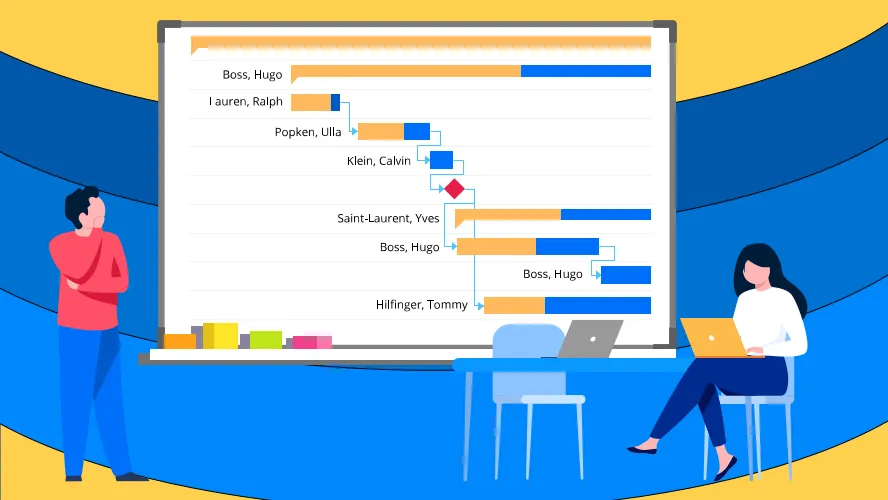
- Gantt chart: A bar chart that visualizes the duration and sequence of tasks.
- Critical path: Identifies the longest sequence of tasks that affects the project.
- Network diagram technique: Represents dependencies between individual tasks.
When scheduling, you should build in buffer times to absorb delays. Unexpected problems are part of almost every project — good scheduling accounts for this from the outset. Our article on scheduling methods provides an overview of all common approaches.
4. Resource planning — Who or what is needed?
No project can be carried out without the right resources. These include:
- Staff — Who takes on which tasks?
- Materials and tools — What working materials are required?
- Time — How long does each work step take to complete?
Realistic resource planning (capacity planning) prevents overloads and bottlenecks. It is particularly important to check the availability of team members early to avoid delays.
5. Cost planning — How does the project stay within budget?
Every project incurs project costs — whether for personnel, materials, or external services. Solid cost planning helps avoid unexpected overspending.
The most important cost estimation techniques:
- Bottom-up method — The costs of each individual work package are estimated and summed.
- Top-down method — An overall budget is established based on previous projects.
- Estimation methods such as the three-point method — Optimistic, realistic, and pessimistic scenarios are combined (cf. effort estimation).
It is important that regular cost monitoring takes place during the project to detect budget overruns early.
With these detailed planning steps you have the knowledge needed to create a well-structured project plan. In the next section we will look at how to avoid typical mistakes in project planning.
Typical Mistakes in Project Planning and How to Avoid Them
Even with solid planning, projects can fail if certain common mistakes are not recognized and avoided in time. Many of these pitfalls are preventable if you are aware of them and take appropriate countermeasures from the outset.
Here are the most common mistakes — and proven strategies for avoiding them:
1. Unclear or Unrealistic Goals
One of the biggest mistakes is setting unclear or unachievable goals. When expectations are not precisely defined, misunderstandings arise and the project loses focus.
Prevention:
- Formulate goals using the SMART method (specific, measurable, achievable, relevant, time-bound).
- Clarify requirements with all stakeholders early on.
- Check regularly whether goals are still realistic or need to be adjusted.
2. Poor Scheduling and Missing Buffer Times
Tasks are often underestimated or important intermediate steps are overlooked. This results in deadlines being missed and the entire project falling behind schedule.
Prevention:
- Use Gantt charts or network diagrams to make dependencies visible.
- Plan buffer times for unexpected delays from the very beginning.
- Set realistic deadlines and take into account experience from similar projects.
3. Inadequate Resource Planning
Many projects fail because insufficient resources (personnel, budget, materials) were planned for. This leads to bottlenecks and delays.
Prevention:
- Determine the exact resource requirements early on.
- Pay attention to the availability of team members and avoid overloading them.
- Use project management software to manage resource capacities.
4. Missing or Inadequate Communication
Poor communication within the team or with stakeholders can lead to misunderstandings and conflicts. Clear responsibilities or regular check-ins are often lacking.
Prevention:
- Establish a clear communication structure (e.g., regular status meetings, recurring meetings, or updates in a project management tool).
- Define a central point of contact for questions and decisions.
- Use clear and comprehensible documentation for all project participants — project documentation should be planned from the start.
5. Missing Risk Management
Many projects do not account for potential risks — and are then caught off guard when unforeseen problems arise.
Prevention:
- Identify risks early and develop contingency plans.
- Monitor project progress regularly to detect risks in good time.
- Stay flexible enough to respond to changes.
6. No Regular Monitoring and Control
A project does not run itself. If progress is not monitored regularly, problems remain undetected for a long time.
Prevention:
- Hold regular status meetings.
- Use Key Performance Indicators (KPIs) to measure success.
- Adjust the plan dynamically when required.
By avoiding these mistakes, you increase the likelihood that your project stays within time and budget and is completed successfully.
In the next section we will show you which methods and tools you can use for optimal project planning. Regarding tools, we focus on those that — in addition to project planning — also enable good project control and solid project monitoring.
Which Methods and Tools Make Project Planning Easier?
Thoughtful project planning is the key to success — but without the right methods and tools it can quickly become complicated and confusing. Which methods are right for your project? And which digital tools can you use to stay on top of things? In this section we present proven project management methods and show you helpful software solutions for efficient planning.
Project Management Methods: What Approaches Are There?
Depending on the type and scope of a project, different planning methods exist. The choice of the right method depends on the requirements, the team structure, and the flexibility of the project.
1. Classic Waterfall Method — Step by Step Toward the Goal
The waterfall model is one of the oldest and most widely used project management methods. The project is divided into linear phases that are worked through sequentially.
Advantages:
- Clear structure with defined workflows
- Well suited for projects with stable requirements
Disadvantages:
- Little flexibility in the face of unexpected changes
- Problems are often identified only late in the process
Ideal for: Construction projects, software development with fixed specifications, production projects
2. Agile Methods — Flexibility and Adaptability
Agile project management with methods such as Scrum or Kanban relies on iterative processes with short development cycles (Sprints). The project is continuously adjusted and improved.
Advantages:
- High flexibility and fast response capability
- Close collaboration with the team and stakeholders
Disadvantages:
- Requires good coordination and regular meetings
- Not ideal for projects with fixed specifications
Ideal for: Software development, marketing campaigns, creative projects
3. PRINCE2 — Structured Project Management with Defined Roles
PRINCE2 (Projects in Controlled Environments) is a process-oriented method that places strong emphasis on a clear division of roles. Every project is divided into phases and controlled through regular reports.
Advantages:
- High transparency and clear responsibilities
- Detailed documentation for later optimization
Disadvantages:
- Relatively bureaucratic and time-consuming
- Less flexible than agile methods
Ideal for: Large corporate projects, government projects, regulated industries
Useful Project Management Tools — Which Software Helps with Planning?
In addition to methods, there are a large number of project management tools and ticketing systems that greatly simplify the planning, control, and monitoring of projects. Here are some of the best solutions:
1. Allegra — For Classic, Agile, and Hybrid Project Management
Allegra is suitable for all types of project management. It offers Gantt charts, Scrum boards, backlogs, and Sprint planning.
Ideal for: Hybrid teams, software development, all types of projects
Cost: Paid from the base version
2. Trello — Simple Kanban Board for Small Teams
Trello is a visual project management tool that works on the Kanban principle. Tasks are organized in lists and cards and can easily be moved via drag and drop.
Ideal for: Small teams, start-ups, simple task distribution
Cost: Base version free, premium features paid
3. Asana — Structured Task Management for Teams
Asana combines list, board, and calendar views for detailed project management. It allows task assignments, deadlines, and priorities.
Ideal for: Mid-sized teams, marketing projects, product development
Cost: Base version free, premium features paid
4. Microsoft Project — Professional Solution for Large Projects
Microsoft Project is one of the most powerful tools for complex projects with many dependencies. It enables detailed Gantt charts, resource management, and budget control.
Ideal for: Large enterprises, construction and IT projects
Cost: Paid, license model
5. Jira — The Best Solution for Agile Teams
Jira was developed specifically for agile project management and is widely used in software development. It offers Scrum boards, backlogs, and Sprint planning.
Ideal for: Agile teams, software development, IT projects
Cost: Paid from the base version
Conclusion: Which Method and Tool Fits Your Project?
Need a simple solution for a small team? → Trello or Asana
Do you have a large project with many resources? → Microsoft Project or PRINCE2
Are you working agile and need flexibility? → Scrum, Kanban, or Jira
The right choice of method and tool plays a decisive role in the success of your project planning. In the next section we will show how you can monitor and control the progress of your project to reach your goal efficiently.
How Do You Stay in Control of Project Progress?
A well-planned project start is important, but equally critical is the ongoing monitoring of progress. Without regular checks, a project can quickly go off course — deadlines get missed or resources are used inefficiently.
But how do you stay on top of things? Here are the best methods to ensure your project stays on track.
1. Regular Status Meetings — Communication as the Key
One of the most important measures for monitoring progress is holding regular project meetings. They enable exchange between team members and help identify problems early.
Proven meeting formats:
Daily stand-up meeting (e.g., in agile teams using Scrum): Brief updates (max. 15 minutes) in which each team member answers three questions:
- What have I completed since the last meeting?
- What am I working on right now?
- Are there any obstacles or problems?
Weekly status meetings: Detailed discussion of project progress, analysis of bottlenecks, and decisions on the next phase.
Monthly management updates: Reports for stakeholders or clients to inform them about overall progress and any plan changes.
2. Project KPIs — Objective Measurement of Success
In addition to meetings, measurable indicators (Key Performance Indicators, KPIs) should be used to assess progress objectively.
Important KPIs for project monitoring:
- Schedule adherence: Is the project within the planned timeframe? Are milestones being reached?
- Budget control: Are costs still within range? Are there unexpected expenditures?
- Work progress: How many tasks have been completed? How many are behind schedule?
- Resource utilization: Are personnel, materials, and budget being deployed efficiently?
- Risk development: What potential problems have emerged, and how were they resolved?
Tools such as Microsoft Project, Asana, or Jira enable automatic tracking of KPIs and simplify data analysis.
3. Visualizing Progress with Gantt Charts and Burndown Charts
Visual representations help you maintain an overview and identify bottlenecks early.
Gantt charts are particularly well suited for classic project planning. They show dependencies between tasks, the timeline, and the current status.
Burndown charts are ideal for agile projects, as they visualize how many tasks remain to be completed and how quickly the team is progressing.
Regular review of these diagrams helps you make timely adjustments.
4. Change Management — Responding Flexibly to Problems
No project runs exactly to plan — delays, new requirements, or unforeseen problems are normal. What matters is how you handle changes.
- Detect early: Regular analyses help identify deviations quickly.
- Document adjustments: Changes should be incorporated into the project plan to avoid later misunderstandings.
- Inform stakeholders: Affected team members, clients, or sponsors should be notified of plan changes in good time.
- Adjust priorities: If necessary, resources must be redistributed or deadlines reassessed.
Well-defined change management ensures that adjustments are implemented in a controlled and targeted way without jeopardizing the entire project.
5. Minimizing Risks and Solving Problems
Every project carries risks — technical challenges, staff shortages, or unexpected costs. But how can these risks be managed?
Strategies for risk minimization:
- Risk management plan: Identify potential risks in advance and create contingency strategies.
- Use early-warning systems: Track KPIs so you can respond immediately to deviations.
- Maintain flexibility: If necessary, project goals must be adjusted or resources redistributed.
- Solve problems as a team: A strong team can often overcome challenges more quickly together.
Project Monitoring Secures Success
The best planning is of little use if progress is not checked regularly. Through clear communication, measurable KPIs, and flexible adjustments your project stays on course and can be guided efficiently to its goal.
Finally
Whether a small internal project or a large corporate initiative — good project planning is the key to success. It helps make optimal use of resources, minimize risks, and maintain an overview.
By using the methods, planning steps, and control mechanisms presented here, you create a solid foundation for structured, efficient, and successful projects.
Now it is up to you: Approach your next project with a clear strategy — and lead it successfully to its goal!
Frequently Asked Questions
What is project planning?
Project planning is the structured process of defining goals, tasks, resources, and timeframes in order to carry out a project efficiently and ensure its success.
What steps does project planning involve?
Project planning encompasses goal setting, task and milestone planning, resource and time management, risk analysis, as well as communication and documentation strategies.
Why is good project planning important?
Good project planning provides clear structures, prevents misunderstandings, saves time and costs, and minimizes risks — so that a project can be completed on time and successfully.
Which tools help with project planning?
Project management tools such as Allegra, Asana, Jira, Microsoft Project, and Monday.com help organize tasks, manage resources, and monitor project progress.
How can you avoid common mistakes in project planning?
Common mistakes can be avoided through clear goal definition, realistic scheduling, early risk assessment, regular communication, and the use of suitable planning tools.

Senior Advisor
Jörg Friedrich is the original author of the project management software Allegra and continues to accompany its development to this day. He has many years of industry experience as a project and department manager. He also serves as a professor in the Faculty of Computer Science and Information Technology at Esslingen University of Applied Sciences.