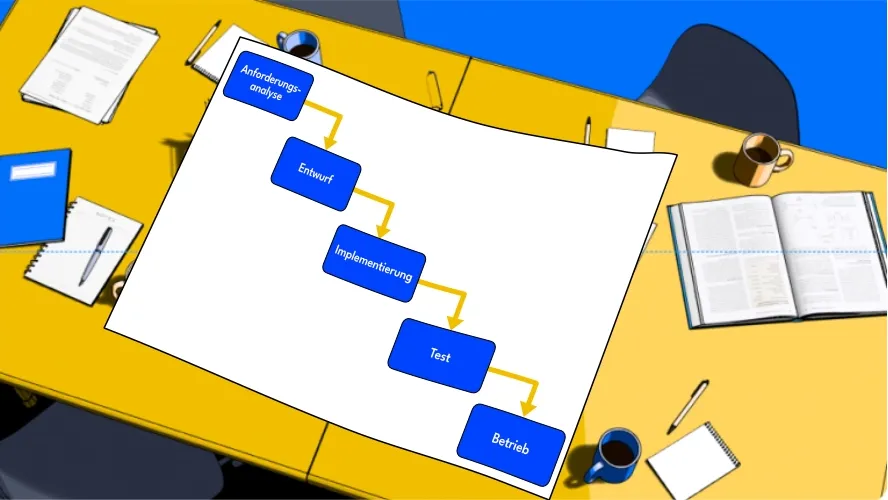
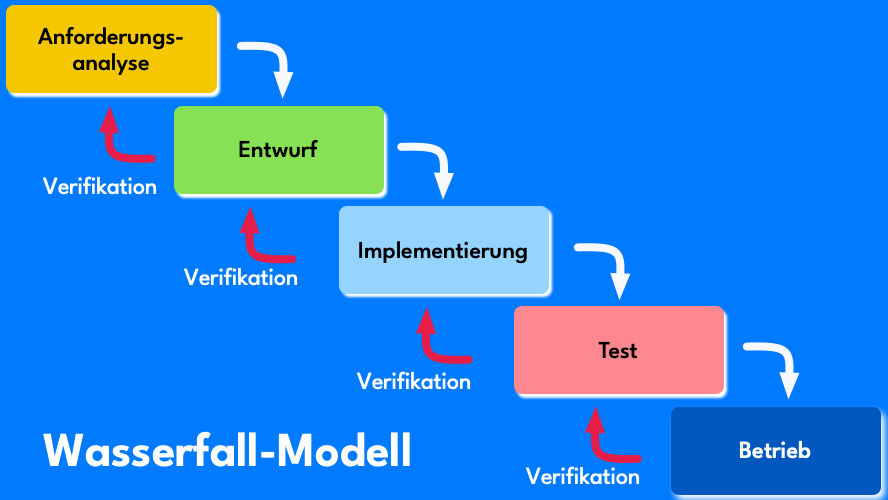
The waterfall model divides a project into clear, manageable phases. It follows the principle that each phase — from initial planning through design, implementation, and testing to maintenance — must be completed before moving on to the next. The sequence of phases is linear, meaning there are no feedback loops.
The waterfall model is used primarily for large-scale projects, in regulated industries, and in projects where an iterative-agile approach would be difficult or not permitted.
What Is the Waterfall Model in Project Management?
The waterfall model is an approach to classic, linear project management characterized by its clear structure and sequential workflow. This project management method offers a transparent, step-by-step approach for guiding projects from the initial idea through to final completion. It is supported by nearly all project management tools for classic project management, such as Allegra Project.
The model emerged in the 1970s to make complex projects manageable by dividing them into clear, well-defined phases. Originally used in software development, it soon spread to other sectors such as mechanical engineering and construction. It is often also referred to as “traditional project management”, “classic project management”, or a “project process model”.
A key principle of this process model stems from the experience that changes become more expensive the later they are introduced. For this reason, significant effort is invested in the early phases of a project, so that as few changes as possible need to be handled in the later project management phases.
When Is the Waterfall Model Appropriate?
The waterfall model competes with other process models such as the spiral model and agile approaches. It can serve as the foundation for process models such as the V-Model and PRINCE2. When should you consider it for your projects? The following sections explain the most important criteria that suggest using this process model and allow its advantages to shine.
-
Complete and stable requirements
Imagine you were a bridge builder. Before beginning construction, you would certainly want to have all the important requirements clarified with your client upfront. For example, you would not want to find out the required load capacity of the bridge just before completion. In German-speaking countries, the client’s requirements are documented in a requirements specification. The performance characteristics the contractor commits to delivering become part of the project documentation in a functional specification.If you can — or must — determine all essential requirements early on, the waterfall model provides a reliable framework. It calls for capturing all functions and quality criteria from the outset, minimizing the risk of unexpected changes and keeping the project on a predictable course.
-
Projects with fixed budgets and schedules
If you have announced the launch of a new product at a trade fair, you absolutely must meet that deadline. You cannot present a half-finished product.For projects with non-negotiable budget and time constraints, you benefit from the clear structure of the waterfall model. You can calculate each project segment precisely and plan costs and time requirements with accuracy. This is especially helpful when you need to convince investors or clients of the financial viability of your project. Detailed project planning helps you minimize risks and avoid financial surprises.
- Regulated industries and standard processes
In regulated industries such as medical technology or aviation, comprehensive documentation and traceability are essential. The waterfall model allows you to document every step without gaps, meeting the often stringent regulatory requirements. Especially in safety-critical areas, a structured approach is indispensable. Through detailed planning and continuous monitoring, you ensure that all standards and norms are met.
How Do Agile Approaches Differ from the Waterfall Model?
A key premise of agile project management is the assumption that it is cheaper to build a prototype than to think through requirements and design thoroughly in advance. In some industries, this is indeed the case (see also “Agile vs Waterfall”).
So what distinguishes the waterfall model from other process models? The key differences are:
-
Clear structure vs. flexibility:
In the waterfall model, you create a comprehensive plan and documentation at the outset that defines the entire course of the project. Agile and iterative models, by contrast, allow for continuous adjustments through short cycles (Sprints) and regular feedback loops. -
Fixed requirements vs. openness to change:
In a waterfall project, the requirements — and therefore the project scope — are clearly defined from the start. Changes during the project are rare and often come at significant cost. Other approaches, such as Scrum or Kanban, allow you to respond flexibly to new insights and client requests. -
Transparency and predictability vs. dynamism:
The strict documentation and sequential approach of the waterfall model give you a complete overview from the very beginning. This is especially advantageous in projects that demand stability and clear milestones. Agile models, by contrast, rely on iterative improvements that make the project more dynamic but also require a greater willingness to adapt.
These differences make the waterfall model the ideal choice when requirements are stable and detailed planning along with comprehensive documentation is required. If, on the other hand, you work in an environment where flexibility and rapid responses to change are called for, agile or hybrid models are a better fit.
What Are the Advantages of the Waterfall Model?
The waterfall model offers you a clear, structured approach for projects where stability and precise planning are paramount. From the outset, you know what you are committing to, because all requirements are captured in detail and documented in a fixed plan. This predictability makes it possible to identify risks early and steer the project in a controlled manner.
-
Clear planning and transparent milestones
With the waterfall model, you begin every project with comprehensive planning. Each phase — from requirements analysis through design to implementation and testing — is completed separately before you move on to the next. This method ensures clear milestones and allows you to check progress precisely at any time. -
Stability and documentation
The rigor of the waterfall model is evident in the detailed documentation of every project phase. This meticulous approach ensures that all stakeholders share the same level of information and that decisions remain traceable. It minimizes room for unforeseen adjustments and supports quality assurance. Especially in industries with high safety standards, such as medical technology or aviation, this comprehensive documentation is a decisive advantage. -
Advantages compared to agile approaches
While agile models impress with their flexibility and short feedback cycles, the waterfall model offers stability and predictability. It is particularly well-suited when requirements are clearly defined from the start and there is little room for changes. This reduces administrative overhead and allows you to focus on executing the planned steps. If you manage projects where precision and strict sequencing matter more than short-term adjustments, the waterfall model is the right choice.
| Advantages | Disadvantages |
|---|---|
| Stable requirements for better planability | High effort for requirements analysis |
| Reliable planning and transparent milestones | Little room for error |
| High adherence to budget and schedule | Little flexibility when changes arise |
| Comprehensive documentation for better traceability |
Overall, the waterfall model provides a solid foundation for executing projects in a targeted and controlled manner. It is the method of choice when you value precise planning, comprehensive documentation, and clear handoff points. These advantages make the waterfall model a reliable strategy — ideal when stability and transparency take precedence over flexibility.
What Are the Disadvantages and Limitations of the Waterfall Method?
The strengths of the waterfall method are, unfortunately, also the source of its weaknesses. The rigid structure can cause problems in dynamic project environments when requirements change during the course of the project. It is therefore important to be aware of its limitations and, where necessary, to incorporate more flexible elements.
-
Inflexibility when changes arise
One of the most common criticisms of the waterfall model is its limited flexibility. Once a phase is complete, it is difficult to introduce changes without revising the entire project plan. This can lead to delays when new insights or requirements emerge late in the process. To counteract this, it is advisable to be especially thorough during requirements analysis and to account for all potential variables. In some cases, hybrid approaches that integrate agile elements can provide a remedy. -
High documentation effort
The comprehensive documentation the waterfall model requires can feel burdensome. It demands significant time and care to capture every phase without gaps. This can create additional administrative overhead, especially in smaller projects. Nevertheless, this attention to detail is also a major advantage, as it increases transparency and makes later adjustments easier. Best practices show that standardized documentation templates and regular reviews can help reduce this effort. -
Risk of faulty planning
Another potential problem is initial faulty planning. If requirements are captured incompletely or inaccurately, this has a negative impact on all subsequent phases. Errors arising in the requirements analysis can propagate throughout the entire project. It is therefore critical to invest sufficient time and resources in the first phase. Real-world examples confirm that projects that fail at the requirements analysis stage frequently encounter significant problems in later phases. Close collaboration with all stakeholders and regular validation of requirements are key to success here. -
Integrating agile elements as a solution
To overcome the rigid character of the waterfall model, many experts turn to hybrid models. These combine the structured flow of the waterfall model with the flexible elements of agile methods. For example, you can build in regular feedback loops to respond to changed requirements without jeopardizing the entire plan. This approach allows you to get the best of both worlds while preserving the advantages of each.
The challenges of the waterfall model call for a conscious approach to planning and documentation. By identifying potential stumbling blocks early and mitigating them through targeted measures, you can ensure the efficiency and quality of your project. Stay flexible and open to improvements, even though the core idea of the waterfall model rests on a fixed structure. That way you can master the typical pitfalls and apply the method successfully, regardless of the complexity of your project.
What Phases Does the Waterfall Model Have?
The waterfall model is organized into a series of successive phases, each covering specific tasks and objectives. Each phase is closely linked to the one before it, ensuring continuous progress. The method is especially well-suited to projects where requirements change little over time. You can rely on each stage being executed precisely and the overall result being transparently documented. Which phases are used in a given project depends on factors such as industry, project type, standardization requirements, and company culture. Below, we describe the approach using the widely adopted 5-phase model:
-
Requirements analysis
In this first phase, you capture all the requirements of the project. The goal is to gain a comprehensive understanding of the expectations and needs of all stakeholders. You create detailed specifications in a requirements specification, functional specification, and solution concept, which serve as the foundation for the subsequent project phases. The meticulous documentation in this phase minimizes the risk of misunderstandings and establishes a clear basis on which all subsequent steps are built. -
Design
Based on the defined requirements, you develop the system architecture and technical concept in the design phase. This involves creating both the high-level architecture and the detailed plans for implementation. This phase covers the planning of components, interfaces, and data flows. A well-thought-out design also forms the basis for the work breakdown structure (WBS), establishing the roadmap and making later implementation easier since all key aspects have already been considered. -
Implementation
The implementation phase often begins with a kick-off meeting and is the practical part where the developed plans are put into action. Programmers and developers write the source code while the various components are integrated simultaneously. Care is taken to ensure that the implementation follows the previously defined requirements and design guidelines exactly. Clean, well-documented implementation is critical to making later maintenance and further development easier. -
Testing
In the testing step, you systematically verify whether the implemented system meets the requirements. Various types of tests are carried out — from unit tests and integration tests to system tests and acceptance tests. The goal is to identify and resolve errors and inconsistencies early. Thorough testing ensures that the system works reliably and meets all quality standards before it goes into live operation. -
Operations
After successful testing, the transition to the operational state takes place. In this phase, the system is put into production and handed over to end users. Operations encompass not only the use of the system but also its continuous monitoring and maintenance. Regular updates and support measures ensure long-term success and help respond appropriately to changing requirements or emerging issues.
These five phases — from requirements analysis through operations — form a clearly structured, sequential process. They ensure that every project system is precisely planned, implemented, and maintained. The result is a high degree of transparency, stability, and quality that makes the waterfall model a proven approach in project management.
Integrating Advanced Aspects
Even though the waterfall model is based on a classic, linear approach, there are advanced aspects you can incorporate into your implementation. For example, you can integrate hybrid methods that weave agile elements into the classic workflow. This allows you to respond flexibly to changes without losing the structured framework of the waterfall model. Such hybrid approaches combine the best of both worlds: you benefit from the predictability of the waterfall model while also gaining the flexibility of agile methods.
Another advanced aspect is the integration of modern technologies and tools. For example, adopting Continuous Integration (CI) and Continuous Deployment (CD) can accelerate the development cycle and enable automated testing and releases. These technologies are standard in many modern software projects and can also be used within the classic waterfall model to increase efficiency and ensure quality.
Who Benefits from the Waterfall Model?
The waterfall model provides clear structures that both newcomers and experienced project managers appreciate. It is aimed at anyone who values planning, oversight, and reliable processes. You benefit from the linear approach, which gives you precise control over every project phase. Different target groups benefit in different ways:
Project managers and team leads
For you as a project manager, the model provides a solid foundation for breaking complex projects down into manageable units. Through precise documentation of every phase, you always maintain an overview and can control the progress of your project exactly. This allows you to plan resources efficiently and identify risks early. The transparent structure also fosters trust and clarity in your communication with stakeholders.
Developers and technical experts
Developers also appreciate the structured approach of the waterfall model. Clear specifications and detailed requirements help you work precisely and focus on implementation. This avoids misunderstandings and lets you concentrate fully on the code and integration. In projects where changes are rare, this approach is particularly effective.
Specialist departments and clients
Specialist departments benefit from the traceable documentation and fixed milestones that provide security. Clients and end users receive a clear overview of the project’s progress from the very beginning. This strengthens confidence in the development process and makes it possible to align requirements early on. A practical example: a company introducing a new customer management system was able, through the waterfall model, to optimize the communication flow between IT and sales — ultimately delivering a product that precisely met their needs.
These target groups show that the waterfall model is not only beneficial for technical experts, but for all other parties involved as well. It ensures that every step of the project proceeds transparently and traceably. Proven best practices are applied to help you secure the success of your project. The structured approach gives you a clear division of roles, precise budget planning, and effective risk minimization.
How Will the Waterfall Model Develop in the Future?
Even though agile methods have grown significantly in importance in recent years, the waterfall model remains relevant in many areas. The future of the classic approach shows that further developments and hybrid models are leading the way. Below, you will find out which trends and innovations are shaping the waterfall model and how you can benefit from them.
Integration of Agile Elements
The boundaries between traditional and agile project management are increasingly blurring. In the future, you will observe hybrid models growing in importance. These combine the structured flow of the waterfall model with the flexibility of agile methods. For example, you can link fixed phases with regular feedback loops to respond more quickly to changing requirements. A real-world example is an IT project in which short iterations were scheduled after each phase to gather client feedback and continuously improve the final product. This approach makes it possible to retain the proven structural concept of the waterfall model while also integrating agile responsiveness.
Technological Innovations and Automation
Technological advances are revolutionizing project management. Modern tools and automation solutions make it significantly easier to execute and monitor projects. Continuous Integration (CI) and Continuous Deployment (CD) are now standard in many development projects. These technologies allow you to track progress in real time and continuously ensure quality. Automated tests and advanced analytics tools help identify errors early and address them promptly. In the future, increasing digitalization will further optimize these processes, allowing you to manage projects even more efficiently and transparently.
Further Development of Classical Methods
The traditional waterfall model itself is also undergoing continuous development. Experts are working to adapt the method to the changing demands of the modern working world, with aspects such as flexibility, efficiency, and user-centricity receiving ever greater attention. The combination of thorough planning and dynamic adaptability makes the model attractive across many industries going forward.
Looking ahead, it is clear that in regulated industries in particular — such as medical technology, aviation, or public administration — the structured approach of the waterfall model will continue to be of great importance. Where traceability and comprehensive documentation are critical, the model continues to offer an invaluable advantage. At the same time, the integration of agile elements opens new perspectives for remaining flexible even in rapidly changing markets.
Expert Forecasts and Market Developments
Industry experts agree: the waterfall model will continue to play a key role in project management in the years to come. It will be understood less as a rigid rulebook and more as a flexible framework that can be adapted to different project types. Studies and market analyses indicate that companies are increasingly turning to hybrid approaches to combine the advantages of both worlds. This makes it possible to connect the proven structure of the waterfall model with the dynamic, iterative processes of agile methods.
In practice, this means that as a project manager you should increasingly pay attention to how you can meaningfully combine classic and modern approaches. By making targeted use of technology and continuously refining your methods, you secure not only the efficiency of your project but also its capacity for innovation.
Further Resources
-
Institute of Project Management
https://instituteprojectmanagement.com/blog/waterfall-methodology
An article by the Institute of Project Management examining classic process models. -
A Brief History of the Waterfall Model: Past, Present, and Future
https://arxiv.org/pdf/2510.03894 -
ProjectManager – Waterfall Methodology
https://www.projectmanager.com/guides/waterfall-methodology
A comparative article explaining the differences between traditional and agile process models.
Frequently Asked Questions
What is the waterfall model?
The waterfall model is a linear and sequential process model in software development in which each phase (e.g., analysis, design, implementation) must be fully completed before the next one begins.
When is the waterfall model used?
The waterfall model is used when the requirements of a project are clearly defined and stable from the outset. It is especially well-suited to projects with little need for change or in regulated industries such as healthcare.
What are the main phases of the waterfall model?
The main phases of the waterfall model are: requirements analysis, system design, implementation, integration and testing, deployment, and maintenance. Each phase has clear objectives and deliverables.
What are the advantages of the waterfall model?
The waterfall model offers a clear structure, easy traceability, and comprehensive documentation. It is ideal for projects where requirements are stable and strict control mechanisms are necessary.
What are the disadvantages of the waterfall model?
One disadvantage of the waterfall model is its limited flexibility. Changes in later phases are often difficult to implement and costly. It can also be difficult to identify errors early, since testing is only carried out late in the process.

CEO Alltena GmbH
Christoph Friedrich is a computer scientist and certified Project Management Professional. He has extensive experience in the introduction and integration of project management tools as well as the analysis and definition of processes in project and service management.