What Is a Milestone?
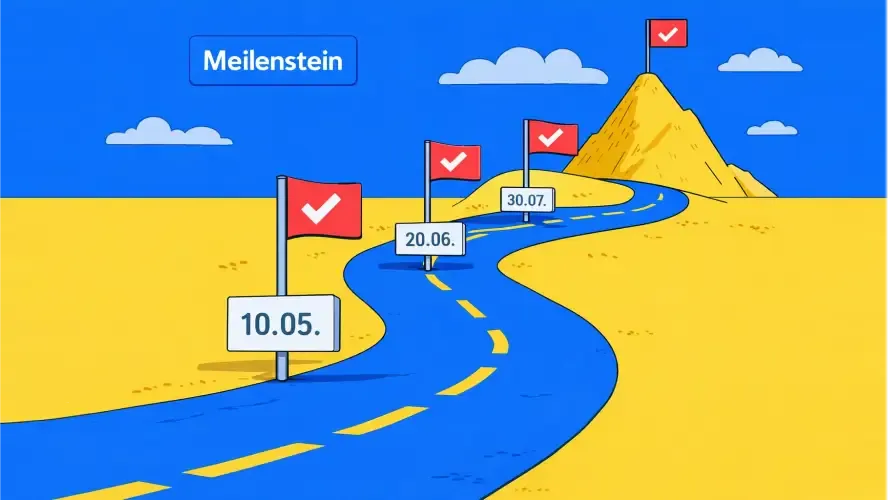
The ancient Romans placed stones along their roads — one after every mile. These stones were more than waymarkers. They told the traveler: you have made progress. You are on the right path. And the next destination lies just ahead.
In project management, a milestone is exactly that: an important point in the project timeline at which a specific intermediate goal should have been reached. It does not mark the work itself, but its result. Not the journey, but the arrival.
A milestone has no duration. It is not a task, an activity, or a work package. It is a checkpoint — a moment to pause and ask: have we achieved what we set out to do?
Most often, a milestone stands at the end of a project phase or marks an important intermediate result. Sometimes it stands at the beginning — at a point where a decision is made that determines the direction of what follows.
Date Milestone and Result Milestone
Not every milestone is the same. There are two variants that commonly appear in practice:
A date milestone is tied to a fixed date. It ensures that certain stages are completed within a given timeframe — such as a delivery date or a contractually agreed deadline.
A result milestone, on the other hand, defines a goal, not a date. It is about what should have been achieved — regardless of exactly when that happens. On a crossing of the Alps, the result milestone would not be next Saturday, but the crossing of the pass itself.
In practice, these boundaries often blur. The best milestones combine both: a concrete result at a planned point in time.
What Are Milestones Used For?
Milestones fulfill several purposes in a project simultaneously. They are something like the joints of a skeleton — without them, the whole lacks structure.
- Structuring the project timeline: Milestones divide a project into auditable sections. Each section has a clear end.
- Go/No-Go decisions: At milestones, decisions are made about whether and how to proceed. Should the project continue? Does the plan need to be revised?
- Quality assurance: Before the next phase begins, it is verified whether the results so far meet the requirements.
- Communication: Milestones create a shared language. They show all stakeholders — from the team to the client — where the project stands.
- Project controlling: By monitoring milestones, overall progress can be assessed without having to know every individual work package in detail.
Milestones appear in Gantt charts, network diagrams, and milestone lists. They are an integral part of every professional project plan.
Benefits of Milestones
Why is it worth setting milestones? Because they give the project something that is otherwise easily lost: orientation.
They provide structure. A project without milestones is like a journey without stops along the way. You travel and travel, but never quite know how far you have come. Milestones break the long road into manageable stages.
They motivate. There are few things more satisfying than reaching an intermediate goal. Milestones make progress tangible and give the team reason to take pride in what has been accomplished.
They create accountability. A milestone is a commitment: by this point, this result should be in place. That creates clarity and responsibility.
They safeguard quality. At each milestone, it is checked: is the result correct? Does it meet the requirements? This way, errors are caught early — not just at the end.
They facilitate communication. Milestones are ideal anchor points for status reports and steering committee presentations. They make the project’s progress understandable even to outsiders.
Disadvantages and Pitfalls
Milestones are powerful tools. But like any tool, they can be misused.
Too many milestones dilute their significance. If every small task is concluded with a milestone, the truly important checkpoints lose their impact. A milestone should mark a genuine achievement — not everyday business.
Milestones as pressure tactics are problematic. Sometimes deadlines are deliberately set earlier to put pressure on the team. This rarely leads to better results — more often to frustration and a drop in quality.
Vague formulations make milestones worthless. If it is not clear exactly what should have been achieved, no one can verify whether the milestone has been reached. More on this in a moment.
The golden rule: set as many milestones as necessary, but as few as possible. Each one should earn its name.
Formulating Milestones Correctly
This is where practice separates the strong from the weak. Many milestones sound good but say little. A well-formulated milestone names an event and a state — and can be demonstrated through a concrete piece of evidence.
What to Avoid
| Formulation | Problem |
|---|---|
| Kick-off meeting | Planned? Started? Completed? |
| Design drawing | Created? Reviewed? Approved? |
| Erect roof structure | This is an activity, not a checkpoint. |
Better Formulations
| Milestone | Evidence |
|---|---|
| Kick-off meeting has been held | Minutes are on file |
| Design completed | Design drawing approved |
| Roof structure has been erected | Architect’s acceptance report |
| Procurement process completed | Purchase confirmations on file |
| Project is completed | Final report has been created |
Three control questions help with formulation:
- What exactly should have been achieved? — The milestone must describe a concrete result.
- Can the achievement be evidenced? — There should be a verifiable proof (document, minutes, sign-off).
- Is it really a checkpoint? — A milestone has no duration. If you are describing an activity, it is not a milestone.
How Many Milestones Does a Project Need?
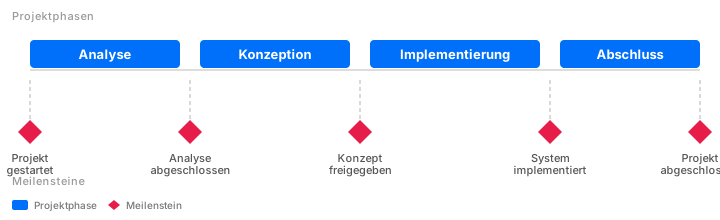
A good rule of thumb: at least one more milestone than there are project phases. One for the project start and one for the end of each phase.
Within phases, additional milestones can be useful — for example, for important intermediate results, approvals, or external dependencies. The more detailed the planning becomes, the more checkpoints crystallize.
An example: an IT project with four phases (analysis, conception, implementation, closure) might have the following milestones:
- Project started
- Analysis completed
- Concept finalized and approved
- System successfully implemented
- Project closure report on file
Intermediate milestones such as “requirements specification agreed” or “tests successfully completed” can be added as needed. This creates a framework that provides enough structure without overwhelming the project.
Representing Milestones
Milestones can be visualized in various ways. The choice depends on who is using the representation and the level of detail required.
In a Gantt Chart
The Gantt chart is the most widespread form of project visualization. Milestones appear in it as diamonds or triangles on the timeline — as point-in-time markers between the bars of the work packages. At a glance, they show when important results are expected to be available.
In a Network Diagram
A network diagram represents the logical dependencies between activities. Milestones appear here as nodes without duration. They make visible where paths intersect and which results are prerequisites for subsequent work.
In a Milestone Network Diagram
The milestone network diagram shows only the milestones and their dependencies — without the details of individual work packages. It is ideal as an overview for clients and senior leadership, and is often the first planning step in a new project.
Milestone Trend Analysis
Setting milestones is one thing. Observing their development over time is another. That is precisely what milestone trend analysis (MTA) does.
The principle is simple: at regular intervals, it is assessed for each milestone when it is expected to be reached. These estimates are plotted in a diagram. Over time, a trend line emerges for each milestone:
- Horizontal line: The date is being held. Everything is on track.
- Rising line: Delay. The milestone is moving further into the future.
- Falling line: Early completion.
The MTA is one of the most effective and at the same time simplest instruments of project controlling. We explain it in detail in our article on milestone trend analysis. How to systematically integrate milestones into your project planning is covered in the article on milestone planning.
Examples of Milestones
Theory is good, but examples are better. Here are typical milestones from various types of projects:
IT Project: Introducing a CRM System
| Phase | Milestone | Evidence |
|---|---|---|
| Analysis | Requirements analysis completed | Requirements specification on file |
| Conception | System architecture approved | Approval report |
| Implementation | CRM system configured | Test environment available |
| Testing | Acceptance test passed | Test report with no critical errors |
| Rollout | System live in production | Go-live confirmed |
Construction Project: New Office Building
| Phase | Milestone | Evidence |
|---|---|---|
| Planning | Building permit granted | Permit notice |
| Shell construction | Shell construction completed | Sign-off by structural engineer |
| Interior fit-out | Interior fit-out completed | Construction acceptance report |
| Handover | Key handover completed | Handover report |
Product Development: New Software Version
| Phase | Milestone | Evidence |
|---|---|---|
| Conception | Feature specification agreed | Signed document |
| Development | Feature freeze reached | No open feature branches |
| Quality assurance | Release candidate approved | QA report with no blockers |
| Launch | Version published | Availability in production system |
Frequently Asked Questions
What is a milestone in project management?
A milestone is an important checkpoint in the project timeline at which a specific intermediate goal should have been reached. It has no duration — it marks a state, not an activity. Milestones structure the project and make progress measurable.
What is the difference between a milestone and a task?
A task is an activity that is carried out over a period of time. A milestone marks a specific point in time at which a result should be in place. “Conduct final test” is a task. “Final test passed” is a milestone.
How do I formulate a milestone correctly?
A good milestone names an event and a state in the format “noun + verb,” for example “concept approved” or “test completed.” Ask yourself: is the result concrete? Can it be evidenced? Does the milestone have no duration?
How many milestones should a project have?
At least one more than there are project phases. One for the start and one for the end of each phase. Within phases, additional intermediate milestones can be added as needed. The key point: not every task needs a milestone.
What is a milestone trend analysis?
Milestone trend analysis (MTA) is a method for monitoring deadlines. At regular intervals, it is estimated when each milestone will be reached. The results are displayed as trend lines in a diagram, so that delays can be identified early.

Senior Advisor
Jörg Friedrich is the original author of the project management software Allegra and continues to accompany its development to this day. He has many years of industry experience as a project and department manager. He also serves as a professor in the Faculty of Computer Science and Information Technology at Esslingen University of Applied Sciences.