What is project control?
Project control refers to all activities aimed at keeping the actual values of a project — schedule, costs, scope — as close as possible to the planned values within the defined tolerances. It is the central responsibility of project management during project execution.
According to DIN 69901-2, project control is one of the fundamentals of project management alongside project planning, administration, and closure. It steers processes so that defined project goals are actually achieved.
A vivid analogy: project control works like the steering wheel of a ship. The project plan is the nautical chart, project controlling is the compass — and project control brings the ship back on course when wind and currents push it off track. Merely observing is not enough. Steering means acting.
Historically, the concept dates back to the 1960s. In Germany, the term became widely known in 1977 through the Fee Schedule for Architects and Engineers (HOAI), which formally described the service profile of project control for the first time. Internationally, standards such as the PMBOK Guide, PRINCE2, and the IPMA’s ICB have further formalized the concept — each with slightly different emphasis, but the same core: planning, monitoring, and controlling form the classic triad of project management.
Project control vs. project controlling
Since the two terms are often confused or used interchangeably in practice, a clear distinction is worthwhile — especially since both disciplines work closely together.
Project controlling creates transparency. It collects actual data, compares it against target values, identifies deviations, and produces forecasts. It is the navigation instrument that shows where the project stands and where it is heading.
Project control acts. It intervenes actively in the course of the project, initiates countermeasures, adjusts the project plan, and ensures that decisions are made and implemented. It is the steering wheel.
| Criterion | Project Controlling | Project Control |
|---|---|---|
| Focus | Creating transparency, identifying deviations | Actively intervening, correcting course |
| Key question | Where do we stand? | What do we do now? |
| Output | Status reports, KPIs, forecasts | Measures, plan adjustments, decisions |
| Character | Analytical, informative | Operational, action-oriented |
| Example | "Costs are 15% over plan." | "We reduce the scope by feature X and negotiate the change order." |
In practice, the two are inseparable: controlling provides the data on which control acts. In smaller projects, project management handles both. In larger organizations, a project controller supports data preparation while project management makes the control decisions.
Who controls a project?
Primary responsibility for project control lies with project management. They monitor actual values, make control decisions, and coordinate all stakeholders with the goal of adhering to the plan.
How much room for maneuver project management has depends on the project organization:
- Staff project organization: Project management has an advisory role. Decisions are made by the line organization. Control options are severely limited.
- Matrix project organization: Project management shares responsibility with line managers. Control requires coordination and negotiation skills.
- Pure project organization: Project management has full leadership and accountability — and therefore the greatest control authority.
Effective project control requires that project management has adequate decision-making and directive authority. Someone who is supposed to steer but is not allowed to decide becomes a mere observer.
In larger projects — particularly in the construction and real estate industry — a dedicated project controller takes on operational control. The AHO publication No. 9 describes this service profile in detail, dividing it into five areas of action: organization, quality, costs, schedule, and contracts.
Above project management sits the steering committee. It is involved whenever control decisions exceed project tolerances — that is, when budget, timeline, or scope need fundamental adjustment. Project control prepares these decisions and then implements the resulting resolutions.
Tasks of project control
The tasks of project control extend across the entire project execution phase. At their core, they are about translating the project plan into reality and taking corrective action when deviations occur.
Aligning and approving the project plan. At the start of the project, the project plan is agreed upon with all stakeholders. Control can only function once all relevant stakeholders understand and support the plan.
Starting and closing work packages. Project control authorizes work packages once the prerequisites are met and ensures their proper completion. It pays close attention to dependencies and the correct sequence.
Leading and coordinating the team. Project control also means leadership: assigning tasks, setting priorities, resolving conflicts, and maintaining motivation. Project management ensures that all involved parties know what is expected of them.
Monitoring project KPIs. Schedule, costs, scope, and quality are continuously observed. The target-actual comparison is the fundamental tool — it shows whether the project is on track or whether action is needed.
Analyzing deviations and initiating countermeasures. When actual values deviate from planned values, project control must respond. This may involve a plan adjustment, a request for additional resources, a change in task allocation, or — in extreme cases — a recommendation to terminate the project.
Reporting and communicating. Regular status reports keep all stakeholders informed. Project control ensures that the steering committee receives the information it needs for its decisions — no more and no less.
Managing resources and capacities. Project control monitors resource planning and responds to bottlenecks: through redistribution, prioritization, or requests for additional resources.
Ensuring quality. Results must meet the agreed requirements. Project control ensures that acceptance criteria are defined and that interim results are reviewed before the project moves forward.
Driving decisions. Not every decision can be made by project management alone. A key task of project control is to prepare decision papers, present them to the steering committee, and then implement the resulting resolutions.
Methods and tools
Various methods and tools are available for project control. Which ones are used depends on project size, complexity, and industry.
Work breakdown structure
The work breakdown structure (WBS) breaks the project down into sub-projects and work packages. For control purposes, it is indispensable because it shows which work packages are open, in progress, or completed. It forms the basis for progress measurement and the assignment of responsibilities.
Gantt chart
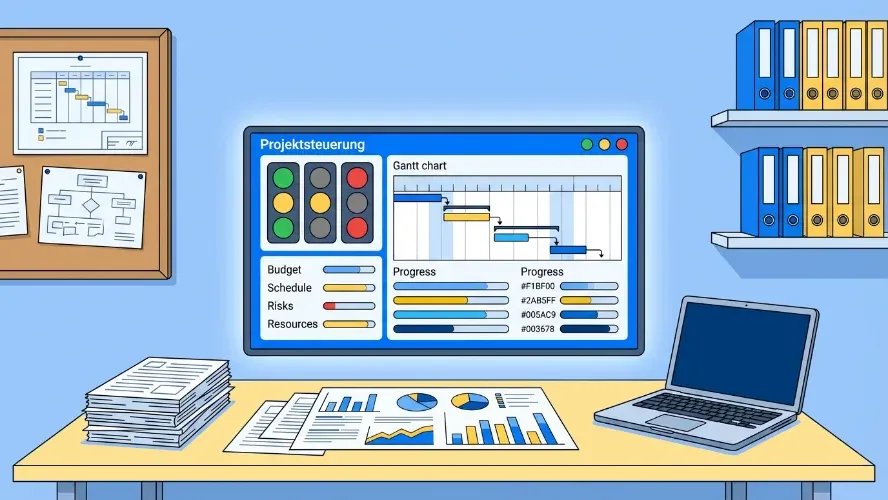
The Gantt chart displays work packages on a timeline and makes dependencies between activities visible. For project control, it is a central tool: at a glance, it shows which activities run in parallel, where the critical path lies, and where buffer times exist. When one activity shifts, the impact on subsequent activities becomes immediately apparent.
Milestone trend analysis
The milestone trend analysis (MTA) shows how the schedule forecasts for milestones develop over time. A rising line signals schedule delay; a horizontal line indicates plan stability. For control purposes, the MTA is particularly valuable because it reveals trends: a milestone that slips back slightly with every reporting date signals a structural problem — before the deviation becomes critical.
Earned value analysis
Earned value analysis (EVA) links costs, time, and scope in a single KPI system. It answers the central control question: Are we getting the expected progress for our money? Metrics such as the Cost Performance Index (CPI) and the Schedule Performance Index (SPI) show whether the project is working efficiently and staying on schedule. EVA is demanding to implement, but for medium to large projects it is the most meaningful control instrument available.
Risk management
Project control works not only reactively but also preventively. Systematic risk management with risk analysis and a risk register identifies potential problems before they occur. Project control draws on this information to act proactively — rather than only reacting once damage has already been done.
Change management
When control measures alter the project scope, budget, or timeline, change management takes effect. It ensures that changes to the project plan proceed in a controlled manner: requested, evaluated, approved, and documented. Without this process, well-intentioned control interventions quickly lead to uncontrolled scope creep.
Methods at a glance
| Method | Control purpose | When to use |
|---|---|---|
| Work breakdown structure | Overview of progress and responsibilities | Always — the foundation of every control effort |
| Gantt chart | Managing schedule dependencies and the critical path | For projects with many parallel activities |
| Milestone trend analysis | Detecting schedule trends early | For projects with defined milestones |
| Earned value analysis | Integrated assessment of cost, schedule, and scope efficiency | For medium to large projects |
| Risk management | Proactive control before problems arise | Always — scope scales with project size |
| Change management | Implementing plan changes in a controlled manner | Whenever control measures alter the plan |
Project control in practice — tips
Start early. Project control does not begin when problems arise — by then, the room for maneuver is already limited. It starts with the first work package. Target values are defined in the planning phase, and actual data collection begins with the project start.
Clear goals as a prerequisite. Without measurable project goals, control is impossible. If you do not know where you want to go, you cannot determine whether you are off course. Goals must be specific, measurable, and time-bound — at the project, milestone, and work package level.
Establish a regular rhythm. Control needs routine. A fixed reporting and review cycle — for example weekly or bi-weekly — ensures that deviations do not go unnoticed for weeks. At every milestone, a complete control review should take place.
Promote transparency. Project control depends on honest data. When team members conceal problems to avoid conflict, the control dashboard shows green even when things have long since turned red. Project management must create a culture in which bad news is welcome — because the earlier a problem is identified, the less costly the countermeasure.
Treat causes, not symptoms. A schedule overrun can have many causes: a one-off estimation error, systematically over-optimistic planning, insufficient resources, or unclear requirements. Only by understanding the root cause can you find the right measure. Deviation analysis is the key to this.
Ensure decision-making capability. Project control is only effective when decisions are made promptly. Clarify at the outset of the project which decisions project management may make independently and at what threshold the steering committee must be involved. Unclear authority leads to decision backlogs — and decision backlogs lead to schedule delays.
Project control with software support
Project management software is no substitute for good project control, but it creates the conditions for it. Without up-to-date, centrally available data, every control decision is made in the dark.
Real-time overview. Dashboards show project status at a glance: progress of work packages, schedule situation, budget consumption, open risks. Project management does not need to gather data first — it can steer directly.
Central data foundation. All project stakeholders work from the same information. Changes to schedules, tasks, or responsibilities are immediately visible to the entire team. This reduces misunderstandings and coordination overhead.
Automated KPIs. Target-actual comparisons, progress calculations, and status reports can be largely automated. This saves time and reduces errors that arise from manual data preparation.
Capacity and resource planning. Bottlenecks become visible before they turn into problems. Project control can redistribute resources in time or request additional capacity.
AI-supported forecasts. Modern PM tools increasingly use AI to identify patterns in historical project data: What risks typically arise? Where are bottlenecks likely? Which effort estimates have been too optimistic in the past? Such insights improve control quality with every project.
Frequently asked questions
What is project control in simple terms?
Project control encompasses all measures that keep a project on track during execution. Project management continuously compares actual values for schedule, costs, and scope against planned values — and actively intervenes when the project deviates from the plan. The goal is to achieve the project objectives within the defined tolerances.
What is the difference between project control and project controlling?
Project controlling is the analytical side: it collects data, produces target-actual comparisons, and makes deviations visible. Project control is the action-oriented side: based on controlling data, it initiates countermeasures, adjusts the project plan, and implements decisions. In practice, the two are closely intertwined — controlling supplies the information, control acts on it.
What are the tasks of a project controller?
Core tasks include: coordinating and monitoring the project plan, starting and closing work packages, leading and coordinating the project team, monitoring project KPIs, initiating countermeasures when deviations occur, managing resources, ensuring quality, producing status reports, and preparing and implementing steering committee decisions.
What methods are used for project control?
The most important methods are the work breakdown structure for an overall overview, the Gantt chart for schedule control, milestone trend analysis for detecting schedule trends, earned value analysis for integrated cost-schedule-scope assessment, and risk management for proactive control. Which methods are appropriate depends on project size and complexity.
When does project control begin?
Project control begins when project execution starts — that is, as soon as the first work package is authorized. However, the foundation is laid in the planning phase: this is where the target values are defined against which control will later be measured. Without sound planning, project control lacks the reference point it needs to identify deviations.

Senior Advisor
Jörg Friedrich is the original author of the project management software Allegra and continues to accompany its development to this day. He has many years of industry experience as a project and department manager. He also serves as a professor in the Faculty of Computer Science and Information Technology at Esslingen University of Applied Sciences.