What is a Stakeholder Analysis?
A stakeholder analysis is a systematic process that identifies the stakeholders relevant to a project, examines their goals, motivations, and attitudes, and derives recommendations for action. It is a core element of stakeholder management and breaks down into three key tasks:
- Identify stakeholders — Who is affected, who has influence?
- Assess stakeholders — How significant is their influence and interest? Are they supporters or opponents?
- Derive strategies — How should each stakeholder be communicated with?
The analysis provides the foundation for targeted project communication. It reveals where support can be mobilized, resistance reduced, and conflicts between interest groups defused early on.
Important: Stakeholder analysis and stakeholder management are not the same thing. Stakeholder management encompasses the entire ongoing process — from identification through analysis to the continuous management of relationships. The stakeholder analysis is one step within that process — but a decisive one.
Why is Stakeholder Analysis Important?
Projects rarely fail because of technical problems alone. More often it is overlooked interests, underestimated resistance, or lack of support from key individuals that brings a project to a standstill. A thorough stakeholder analysis counteracts this:
- Recognizing risks. Stakeholders with high influence and a negative attitude represent a project risk. The analysis makes them visible before they cause damage. These insights feed directly into the risk analysis.
- Activating supporters. Knowing who the advocates are allows you to involve them strategically — as promoters, multipliers, or decision-makers.
- Shaping communication. Not every stakeholder needs the same information at the same time. The analysis shows who needs to be closely involved and who is fine with a monthly update.
- Securing scope. Knowing stakeholder expectations early makes it possible to define the project scope realistically and prevent scope creep.
The earlier the stakeholder analysis takes place, the greater its value. Ideally it belongs in the planning phase — before the detailed project plan is in place.
Conducting a Stakeholder Analysis: Step by Step
1. Identify Stakeholders
In the first step, the project team collects all people, groups, and organizations that can influence the project or are affected by its outcome. Team brainstorming is the quickest starting point. Systematic guiding questions help to supplement it:
- Who funds the project or approves the budget?
- Who uses the outcome — directly or indirectly?
- Who provides resources, data, or contributions?
- Who can block or delay the project?
- Who will have their working practices changed by the outcome?
Typical stakeholder categories:
- Internal: Senior management, project sponsor, specialist departments, IT, works council, end users
- External: Customers, suppliers, implementation partners, authorities, consultants
The result is a complete stakeholder list — ideally with names, roles, and contact details. Completeness is more important than depth: an overlooked stakeholder can cause more damage than one who is imprecisely assessed.
2. Analyze and Assess Stakeholders
Each identified stakeholder is assessed along several criteria. The three most important dimensions:
Influence (Power): Can the stakeholder significantly promote or block the project? Influence does not have to be tied to formal hierarchy — informal power often carries more weight than an org-chart box.
Interest: How strongly is the stakeholder affected by the project? What changes for them in terms of working practices, position, or responsibilities?
Attitude: Does the stakeholder view the project positively, neutrally, or negatively? This dimension is crucial for the later strategy — a powerful opponent requires different measures than a powerful supporter.
Additionally, influenceability can be captured: how easily can the stakeholder’s position be shifted? A powerful opponent who is open to arguments presents a different challenge than one with an immovable stance.
For gathering information, one-on-one conversations, team workshops, analysis of project documents, and — for larger stakeholder groups — structured surveys are all useful.
Three levels (low, medium, high) per dimension are usually sufficient. Finer scales suggest a precision that subjective assessments rarely deliver.
3. Plot Stakeholders in the Influence-Interest Matrix
The influence-interest matrix — also known as the stakeholder matrix or power-interest grid — is the central visualization tool of stakeholder analysis. It places each stakeholder along two axes:
- Y-axis: Influence (low → high)
- X-axis: Interest (low → high)
This produces four quadrants, each with an appropriate action strategy:
| Low Interest | High Interest | |
|---|---|---|
| High Influence | Keep Satisfied Inform regularly, involve in key decisions | Manage Closely Key players — actively involve in decisions |
| Low Influence | Monitor Minimal effort, reassess when things change | Keep Informed Regular updates, open communication channels |
Rows = Influence, Columns = Interest
Key players (high influence, high interest) deserve the most attention. They can drive the project forward or cause it to fail. Involve them actively in decisions and maintain personal contact.
Keep satisfied (high influence, low interest): These stakeholders can move a lot but are not interested in the project’s details. Keep them satisfied without overwhelming them with information. Bring them in for critical decisions.
Keep informed (low influence, high interest): This group follows the project closely but has little ability to influence it. Regular status reports and an open ear are usually enough.
Monitor (low influence, low interest): Minimal communication effort. Check regularly whether influence or interest has changed.
4. Derive the Communication Strategy
The stakeholder’s position in the matrix determines the communication plan. For each stakeholder or stakeholder group, the team defines:
- Channel: Personal conversation, email, project status report, workshop
- Frequency: Weekly, bi-weekly, monthly, event-driven
- Content: Strategic decisions, status updates, technical details
- Responsible person: Who maintains the relationship?
Key players receive personal conversations and are involved in decisions. Stakeholders in the “keep informed” quadrant receive regular updates via the project status report. In the “monitor” quadrant, a check at each milestone is sufficient.
Stakeholder Analysis: Template
The following template consolidates all relevant information in a single table. It can be maintained in a spreadsheet or project management software.
| Stakeholder | Role | Influence | Interest | Attitude | Strategy | Channel | Frequency |
|---|---|---|---|---|---|---|---|
| Ms. Meier, Executive Management | Project Sponsor | High | High | + | Manage Closely | Personal conversation | Weekly |
| Mr. Schulz, Sales Director | Key User | Medium | High | +/− | Keep Informed | Workshop, email | Bi-weekly |
| Works Council | Employee Representative | High | Medium | 0 | Keep Satisfied | Status report | Monthly |
| Ext. Implementation Partner | Supplier | Medium | Medium | + | Keep Informed | Regular meeting | Weekly |
| Data Protection Officer | Consultant | Medium | Low | 0 | Monitor | Event-driven |
Attitude: + = supporter, 0 = neutral, − = opponent, +/− = ambivalent
Practical Example: Stakeholder Analysis for an ERP Implementation
A medium-sized company with 200 employees is switching its ERP system. The project manager conducts a stakeholder analysis in a three-hour workshop with the core team.
Identified Stakeholders
The team identifies seven key stakeholders:
| Stakeholder | Influence | Interest | Attitude | Quadrant |
|---|---|---|---|---|
| CEO — approves budget, expects efficiency gains | High | High | Supporter | Manage Closely |
| Head of IT — responsible for infrastructure and interfaces | High | High | Supporter | Manage Closely |
| Head of Accounting — key user, daily work affected | Medium | High | Ambivalent | Keep Informed |
| Works Council — monitors employee rights, data protection | High | Medium | Neutral | Keep Satisfied |
| Sales Team (15 people) — uses ERP for orders | Low | High | Skeptical | Keep Informed |
| Ext. Implementation Partner — delivers configuration | Medium | Medium | Supporter | Keep Informed |
| Data Protection Officer — checks GDPR compliance | Medium | Low | Neutral | Monitor |
Influence-Interest Matrix for the Example Project
| Low Interest | Medium Interest | High Interest | |
|---|---|---|---|
| High Influence | Works Council | CEO Head of IT | |
| Medium Influence | DPO | Ext. Partner | Head of Accounting |
| Low Influence | Sales Team |
Derived Measures
The CEO and Head of IT as key players are involved weekly in the steering committee. Both are supporters — the team must actively leverage and make their support visible.
The Works Council has high influence but only moderate interest. The project manager informs them monthly via a status report and brings them in early on topics such as changes to working practices and data protection.
The Head of Accounting is ambivalent: she sees the value but fears the transition effort. The solution: involving her as a key user in the pilot phase, with hands-on training using real transaction data.
The Sales Team is skeptical but has little formal influence. Nevertheless, lack of acceptance can jeopardize success — a classic project risk. Measure: make quick wins visible, involve two sales representatives as ambassadors.
Overview of Stakeholder Analysis Methods
The influence-interest matrix is the most widely used method, but not the only one. Depending on the project context, additional techniques may be useful:
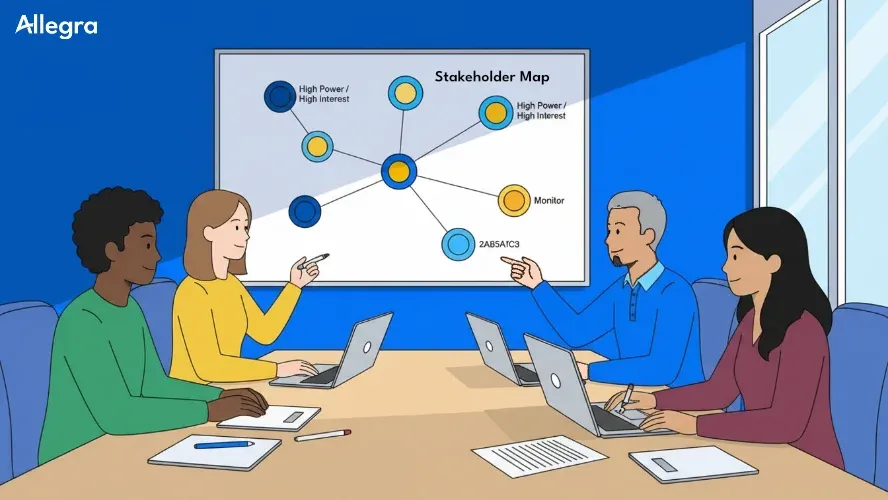
Stakeholder mapping. Visualizes relationships and dependencies between stakeholders. Useful in complex projects with many participants, where coalitions and conflicts between stakeholders play a role.
SWOT analysis per stakeholder. Assesses the strengths, weaknesses, opportunities, and risks of working with individual key stakeholders. More effort-intensive, but helpful for critical relationships.
Interviews and surveys. Provide qualitative in-depth insights into motivations, expectations, and concerns. Particularly valuable for stakeholders whose attitude is unclear.
Scenario analysis. Simulates how stakeholders might react to specific decisions. Useful before critical turning points in the project.
For most projects, the influence-interest matrix is sufficient as the core method, supplemented by one-on-one conversations with the most important stakeholders.
Practical Tips
-
Start early. The stakeholder analysis belongs at the beginning of the planning phase. Waiting until resistance is already felt means valuable time has been lost.
-
Update regularly. Attitudes and power dynamics shift over the course of a project. Plan a review at every milestone. The analysis is a snapshot — not a one-time document.
-
Conduct it as a team. Individual assessments are prone to blind spots and bias. Different perspectives — project management, subject-matter experts, team members — combine into a more realistic picture.
-
Treat it as confidential. The results of a stakeholder analysis are sensitive. A stakeholder who learns they have been classified as an “opponent” is unlikely to become more cooperative. Restrict access to the core team.
-
Assess individuals, not groups. “The IT department” is not a homogeneous block. Within a group, interests and attitudes can vary considerably. When in doubt, assess individuals.
-
Hierarchy ≠ influence. Formal position and actual power rarely align. Informal opinion leaders, long-tenured employees with strong networks, or external consultants with the ear of senior management can move more than many a department head.
Frequently Asked Questions
What is a stakeholder analysis?
A stakeholder analysis is a systematic process for identifying, assessing, and prioritizing all people and groups who influence a project or are affected by it. The output consists of stakeholder profiles and an influence-interest matrix that serves as the basis for targeted communication strategies.
How do you conduct a stakeholder analysis?
In four steps: first, all stakeholders are identified. Then the team assesses each stakeholder by influence, interest, and attitude. Next, stakeholders are positioned in the influence-interest matrix. From their respective quadrant, the appropriate communication strategy is derived — ranging from “manage closely” to “monitor.”
What is a stakeholder matrix?
A stakeholder matrix — also known as an influence-interest matrix or power-interest grid — is a two-dimensional representation that categorizes stakeholders by influence (Y-axis) and interest (X-axis). The four quadrants define the action strategy: manage closely, keep satisfied, keep informed, or monitor.
What is the difference between stakeholder analysis and stakeholder management?
Stakeholder management encompasses the entire ongoing process: identification, analysis, communication, and the continuous management of stakeholder relationships throughout the full project duration. The stakeholder analysis is one step within that process — it assesses and prioritizes the identified stakeholders at a specific point in time.
When should the stakeholder analysis be updated?
At least at every milestone and whenever there are significant changes in the project environment — such as a new sponsor, a reorganization, or a scope change. Attitudes and power dynamics shift over the course of a project. An outdated stakeholder analysis is worse than none at all, because it conveys a false picture of the support landscape.

Senior Advisor
Jörg Friedrich is the original author of the project management software Allegra and continues to accompany its development to this day. He has many years of industry experience as a project and department manager. He also serves as a professor in the Faculty of Computer Science and Information Technology at Esslingen University of Applied Sciences.