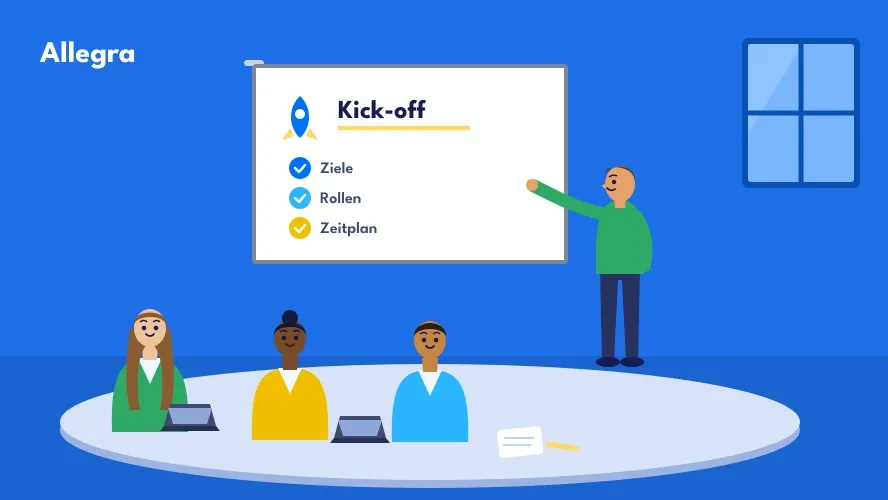
The Kickoff Meeting: The Foundation for a Successful Project!
When a new project involves many stakeholders, it is essential that everyone works together. All team members must have the same overview of the schedule and the required resources, and they must be able to ask questions about them. A kickoff meeting (also: kickoff event, project launch meeting) belongs to the canon of project management methods and is particularly well suited to launching a large project with all stakeholders. It provides the opportunity to discuss goals and align on a shared vision for the project. It is an important component of project management in many organizations. It typically falls in the later project management phases of “initiation” or “planning.”
To ensure that a kickoff meeting achieves its goals successfully, it is important to consider and plan various elements such as objectives, participants, preparation, and agenda. In this blog you will learn more about these aspects and how to use technology to enhance the kickoff meeting experience.
What Is a Kickoff Meeting?
A kickoff meeting (also: kickoff event, project launch meeting) is a proven method for starting a project together with all stakeholders. It provides the opportunity to discuss goals and align on a shared vision for the project. It is an important component of project management in many organizations.
At the kickoff meeting, all key stakeholders are introduced, roles and responsibilities are presented, and the tone for future communication and collaboration is set. The kickoff meeting is an important step in the project management process that can contribute significantly to a project’s success.
A project’s success depends on effective communication and collaboration among team members. A kickoff meeting provides the opportunity to establish these important foundations and ensure that everyone is on the same page from the very beginning. By taking the time to properly plan and run a kickoff meeting, project managers can increase the chances of project success.
Depending on the organizational structure and working style, the concept of a kickoff meeting may vary. In general, however, there is agreement that the kickoff program for a new project should include the project participants as well as other identified stakeholder groups.
To ensure that a kickoff meeting achieves its goals successfully, it is important to consider and plan various elements such as objectives, participants, preparation, and agenda. In this blog you will learn more about these aspects and how to use technology to enhance the kickoff meeting experience.
What Are the Goals?
The goals of a kickoff meeting are varied and project-dependent. Primarily, however, they serve to enable a common start for the new project, promote motivation, and gain the support of participants and stakeholder groups for the project’s success.
The most important topics include:
- Giving stakeholder groups the opportunity to learn about the project, its goals, and the tasks and responsibilities of individual team members.
- Creating the project plan, outlining the schedule and the budget
- Establishing clear communication channels and a schedule for future meetings and updates
- Identifying potential challenges and risks — a SWOT analysis can help with this
A kickoff meeting gives all team members and stakeholder groups the opportunity to learn about the project, its goals, and the tasks and responsibilities of individual team members. This ensures that everyone pulls in the same direction and works toward the same goals.
The project manager should provide an overview of the project, including the schedule, budget, and expected outcomes. This ensures that all stakeholders understand the scope and expectations of the project precisely and can plan accordingly.
It is also important to define how the team will communicate and collaborate during the project, and to establish a schedule for future meetings and updates. This ensures that all stakeholders stay informed and that the project remains on track.
The team should also identify and discuss potential challenges or risks and how they will be addressed. By proactively tackling potential problems, it is more likely that the project will be completed successfully.
Preparing and Running a Kickoff Meeting
To ensure the success of a kickoff meeting, it is important to follow these best practices for preparation and execution:
- Define the purpose and objectives of the meeting: Clearly define the meeting’s goals and what you hope to achieve.
- Invite all relevant stakeholders: Make sure to invite all team members as well as all key stakeholder groups who will be involved in the project. This ensures that all parties can participate in the discussion.
- Create an agenda (see the article Meeting Minutes): An agenda helps organize the meeting and keep it on track. It should include an introduction, an overview of the project, a discussion of roles and responsibilities, and any other relevant information.
- Prepare all required materials: These may include project plans, budget documents, or presentations. Make sure all participants receive copies of these materials in advance.
- Choose an appropriate venue and time: When selecting the location and time for the meeting, consider the size of the team and any logistical considerations.
- Send reminder notices: Send reminder notices to all participants a few days before the meeting to ensure everyone is aware of the date and time.
- Plan follow-up actions: Follow-up actions are an important part of a successful kickoff meeting. Make sure to schedule all necessary follow-up meetings or tasks and assign responsibility for completing them.
By following these best practices, you can ensure that your kickoff meeting is well-prepared and successful.
The Kickoff Meeting Agenda
1. Welcome and Introductions (10 minutes)
- Welcome by the project manager
- Introduction round for all participants with a brief note on their respective roles in the project
⇒ “Who is leading the project?”, “Who are the project stakeholders?“
2. Vision and Project Overview (20 minutes)
- Explanation of the vision and significance of the project for the organization
- Presentation of the project goals and their relevance in the broader business context
- Clarification of the project scope and expected outcomes
⇒ “What is the underlying vision?”, “What is the project about?”, “What is the project scope?”, “What outcomes are expected?“
3. Goals and Expectations (15 minutes)
- Detailed discussion of the project goals
- Detailed discussion of the project goals in the context of overarching organizational objectives
- Clarification of expectations for each project member
⇒ “What goals are being pursued?”, “How do the project goals relate to overarching organizational objectives?”, “What is expected from each project member?“
4. Roles, Responsibilities, and Brief Introductions (15 minutes)
- Discussion of responsibilities and team composition
- Subsequent assignment of roles to individual team members
- Brief getting-to-know-you within the defined teams
⇒ “Who works with whom?”, “What role does each team member take on?“
5. Project Plan, Timeline, and Milestones (45 minutes)
- Presentation of the project plan including milestones, Sprints, and deadlines
- Discussion of potential risks and issues, including guidance on how to handle delays
- Subsequent discussion among all stakeholders
⇒ “What does the project plan look like?”, “What milestones are planned?”, “When are Sprints scheduled?”, “What deadlines must be met?”, “What are potential risks and issues that could cause delays in the project plan?“
6. Communication Plan (10 minutes)
- Explanation of communication protocols
- Scheduling of regular meeting dates and touchpoints
⇒ “Where and how is communication recorded?”, “When and how often do meetings take place?”, “What touchpoints exist between individual project/team members outside the scheduled meetings?“
7. Resources and Tools (20 minutes)
- Overview of tools and resources for the project (e.g., tools, software, budgets, etc.)
- Information about the accessibility and use of tools and resources
⇒ “What resources are allocated to the project?”, “How can project stakeholders access tools and resources?”, “What tools are planned and how are they used?“
8. (Optional) Risk Management (15 minutes)
- For projects with high risks and anticipated problems, risk management can be explicitly addressed and discussed separately from item 5
⇒ “How will anticipated problems and delays be handled?”, “Is setting up an early-warning system advisable?“
9. Questions, Answers, and Participant Feedback
- Open discussion round to address any questions and comments
10. Shared Lunch
- Extended break with an opportunity for further introductions or, if appropriate, professional exchange
- No explicit focus on the project
5 Tips for Successful Kickoff Meetings
1. You Only Get One Chance to Make a First Impression!
First impressions are crucial — they are often formed within seconds and have a lasting influence on how people work together. A strong first impression at the kickoff meeting can build trust and rapport, while a poor impression is hard to overcome. Since there is no second chance at a first impression, you should prepare well and show up authentically to achieve the best possible effect. This principle is especially relevant for the kickoff meeting, where the first impression can set the tone for the entire collaboration.
2. If It Isn’t Written Down, It Didn’t Happen!
The importance of written documentation and communication for long-term success and memory is often underestimated. Written records not only preserve knowledge and ideas, but also serve as evidence and reference when it comes to tracking decisions and agreements. In a world where spoken statements can easily be forgotten or distorted, written documentation provides clarity and reliability. Anyone who takes the effort to document thoughts and information leaves a lasting impression. Written records endure and can continue to provide guidance and influence even years later. Make sure that all key statements and information are captured in writing during the kickoff meeting and remain permanently accessible to all participants.
3. Communicate Processes and Roles Clearly
It is important that all project participants are familiar with at least the part of the overall process that concerns them. The overall process, with its key terms, roles, and activities, must be described in a project handbook before the kickoff meeting. During the meeting, this handbook can be briefly presented.
4. Allow Sufficient Time for Getting to Know Each Other
Trust is the foundation of any good collaboration. Trust can only grow when you experience and get to know the other person. Getting to know each other provides the opportunity to build trust through shared experiences, honest communication, and mutual appreciation. The more people get to know each other and can rely on one another, the more stable and resilient the relationship becomes. Provide an opportunity for a first introduction during or after the kickoff meeting.
5. Provide an Opportunity for Feedback
Creating space for feedback in the kickoff meeting is important because it allows participants to raise their concerns, ideas, and expectations early on — leading to clearer project alignment. It fosters a sense of involvement and engagement, since all team members are heard and can share their perspectives. Feedback also helps resolve misunderstandings or ambiguities directly before the project truly gets underway, which can prevent later conflicts and delays. It also strengthens trust within the team, as openness to feedback signals that everyone’s opinions and contributions are valued.
Avoid These Mistakes at the Kickoff Meeting!
- 1. Unclear goals: A common problem is that project goals are not clearly defined or communicated in the kickoff meeting. This means the team does not know exactly what it is working toward, which can cause misunderstandings and inefficient work.
- 2. No clear division of roles: When team members’ responsibilities and roles are not clearly defined, overlaps, ambiguities, and frustrations can arise, as everyone is uncertain about what is expected of them.
- 3. Ignoring concerns: Another mistake is failing to take seriously or outright ignoring team members’ feedback or concerns. This can undermine the team’s trust and motivation and lead to problems as the project progresses.
- 4. Too much information at once: Overloading the meeting with too many details can overwhelm participants and obscure important information. It is essential to present information precisely and in a well-structured way.
- 5. No follow-up: After the kickoff meeting, the points discussed and agreements reached should be documented and followed up on. If this does not happen, important decisions and agreements can be lost, leading to delays and misunderstandings as the project unfolds.
Kickoff Meeting Checklist
| Topic | Activities and Deliverables |
|---|---|
| 1. Preparation |
|
| 2. Introduction |
|
| 3. Project Overview |
|
| 4. Roles and Responsibilities |
|
| 5. Schedule and Milestones |
|
| 6. Communication Plan |
|
| 7. Risk Management |
|
| 8. Budget and Resources |
|
| 9. Meeting Close |
|
| 10. Follow-Up |
|
The Client as an Important Participant
There are several reasons why it is important for the client to attend the kickoff meeting:
The client is one of the main actors in the project, and their input and feedback are critical to success. By participating in the kickoff meeting, the client can offer valuable insights and clarify their expectations for the project.
The client is the end user of the product to be delivered or the service to be provided, so their perspective is extremely valuable for understanding the needs and requirements of the project. The client’s participation in the kickoff meeting helps build a cooperative relationship between the client and the project team.
This can lead to better communication and understanding throughout the entire project, which can ultimately result in a better outcome. Overall, the client’s participation in the kickoff meeting is important to ensure that the project is successful and meets the needs of all stakeholders.
Digitize Your Meeting with Project Management Tools
To be able to start working directly during your kickoff meeting, software such as Allegra is incredibly useful. If you can display the presentation on a screen visible to everyone, you can immediately begin scheduling all the necessary items and compiling the workload together. You can also ask participants to bring their devices to the kickoff event, and everyone can log in to Allegra from there and get organized right from the start.
All in all, kickoff meetings and events are a fantastic way to ensure project success. Put the project’s goals at the center of the meeting and be open to any questions that participants might raise. The ability to resolve all questions right at the kickoff can lead to a reduction in delays — which is great! Try to make the meetings enjoyable and engaging, because if they are dull and monotonous, it will be difficult to build the motivation needed to complete a successful project for the client.
Use our project launch checklist as a complement to the kickoff meeting to systematically work through all startup activities. Hopefully this blog has given you a small glimpse into the exact meaning and the benefits that come with starting every project with a fantastic kickoff event. The ability to motivate employees and team members and exchange ideas and thoughts right at the beginning is of great value to the overall outcome of the project. And Allegra is a genuine project and task management tool that will help you succeed every step of the way.
Frequently Asked Questions
What is a kickoff meeting?
A kickoff meeting is an initial meeting that marks the official start of a project’s implementation phase. Participants are informed about the goals, significance, and planned process so that everyone can ensure a successful project launch together and the team is motivated from the outset.
How does a kickoff meeting work?
A kickoff meeting marks the start of a project. All project participants come together to get to know each other, define the project goals, schedules, and role assignments, and establish a shared understanding of the project. It is a platform for clarification and for motivating the team.
How long does a kickoff meeting last?
The duration of a kickoff meeting can vary depending on the scope of the project. On average it is between one and two hours. For larger projects, kickoffs can take up to eight hours, with all project stakeholders and key stakeholder groups present.
When does a kickoff take place?
A kickoff meeting is typically scheduled after the initial project planning is complete and immediately before the implementation phase begins. It serves to bring all project stakeholders together, clarify the goals, and lay the foundation for successful collaboration.
Author