Why is the project kickoff so critical?
A building stands or falls with its foundation. Project management is no different: the quality of the project kickoff determines how stable the entire endeavor will be. Mistakes made in the first days and weeks carry through every subsequent phase — and become more expensive to correct with each passing week.
This is also borne out in the data. The most common reasons for project failure lie not in technology or budget, but in the startup phase: unclear goals, missing alignment, vague responsibilities. Investing here saves money later.
That said, the project kickoff is not the same thing as project planning. Planning works out in detail what needs to be done, by whom, and when. The kickoff creates the prerequisites for that: clarity about the goal, a capable team, and the buy-in of all relevant stakeholders.
What does a project kickoff involve?
The project kickoff — often referred to in professional circles as project initiation — encompasses all activities between the idea for a project and the start of actual planning. The aim is to establish three things:
Clarity: What is to be achieved? What is in scope, and what is not? What are the constraints?
Organization: Who leads the project? Who is on the team? What roles and responsibilities exist?
Communication: Who needs to be informed or involved? Through which channels? How frequently?
What does not belong in the project kickoff: detailed scheduling, creating a complete project plan, or operational execution. Those are tasks for the subsequent phases.
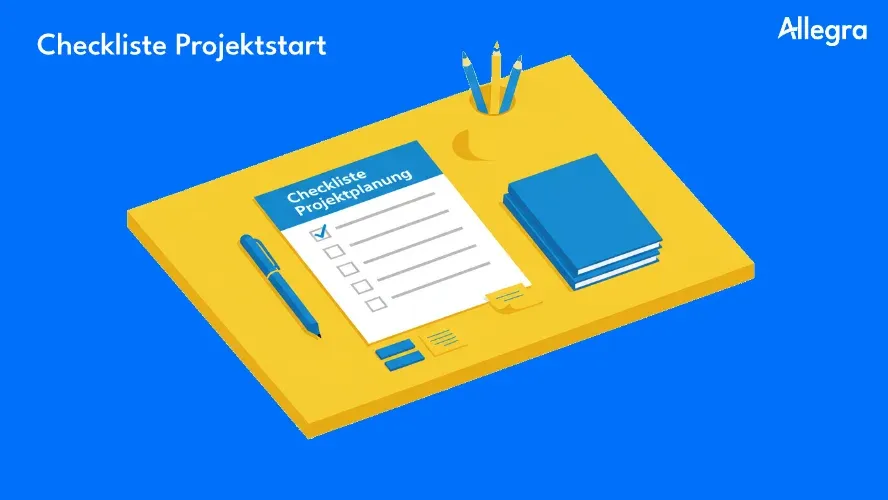
Project kickoff checklist: 8 steps
1. Clarify the project charter
Every project needs a sponsor and a clearly defined charter. The project charter is the document that authorizes the project manager to deploy resources and make decisions. It answers the fundamental questions: Why is this project being carried out? What should be in place at the end?
The charter must exist in writing. Anything not documented will inevitably be interpreted differently over the course of the project. Keep the charter concise — half a page to one page is sufficient in most cases.
2. Define project goals using SMART criteria
Concrete project goals are derived from the project charter. They describe the state to be achieved upon successful completion — not the activities that lead there.
The SMART method has proven its worth: goals must be specific, measurable, achievable, realistic, and time-bound. Distinguish between must-have goals (non-negotiable) and nice-to-have goals (desirable but deferrable when resources are tight).
The three dimensions of the project management triangle help ensure completeness: What is to be achieved (scope)? By when (time)? At what cost (budget)?
3. Define the project scope
Just as important as defining what the project includes is defining what it does not include. A clearly defined project scope protects against scope creep — the gradual expansion of project scope that blows timelines and budgets.
State explicitly what is within scope and what falls outside it. For larger projects, a requirements specification is the appropriate tool to document requirements and lock down the scope in a binding way.
4. Identify and engage stakeholders
Stakeholders are all individuals and groups affected by the project, who can influence it, or who have an interest in its outcome. Early stakeholder analysis ensures that no one whose expectations could become a problem later is overlooked.
For each stakeholder, clarify: What influence do they have? What expectations do they bring? How and how often should they be kept informed? The analysis leads directly to a communication plan — a central element of stakeholder management.
5. Assemble the project team and clarify roles
A project without clear responsibilities does not work. Clarify early on: Who leads the project? Who is on the core team? Is there a steering committee?
The RACI matrix is a proven tool for making responsibilities transparent: Who is Responsible (accountable for execution), who is Accountable (ultimately answerable), who is Consulted (brought in for advice), and who is Informed?
Depending on the size of the organization and the project structure, the roles will vary in complexity. What matters is that every team member knows what they are responsible for — and what they are not. More on building a high-performing team can be found in the article on assembling a project team.
6. Capture constraints and risks
Before planning begins, all constraints must be on the table: What budget is available? What timeline has been set? Are there technical requirements, regulatory demands, or dependencies on other projects?
At the same time, an initial risk assessment is worthwhile. What risks could jeopardize project success? How likely are they? What countermeasures are possible? The results will feed into systematic risk management later on. Budget planning forms the basis for subsequent project cost control.
7. Establish communication channels
Good communication does not happen by chance. Determine from the outset how information will flow through the project:
- Tools: What software will be used for task management, documentation, and communication?
- Meetings: What recurring meetings are needed (stand-ups, status meetings, steering committee)?
- Reports: Who receives which status reports, when, and in what format?
Clear communication rules prevent important information from getting lost or reaching the wrong people. Choosing the right communication tools makes a significant contribution here.
8. Prepare and run the kickoff meeting
The kickoff meeting marks the official start of the project. It brings all stakeholders together, presents the goals and framework, and creates a shared understanding of the endeavor.
Prepare the kickoff carefully: a clear agenda, the right participants, realistic timing. Present the project goals, scope, roles, and next steps. Allow time for questions. And document the outcomes — they are the working basis for everything that follows.
Project kickoff checklist: summary table
| Step | Task | Deliverable |
|---|---|---|
| 1 | Clarify the project charter | Written project charter with sponsor, rationale, and goal description |
| 2 | Define SMART project goals | Documented must-have and nice-to-have goals with metrics and deadlines |
| 3 | Define the project scope | Scope document with in-scope and out-of-scope areas |
| 4 | Identify stakeholders | Stakeholder register with influence, expectations, and communication plan |
| 5 | Assemble the team and clarify roles | Org chart or RACI matrix with all responsibilities |
| 6 | Capture constraints and risks | Documented parameters (budget, time, technology) and initial [risk list](/en/blog/project-management/risk-management/risk-register/) |
| 7 | Establish communication channels | Communication plan with tools, meeting cadence, and reporting formats |
| 8 | Run the kickoff meeting | Minutes with goals, roles, open questions, and next steps |
Common mistakes at project kickoff
Even experienced project managers repeatedly fall into the same traps. Four mistakes are particularly widespread:
Goals remain vague. “The project should improve customer satisfaction” sounds good, but it is not a goal. Without measurable criteria and a deadline, there is no basis for any evaluation of success. The SMART method helps turn vague intentions into verifiable objectives.
Stakeholders are brought in too late. Informing key stakeholders only once the project is already underway risks resistance, additional demands, and changes in direction. Early involvement is not a courtesy — it is risk mitigation.
No written project charter. Verbal agreements are the surest path to misunderstandings. A documented charter creates accountability and a shared reference point that everyone involved can refer to.
Roles and responsibilities remain unclear. When no one knows exactly who is responsible for what, tasks fall through the cracks or get done twice. Both cost time and energy. More on common stumbling blocks can be found in the article on frequent mistakes in project management. The counterpart to the startup phase — the structured project closure — is equally critical to long-term project success.
Tools for the project kickoff
A project kickoff checklist on paper is better than no checklist. Even better is project management software that supports the entire startup process digitally: task lists for kickoff preparation, templates for recurring project types, dashboards for an overview of goals, roles, and progress.
Modern PM tools make it possible to set up the checklist as a task package, assign responsibilities, and track the status of each step in real time. This turns a static list into a living process.
Frequently asked questions
What does a project kickoff involve?
The project kickoff includes all activities that put a project on a solid footing: clarifying the project charter, defining goals, scoping the project, identifying stakeholders, assembling the team, capturing constraints and risks, establishing communication channels, and running the kickoff meeting.
How long does the project kickoff phase take?
It depends on the size and complexity of the project. For small initiatives, a few days may suffice; for large projects, the startup phase can take several weeks. What matters is not the duration but the thoroughness: better to invest two extra days at the start than spend two months correcting mistakes later.
What is the difference between a project kickoff and a kickoff meeting?
The project kickoff is a process comprising several steps — from clarifying the charter to assembling the team. The kickoff meeting is a single event within that process: the official launch event where all stakeholders come together and the results of the kickoff preparation are presented.
Who is responsible for the project kickoff?
Typically the project manager, who is commissioned by the sponsor to carry out the project. The project manager coordinates the kickoff activities, assembles the team, and prepares the kickoff meeting. In larger organizations, a PMO (Project Management Office) can support the startup process with templates and standards.
Why do projects fail at the very start?
The most common causes are unclear goals, no written project charter, stakeholders being involved too late, and unclear responsibilities. All of these problems can be avoided through a structured approach — which is exactly what a project kickoff checklist is for.

Senior Advisor
Jörg Friedrich is the original author of the project management software Allegra and continues to accompany its development to this day. He has many years of industry experience as a project and department manager. He also serves as a professor in the Faculty of Computer Science and Information Technology at Esslingen University of Applied Sciences.