Why Project Closure Matters So Much
The project is done, the deliverable is ready — and the next initiative is already waiting. This common scenario is far from ideal. Projects that aren’t properly closed leave a trail behind them: invoices go unpaid, knowledge is lost, and team members are left in organizational limbo.
The consequences often don’t surface until weeks or months later. A supplier chases an unpaid invoice. A client complains because partial deliverables were never formally handed over with documentation. The same problems crop up in the next project because nobody recorded the lessons learned. And in the worst case, the project manager is held personally responsible for something they considered resolved long ago — but that was never formally documented.
Project closure isn’t bureaucracy. It protects against liability, preserves knowledge for future projects, and gives everyone involved a clear finishing line. An hour invested here saves days later.
What Does Project Closure Include?
Project closure covers all activities between the final delivery and the formal dissolution of the project. It is a distinct project phase — not an appendage of the execution phase.
Three core areas structure the closure:
Results consolidation: Deliverables are reviewed, formally accepted by the client, and handed over together with documentation. What isn’t documented doesn’t exist — at least not for those who come after you.
Evaluation: A target-vs-actual comparison shows whether the project objectives were achieved. The post-calculation makes actual costs transparent. And in a lessons learned workshop, the team records what should go better next time.
Dissolution: Team members are returned to line management, resources are released, and the cost center is closed. The project is formally ended.
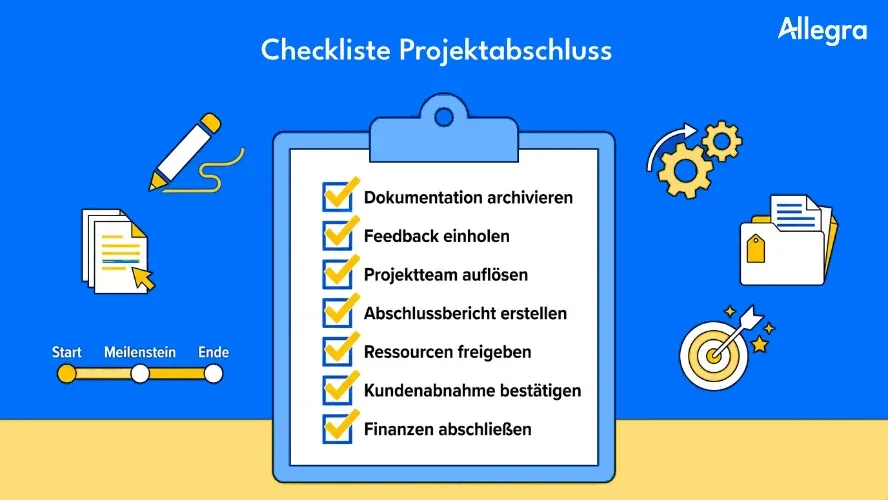
Project Closure Checklist: 10 Steps
1. Review and Formally Accept Deliverables
Before a project can be closed, it must be clear that all agreed deliverables are in place. Check that all work packages have been completed and all milestones have been reached.
Formal acceptance is carried out by the client. It confirms that the deliverables meet the agreed requirements. Document the outcome in a handover record — including the date, scope, and any reservations.
2. Document and Hand Over Open Items
No project ends without outstanding tasks. The key is making sure they don’t fall through the cracks. Capture all open items: pending corrections, known defects, decisions not yet made.
Assign responsibility for each item and set a deadline for completion. Hand the list over to line management or the follow-on project — in writing, with clear ownership.
3. Complete the Project Documentation
Project documentation is the memory of the project. Make sure all relevant materials are complete and up to date: technical documentation, process descriptions, manuals, requirements specifications and functional specifications.
Archive the materials centrally, in a way that allows people outside the project team to understand the outcomes. A year from now, no one will remember verbal explanations.
4. Conduct a Target-vs-Actual Comparison
Were the project objectives achieved? The target-vs-actual comparison answers this question across the three dimensions of the project management triangle: performance, time, and cost.
Compare actual results with the originally defined targets. Identify variances and document their causes. This step provides the factual basis for the closure report and for assessing project success.
5. Prepare the Post-Calculation
The post-calculation captures the actual project costs: personnel effort, material costs, external services, travel expenses, and all other project-related expenditures.
Compare actual costs against the planned project budget. The results are not just relevant for project controlling — they also provide reliable benchmarks for calculating future projects.
6. Run a Lessons Learned Session
A lessons learned workshop is one of the most effective tools in the project closure toolkit. The core team reflects together: What worked well? What went wrong? What would we do differently next time?
The framing matters: no blame, just an open exchange aimed at deriving concrete improvements. Document the outcomes and make them centrally available — only then can other teams benefit as well.
7. Inform Stakeholders
All stakeholders have a right to be informed about the project closure and the results achieved. Depending on the project’s reach, this might take the form of a closing presentation to the steering committee, a written status report, or a personal communication to the client.
Don’t forget the less obvious stakeholders: departments that will work with the project outputs, or suppliers whose contracts are expiring.
8. Write the Closure Report
The project closure report consolidates all relevant information: project objectives, achieved results, variances, post-calculation, lessons learned, and open items. It is the central reference document for anyone who engages with the project later — whether for audits, follow-on projects, or management review.
Keep the report clearly structured and focused on what matters. It must be understandable to people who were not involved in the project.
9. Release Resources and Dissolve the Project
With formal closure, all allocated resources are released. Return team members to their line organization or to new projects. Close the cost center, return licenses, workspace, and equipment.
Remove the project from the company’s project portfolio. This step sounds trivial but is often forgotten — with the result that budgets and resources remain tied up on paper. Make sure the next project kickoff can benefit from the closure’s insights.
10. Celebrate the Project’s Success
The last item on the checklist may be the most important for team culture: celebrate the closure. Recognition for work done isn’t a nice-to-have — it strengthens motivation and cohesion for future projects.
The form can be proportionate: a team dinner, a brief acknowledgment in the team meeting, or a thank-you note. What matters is that the team receives the signal: your work was important, and it is seen.
Project Closure Checklist: Summary Table
| Step | Task | Outcome |
|---|---|---|
| 1 | Review and formally accept deliverables | Handover record with client sign-off |
| 2 | Document and hand over open items | Open-items list with owners and deadlines |
| 3 | Complete the project documentation | Complete, centrally archived project materials |
| 4 | Conduct a target-vs-actual comparison | Documented comparison of targets and results (performance, time, cost) |
| 5 | Prepare the post-calculation | Comparison of planned and actual costs |
| 6 | Run a lessons learned session | Documented insights and improvement recommendations |
| 7 | Inform stakeholders | Closing presentation or report to all relevant parties |
| 8 | Write the closure report | Structured report covering results, variances, and insights |
| 9 | Release resources and dissolve the project | Released resources, closed cost center, dissolved project team |
| 10 | Celebrate the project's success | Recognition of team performance and shared conclusion |
Common Mistakes in Project Closure
Four mistakes come up again and again in practice:
Project closure is skipped entirely. The next project is pressing, and closure falls by the wayside. The result: open items linger, knowledge is lost, invoices go unpaid. What saves time in the short term creates extra work in the long run.
No formal sign-off. Without documented acceptance from the client, it remains unclear whether the deliverables meet expectations. Retroactive complaints then become almost impossible to counter. A signed handover record creates accountability for both sides.
Lessons learned are not conducted. The result: the same mistakes repeat from project to project. Yet a two-hour workshop with the core team is often enough to capture the most important insights.
Resources are not released. Team members and budgets remain allocated even though the project is effectively over. This blocks other initiatives and distorts the company’s resource planning. Make sure the next project kickoff can benefit from the closure’s insights.
Tools for Project Closure
A paper checklist is better than no checklist at all. Even better is project management software that provides structured support for the closure process: task lists for each step, templates for closure reports, dashboards for tracking open items and releases.
Modern PM tools make it possible to set up the checklist as a task package, assign responsibilities, and track the status of each step in real time. This turns a static list into an active process — and ensures no step is forgotten.
Frequently Asked Questions
What does project closure include?
Project closure covers all activities that formally and substantively conclude a project: reviewing and formally accepting deliverables, documenting open items, completing project documentation, conducting a target-vs-actual comparison, preparing the post-calculation, running lessons learned, informing stakeholders, writing the closure report, releasing resources, and celebrating the project’s success.
Who is responsible for project closure?
Typically the project manager. They coordinate the closure activities, compile the closure report, and ensure that resources are released. Formal acceptance of deliverables is carried out by the client. The entire project team contributes by completing documentation and participating in the lessons learned session.
What is a project closure report?
The project closure report is the central document at the end of a project. It summarizes project objectives, achieved results, variances, post-calculation, lessons learned, and open items. It serves as a reference for follow-on projects, audits, and management review.
Why are projects so often not properly closed?
The most common reasons: time pressure from follow-on projects, the perception of closure as unnecessary bureaucracy, and a lack of established processes within the organization. Yet a structured closure is not a formality — it secures results, protects against liability, and provides insights that improve the success of future projects.
What is the difference between project closure and project sign-off?
Project sign-off is a single step within project closure: the client formally confirms that the deliverables meet the agreed requirements. Project closure is the entire process — from sign-off through post-calculation and lessons learned to the dissolution of the project team and the release of all resources.

CEO Alltena GmbH
Christoph Friedrich is a computer scientist and certified Project Management Professional. He has extensive experience in the introduction and integration of project management tools as well as the analysis and definition of processes in project and service management.