What Is the RACI Matrix?
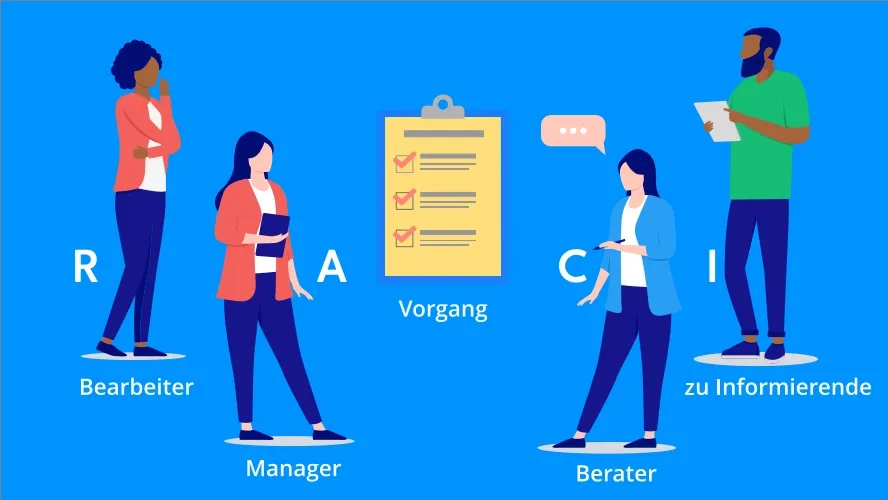
The RACI matrix (sometimes also called a RACI diagram, RACI chart, responsibility matrix, or Responsibility Assignment Matrix (RAM)) allows you to link processes (e.g., tasks, milestones, or project deliverables) to members of your project team via roles. This way, the RACI method helps you clarify responsibilities and eliminate ambiguities.
The RACI matrix is among the less commonly known project management methods. In it, processes or tasks are listed in rows and project participants in columns. In the intersection field of a task and a team member, the respective role that connects the team member to that process is entered. There are four types of relationships or roles in the RACI system, which we explain below.
Responsible
The Responsible is the person who does the work. They carry out the task, implement decisions, and make sure things happen. Without them, nothing moves forward. Ideally, there is always exactly one Responsible per process. Clarity is key — too many cooks spoil the broth.
Accountable
The Accountable is the person who is ultimately responsible for the outcome. They ensure that the task gets done — even when someone else is doing the actual work. The Accountable makes decisions, monitors progress, and gives the final approval. There is always only one, because too many Accountables lead to confusion and delays. Without a clearly defined Accountable, no one can truly feel responsible — and that is often what causes projects to fail.
Consulted
The Consulted brings expertise and is actively involved in decisions. They provide advice, share their experience, and help identify problems early. But in the end, it is not they who make the decision — that is the Accountable’s role. Consulted individuals are often experts who resolve important questions before a task is completed. Their opinion matters, but they bear no responsibility for the outcome. Without them, wrong decisions could be made — but too many of them? Then things get slow and complicated.
Informed
The Informed is kept up to date on progress and results, but makes no decisions and carries out no tasks. This person needs to be informed because their work or decisions depend on the project. They receive updates but do not need to advise or approve. Too many Informed parties? That creates unnecessary overhead. Too few? Then transparency is lost. The right balance keeps the team efficient and ensures that everyone who needs to know does know — no more, no less.
In the intersection fields, you enter an R, A, C, or I, or leave the field blank. Each task should have only one R, meaning no more than one R should appear per row.
RACI Matrix Example
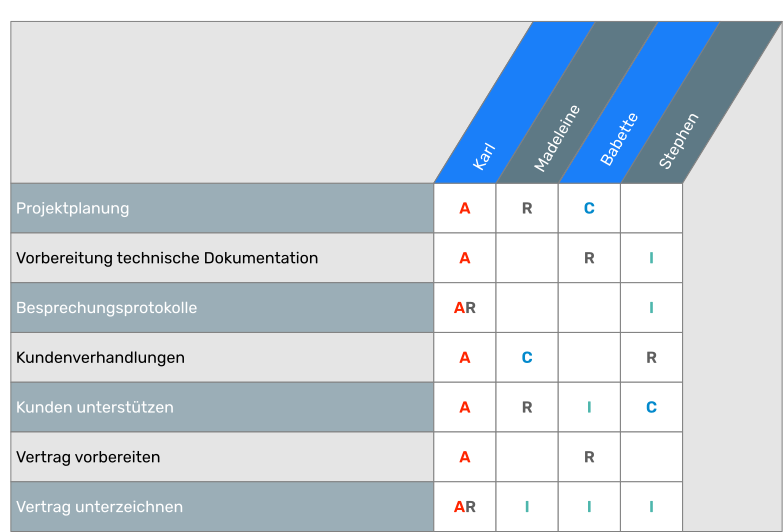
To illustrate the RACI principle for project management, let’s use the table above. The process described calls for Karl to be the decision-maker (Accountable) for questions relating to the “Plan Project” process. Madeleine is responsible (Responsible) for completing the project planning. And Babette can be brought in as an advisor (Consulted) because she knows about dependencies between this project and her own, and can alert Madeleine to potential conflicts.
Furthermore, the process specifies that Stephen generally receives copies of the meeting minutes (Informed), as he needs this information to manage his own work.
What Are the Benefits of the RACI Diagram?
When applied correctly, the RACI method offers you a whole range of benefits:
- Transparency: The RACI chart clearly shows who is responsible for what. This avoids unnecessary discussions and eliminates misunderstandings.
- Fair task distribution: It becomes visible when individual team members have been assigned too many or too few tasks.
- No bottlenecks: It becomes clear when team members appear as Consulted in too many places in the process, potentially slowing down project progress.
- Targeted communication: If a team member is listed as Informed for almost every process, you should question whether that is really necessary. The RACI method helps build an efficient communication scheme in projects and organizations. Good time management supports the flow of information in a targeted and timely manner. Information reaches exactly where it is useful in a systematic way. Unnecessary communication following a “watering-can” approach is avoided.
How Do You Create a RACI Matrix?
Here is how you set up a corresponding scheme for your project:
- Create a list of project tasks
- Identify the project participants
- Assign one Responsible and one Accountable for each task or process
- Ensure there is only one Responsible per process
- Talk to all Responsible and Accountable parties and make sure everyone has understood their tasks and role
- Add Consulted and Informed parties as needed
All of this happens almost automatically when you work with a project management tool like Allegra. There you already create all processes with one Responsible each, and you can optionally add Accountable (manager), Consulted (editors), and Informed (observers).
Tips for the RACI Matrix
- The RACI matrix must not be misused as a control instrument. The RACI matrix cannot fix a dysfunctional team. Team spirit must be in place and trust must exist.
- Tasks must be formulated clearly and understandably. The scope of a task must be clear.
- Establish — for example in a project manual — who is responsible for creating and maintaining the RACI chart itself.
- Define whether a Consulted party can and must act on their own initiative or only upon request.
- Make it clear that it is not the Accountable who is responsible for a task, but the Responsible. Of course, both roles can also be held by the same person.
- Ensure that exactly one Responsible (R) is named in each row. It rarely works well when multiple people are responsible. If in doubt, split a task into two sub-tasks.
- Avoid bottlenecks by keeping the number of C’s in any one row low.
- Ensure that the RACI method is integrated into regular project planning. It serves no purpose if you maintain the RACI matrix in a spreadsheet while handling project planning and tracking in a separate tool.
RACI and Agile
RACI does not necessarily have to be limited to classic process models like PRINCE2. Some Scrum practitioners are of the opinion that the RACI chart cannot be integrated unchanged into Scrum projects. There is often a desire to add Scrum-specific roles, activities, and responsibilities such as “Facilitator/Coach” or “Ensuring consistency of Scrum practices.” These adaptations frequently lead to discussions that touch on both technical details and the fundamental principles of the Agile Manifesto and the Scrum Guide.
To develop a Scrum-based RACI method, you should examine which tasks are truly necessary. For example, one might ask why certain activities such as “protecting the team from interruptions” or “informing stakeholders” are missing. There are over 50 specific tasks distributed across Scrum roles. A well-structured RACI matrix should include these tasks and clearly delineate responsibilities. It is particularly important for the Product Owner (PO) to have clearly defined responsibilities. According to the Scrum Guide, the PO is responsible for the product backlog, but can delegate tasks to the development team — while overall accountability remains with the PO.
Another issue concerns missing Scrum roles in traditional RACI diagrams — such as stakeholders and the development team — while roles like project manager are often included. To remain Scrum-compliant, these gaps should be closed and all relevant Scrum roles taken into account.
Both the Agile Manifesto and the Scrum Guide are designed as frameworks and not complete project management methods. Therefore, adaptations to the RACI matrix should only be made when they are truly necessary. For example, the Product Owner remains both responsible and accountable for backlog management according to the Scrum Guide, but can delegate certain tasks to the development team. This results in a RACI distribution where the development team is assigned “R” (Responsible) while the PO remains “A” (Accountable).
Collaboration between business representatives and developers is enshrined in the Agile Manifesto. This means that stakeholders are also obligated to provide feedback and take responsibility for collaboration.
Scrum places great value on communication and self-initiative. Any team member can be consulted, and the Daily Scrum provides an opportunity to give feedback quickly. With these principles in mind, a Product Owner or project manager can develop a RACI template that is discussed and agreed upon in the kickoff meeting when the Scrum team defines the Definition of Done.
A Scrum RACI matrix could, unlike in the waterfall approach, contain only activities that are defined in the Sprint Backlog. In Scrum, tasks are assigned to people, and good Scrum tools often provide a digital task board view where all current responsibilities within the team are visible. If the team composition or task distribution changes, the task board can easily be updated to reflect the new responsibilities.
Letting RACI Work for You
The RACI matrix is most effective when it is integrated into task management. This automatically ensures, for example, that there is always exactly one Responsible for any given process.
Through a corresponding auto-mail scheme in project management, you can precisely define for each RACI role who gets informed, when, and how. And through a permissions scheme, you can use RACI roles to determine who has access to a process and who does not.
RACI Variants
There are quite a number of variants of the RACI method for project management to clearly define responsibilities and accountabilities. A fairly comprehensive list can be found on Wikipedia.
DRASCI: This adds the roles “Driver” and “Support.” The “Driver” assists the Responsible in management, while the “Support” assists them at the execution level.
RASCI: The standard RACI matrix extended by “Support” — the people who assist the “Responsible” person in carrying out a task.
RACI-VS: This introduces two additional dimensions: If a role is assigned “Verify,” that party should check whether the defined product properties have been implemented as intended. “Signatory” means that a person endorses the “Verify” result. Compared to standard RACI, additional review steps are built in here.
CAIRO: Essentially standard RACI, simply extended by “Omitted.” When this value is assigned, participants are deliberately excluded from a task.
RACI in Allegra
In the project management software Allegra, the RACI matrix is built in. The RACI principle is used in two contexts:
- To control access and permissions
- To control notifications
Each process can be assigned a (R)esponsible, (A)ccountable, (C)onsulted, and (I)nformed. These RACI roles are called “Assignee,” “Manager,” “Editor,” and “Observer” in Allegra. It is configurable which people or groups may assume these roles in a given area. This allows you to give a user edit permissions for a specific process, even if that user might not normally be able to view the processes of other users.
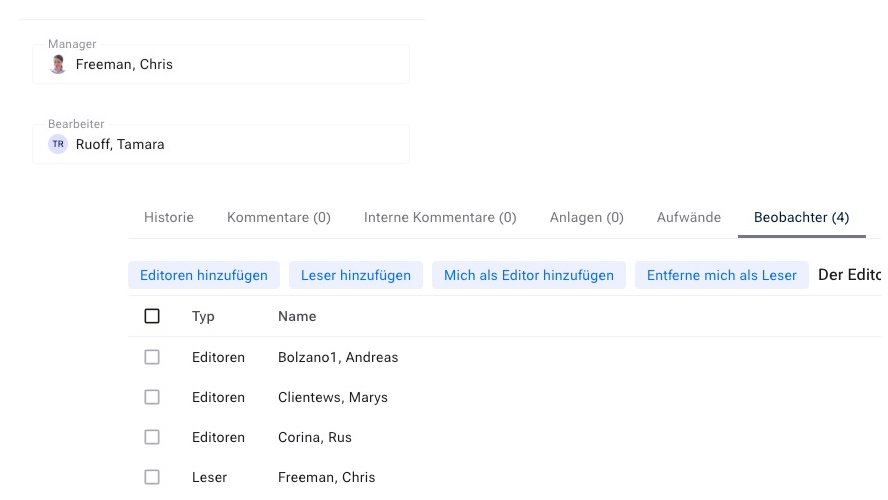
Notifications are also controlled via RACI roles. For each role a user holds in relation to a process, they can configure which events they want to be notified about. For example, as an Accountable you may only want to be notified when a process status changes to “done,” while a Responsible is interested in almost all changes.
This pragmatic use of the RACI principle creates an advantageous system for access control and notifications.
Frequently Asked Questions
What is RACI?
RACI is a model for assigning responsibilities in projects and stands for Responsible, Accountable, Consulted, and Informed. It helps establish clear responsibilities for tasks and ensures that all parties know their role. This prevents misunderstandings and overlaps in project management.
What is a RACI matrix?
The RACI matrix is a tool in project management used to clearly define roles and responsibilities for specific tasks or processes. It presents participants in a table, specifying for each task who is Responsible, Accountable, Consulted, and Informed. This matrix helps create transparency and clarify communication channels within the project.
Are there RACI tools?
The project management software Allegra has built-in RACI functionality. Learn how to integrate the RACI matrix into your project planning and present it at your kickoff meeting in our further reading articles.

Senior Advisor
Jörg Friedrich is the original author of the project management software Allegra and continues to accompany its development to this day. He has many years of industry experience as a project and department manager. He also serves as a professor in the Faculty of Computer Science and Information Technology at Esslingen University of Applied Sciences.