What Is Time Management?
Time management deals with the art of dividing your time as profitably as possible. With the help of appropriate methods and techniques, the goal is to increase productivity and efficiency while avoiding unhealthy stress. What constitutes a “profit” is something everyone decides for themselves.
Time management is relevant to everyone, because every person arrives in this world with an unknown budget of time that they spend over the course of their life. Some expenditures are imposed on them; others they make gladly.
In this article, we focus primarily on personal time management or self-management. Beyond that, there are activities within the context of project management that relate to time management, which we touch on only briefly here.
Time management is an art. As with any other art, three factors are needed to master it:
- Knowledge of methods and techniques
- Self-discipline for regular practice
- Talent
We won’t dwell on the last point, even though it plays a significant role. The talent for time management and organization is not evenly distributed, and its distribution is beyond our influence. Lack of talent can only be partially compensated for by attending seminars or reading books and articles.
What Do You Get Out of Time Management?
Time management helps you and your team to do significantly more within the time available, and to do more of what matters. The key benefits are:
- Higher productivity thanks to more efficient work organization, stronger focus on the most important tasks, and optimal use of available time and energy.
- Less stress, since you proceed in a planned manner and reduce hectic rushing and deadline pressure with sensible time budgets.
- Improved work quality, because it is easier to avoid mistakes and pay attention to detail when you are not constantly in a hurry. “There was never enough time to do it right the first time, but somehow there was always time to do it over.”
- Better forecasts as a result of regularly estimating tasks, which improves your reliability and increases your chances of success.
- Greater self-confidence, because when you meet your deadlines and achieve your goals, you feel more confident and successful.
- Clear boundaries between work and personal life help you find time “to sharpen the saw.” You need phases of rest and defocusing in order to stay creative and mentally strong.
11 Techniques for Better Time Management
There are a number of techniques for time management, some of which are supported by corresponding methods. The most important core concepts and techniques are presented below.
1. Collect, Organize, and Prioritize
Every day we deal with matters that are triggered either by our own thoughts or through one of the many communication channels available to us. If we react to them without a system, we frequently have to switch context and jump from one task to the next depending on what comes in. That is not very effective.
It has proven beneficial to periodically collect all matters first, organize them, and then prioritize them. For collecting and organizing, the Getting Things Done method (GTD) is a great fit. For prioritization, the Eisenhower Matrix, the Pareto Principle, the ABC Method, and the ALPEN Method are particularly well suited.
According to the GTD method, you first collect all incoming matters in a personal inbox. The “inbox” can be maintained electronically, for example in task management software or one of the many available project management tools. The contents of this inbox are analyzed regularly and sorted into one of three categories: “requires action,” “no action required,” and “planned.”
You address the items requiring action at the earliest possible opportunity. You take note of items that require no action and file them somewhere if appropriate. Planned items require time for planning and can be part of, for example, a work breakdown structure (WBS) for a project or a Scrum product backlog.
All matters can be categorized according to the Eisenhower Principle, which puts them into a priority order. This way you first attend to what is urgent and important, and you don’t get caught up in what is neither urgent nor important.
2. Structure and Plan
Larger tasks or matters cannot be handled ad hoc — they require planning. For project planning, it is helpful to break larger items down into sub-items until only tasks or items of the scope of a reporting interval remain, such as a week or a day. For documenting meeting results, taking minutes can be helpful. This way you won’t feel overwhelmed by the scope of a task but will work through the sub-items in an orderly, sequential fashion. When structuring and planning, you work with calendars, ticketing systems, or project management software.
3. Define Time Blocks
It has proven useful to group similar tasks together and work through them all at once without interruption. Therefore, reserve fixed time slots for particular types of tasks. This can help minimize distractions and maintain focus on the current task. Helpful methods for this include Time Blocking, Time Boxing, Jour Fixe, and the Pomodoro Technique.
4. Set Goals
Setting goals is a decisive tool for personal and professional progress. Goals provide:
- Direction and focus: Goals offer a clear sense of where you want to go and what steps are necessary to get there.
- Motivation: Knowing the “why” behind a goal can serve as a driving force, especially in difficult times.
- Measurability: By setting clear goals, you can monitor your progress and make adjustments as needed.
- Self-confidence: Achieving the goals you set promotes self-confidence and belief in your own abilities.
What approaches lend themselves to formulating goals? The most important are:
- SMART principle: A widely used approach for goal-setting is the SMART principle. It calls for goals to be clearly and precisely defined. There should be criteria by which you can measure progress and the achievement of the goal. Goals should be motivating and desirable, and — despite being challenging — attainable. Finally, they should be reached at some point, meaning they should be given a deadline.
- Writing them down: Studies have shown that written goals are more likely to be achieved.
- Defining sub-goals: Large goals can be broken down into smaller, manageable steps or sub-goals. This makes the overall goal less overwhelming and facilitates progress.
- Visualization: Mentally “seeing” the achieved goal can serve as motivation and strengthen the desire to reach it.
- Regular review: It is important to revisit goals regularly and adjust them as needed. Life is dynamic, and flexibility with goals may be necessary.
5. Delegate: Gaining Power by Letting Go
Whether in a company, a project team, or even in everyday family life — effective delegation is a key to success. Why should you delegate tasks?
- Time efficiency: Nobody can do everything alone. Delegating tasks makes it possible to accomplish more in less time and to focus on the things that truly matter.
- Leveraging strengths: Everyone has their strengths. By delegating tasks to people who are better in certain areas, the result is often of higher quality.
- Team development: When team members are given responsibility, they often grow beyond themselves, acquire new skills, and feel valued.
Why do people shy away from delegating?
- Fear of losing control: Many people worry that delegated tasks will not be completed to the desired quality.
- Micromanagement: Even after delegating, some find it hard to let go. Constant interference, however, can be demotivating and undermine the delegation process.
- Imprecise communication: When expectations and instructions are not communicated clearly, this can lead to misunderstandings.
What should you pay attention to when delegating?
- Choose the right task: Not every task is suitable for delegation. It is important to think strategically about which activities can be handed off.
- Choose the right person: Consider who has the skills and knowledge required for the task.
- Set clear expectations: Make sure the person clearly understands what they need to do, what results are expected, and what deadlines apply.
- Offer support: Provide resources and training, and be available as a point of contact.
- Give feedback: After the task is completed, it is important to give feedback — both positive and constructive.
6. Avoid Perfectionism: Good Enough Is Often Better
Perfectionism can lead to burnout, stress, and inefficient working in everyday professional life. While striving for excellence is commendable, excessive perfectionism can be counterproductive. But how do you find the right balance, and why is it important to avoid perfectionism?
- Time investment: Perfectionists tend to invest far too much time in tasks that could be satisfactorily solved with less effort.
- Fear of mistakes: The fear of making mistakes can be paralyzing and prevent innovative approaches.
- Stress and burnout: The constant pursuit of perfection can lead to excessive stress and ultimately to burnout.
- Team dynamics: Excessively high expectations can create tension within the team and make collaboration more difficult.
How can you avoid perfectionism?
- Set priorities: Consider which tasks truly need to be perfect and which simply need to be done well.
- Set limits for yourself: Decide in advance how much time you want to spend on a task, and stick to it.
- See mistakes as learning opportunities: Every mistake is a chance to learn and grow. Instead of focusing on the mistake, ask yourself what you can learn from it.
- Seek feedback: Sometimes we need another person’s perspective to recognize that our work is already of high quality.
- Healthy work habits: Take regular breaks, practice mindfulness or meditation, and make sure you get physical activity to reduce stress.
- Self-reflection: Question where your perfectionism comes from. Is it an inner drive or external pressure? Understanding the causes can help you manage perfectionism better.
Avoiding perfectionism does not mean doing sloppy work. It is about finding the right balance between quality and efficiency. In many cases, “good enough” can actually be better than perfect — especially when it comes to meeting deadlines, maintaining workflow, or simply staying mentally healthy.
7. Block Out Distractions
In our modern, connected world, distractions are everywhere. Every notification, every new email, and every sudden noise can break our concentration. Especially in the context of time management, blocking out distractions is essential for working productively and meeting deadlines. But how do you manage to focus in a distraction-rich environment?
Before we address how to minimize distractions, we should understand why they can be so harmful:
- Interruption of workflow: A quick glance at a smartphone can cause you to lose valuable minutes — or even hours — before you find your way back into a “flow” state.
- Mental exhaustion: Constantly switching between different tasks can be mentally tiring and reduce cognitive performance.
- Loss of quality: Distractions can impair the quality of work and lead to mistakes.
The following strategies help with blocking out distractions:
- Optimize your work environment: Ensure a quiet, tidy workspace. If possible, choose a location where you are protected from unwanted interruptions.
- Control communication: Turn off non-urgent notifications, keep your smartphone out of reach, or use apps that block distractions.
- Fixed times for breaks: Schedule regular breaks during which you consciously allow yourself to give in to distractions. This can help reduce the urge to get distracted during working time.
- Set priorities: Create a clear list of tasks and focus first on the most important and most urgent.
- Time blocks: Use the technique of time blocking, in which you reserve fixed times for specific tasks. This creates structure and limits opportunities for distraction.
- Set boundaries: Inform colleagues, family members, or housemates about your working hours and ask them to respect these periods.
8. Don’t Forget Breaks
Working with a blunt saw because you can’t find time to sharpen it is foolish. If a bow is kept under constant tension, it will lose its elasticity. “Sharpening the saw,” releasing the bow’s tension, means giving body and mind periods of recovery.
Stepping away from the hustle and bustle of daily life, letting go of work, and turning our thoughts to something else does not mean wasting our time unproductively. On the contrary — because the saw is sharp again, we will be significantly more productive overall. The Pomodoro Technique has proven very effective in this regard. Even short breaks during work can boost productivity and prevent you from feeling burned out.
9. Avoid Procrastination
Many people drag around a pile of unpleasant tasks they keep putting off. Sooner or later this leads to stress. To counter this, you can, for example, make it a general rule to put such tasks at the beginning of the day. Self-reflection is also helpful — making yourself aware of why you tend to postpone certain tasks. Many of the time management techniques discussed here help to reduce procrastination.
10. Minimize Multitasking
People can perform simple, automated tasks simultaneously — for example, walking and talking. However, when it comes to more complex cognitive tasks, such as reading an article and listening to a podcast, it becomes much harder to do both effectively at the same time.
What people often refer to as multitasking is actually rapid switching between tasks, also known as “task switching.” Every time we switch between tasks, there is a “switching cost” that — even if it amounts to only fractions of a second — can lead to less efficient work over time. It is therefore advantageous in most cases to focus on one thing at a time and block out distractions.
11. Build Routines — Or the Power of Habit
Routines give the day a clear structure. This helps with setting priorities and ensuring that important tasks are completed regularly. By performing certain activities routinely, you reduce the number of decisions you have to make each day. This saves mental energy and minimizes decision fatigue. When you perform a task regularly, it becomes a habit and requires less conscious effort. This makes it possible to reserve cognitive resources for more complex tasks. Through routines, you know exactly when and how you will handle certain tasks. This allows you to optimize workflows and save time. Routines provide a degree of predictability in everyday life. This can strengthen the sense of control and contribute to mental stability.
8 Time Management Methods for Greater Productivity
1. Time Blocking
With time blocking, the day is divided into fixed time blocks. Instead of responding to emails throughout the entire day, for example, we reserve a specific time period — say, from 8:00 to 8:30 a.m. — to clear our inbox and reply to messages. Once that’s done, we move on to the next task.
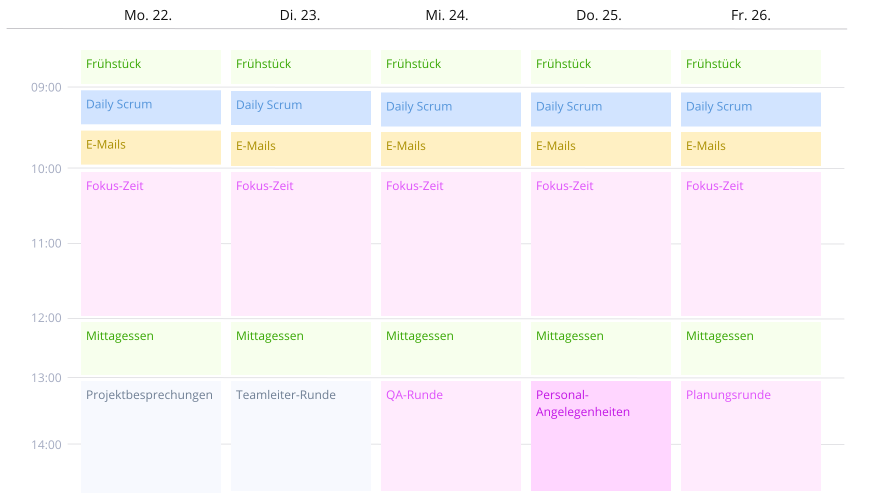
An essential element of time blocking is setting aside time blocks for “deep work” — focused work on one type of task. New tasks are categorized and assigned to the next available free time block designated for them. This allows us to avoid unproductive multitasking and prevents interruptions from dictating our day.
2. Time Boxing
With Time Boxing, we reserve a fixed time block in our calendar for each task or activity. During that time, we focus exclusively on the task at hand and aim to complete it within the defined timeframe.
The idea behind time boxing is that a clear time limit helps us work with greater focus and productivity. By setting a defined time limit, we direct our attention to what matters most and minimize distractions. At the same time, it reduces the risk of procrastination, since we are aware of the limited time available and are motivated to complete the task within the allotted period.
3. Eisenhower Matrix
With the Eisenhower Matrix, we distinguish between the urgency and importance of a task. The combination of importance and urgency determines priority. The Eisenhower Matrix organizes pending tasks into four priority levels:
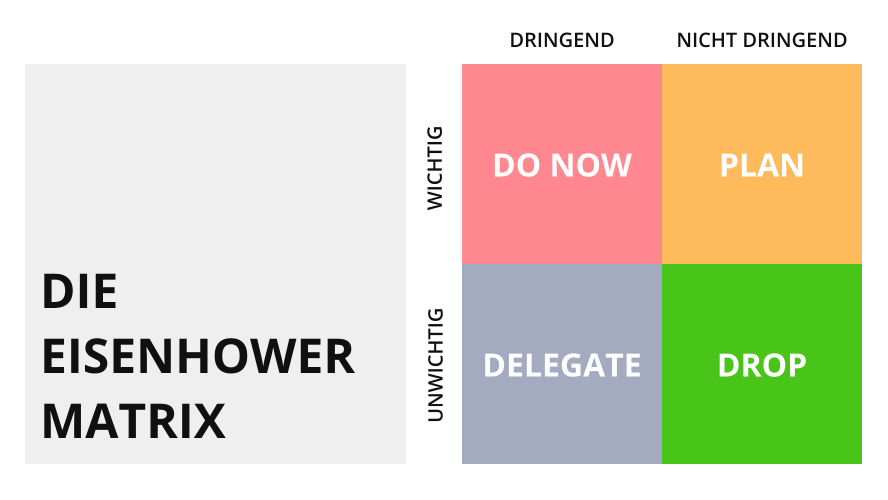
- important and urgent
- important and not urgent
- not important but urgent
- neither important nor urgent
Urgent matters require our attention in the short term. Sometimes, however, they are completely unimportant.
Tasks are usually important because their outcome matters. Sorting tasks by importance always has to do with results.
We tend to put off important things when they are not also urgent. While we respond to urgent tasks almost automatically, important but non-urgent tasks require a conscious and proactive approach. This calls for both practice and a corresponding mindset.
Quadrant 1 in the Eisenhower Principle describes what is both important and urgent. These are often “crises” or “problems.” You don’t want too many of those.
Quadrant 3 gives the impression of dealing with important tasks. This impression often arises because others expect something to be done quickly, lending the task an apparent importance. This artificially created urgency makes unimportant tasks suddenly seem important, even though the result actually has little to no significance.
Not important but urgent: catching up with a colleague who just walked into the office on the latest news, so you can pass it on.
Not important and not urgent: organizing your stamp collection right now.
Applying the Eisenhower Principle is an elegant, simple tool for setting priorities. The only reason it doesn’t always succeed in practice is that we prefer to occupy ourselves with things we enjoy.
4. Pomodoro Technique
One of the best-known time management methods is the Pomodoro Technique, developed in the late 1980s by Francesco Cirillo. The name “Pomodoro” is the Italian word for “tomato,” inspired by the tomato-shaped kitchen timer Cirillo used as a student when practicing the method.
The basic concept of the Pomodoro Technique is quite simple and is based on the idea that frequent breaks can improve mental agility.
How the Pomodoro Technique Works
- Choose a task: Start with a specific task or group of tasks you want to complete.
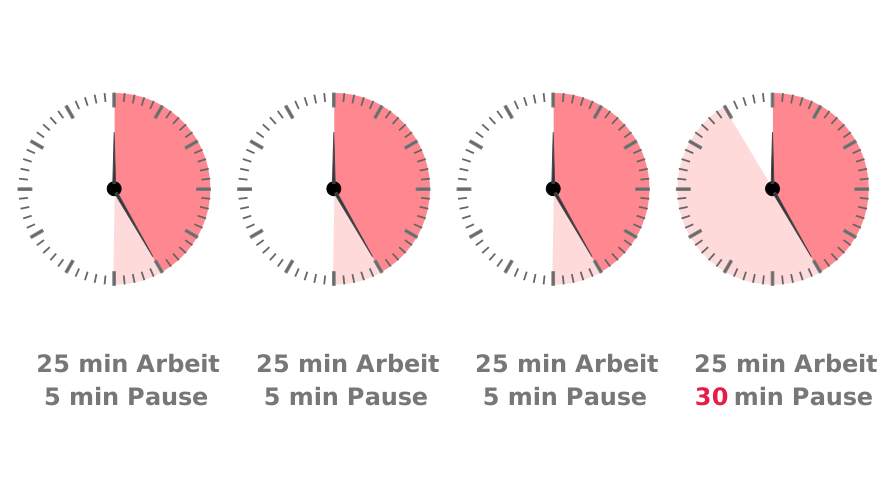
- Set a timer for 25 minutes: These 25-minute intervals are called “Pomodoros.”
- Work on the task: Work on the chosen task until the timer rings. During this time, you should focus entirely on the task and avoid all distractions.
- Short break: When the 25 minutes are up, take a 5-minute break. This gives you the opportunity to relax and mentally prepare for the next Pomodoro.
- Repeat: After your break, set the timer again for 25 minutes and continue working on your task or start a new one.
- Longer breaks: After completing four Pomodoros (a total of 100 minutes of work time), take a longer break of 15–30 minutes. This helps you recover and ensures sustained concentration over longer periods.
Benefits of the Pomodoro Technique in Time Management
- Focus: The method forces you to concentrate on one task and minimize distractions.
- Regular breaks: The regular breaks can help reduce mental fatigue and maintain concentration over longer periods.
- Structuring the workday: The technique provides a clear structure that promotes a sense of progress and control.
- Reducing procrastination: Knowing that only 25 minutes of intensive work lie ahead can lower the barrier to starting a task.
- Time tracking: It can also be a useful tool for finding out how much time you actually need for various tasks.
Many people find the Pomodoro Technique useful for boosting their productivity and making their work more efficient. It is important to emphasize, however, that not every method is ideal for everyone. Some people prefer longer work intervals or different break times. It is worth experimenting with various approaches to find out what works best for you.
5. Getting Things Done
“Getting Things Done” (GTD) is a time management and productivity method introduced by David Allen in his book of the same name, “Getting Things Done: The Art of Stress-Free Productivity.” The method focuses on organizing tasks, ideas, and commitments in a reliable system so that the mind remains free from distractions and can focus entirely on the task at hand.
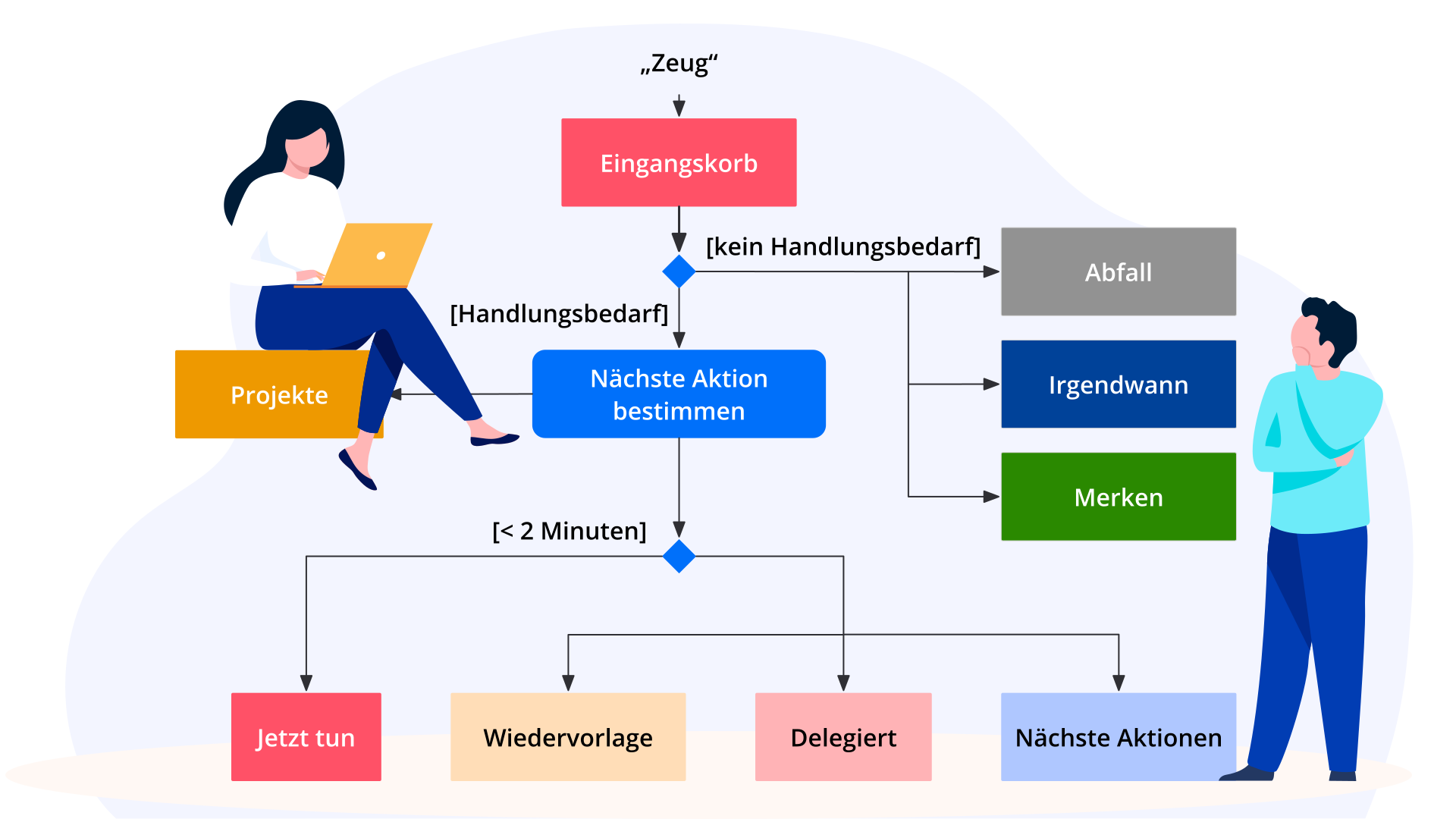
The GTD system is based on the concept that when a person relies on their memory to keep track of all information and tasks in their head, they will inevitably end up stressed. GTD proposes transferring all this information to an external system.
Here are the five core steps of the GTD method:
- Capture: Write down everything that requires your attention. It could be a task, an idea, an appointment, or anything else. The goal is to get everything out of your head and collect it in one place — whether that’s a notebook, an app, or, for example, task management software.
- Clarify: Review the captured items and decide what action is required. If no action is required, archive the information, delegate it, or discard it. If an action is required, define the next step.
- Organize: Sort the captured and clarified tasks and information into the right places. These can be to-do lists, calendars, dedicated folders, or other systems. David Allen recommends various lists, such as a project list, a waiting list (for delegated tasks), and a list for future tasks.
- Reflect: Regularly review and update your GTD system. A weekly review, in which you go through your lists and ensure everything is current and that you are setting the right priorities, is a central component of the method.
- Engage: Carry out the actions you have defined in your lists, with clear focus and without distraction.
Some benefits of GTD are:
- Less stress: By capturing and organizing all tasks in an external system, GTD reduces the feeling of being overwhelmed.
- Clear focus: By reflecting and reviewing regularly, you can ensure that you are concentrating on the right things.
- Flexibility: GTD can be implemented with various tools and in different environments, whether with pen and paper or digital tools.
GTD does require an initial settling-in period and discipline to develop the habit of regularly reviewing and capturing tasks. Many people who apply the system consistently, however, report a significant increase in their productivity and a reduction in their stress levels.
6. Pareto Principle
The Pareto Principle, also known as the Pareto Method or the 80/20 Rule, was named after the Italian economist Vilfredo Pareto. Pareto originally observed that approximately 80% of the land in Italy was owned by 20% of the population. This principle was later applied to many other areas, including time management.
In the context of time management, the Pareto Principle states:
80% of results come from 20% of efforts.
In other words: a large share of the outcomes we achieve in work or life stems from a relatively small portion of our efforts. This implies that there are many activities we undertake that do not necessarily have the greatest impact on our desired results.
Here are some applications of the Pareto Principle in time management:
- Prioritizing tasks: Identify the 20% of tasks that will deliver 80% of the desired results, and focus on those first.
- Increasing efficiency: Recognize the activities that have the greatest impact on your work or project, and invest more time and resources in them while reducing or eliminating less productive activities.
- Analyzing problems: When problems arise in a project or process, 80% of the problems can often be traced back to 20% of the causes. By focusing on these root causes, problems can be resolved more efficiently.
- Customer management: In many businesses, 20% of customers generate 80% of revenue. Recognizing and nurturing these key customer relationships can help businesses grow.
- Personal development: Consider which 20% of skills or knowledge could deliver 80% of the desired progress in your career or personal life. Focus on growing in those areas.
It is important to emphasize that the numbers 80 and 20 do not always apply exactly and should be understood more as a metaphorical ratio. The essential point of the Pareto Principle is the concept that there is often an imbalance between effort and outcome. Understanding this principle can help us make optimal use of our time and resources.
7. SMART
SMART is an acronym that serves to define goals more clearly, measurably, and realistically. A SMART-defined goal should meet the following criteria:
- S – Specific - The goal should be formulated as precisely as possible. Instead of “I want to lose weight,” a specific goal might be: “I want to lose 5 kilograms.”
- M – Measurable - The goal should be defined in a way that allows for measuring or evaluating progress. For the goal above, measurability could be achieved through regular weigh-ins.
- A – Achievable - The goal should be realistic and attainable, taking into account available resources and constraints. A goal of losing 20 kilograms in one month would probably not be achievable and could even be harmful to your health.
- R – Relevant - The goal should be important and meaningful to the individual or the team. If you have no interest in running marathons, for example, setting the goal of running one would not be relevant.
- T – Time-bound - The goal should have a clear timeframe or end date. “I want to lose 5 kilograms in the next 3 months” provides a clear timeframe within which the goal is to be achieved.
Applying the SMART criteria in goal-setting can help transform vague or unclear goals into concrete, action-oriented, and verifiable ones. When goals are defined this way, they are more likely to be achieved, since they are clearly communicated and progress can be tracked more easily. This in turn can increase motivation and improve time management, because you know exactly what you want to achieve and by when.
8. Kanban
Kanban is a method for visualizing workflows and processes that has its origins in the Japanese Toyota factories of the 1940s. The word “Kanban” comes from Japanese and literally means “sign” or “board.” In today’s working world, the Kanban method is often used with cards (physical or digital) on a board to represent the progress of tasks through the various stages of a process.
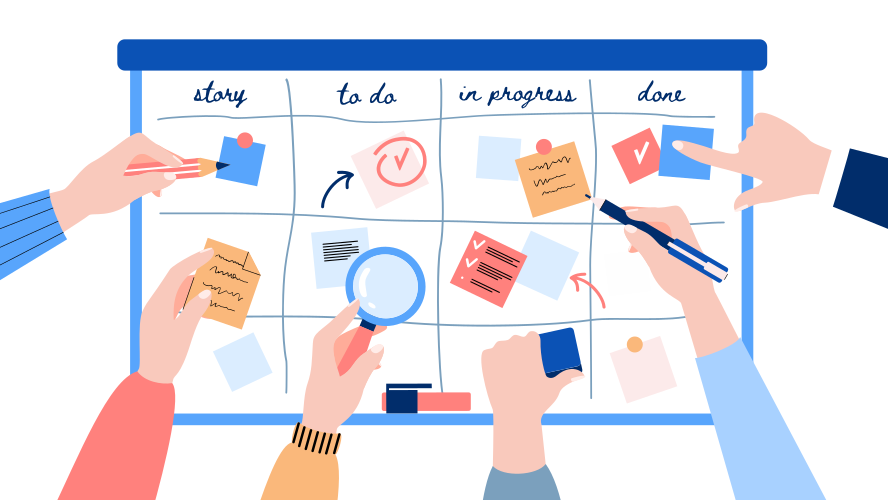
The Core Principles of Kanban Are:
- Visualization of workflow: All tasks are represented on cards and placed on a Kanban board. This board is divided into several columns representing the various stages or phases of the work process — usually at minimum “To Do,” “In Progress,” and “Done.”
- Limiting work in progress: To avoid bottlenecks and increase efficiency, the number of tasks that can be worked on simultaneously in any given phase is often capped. This is referred to as the Work-in-Progress limit (WIP limit).
- Flowing work: The goal is to let work flow through the process as smoothly as possible. By limiting simultaneous work and regularly reviewing the board, bottlenecks and delays can be quickly identified and addressed.
- Continuous improvement: Teams using Kanban should regularly review their work process and look for opportunities to optimize and improve it.
Benefits of Kanban:
- Transparency: All team members can see the current status of a task and the entire work process at a glance.
- Flexibility: Unlike other methods in which work is organized in fixed cycles (such as Scrum Sprints), Kanban allows for flexible handling of tasks, since new tasks can be added at any time.
- Focus: By limiting simultaneous work, team members can concentrate better on their current tasks and are less affected by multitasking or constant switching between tasks.
- Faster problem detection: Bottlenecks, blockages, or inefficiencies quickly become visible through the visual nature of the Kanban board and can be addressed.
Kanban is now used not only in manufacturing but especially in software development and IT project management. There are also many digital tools that offer virtual Kanban boards, such as Allegra, Jira, Trello, and many others.
Summary
Time management is one of the keys to better work outcomes — time management techniques promote professional growth, a more fulfilling and happier life. This practice helps you navigate the chaos of modern life with ease, even if you need to invest some effort to understand how time management works and how to implement it correctly.
You can find more information on project management tips in our Allegra blog posts. Reach out to an Allegra consultant to get software tools that help you manage your time and tasks.
Frequently Asked Questions
What is meant by time management?
Time management refers to the planning and effective allocation of time for tasks in order to increase personal efficiency. It serves to create realistic schedules and ensure the productive use of available time. Through time management, you can set priorities and maximize your productivity. Effective time allocation helps reduce stress and provides a structured method for handling tasks.
What does good time management involve?
Good time management encompasses various measures and techniques, such as reducing and delegating tasks, creating daily plans, avoiding distractions, breaking tasks down, setting priorities, tracking time use, avoiding mistakes and perfectionism, and documenting the status of activities. These steps help make effective use of time and become more productive.
What time management methods are there?
There are various time management methods for increasing productivity. These include Time Boxing, Time Blocking, the Pomodoro Method, the Eisenhower Principle, Eat the Frog, the Pareto Principle, and Getting Things Done (GTD). Another effective method is linking everyday work to goals. Learn how these methods can help you make better use of your time and boost your productivity.
What makes time management good?
Good time management means avoiding overwhelm and using the available time productively. It helps you keep track of tasks and set priorities. By working efficiently, you can avoid exhaustion and successfully work through your task list. Optimize your time management for better productivity and well-being.

CEO Alltena GmbH
Christoph Friedrich is a computer scientist and certified Project Management Professional. He has extensive experience in the introduction and integration of project management tools as well as the analysis and definition of processes in project and service management.