What does productivity actually mean?
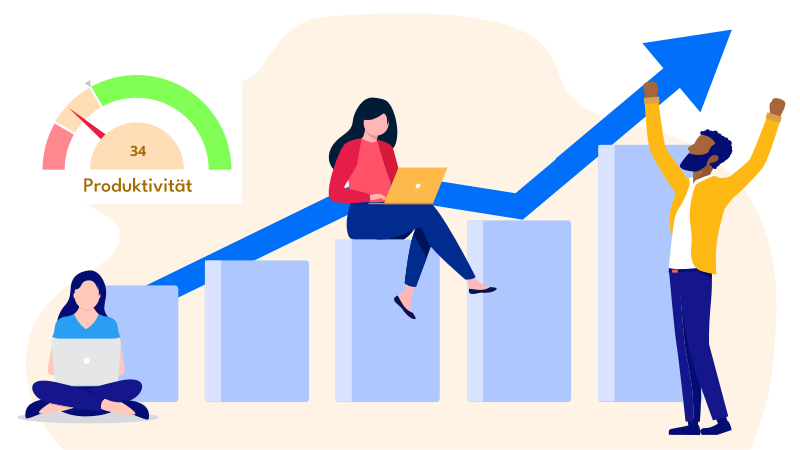
Productivity describes the ability to generate as much value or output as possible within a given period of time. At its core, it is about using available time and resources in a way that brings the greatest possible benefit from the work. While many people associate productivity exclusively with the quantity of work completed, it is in reality also about the quality and the relevance of the tasks accomplished. Productivity is not just an individual trait — it is also a central factor at the societal and economic level. In the modern world of work, how effectively and efficiently people and organizations work is decisive.
Productivity and working hours
A widespread misconception is that longer working hours automatically lead to higher productivity. Studies show the opposite, however: excessive working hours can actually reduce productivity.
A frequently cited study on the relationship between working hours and productivity comes from John Pencavel of Stanford University. In this study titled “The Productivity of Working Hours” (2014), Pencavel showed that productivity declines significantly after a certain point in working hours. He analyzed data from British factory workers during World War I and found that productivity per hour drops significantly after 50 working hours per week. At 70 hours, productivity was barely higher than at 55 hours, indicating diminishing efficiency with longer working hours.
The study argues that more working hours do not necessarily lead to a proportional increase in output, and that too many hours can even be counterproductive, as mental and physical fatigue grows. This leads to errors, slower work, and ultimately lower quality. (Source Pencavel, J. (2014). The Productivity of Working Hours. IZA Discussion Paper No. 8129. Available at https://docs.iza.org/dp8129.pdf.
Breaks and recovery are therefore essential components of a productive working day. People who manage their time well and consciously take breaks often manage to accomplish more in less time, because they approach their tasks with greater focus and freshness.
Efficiency vs. productivity
Although the terms efficiency and productivity are often used interchangeably, there are important differences. Efficiency refers to completing a task with as little expenditure of resources — such as time or energy — as possible; it means doing things right. Productivity goes a step further and also asks whether the right things are being done. An example: someone can be very efficient at answering many emails in a short time, but if those emails do not contribute to the important goals or projects, the person may be efficient but not truly productive.
The worst combination in an employee is stupidity paired with diligence.
Dr. R. Malutzki
Productivity therefore requires working both efficiently and effectively. Effectiveness means identifying and completing the right tasks — those that have the greatest impact on progress and goal achievement. Ultimately, productivity is about the smart use of time, priorities, and energy, not just to tick off tasks, but to achieve sustainable, valuable results.
Tip 1: Avoid Distractions
In a world full of digital and social stimuli, it is often difficult to concentrate on one task and work productively. Distractions are omnipresent and can significantly impair our ability to work efficiently. But what exactly distracts us, why do we let ourselves be distracted, and what can we do to minimize these disruptions?
What distracts us?
The most common distractions in the modern workplace are digital interruptions such as notifications from smartphones, emails, social media, and chat messages. Studies show that a single interruption often means we need several minutes to regain full concentration. There are also physical distractions such as noise, conversations from colleagues, or personal commitments that pull us out of our workflow. Another obstacle is internal distractions, such as a wandering mind or the urge to keep switching between tasks without completing them.
Why do we let ourselves be distracted?
People allow themselves to be easily distracted for various reasons. One of them is human curiosity and the desire for social interaction. Our brains are trained to respond to new stimuli, particularly those that promise rewards such as social validation in the form of likes or messages. In addition, constantly switching between tasks is often tempting because our brain prefers short-term rewards to long-term goals. So-called multitasking tempts us to want to handle several tasks simultaneously — even though it has been shown to reduce productivity.
What can we do about distractions?
To minimize distractions, it is crucial to create a structured working environment. One of the most effective methods is to control digital distractions. This includes turning off notifications on your smartphone or computer and setting up specific time blocks during which emails and messages are processed. Tools like website blockers can help limit access to distracting websites during working hours.
In addition, the Pomodoro Technique can be used to work in focused intervals (e.g., 25 minutes of work followed by 5 minutes of rest). This method creates clear structures and provides regular breaks that the brain needs to stay fresh.
Creating routines also helps to avoid distractions. By sticking to a fixed work schedule and setting clear goals, you reduce the likelihood of losing concentration. Finally, it can be helpful to create a distraction-free environment, whether by wearing headphones or working in a quiet room.
Overall: concentration and discipline are key to avoiding distractions and increasing productivity. With the strategies presented here, we can resist the daily disruptions and maximize our work performance.
- Create a structured working environment
- Turn off notifications on your smartphone or computer
- Set up time blocks during which emails and messages are processed
- Use website blockers to limit access to distracting websites during working hours
- Use the Pomodoro Technique to work in focused intervals
- Create routines
- Create a distraction-free environment, e.g. by wearing headphones or working in a quiet room
Tip 2: Learn to Deal with Procrastination
Procrastination — the constant postponement of tasks — is a widespread problem that can significantly impair productivity. Many people tend to defer important activities to later, often in favor of less urgent or even pointless tasks. This not only leads to unnecessary stress and loss of time, but also diminishes the quality of the work. But why do we tend to procrastinate, and how can we successfully avoid it?
Why do we procrastinate?
Procrastination arises for various reasons. One of the most common is the feeling of being overwhelmed. When a task seems too large or too complex, we shy away from starting it because the end goal feels unattainable. The fear of failure also plays a role — out of fear of not completing a task well enough, we prefer to put it off. Another reason is the inability to properly weigh short-term and long-term rewards. People tend to prefer short-term pleasures such as surfing the internet or watching videos, even though long-term goals like completed projects or professional success would be more important.
How does procrastination reduce productivity?
Procrastination inevitably leads to a reduction in productivity, as it wastes valuable time and disrupts the workflow. When tasks are deferred, the to-dos pile up, leading to stress and time pressure. This can result in work being done hastily and often inaccurately. Moreover, less time remains to deal with the truly important and demanding tasks, leading to a loss of quality. In addition, constantly putting things off undermines one’s own motivation, as you constantly feel guilty and develop self-doubt.
How do I avoid procrastination?
The first step to avoiding procrastination is to break the task down into smaller, manageable steps. Instead of focusing on the end goal, you should set small, achievable intermediate targets that can be tackled immediately. This method reduces the feeling of being overwhelmed and makes it easier to get started.
Another helpful approach is time planning. Techniques like the Pomodoro Method help to divide work into short, focused phases. By establishing clear time blocks (e.g., 25 minutes of work followed by 5 minutes of rest), you can maintain attention without getting distracted too quickly.
Furthermore, it is important to focus on the long term. Your own goals and priorities should be clearly defined and always kept in sight, in order to resist short-term temptations such as social media or entertainment. Creating a distraction-free environment is also crucial for staying focused.
Finally, it helps to train self-discipline. Through daily routines, setting fixed working hours, and consciously avoiding distractions, procrastination can be combated in the long term. With these strategies, anyone can increase their productivity and successfully overcome constant postponement.
- Break the task down into smaller, manageable steps
- Plan your time systematically, e.g. with the Pomodoro Method
- Focus on the long term — clearly define your own goals and priorities and always keep them in sight
- Create a distraction-free environment to stay focused
Tip 3: Prioritize Important Tasks
Prioritizing tasks is one of the most effective methods for increasing your own productivity. It allows you to focus on the most important and valuable activities, rather than wasting time and energy on unimportant tasks. Through prioritization, you gain clarity about which tasks require immediate attention and which can be postponed or delegated. But why is prioritization so effective, and which methods help to implement it efficiently?
Why does prioritization increase productivity?
Prioritization makes it possible to make the best use of the limited resource of time. By focusing on the most important tasks, you ensure that these are completed with the highest energy and attention, which increases their quality. The feeling of being overwhelmed is also reduced, because clear decisions are made rather than randomly working on several tasks at once. Prioritization also ensures that you work towards long-term goals instead of getting lost in short-term or less relevant tasks.
Another advantage lies in the ability to better respond to unforeseen events. When new tasks or challenges arise, a clear plan helps to quickly decide whether they need to be addressed immediately or whether they can wait without affecting the overall result.
Methodical approaches to prioritization
There are several methods for effectively prioritizing tasks. One of the best known is the Eisenhower Matrix, which categorizes tasks by urgency and importance. The matrix divides tasks into four quadrants:
- Urgent and important (do immediately),
- Important, but not urgent (plan),
- Urgent, but not important (delegate),
- Neither urgent nor important (eliminate or postpone).
This method helps to focus on strategically significant tasks and minimize unimportant ones.
Another helpful technique is the Pareto Principle rule, also known as the 80/20 rule. It states that 80% of results come from 20% of efforts. By focusing on this 20%, you can achieve a large part of the desired result with less effort.
Studies on the effectiveness of the methods
The effectiveness of prioritization is well documented. A study by the Harvard Business Review (2011) found that managers who clearly prioritize their tasks are on average 25% more productive than those who do not. The Pareto Principle has also been confirmed repeatedly. An analysis of business results showed that companies that focus on their most valuable activities can significantly increase their efficiency.
- Categorize your tasks using the Eisenhower Method
- Distinguish your tasks using the Pareto Principle
Tip 4: Use Time Management Strategies
Time management is a decisive factor for high productivity. The ability to plan and prioritize tasks and goals within limited periods of time makes it possible to reduce stress while increasing efficiency. Without effective time management, there is a risk of getting bogged down in tasks that contribute little, while important activities are neglected. Time management strategies offer concrete tools to not only get more tasks done, but also to focus on the right things.
The 7 most important time management strategies and how they work:
-
Eisenhower Matrix
The Eisenhower Matrix divides tasks into four categories: urgent and important, important but not urgent, urgent but not important, and neither urgent nor important. This categorization makes it easier to set priorities and focus on what matters. Important things are planned, while unimportant things are eliminated or delegated. -
Pomodoro Technique
The Pomodoro Technique is based on the idea of working in short, intensive work phases (usually 25 minutes), followed by short breaks (5 minutes). After four work phases, there is a longer break. This technique helps to increase concentration and build in regular recovery breaks to avoid mental fatigue. -
Pareto Principle (80/20 Rule)
The Pareto Rule states that 80% of results are achieved through 20% of efforts. By focusing on these most important 20% of tasks, you can achieve the greatest benefit and efficiently reduce the workload. -
SMART Method
SMART goals stand for specific, measurable, attractive, realistic, and time-bound. This method helps to set clear and achievable goals that make it easier to track progress and complete tasks within the time frame. The SMART method ensures that goals are tangible and actionable, which increases productivity. -
Getting Things Done (GTD)
The GTD method by David Allen encourages outsourcing all pending tasks and ideas into a reliable system. This relieves the mind and ensures that nothing is forgotten. Tasks are broken down into concrete steps and organized in a structured system to be worked through efficiently. -
Time-Blocking
With Time-Blocking (not to be confused with Timeboxing), specific time blocks in the calendar are reserved for specific tasks or projects. By creating time windows for focused work, you ensure that the most important activities receive the necessary attention. Distractions are avoided and the working day is structured. -
ABC Method
The ABC Analysis prioritizes tasks into three categories: A-tasks (very important), B-tasks (important but not urgent), and C-tasks (less important). The strategy helps to direct attention to the essential tasks while less important activities are treated as secondary.
Tip 5: Avoid Multitasking
Multitasking — working on several tasks simultaneously — seems at first glance like a productive way of working. In reality, however, it often leads to inefficient work and lower quality results. Multitasking describes the switching back and forth between different activities, whether answering emails while working on a project, or talking on the phone while creating a presentation. Although we believe we are saving time this way, research shows that multitasking greatly impairs our productivity and concentration.
Why is multitasking bad for productivity?
The brain is not designed to concentrate on several demanding tasks at the same time. When we try to multitask, we are in reality switching quickly between different tasks. This constant switching requires mental effort, which reduces concentration and increases the likelihood of errors. Studies show that people who multitask frequently take longer to complete their tasks and make more mistakes. According to a study by the American Psychological Association, constant task switching can reduce productivity by up to 40%.
Multitasking is the art of doing twice as much as necessary, and half as well as you could.
unknown
Multitasking also impairs memory. Since the brain is burdened with several tasks at once, it becomes harder to remember information, and long-term knowledge is stored less well. The stress level also rises with multitasking, as the constant switching between tasks creates the feeling of never fully completing a task.
Strategies to avoid multitasking
Effective strategies to avoid multitasking include:
- Focus on one task at a time. An effective strategy for this is Time-Blocking. Here, specific time blocks are set in the calendar in which you devote yourself exclusively to one task. This method ensures that each activity receives the necessary attention and distractions are minimized.
- Use the Pomodoro Technique: It divides work into focused sections of 25 minutes (Pomodoros), followed by short breaks. During this focused working time, only one task is worked on, which increases efficiency and reduces distractions.
- Set clear priorities: Once the most important tasks of the day are established, you can focus on these and consciously decide to temporarily put other activities aside.
- Set small steps: Break large tasks down into smaller, manageable steps. Start with a simple, quick task to achieve an immediate success and create motivation for the further steps.
- Reduce distractions: Identify what distracts you most often (e.g., smartphone, social media) and eliminate these sources of disruption during working hours.
- Stay focused with background music: Melodic music without lyrics is well suited for this, e.g. classical music. Forest sounds or the sound of waves also have a calming effect and promote concentration.
Tip 6: Stay Rested and Fit at Work
Productivity depends not only on time management and work strategies, but also strongly on our physical well-being. Healthy eating, sufficient sleep, and regular exercise are essential factors that increase our mental and physical performance. Those who integrate these three aspects into their daily routine can work with greater concentration, make better decisions, and significantly increase their productivity in the long term.
Healthy eating
A balanced and healthy diet is the fuel for our body and brain. Foods that are rich in nutrients — such as fresh fruit, vegetables, whole grains, healthy fats, and protein sources — provide the energy we need for high concentration and endurance. In particular, omega-3 fatty acids, found in fish such as salmon or in nuts, are well known for supporting cognitive function. Sugary and heavily processed foods, on the other hand, lead to energy spikes followed by a rapid drop, which can greatly impair concentration and performance. A regular, balanced diet ensures a stable blood sugar level and keeps energy constant throughout the day.
Sufficient sleep
Sleep is an often underestimated but crucial factor in our productivity. Sleep deprivation can lead to reduced concentration, slower thinking, and poorer decision-making. Studies have shown that adults need on average between 7 and 9 hours of sleep per night to function optimally. During sleep, the brain regenerates, processes information, and prepares us for the next day. A good sleep routine — which includes going to bed and getting up at the same time regularly — promotes optimal mental performance and helps to remain alert and focused throughout the day.
Exercise
Regular exercise affects both physical health and mental fitness. Sport increases blood circulation and ensures that more oxygen reaches the brain, which leads to better concentration. Exercise also helps to reduce stress and increase general well-being, which has a positive effect on productivity. Even just 30 minutes of physical activity per day — whether running, cycling, or yoga — can increase energy levels and improve mental clarity.
- Get enough sleep (not during working hours)
- Pay attention to a balanced diet
- Exercise sufficiently
Tip 7: Make Use of Windows of Increased Productivity
There are certain time windows during the course of the day when productivity is naturally elevated, depending on our biorhythm. Here are some examples:
-
Morning (between 8 and 11 a.m.):
Many people experience a phase of peak productivity in the morning after waking up. The mind is rested and clear after sleep, and energy levels are high. This is an ideal time to tackle demanding and creative tasks that require concentration. -
Afternoon slump (between 1 and 3 p.m.):
After lunch, many people experience an energy dip that can negatively affect productivity. During this phase, routine tasks or light activities that require less mental effort are well suited. Alternatively, exercise or a short nap can help restore energy. -
Late afternoon (between 4 and 6 p.m.):
After the afternoon slump, a second phase of increased productivity often follows. The body has recovered, and concentration rises again. This is a good time to finalize projects or continue working on complex tasks. -
Evening (between 7 and 9 p.m.):
Some people — particularly night owls — experience a creative peak in the evening. This can be a good time for strategic planning or creative projects, as there are often fewer external distractions.
These time windows can vary from person to person. Understanding your own biorhythm and adapting your work schedule to your natural peak phases can significantly increase productivity.
Tip 8: Create More Clarity in the Team
Clarity within the team is essential for increasing efficiency and productivity. Clear task assignments ensure that all team members know exactly what needs to be done and misunderstandings are avoided. Clear responsibilities are equally important: the RACI model (Responsible, Accountable, Consulted, Informed) helps to clearly define for each task who carries it out, who bears responsibility, who needs to be consulted, and who should be informed. This prevents tasks from either being forgotten or being duplicated by multiple people.
A project management tool can provide valuable support here. It enables a clear representation of goals, tasks, and responsibilities, and offers a central platform where all relevant information can be stored and retrieved. With such a tool, team members have a transparent view of the current state of the project at any time. Tasks can be tracked in real time, and responsibilities are visible to everyone.
By integrating clear goals and deadlines into the project management tool, progress can be continuously reviewed and adjustments made when necessary. The tool also promotes targeted communication, as it centralizes information and structures the exchange between those involved. This ensures that all team members are sufficiently informed and the project can proceed smoothly.
Tip 9: Minimize Notifications
Both too much and too little information can significantly impair productivity and effectiveness in teams. Too little information often leads to uncertainty and misunderstandings. Team members do not know exactly what is expected of them, or do not have all the necessary details to successfully complete a task. This can lead to errors, delays, and inefficient processes, as important aspects are overlooked or misinterpreted.
On the other hand, too much information can also be an obstacle. When employees are flooded with unnecessary or irrelevant details, it becomes difficult to focus on what matters. Important information gets lost in the flood, and decision-making becomes more difficult because it takes too long to filter out the relevant data. This information overload — often referred to as information overload — leads to stress, overwhelm, and ultimately lower productivity.
Why should I tell my brother what he can so easily figure out for himself?
Winnetou
The solution lies in proper information management. It is crucial to find the right balance by providing relevant information clearly, precisely, and at the right time. Project management tools can help here by filtering information according to importance and responsibility. As a result, team members receive exactly the data they need to work efficiently, without being distracted by unnecessary information. This keeps communication focused and clear.
Avoid the Most Common Productivity Killers!
Avoiding factors that reduce the efficiency and performance of a person or team and prevent tasks from being completed optimally can lead to significantly higher productivity. The following describes a few such “productivity killers.”
Unnecessary Meetings
Unnecessary meetings are among the biggest productivity killers in many organizations. They steal valuable working time, interrupt the workflow, and often prevent employees from completing tasks on time. Poor preparation or the absence of a clear agenda frequently lets meetings drift into unstructured discussions, which greatly diminishes the value of the session. Moreover, overly long meetings cause the attention and concentration of participants to wane, further reducing effectiveness.
Everything has already been said, but not yet by everyone.
Dr. W. Oehler
Things become particularly critical when too many people are invited to meetings whose input is not strictly necessary for the discussion. These participants spend unnecessary time in meetings instead of working on their core tasks. Studies show that poorly planned or overly frequent meetings fragment the working day and greatly reduce productive working time.
To avoid unnecessary meetings, meetings should only be called when they are truly necessary and cannot be replaced by an email or a brief update. It helps to establish a clear agenda in advance to ensure the discussion stays on track. Furthermore, only the truly relevant people should be invited, and the duration of the meeting should be limited, in order to work more efficiently and save valuable time.
Perfectionism
Perfectionism and attention to detail can significantly impair productivity. People who constantly strive for perfection often spend too much time on small details that have little impact on the final result. They delay decisions because they are always looking for the “perfect” solution rather than making pragmatic progress. This frequently causes projects to take longer than necessary or to grind to a halt entirely. Perfectionists tend to get lost in the finer points rather than keeping the big picture in mind, which reduces efficiency.
Attention to detail can also lead to tasks being checked or revised repeatedly, even when the result already meets the requirements. This causes unnecessary extra work and prevents other equally important tasks from being completed on time.
To overcome perfectionism, it helps to focus on the value of the task and find a balance between quality and time. One approach is the 80/20 rule (Pareto Principle), which states that 80% of results can often be achieved with 20% of the effort. Instead of spending too much time on perfection, tasks should be completed in several phases: first, a solid draft is created, which can later be refined if necessary. It also helps to set realistic goals and prioritize the most important aspects, so as not to get lost in unimportant details.
Learn to Say “No”!
Saying “no” is one of the most important skills for increasing your own productivity. Overwhelm and stress often arise from taking on too many tasks or trying to meet all demands. By saying “no” clearly and respectfully, you can keep your focus on your own priorities and prevent your time and energy from being used up on less important tasks.
It is often difficult to say “no” because you do not want to offend others or be seen as uncooperative. But by accepting all tasks, you risk losing yourself in the details and losing the overview. This often leads to overload, lower quality of work, and frustration. Productivity suffers, because you cannot approach the important tasks with the necessary attention and care.
Consciously setting boundaries and the ability to decline unimportant or non-urgent tasks make it possible to focus on what matters. It helps to prioritize tasks and manage your own time better. A clear “no” can also demonstrate that you know your own capacities and take responsibility.
To say “no” without creating conflicts, it is helpful to offer alternatives or explain the reason. For example: “I currently have other urgent tasks, but I can look into this later” or “Perhaps someone else can take this on.” With this approach, saying “no” becomes a valuable tool for greater productivity.
Frequently Asked Questions
How can you work productively?
To work productively, it is important to create a structured work plan, set clear goals, and minimize distractions. It can also be helpful to allow yourself regular breaks and to be in an organized environment, whether in the office or working from home. Also make use of technologies and tools to organize and manage your work efficiently. With these tips, you can increase your productivity and achieve your goals effectively.
How can I use my day productively?
To use your day productively, create a daily plan, set clear goals, and prioritize your tasks. Avoid distractions and take regular breaks to maintain your energy. Use efficient work techniques such as the Pomodoro Technique and delegate tasks where possible. Stay organized and monitor your progress in order to remain motivated.
What does working productively mean?
Working productively means achieving good results through efficient time and resource planning. It is about reaching the desired goals with reasonable effort by planning and organizing skillfully. Effective work and maximum output are the focus.
How can work productivity be increased?
Sustainable methods can be applied to increase work productivity. A continuous improvement of performance is achieved through consistency. Employees can support each other in order to be productive together. Incentives can be created to promote increased performance. In addition, clear rules for standard processes and the reduction of distracting emails help to increase productivity.

Senior Advisor
Jörg Friedrich is the original author of the project management software Allegra and continues to accompany its development to this day. He has many years of industry experience as a project and department manager. He also serves as a professor in the Faculty of Computer Science and Information Technology at Esslingen University of Applied Sciences.