Goethe wrote roughly 15,000 letters in his lifetime and received around 20,000. That works out to about one letter per day. Phone calls and chats, as far as we know, were not part of his world.
A well-known attorney told me recently that he receives around 400 emails a day. The industry association bitkom puts the average number of professional emails at 26 per day. Statista has found that every messaging-app user receives between 10 and 20 messages per day (lol).
The constant flood of notifications can end up pulling us along on a leash, dictating what we work on. We hop from task to task like dancing bears and rush from meeting to meeting.
These perpetual context switches are a primary cause of low productivity. The busyness initially gives us the feeling of being diligent and industrious. But when we look at the actual results, an uncomfortable suspicion creeps in: we’re spending a lot of time on unproductive switching between different topics.
Why Time Management?
The author of Ecclesiastes in the Old Testament already knew this around 400 years before Christ:
“To every thing there is a season, and a time to every purpose under the heaven:”
Eccl 3:1, Luther Bible 2017
Time management is therefore no modern invention — it’s as old as the hills. Time is a resource that is only available to each person in limited quantities. Many books have been written exploring how best to use it.
Here we focus on working hours. And when it comes to work, it matters which activities we pursue and when. One well-known author in relevant circles is said to have stated:
“A 40 hour time-blocked work week, I estimate, produces the same amount of output as a 60+ hour work week pursued without structure.”
Cal Newport, author of “Deep Work”
In a 2018 survey covering 100 productivity hacks, Time Boxing — a time management strategy closely related to Time Blocking — was rated the most effective.
Methodical time management can help us move away from busy-but-unproductive activity and toward genuine productivity. An appropriate time management strategy can give us a much greater sense of control over our workday. We decide for ourselves what we want to do and when, switch off all distractions for that period, and then get it done.
The benefits of time management — and of Time Blocking in particular — are numerous, varied, and enormously powerful. The practice improves how we feel (a sense of control), our individual performance (personal productivity), and the performance of the team we work in (improved collaboration). This may be the most important skill or practice we can develop as modern professionals, because it frees up so much time to accomplish everything else. And it is simple to apply and costs nothing.
What Is Time Blocking?
With Time Blocking, every day is divided into defined time blocks. Instead of reacting to email after email throughout the day, we set aside a specific time block — say, 8:00 to 8:30 a.m. — to clear our inbox and reply to messages. Once the inbox is empty, we move on to the next task.
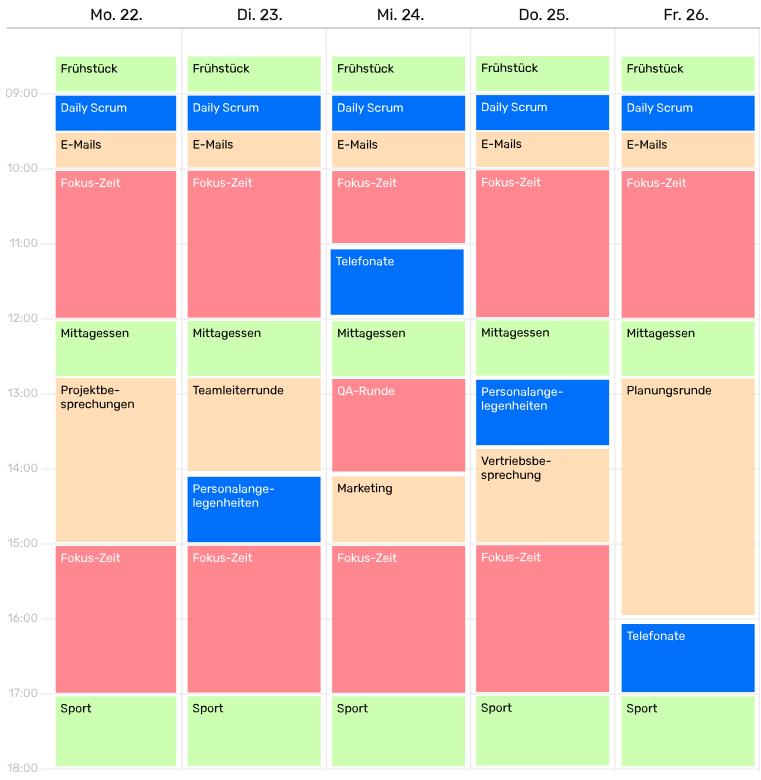
A core element of Time Blocking is scheduling blocks for “Deep Work” — focused work on a single type of task. New tasks are categorized and assigned to the next available block designated for that category. This way we avoid unproductive multitasking and prevent interruptions from dictating our day. We work through pending tasks faster and are more productive overall.
It is easy to forget to plan time for yourself. Whether it is five minutes or an hour, Time Blocking forces us to put this much-needed “Me-Time” in our calendar. During this time we reflect, exercise, read, or do other things that make us happy. S. R. Covey calls this “sharpening the saw” in his famous book “The 7 Habits of Highly Effective People.”
What Variations of Time Blocking Are There?
Under the umbrella term “Time Blocking” there are a number of variations. We should not treat these variations as rigid rules — we are not joining a monastic order. Rather, the methods presented can be adapted flexibly to individual needs and working styles. As old Fritz once put it, through appropriate combination and adaptation, everyone can find their own path to success.
The following table gives an overview of common Time Blocking variants, which are then discussed in more detail below.
| Method | What is it? | Example |
|---|---|---|
| Time Blocking | Dividing the day into time blocks, where each block is dedicated to completing a specific task or activity — and that activity alone. | "I will write every day from 9 a.m. to 11 a.m." |
| Task Batching | "I will answer all my emails at 3 p.m." | |
| Time Boxing | "I will write 1,000 words tomorrow between 9 a.m. and 11 a.m." | |
| Day Structuring | "At 9:00 a.m. I meet with the team for the Daily Scrum. From 9:30 to 10:30 a.m. I answer emails. After that, until noon, I hold one-on-one conversations. The afternoon is reserved for creating documents and software. The last hour of the day is again reserved for answering emails. | |
| Day Theming | "Every Monday I will focus on content creation. Every Tuesday I will focus on promoting content. Every Wednesday I will focus on research and ideation." |
Task Batching
Task Batching means grouping similar or related tasks together and completing them in a single, continuous time block. Instead of tackling tasks individually and independently, we focus on a specific type of task during the batching time block.
The purpose of Task Batching is to increase efficiency by handling similar tasks in one go. This allows us to minimize the switching of mental resources and the context changes that come with constantly jumping between different tasks.
For example, we might only check and reply to emails at specific times. That time block is our “email batching block.” By bundling email-related tasks we prevent the constant ping of email notifications from distracting us. Other possible categories include phone calls, research, reports, or creative tasks. This structured approach lets us focus more sharply on the specific requirements of a task category and potentially achieve higher quality work as well.
Time Boxing
Time Boxing means setting fixed time intervals for individual tasks or projects. We define a specific period during which we work exclusively on one task, and we aim to complete it within that limited timeframe.
Time Boxing means scheduling a dedicated time block in our calendar for each task or activity. During that block we devote ourselves exclusively to that task and do everything we can to finish it within the allotted time.
The idea behind Time Boxing is that a time constraint leads us to focus better and work more productively. By setting a clear time limit we force ourselves to concentrate on what matters and minimize distractions. It also helps reduce procrastination, because we are aware of the time available and motivated to complete the task within that window.
Day Theming
Day Theming is a time management method in which specific days of the week are dedicated to particular themes or task categories. Instead of filling every day with a variety of tasks and activities, specific days are devoted to a particular purpose or type of work.
The concept of Day Theming is based on the idea that different types of tasks are better handled in separate time blocks or days rather than spread across the entire week. By giving our days a thematic structure, we create clear organization and promote better focus on the relevant tasks.
We might, for example, reserve Mondays for strategic planning and business development. Tuesdays could be set aside for client conversations and collaboration with customers. Wednesdays could be used for creative tasks or project work. Thursdays could be reserved for administrative tasks and office organization. Fridays could be used for continuing education, learning, or personal projects.
Day Theming ensures that we have enough time for important task areas and do not neglect them. We can concentrate more effectively on each theme because we are already mentally prepared for it and do not have to switch back and forth between different tasks and contexts.
One advantage of Day Theming is that it allows us to plan our day in advance and prepare for the specific demands of a given day. It also creates a degree of predictability and clarity about the tasks that need to be completed on a particular day, and helps avoid overload.
Day Theming can be adapted to suit our individual needs and working styles. We can vary the number of themed days per week, or reserve half-days for certain tasks, depending on our work environment and commitments.
Day Structuring
Day Structuring in the context of Time Blocking refers to dividing the day into different time blocks or phases in order to organize specific activities or task categories.
We decide in advance how we want to break the day into sections. Each section is devoted to a particular purpose or type of task. For example, we might reserve the morning for focused work or Deep Work, the afternoon for meetings and collaboration, and the evening for lower-priority tasks or relaxation.
Day Structuring within a Time Blocking framework allows us to plan our schedule more effectively and use our resources more efficiently. We can direct our energy and concentration purposefully toward the relevant task areas and ensure that we have enough time for high-priority activities.
Why Is Time Blocking So Effective?
More Focus on What Matters
Time Blocking allows us to focus on one task at a time. To do this, we minimize distractions and interruptions. It creates the optimal environment for Deep Work — a state of deep concentration and productivity. In contrast, a lack of focus and constantly jumping between different tasks leads to inefficient work and reduced output.
Groups Tasks That Eat Up a Lot of Time
By grouping similar tasks we can save time and energy. While “Shallow Work” — activities that require little mental effort — can be completed quickly, “Deep Work” requires a longer, uninterrupted stretch of time to immerse yourself in complex tasks. Time Blocking lets us bundle multiple tasks that require similar levels of concentration.
Develops a Better Sense of Time Spent
We often underestimate how long certain tasks take, and then feel frustrated when we fail to meet our goals on time. Time Blocking helps develop a realistic understanding of how much time specific activities actually require. By dividing our tasks into time blocks, we gain a better picture of what we can accomplish in a given period and can adjust our planning accordingly.
Helps Combat Perfectionism
Perfectionism can cause us to spend too much time on a single task and neglect other important ones. Time Blocking creates clear boundaries and forces us to focus on what matters. By assigning time blocks to individual tasks, we can keep perfectionism in check and remind ourselves that good results are often more important than perfect ones.
Avoids Unnecessary Context Switching
A 2020 Cornell University study examined the widespread assumption that quick responses to work emails signal hard work, and that employees must be constantly reachable in order to succeed. The authors found that recipients of work emails overestimate the response-time expectations of the senders, particularly for non-urgent emails sent outside regular working hours.
The study found that this misperception of expectations led to increased feelings of stress among recipients and was associated with lower subjective well-being as a result of the experienced stress. The authors found, however, that a simple adjustment on the sender’s side can mitigate the email-urgency bias — for example, adding a brief note to emails clarifying response-time expectations for non-urgent matters.
This study illustrates that for many messages it is perfectly possible to batch their processing and thereby avoid the unnecessary mental resource drain of context switching.
Planning Tasks Helps Achieve Goals
A 2015 Harvard University study, “Beyond Good Intentions: Prompting People to Make Plans Improves Follow-Through on Important Tasks,” examined the effects of task planning on goal achievement. The study shows that people are more likely to achieve their goals when they have concrete, planned courses of action.
The authors conducted a series of experiments to test their hypothesis. In one experiment, participants were asked to complete a specific task either with or without a specific plan. The results show that those who had created a detailed plan were more likely to complete the task successfully.
Another experiment showed that the quality of the plan matters. Participants who specified exact times, locations, and approaches were better able to achieve their goals than those who created vague plans.
The authors explain that task planning creates a cognitive framework that enables people to manage their actions more effectively and overcome obstacles. By thinking through the process in advance, one can better prepare for executing the task and identify potential stumbling blocks.
The findings of the study have important practical implications. Encouraging people to create concrete plans can increase their likelihood of achieving their goals. This can be achieved through simple interventions such as creating checklists or setting reminders.
Overall, the article shows that creating concrete action plans is an effective strategy for improving follow-through on important tasks. It underscores the importance of planning and offers practical guidance on how to help people achieve their goals successfully.
Time Blocking provides a structured method for embedding our goals into the calendar — similar to how the ALPEN method structures the daily routine — and ensures that we plan enough time to pursue them. By committing our tasks to concrete plans, we increase the likelihood of actually reaching our goals.
Who Benefits Most from This Time Management Method?
Time Blocking is particularly useful for people whose work requires intense concentration, such as writers, researchers, programmers, or creative professionals. But anyone who wants to boost their productivity and make their day more efficient can benefit from Time Blocking.
Time Blocking cannot be applied effectively when our calendar is packed with meetings or standing meetings. Other time management methods such as Timeboxing or setting priorities complement Time Blocking. Project management tools support calendar planning. However, if we regularly keep time windows free in our calendar, this technique can help us direct our attention toward the things that truly matter. Parkinson’s Law states that “work expands so as to fill the time available for its completion.”
Time Blocking proves especially helpful when:
- We tend to multitask
- We want to focus on a specific task and avoid distractions
- We want to reclaim control over our time and energy at work
- We want to develop a better understanding of where our time actually goes
- We regularly feel overwhelmed
To apply Time Blocking effectively, treat each time block as a phase in which you will not be distracted and can fully concentrate on your work. This approach is also known as “Deep Work.” Setting priorities and the Pomodoro Technique are also well suited for focusing on individual tasks.
The Most Common Time Blocking Misconceptions and How to Avoid Them
Time Blocks Are Misjudged
It is important to schedule realistic time blocks for your tasks. Do not overload your calendar with too many activities that cannot realistically be completed in the time available. Make sure to build in enough buffer time to account for unexpected events or tasks that run long.
Over time you will get better at estimating how long tasks take, but until you have sharpened your instincts, it is better to plan a bit more time for tasks than too little. Buffer your schedule with extra time to complete tasks and manage the transition between them. You can even create “contingency time blocks” to fall back on when you are running behind.
Tip: Account for buffer times and try not to overestimate yourself — it gets easier with practice.
Rigid Structures, Little Flexibility
Although Time Blocking is a structured approach, you should still maintain flexibility. Sometimes unexpected events require you to adjust your schedule. Be prepared to shift or adapt time blocks to respond appropriately to these situations.
The Right Duration for Time Blocks Is Crucial
It is important to set the right duration for your time blocks. A block that is too long can lead to fatigue and declining concentration, while one that is too short may not be enough to complete a task. Experiment with different time intervals and find out which ones work best for you.
Tip: You are not a robot and do not need to calculate your workday down to the minute. A blocked time window for “free time” offers more room for various activities — what exactly you do in it is not necessarily what matters.
Conclusion: Time Blocking is an extremely effective method for dividing your calendar into time blocks and boosting productivity. By planning your tasks concretely and assigning them dedicated time blocks, you can improve your focus, handle complex tasks more effectively, and develop a better understanding of how you spend your time. Whether you are a writer, a business owner, or a student, Time Blocking can help you use your time more efficiently and achieve your goals more effectively. Give it a try and watch how your productivity increases and your schedule gains clarity.

CEO Alltena GmbH
Christoph Friedrich is a computer scientist and certified Project Management Professional. He has extensive experience in the introduction and integration of project management tools as well as the analysis and definition of processes in project and service management.