Every organization that runs projects depends on successful project management.
1. Overview
Project management is the application of processes, methods, skills, knowledge, and experience to achieve specific project goals in accordance with project acceptance criteria within agreed parameters. It has definitive outcomes that are tied to a limited timeframe and budget.
Project management always rests — consciously or unconsciously — on a process model, which is manifested above all in the project documentation produced over the course of the project. Here we follow the model and terminology of PMBOK.
2. Nine Principles of Project Management
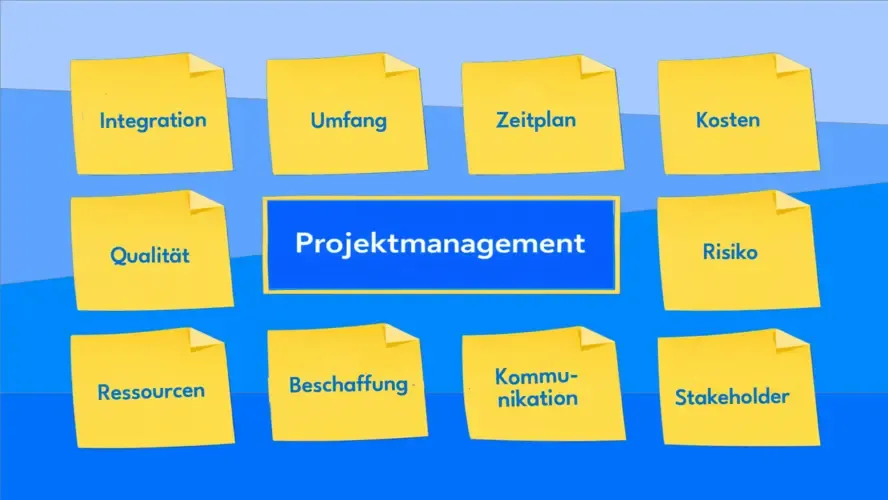
2.1 Project Integration Management
Project integration management refers to the coordination of all elements of a project. This includes coordinating tasks, resources, stakeholders, and other project elements, as well as managing conflicts between different aspects of a project, balancing competing requirements, and evaluating resources.
2.2 Project Scope Management
Scope management is the process by which outputs, outcomes, and benefits are identified, defined, and controlled. The term “scope” is used in project management to describe the totality of deliverables, results, and benefits, as well as the work required to achieve them.
2.3 Project Time Management
Project time management encompasses the analysis and development of a schedule and timeline for project completion.
2.4 Project Cost Management
Cost management in project management is the process of planning, estimating, budgeting, and controlling project costs.
2.5 Project Quality Management
In project quality management, the quality of all activities is continuously measured and corrective actions are taken until the desired quality is achieved.
2.6 Project Human Resource Management
Project human resource management encompasses the processes for organizing, managing, and leading the project team.
2.7 Project Communications Management
Project communications management is a collection of processes that ensure the right messages are sent, received, and understood by the right people.
2.8 Project Risk Management
Project risk management is a procedure used by project managers to handle potential risks that can affect a project in any way — both positively and negatively. The goal is to minimize the impact of these risks. A comprehensive risk management example illustrates the process in practice.
2.9 Project Procurement Management
Procurement management is a structured process used to define, plan, implement, and control an activity, transitioning it from a current state to a future state.
3. Phases of Project Management
In this article we walk through each phase individually and give you tips on how to increase success in each one. The five phases of project management were developed by the Project Management Institute (PMI) and include conception and initiation, planning, execution, performance/monitoring, and project closure.
3.1 Project Initiation
This is the beginning of the project, and the goal of this phase is to define the project at a broad level. This phase typically begins with a business case. Here it is examined whether the project is feasible and whether it should be carried out. If a feasibility review is required, it is conducted during this phase of the project.
3.2 Project Planning
This phase is the key to successful project management and focuses on developing a roadmap that all stakeholders will follow. This phase typically begins with setting goals.
Smart Goals
A SMART goal is used as a guide for goal setting. SMART is an acronym that stands for Specific, Measurable, Achievable, Realistic, and Timely. A SMART goal therefore includes all of these criteria to focus your efforts and increase the likelihood of achieving your goal.
Clear Goals
Employees should collaborate by each contributing their unique skills and expertise to help the team achieve its goals.
- Cooperative (Goals should encourage employees to work cooperatively and in teams)
- Limited (Goals should be limited in both scope and duration)
- Emotional (Goals should create an emotional connection with employees by tapping into their energy and passion)
- Valuable (Large goals should be broken down into smaller goals so they can be achieved faster and more easily and deliver long-term benefits)
- Refinable (Set goals with a firm and unwavering target, but give yourself permission to refine and change your goals as new situations or information arise)
3.3 Project Execution
What should a project execution plan contain?
- Project definition and a summary of the strategic mandate or, at a later stage, the project charter.
- Drawings, if developed at this stage.
- Project programme.
- Cost plan, cost management, and accounting procedures.
- Contract award and procurement strategy.
- Roles, responsibilities, and authorities.
The project execution phase is typically the longest phase in the project management lifecycle and consumes the most energy and resources. These processes help you manage time, cost, quality, changes, risks, and issues. They also help you manage procurement, customer acceptance, and communications.
3.4 Project Monitoring and Control
The phase of project monitoring and project controlling runs concurrently with project execution and thus ensures that the goals and project deliverables are met.
As a project manager, you can ensure that no one deviates from the original plan by establishing Critical Success Factors (CSF) and Key Performance Indicators (KPI).
In the monitoring phase of project management, the manager is also responsible for quantitatively tracking effort and costs throughout the process. This tracking not only ensures that the project stays within budget, but is also important for future projects.
3.5 Project Closure
The project closure phase marks the end of the project following final delivery. It can happen that external professionals are hired specifically for the project on a contractual basis. Terminating these contracts and handling the necessary formalities are also the project manager’s responsibility.
In this phase, the project is concluded. Contractors hired specifically for the project are released at this point. Valuable team members are acknowledged.
4. The Most Popular Project Management Methods
A methodology is essentially a collection of methods, practices, processes, techniques, procedures, and rules. In project management, methodologies are specific and rigorous and typically contain a series of steps and activities for each phase of a project’s lifecycle.
Choosing the right methodology matters, because it determines how we work. The right methodology helps to steer the process of project efficiency. And since you already know that there is no one-size-fits-all method suited to every type, size, or industry of organization, it is important that you invest some time and effort in selecting the right project management methodology for your context.
4.1 Agile
Agile is an iterative approach to project management and software development that enables teams to deliver value to their customers faster and with fewer problems. Requirements, plans, and results are continuously evaluated, giving teams a natural mechanism to respond quickly to change.
4.2 Scrum
Scrum is a framework that helps teams collaborate. Scrum describes a set of meetings, tools, and roles that work together to help teams structure and manage their work.
4.3 Kanban
Kanban is a workflow management method for defining, managing, and improving services that deliver knowledge work. It is designed to help you visualize your work, maximize efficiency, and continuously improve. Originally from manufacturing, it was later adopted by agile software development teams.
4.4 Scrumban
Scrumban is a management framework that combines key features of two popular agile methods: Scrum and Kanban. The Scrumban framework merges the structure and predictable routines of Scrum with the flexibility of Kanban to make teams more agile, efficient, and productive.
4.5 Lean
Lean project management is a method that maximizes customer value and minimizes waste by optimizing the flow of materials or tasks through the system as a whole.
A methodology is essentially a collection of methods, practices, processes, techniques, procedures, and rules. In project management, methodologies are specific and rigorous and typically contain a series of steps and activities for each phase of a project’s lifecycle.
Choosing the right methodology matters, because it determines how we work. The right methodology helps to steer the process of project efficiency. And since you already know that there is no one-size-fits-all method suited to every type, size, or industry of organization, it is important that you invest some time and effort in selecting the right project management methodology for your context.
4.1 Agile
Agile is an iterative approach to project management and software development that enables teams to deliver value to their customers faster and with fewer problems. Requirements, plans, and results are continuously evaluated, giving teams a natural mechanism to respond quickly to change.
4.2 Scrum
Scrum is a framework that helps teams collaborate. Scrum describes a set of meetings, tools, and roles that work together to help teams structure and manage their work.
4.3 Kanban
Kanban is a workflow management method for defining, managing, and improving services that deliver knowledge work. It is designed to help you visualize your work, maximize efficiency, and continuously improve. Originally from manufacturing, it was later adopted by agile software development teams.
4.4 Scrumban
Scrumban is a management framework that combines key features of two popular agile methods: Scrum and Kanban. The Scrumban framework merges the structure and predictable routines of Scrum with the flexibility of Kanban to make teams more agile, efficient, and productive.
4.5 Lean
Lean project management is a method that maximizes customer value and minimizes waste by optimizing the flow of materials or tasks through the system as a whole.
5. How to Make Project Visualization Easier
Project management visualization involves a combination of data visualization tools and methods, traditional communication, reporting, and task management. It means taking a visual approach to project management and project execution.
Visual Project Management: How to Visualize a Project Plan
- Plan the schedule with a Gantt chart.
- Structure your team with an org chart.
- Visualize data.
- Assess risks with a risk breakdown structure.
- Track progress with a status report.
- Clarify information with symbols.
- Use color coding to communicate effectively.
There are three common methods for visualizing project progress:
- Timelines (or Gantt charts)
- Kanban boards.
- Calendars.
6. Communication in Project Management
Without strong communication skills, it would be incredibly difficult — if not impossible — for project managers to lead their teams effectively and coordinate efforts to complete a project successfully.
To prevent misunderstandings, the 5 Cs of communication are recommended: correct, concise, clear purpose, coherent.
7. Roles in Project Management
The project team is responsible for contributing to the overall project goals and specific team deliverables by participating in planning project activities and executing assigned tasks/work within the expected quality standards to ensure project success.
- Client/Customer
- Project sponsor
- Project manager
- Project team member
- Stakeholder
Success Factors of Efficient Project Management:
Five critical success factors for project managers
- Agree on the project goals.
- Develop clearly defined plans with assigned
- responsibilities and accountabilities.
- Efficiently manage the project scope.
- Maintain constant effective communication.
- Make sure you have the support of senior management.
Skills Required to Become a Project Manager in 2025
A project manager should:
- be able to plan, monitor, and review effectively;
- be able to manage resources;
- be able to motivate and encourage others;
- be decisive and able to work well under pressure
- be aware of who is affected by the project,
- and be able to deal with the impact of the project on those people;
- earn respect and trust
What Are the Responsibilities of a Project Manager?
- Planning and developing the project idea. Every project starts with an idea.
- Create and lead your ideal team.
- Monitor project progress and set deadlines.
- Solve problems as they arise.
- Manage the budget.
- Ensure stakeholder satisfaction.
- Evaluate project performance.
Project Management Certifications
According to the Project Management Institute, the PMP (Project Management Professional) is an examination process used to determine whether someone has the significance, criticality, and frequency of the expertise, skills, and organization required to become a project manager.
Learn more in our article on project management certifications.

CEO Alltena GmbH
Christoph Friedrich is a computer scientist and certified Project Management Professional. He has extensive experience in the introduction and integration of project management tools as well as the analysis and definition of processes in project and service management.