The Scrum artifacts are an essential component of this agile project management method. In the following we describe the most important products that emerge over the course of a Scrum project.
Product Backlog
The Product Backlog is the list of desired changes and new features for a product. The Product Owner is responsible for it (see also Scrum roles). It includes new features, bug fixes, changes to documentation, and anything else considered useful and value-adding. We refer to these entries as “Backlog Items” or “User Stories.”
The list of User Stories is ordered so that the most important story sits at the top — this is the one the team should work on next. Directly below it is the User Story the team should implement second, and so on. Because User Stories near the top of the Product Backlog will be tackled soon, they should be compact and easy for the whole team to understand. User Stories further down the list may be broader and less precisely formulated. They will be refined over time and potentially split into multiple User Stories.
Sprint Backlog
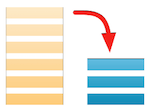
The Sprint Backlog is the team’s to-do list for the current Sprint. This list must be completed by the end of the Sprint. The Sprint Backlog contains all User Stories the team has selected for implementation in this Sprint, along with the associated tasks.
A User Story is implemented by completing the tasks assigned to it. A task is typically assigned to one team member, while a User Story is owned by the entire team.
Burn Charts

A Burn Chart illustrates the relationship between time and functionality. Time is shown on the horizontal axis and functionality on the vertical axis.
A Burnup Chart shows how much functionality the team has implemented within a given time period. Every time something new is completed, the line moves up a little.
A Burndown Chart illustrates how much work remains to be done. In general, you would expect the list of remaining features to decrease over time as the team implements the desired functionality. Sometimes the list changes suddenly — for example, when scope is added or removed.
These events appear as vertical lines in the Burndown Chart: a vertical rise indicates that functionality has been added. If the line goes down, functionality has been removed.
Task Board
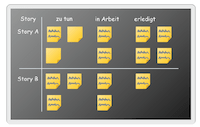
A description of the Scrum artifacts would be very incomplete without the famous Task Board. The simplest Task Boards consist of three columns with the headings:
- “To Do”
- “In Progress”
- “Done”
A Task Board is placed in the room so that every team member has access to it. When teams are distributed across locations, electronic, web-based Task Boards help — many project management tools and agile project management software offer such boards.
Tasks are moved across the board so it is visible which tasks are done, which are in progress, and which have not yet been started. This visibility allows the team to assess its current situation and adapt if necessary. The board also helps stakeholders and the Product Owner to monitor project progress.
A variant of the Task Board is the Kanban Board. The combination of Scrum with Kanban is called “Scrumban.” Almost every well-known agile project management software offers the Scrum Task Board and Kanban.
Definition of Done

The list of Scrum artifacts would be incomplete without the “Definition of Done.” In a project it is important that everyone involved shares a common understanding of what “done” means. Just because a developer has finished writing the source code and testing it doesn’t mean the software is ready to be delivered to the customer. Just because a tester has reached a positive conclusion doesn’t mean the system is ready to go into production. A salesperson understands “done” to mean that the product can be sold to customers and they can use it immediately.
To avoid the confusion that arises from these differing understandings, Scrum teams clearly define what the word “done” means for them. A typical set of criteria looks like this:
- Code written
- Code reviewed
- Regression tests passed
- Customer acceptance
- etc.
This list of things that must be completed before a User Story can be called “done” is referred to as the “Definition of Done.” Many teams keep their Definition of Done checklist posted next to their Task Board.
Further Information
If you are interested in reading more about Scrum roles, you can do so there. In this article you can find an overview of agile project management. For implementation we recommend agile project management software and a comparison of project management tools. Further reading: agile principles, agile values, agile practices, Scaled Agile Framework, and Agile vs. Waterfall.

Editor and Writer
Gabriella Martin is a Yale University graduate and holds a Master's degree in German Literature from the University of Tübingen. She loves explaining complex things in simple terms.