When writing a requirements specification, how you phrase requirements in a project has a significant impact on its success. Below we have compiled a set of rules that help when writing a requirements specification and that can serve as a checklist for a requirements specification assessment. Ideally, a requirements specification already exists when the project plan is created.
Writing a Requirements Specification: Tips and Tricks
In this article we have gathered the most important universally applicable rules you should keep in mind when writing a requirements specification. We have ordered the individual aspects by category.
This article is partly based on information from the VDA volume “Component Requirements Specification – Automotive Standard Structure”.
Structure and Content
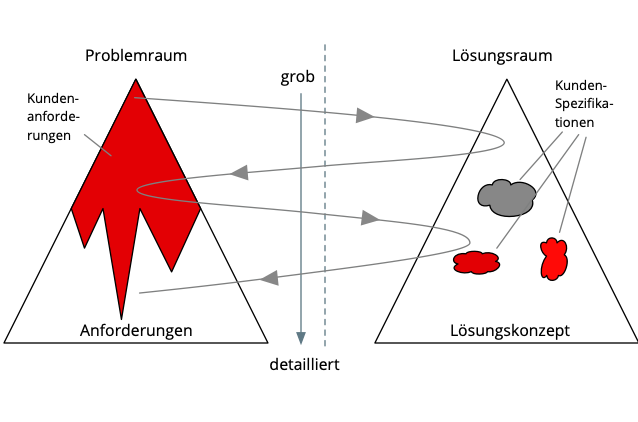
I recommend the Twin Peaks model for creating a requirements specification and a functional specification. The most important result is a solution concept that must describe the desired project outcome in a way that is equally understandable to both client and contractor, using appropriate means (text, tables, diagrams, pseudo-code).
| 1 | Clearly mark requirements in the requirements specification as such, and separate them from contextual information. | |
| 2 | Give each requirement a unique identifier. | |
| 3 | Phrase mandatory requirements with "must". | |
| 4 | Use the same term consistently throughout the requirements specification for the same thing, even if the term appears frequently. | |
| 5 | Define an acceptance criterion or verification method for each requirement from the outset. | |
| 6 | Prefer tables and graphical representations over textual descriptions. | |
| 7 | Phrase exactly one requirement per sentence (or paragraph), never multiple. | |
| 8 | Document the source of a requirement to the extent it is known, or reference it. | |
| 9 | Define potentially ambiguous terms and names in a glossary. | |
| 10 | Do not use the "/" character or "respectively" without clearly indicating whether the slash means "and", "or", or both "and/or". |

Writing a Requirements Specification with Style
The style in which you write also affects the readability of a requirements specification. Here are a few points to pay attention to.
| 1 | Use proven sentence patterns as shown in the examples below. | |
| 2 | Phrase requirements in complete sentences, not as bullet-point fragments. | |
| 3 | Use active sentences and avoid passive constructions. | |
| 4 | Write short sentences and avoid nested clauses. | |
| 5 | Avoid "Weak Words" (but, absolutely, similar, current, at most, however, far too, as if, other, otherwise, differently — see the more extensive list below). | |
| 6 | Avoid qualitative adjectives such as "slow", "fast", "nice", "hot", "cold", "cyclic", etc. |
Sentence Patterns
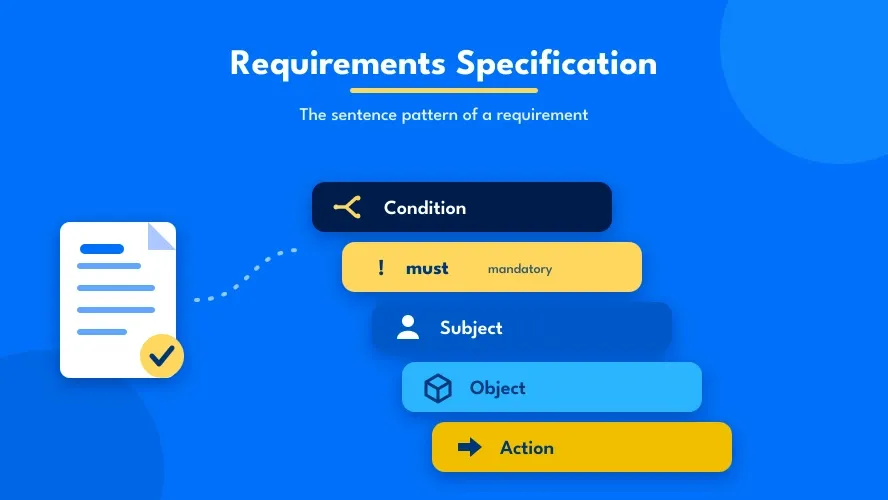
When creating a requirements specification, use proven sentence patterns such as the following:
- [Condition] “When the pressure exceeds 1 bar,”
- [Requirement word] “must”
- [Subject] “the controller”
- [Object] “the relief valve”
- [Action] “open”
In agile environments, the following sentence pattern is commonly used:
- [As a {role}] As an administrative user
- [I want to {do something}] I want to import a column from an Excel spreadsheet
- [in order to {goal}] in order to populate a selection list
List of “Weak Words”
The use of words from the following list indicates vague ideas about requirements. When creating a requirements specification, these expressions must not appear in any finalized requirement text (list after Dreher, Marion).
| A | ab, aber, absolut, ähnlich, aktuell, allenfalls, allerdings, allzu, als ob, andere, andernfalls, anders, anhaltend, annähernd, anscheinend, ansonsten, auf keinen Fall, augenscheinlich, ausführlich, ausnahms- weise, außerordentlich, äußerst |
| B | bald, bedienbar, bedingt, bei, beinahe, besonders, besser, beste, bestimmt, bestmöglich, bisweilen |
| C | ca. |
| D | damals, daneben, dann, demnächst, denkbar, denn, dereinst, deutlich, dicht, doch, durchaus |
| E | eben, ehedem, ehemals, eher, eigentlich, eilends, ein bisschen, ein paar, ein wenig, eindeutig, eine Weile, einfach, einige, einigerma- ßen, einmal, einst, einstmals, einzeln, elementar, eng, enorm, ent- sprechend, erstaunlich, etliche, etwa, etwa wie, etwas, etwelche, eventuell |
| F | fabelhaft, fast, fortschrittlich, für den Fall, furchtbar |
| G | gängig, ganz, gar, gebräuchlich, gegebenenfalls, gegen, genau, genug, gerade so, gering, gesamt, gewaltig, gewisse gewohnt, gleich- zeitig, groß, größtenteils, gründlich, gut |
| H | halbwegs, halbwegs, halt, häufig, hauptsächlich, hin und wieder, höchst, höchstens, höchstwahrscheinlich, hoffentlich |
| I | intuitiv, inzwischen, irgend, irgendetwas, irgendwelche, irgendwer, irgendwie, irgendwo, irgendwoher, irgendwohin |
| J | ja, je nachdem, jemand |
| K | kaum, klassisch, klein, knapp, kolossal, kurz, kürzlich |
| L | landläufig, lang, langsam, längst, laut, leicht, leise, letztens |
| M | mal, man, manche, manchmal, mäßig, mehr, mehr oder minder, mehrere, mehrfach, mehrmals, meist, meistens, minder, mitunter, modern, möglich, möglicherweise, möglichst |
| N | nach Möglichkeit, nahezu, nebenbei, neuartig, neulich, niemals, nur, offensichtlich, oft, öfter, öfters, optimal |
| P | pauschal, phantastisch, plausibel, prinzipiell |
| Q | quasi |
| R | regelmäßig, reichlich, riesig, rund (abschätzend, wie ca.) |
| S | schätzungsweise, scheinbar, schlecht, schnell, schon, schön, schrecklich, schwer, schwerlich, sehr, selbsterklärend, selten, sicher, sicherlich, so, sogar, solche, soll, sollte, somit, sonstige, sorgfältig, sozusagen, speziell, stark |
| T | teils, teilweise, u. a. |
| U | u. U., überaus, überhaupt, üblich, übrige, umgehend, unbedingt, unbeträchtlich, und, und wann, ungefähr, ungemein, ungewöhnlich, ungezählt, unlängst, unmerklich, unter Umständen, unterdessen, etc. |
| V | verblüffend, vereinzelt, vermutlich, verschieden, verständlich, viel, vielfach, vielleicht, vielmal, vollendet, vollkommen, vorerst, vorhin |
| W | wahnsinnig, wahrscheinlich, weit, weitaus, weitem, weitere, wenig, wesentlich, wie wenn, winzig, wirklich, wohl, womöglich, Wunders wie |
| Z | z. T., zahllos, zahlreich, zeitgemäß, zeitweise, ziemlich, zirka, zu, zu meist, zudem, zugleich, zunächst, zuweilen, zyklisch |
Attributes for Requirements
| Attribute | Required | Value |
|---|---|---|
| Id | yes | Number or text |
| Type | yes | Heading |
| Requirement | ||
| Context | ||
| Version | yes | Text |
| Status | yes | Draft |
| Ready for review | ||
| To revise | ||
| Finished | ||
| Supplier statement | accepted/not accepted | |
| Supplier comments | Text |
Further Information
Also read how to create a project plan, learn more about the form and content of a requirements specification and its counterpart on the contractor side, the functional specification. Get an overview of important elements of project documentation. For phrasing measurable requirements, the SMART method is a helpful tool.

Editor and Writer
Gabriella Martin is a Yale University graduate and holds a Master's degree in German Literature from the University of Tübingen. She loves explaining complex things in simple terms.