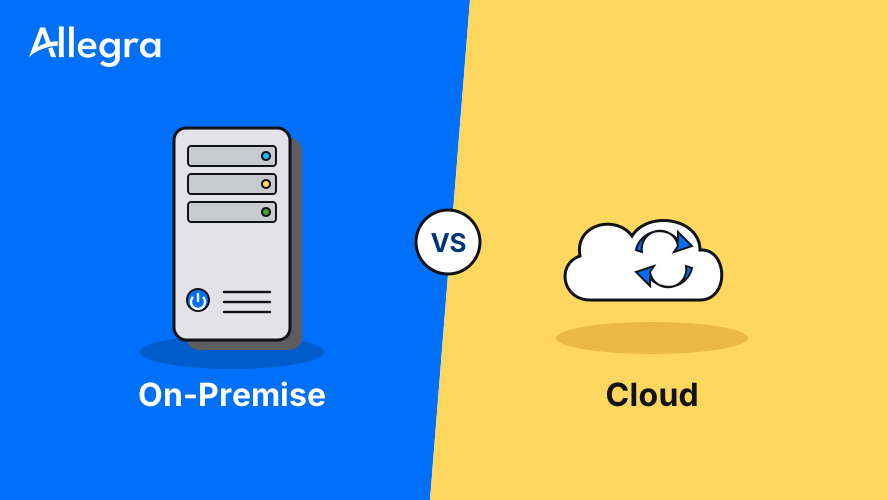
There are many different factors a company must consider to keep its data secure and accessible to its employees. During Covid-19, many organizations had to adapt to online tools so that employees could work from home. But what should you keep in mind when deciding whether cloud or on-premise data storage is right for you? In this blog, you will learn what matters in this decision and what the key differences, advantages, and risks might be.
Project Management Software On-Premise vs. Cloud:
As already mentioned, it is not surprising that cloud computing has gained in popularity (a trend that was further accelerated by the pandemic). Its appeal lies in the attribute of newly gained flexibility for companies, ranging from saving time and financial resources to improving scalability, growth, and agility.
This stands in contrast to On-Premise software, which is installed on a company’s own premises. Here, companies have their own secure firewalls (a feature that many older organizations view through the lens of “if it ain’t broke, don’t fix it”). In addition, various on-premise applications are reliable, secure, and offer a sufficient level of control that cloud solutions often cannot match to the same degree. IT decision-makers within companies agree that on-premise and legacy systems must be used in conjunction with new cloud applications. This is done so that the company keeps up with the times and does not fall behind with outdated software practices — and, more importantly, so that they are able to achieve their ultimate business goals through the use of cloud software.
On-Premise Software Deep Dive:
Regardless of whether a company decides to store its applications — such as its project management tools — in the cloud or to keep them on-site, data security remains an absolutely non-negotiable criterion. For certain companies operating in heavily regulated industries, however, storing data on-site may be the only available option. This has its advantages, as it is certainly reassuring to know that your data resides on your own servers and within your own IT infrastructure. All of this helps to minimize concerns.
There are, however, a few notable drawbacks to using on-premise storage. First, it certainly comes with administrative and maintenance costs. These expenses ensure that all licenses and solutions function smoothly, and these costs can have a significantly greater impact than the costs associated with cloud computing environments. Furthermore, the initial setup costs for an on-premise environment require sophisticated in-house hardware, software licenses, integration capabilities, and IT staff to provide ongoing support and manage any issues that may arise. This includes any type of maintenance that might be needed when hardware components malfunction or break down, and so on.

Key Differences and Things to Consider Regarding On-Premise vs. Cloud
As noted above, there are some differences between cloud and on-premise environments that should be taken into account. It is important to consider these few factors and see what is best suited to your specific company to ensure that your organization’s requirements are fully met.
1. Cost: On-Premise vs. Cloud
On-Premise: For organizations that want to host their own software “in-house,” there is an additional responsibility for ongoing maintenance, energy consumption, physical office space, and other applicable insurance. This can lead to significant costs for an organization just to protect its data and software.
Cloud: Organizations that want to use cloud management systems are only responsible for the costs of the resources they consume. There would be no maintenance costs — only the costs for how much is used within a given period.
2. Control: On-Premise vs. Cloud
On-Premise: When a company uses an “in-house” environment for its data and software, it is likely seeking a high degree of control. This is enabled by the use of on-premises software, and companies in heavily regulated industries with massive data protection concerns are generally satisfied with this particular system. They are often reluctant to switch to cloud software, as they are concerned about the security of their data.
Cloud: An important element of control in relation to cloud computing comes into play during decision-making. The concern lies in data ownership when it is hosted by a third party. If something goes seriously wrong, how will accountability be maintained when the unexpected happens and the server goes offline? Access to data can be interrupted if the host experiences technical difficulties, and that is something organizations are not willing to compromise on.
3. Security: On-Premise vs. Cloud
On-Premise: This question of security is closely tied to the level of control an organization requires when it comes to its data. Companies that handle sensitive information (especially in the medical, government, or banking industries) must ensure an extremely high level of security at all times. This is particularly relevant given the constantly increasing number of cyberattacks on large organizations. Therefore, despite the interest in cloud-based data, the risk of something going wrong is too great to bear, and despite the higher costs associated with on-premise data and software, it makes increasingly more sense for members of these sensitive industries.
Cloud: It is no secret that security concerns are a massive issue when it comes to deciding whether to use cloud computing or not. Cloud breaches and cyberattacks are regularly disclosed, with devastating effects on large and small organizations alike. But the security of one’s own data is not always one hundred percent guaranteed either. Hard drives containing sensitive information are known to go missing, and even fires and other disasters can completely destroy companies with “in-house” hosting plans. Security is not guaranteed with either method. That is why a combination of both options may be the best solution.
4. Setup: On-Premise vs. Cloud
On-Premise: Resources are deployed internally when an organization uses an in-house system. The IT infrastructure is therefore responsible for maintaining all associated processes for the specific organization.
Cloud: Naturally, there will be various forms of cloud computing — such as public cloud, private cloud, and hybrid cloud — yet there are fairly uniform methods of deployment, meaning access to the applications you need should be demand- and usage-oriented.
5. Legal Compliance: On-Premise vs. Cloud
On-Premise: Most organizations are subject to various forms of regulatory oversight depending on the industry in which they operate. It is therefore always imperative that organizations are fully aware of and compliant with these regulations, including those relating to data security and on-site requirements.
Cloud: Companies that choose to use cloud computing models must always fulfill their due diligence and ensure that their third-party host is consistently compliant with the legal requirements mandated in their industry. Sensitive information must always be secured, and the privacy of customers, partners, and employees must be guaranteed.
Hybrid Cloud Solutions
As you have probably already guessed, there are risks that one ultimately must accept when choosing either solution for data management. Security considerations are sometimes outweighed by cost factors, and so on. It really all depends on the specific requirements of the organization. A hybrid solution is therefore often seen as the best approach — even the best of both worlds. A hybrid solution essentially uses a range of deployment models, spanning from on-premise to cloud (private and public). A hybrid cloud solution is becoming increasingly popular in today’s world, especially since Covid-19 had a massive impact on on-site work and drove a massive shift to online operations.

Current Solutions for Cloud and On-Premise Project Management Software
Let’s take a look at which project and task management tools are currently offered for cloud and/or on-premise deployment.
On-Premise Project Management Tools
- Allegra
- Open Project
- Bitrix 24
Cloud Project Management Tools
- Meistertask
- Trello
- Freedcamp
- ClickUp
- Bitrix24
- awork
- Jira
- Wrike
- OpenProject
- Allegra
- Monday
- Asana
- Bitrix 24
Conclusion
As we can see in this comparison, only three project management solutions offer both cloud and on-premise hosting. If you would like to learn more about Allegra and why Allegra is the most comprehensive project management software on the market, book your free live webinar here: Allegra free live demo.
If you enjoyed this blog, why not check out a few others that might interest you!

Editor and Writer
Gabriella Martin is a Yale University graduate and holds a Master's degree in German Literature from the University of Tübingen. She loves explaining complex things in simple terms.