Freedcamp: Interesting Project Management Software
Freedcamp is an interesting software for general task management and project management in teams. Freedcamp attracts users with a free entry-level option, which is only suitable for very basic task management. Freedcamp only becomes a true project management tool with the paid Business and Enterprise versions.
1. General Functionality
Operation
Freedcamp is offered exclusively as Software as a Service (SaaS) in the cloud operated by the vendor.
The vendor guarantees compliance with European data protection standards. Data is normally stored in the USA. On request and for a larger usage quota, data can also be kept in the EU.
Projects and Project Types
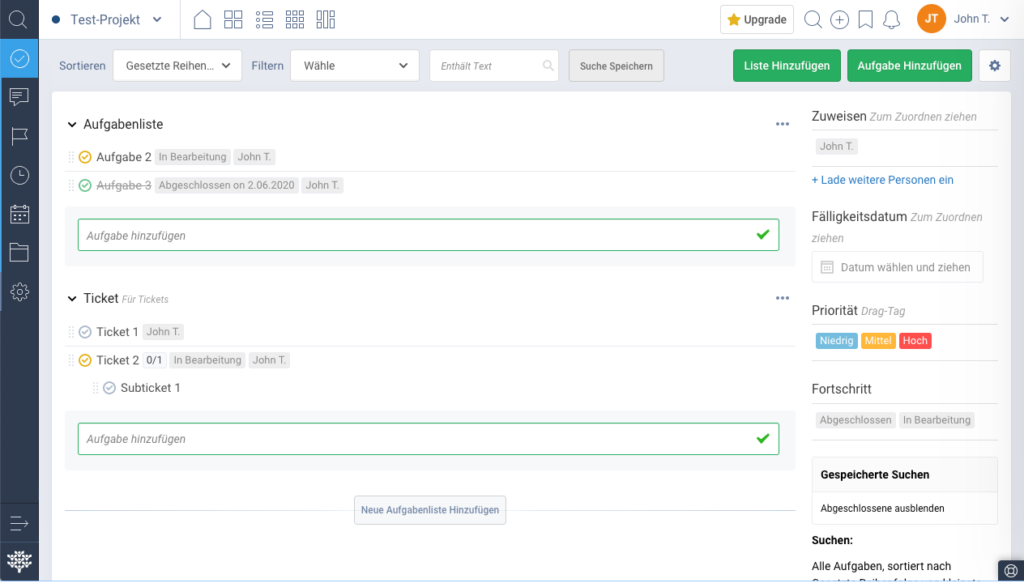
In Freedcamp, tasks are managed within projects. There is no concept of “project types.” Central configuration of existing projects is not possible. However, it is possible to create projects from project templates.
Issues and Issue Types
In task and project management, almost everything revolves around “issues.” In Freedcamp, you can create “lists” that correspond to an issue type — for example, “tasks,” “action items,” and “bug reports.”
These lists can be extended as desired, but the corresponding issues do not differ from one another in terms of their handling, attributes, or behavior.
Issue Hierarchies
Freedcamp offers exactly one hierarchy level in the free version. In the paid versions, real sub-tasks can be created, making it possible to represent project structures and work breakdown structures.
The type of subordinate issues can be restricted depending on the type of the parent issue. This can prevent, for example, an issue of type “Car” from being subordinated to an issue of type “Engine.”
Notifications
Freedcamp has a simple notification system that is configurable within certain limits. You can configure what is sent to whom and when.
Email notifications are based on non-configurable templates. There is an @-mention function and a reminder function.
Access Permissions
Freedcamp has a simple, level-based permission system. Permissions are fixed to the levels. It is not possible to define custom levels. However, there is the option to grant users and teams access to “applications” for projects. Applications include task lists, discussions, milestones, attachments, or logged effort.
Attributes
In Freedcamp, customer-specific attributes can be configured in the paid versions via the web interface without programming.
A comprehensive selection of attribute types is available, such as labels, person selectors, or date fields. In addition, the behavior of standard attributes can be adjusted in meaningful ways — for example, the default value for a start or end date.
Input Forms
In Freedcamp, custom input forms cannot be defined.
Dependencies
In project management and task management, issues are often related to one another. For example, a task cannot be started before another is completed, or an issue cannot be closed before a dependent issue has been resolved.
Freedcamp provides basic support for defining dependencies or links.
Cockpits
The system offers users an overview page (cockpit, dashboard).
Each user has the option to use pre-configured cockpits or to assemble a custom cockpit from an extensive list of cockpit widgets. However, there are no cockpit templates, and cockpits cannot be centrally assigned to users by system administrators. The following cockpit elements are available, among others:
- My issues
- Number of issues in state X over time
- Activity stream
- Predefined filters
Reporting
Freedcamp has no report templates. Reports can be created in Freedcamp in Excel and PDF formats.
User Management
Synchronization of Freedcamp with a directory server is not supported. Freedcamp can be integrated for true single sign-on with CAS. The system supports two-factor authentication.
User Interface and Usability
The software offers a clean, well-organized, and modern-looking user interface. Regular users can get up to speed relatively quickly even without training. Context-sensitive help supports you when something is not immediately obvious.
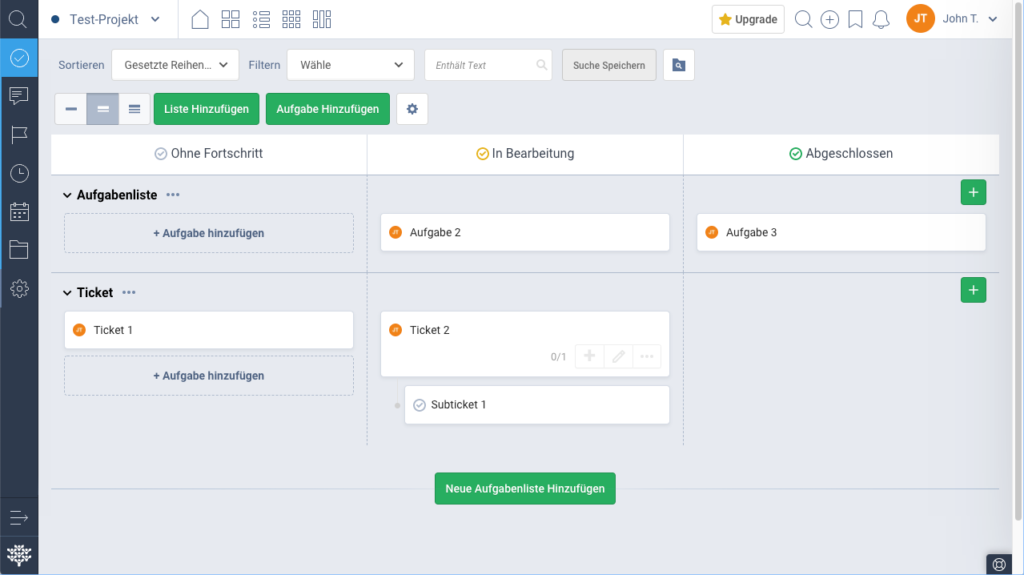
For configuration, you need to familiarize yourself with the basic concepts of Freedcamp. Supporting material is available in the form of tutorials, videos, slide sets, and user manuals. Training courses are also offered.
The user interface can be adapted to users’ requirements by enabling “applications.” The available menu items can be individually configured for each user or user group.
The online help is only available in English.
Interfaces and Extensibility
Almost all functions available in the user interface are accessible in Freedcamp via a comprehensive REST interface. For example, users can be managed, projects created, modified and deleted, and queries executed.
Freedcamp cannot be extended by the user; there are no suitable interfaces for this.
2. Task Management
Delegation
The Freedcamp task management software supports the delegation of issues including follow-up. The delegator retains their relationship to the issue, and the follow-up date is personal to the delegator. The delegator has an overview of the issues they have delegated.
Deputy Function
In Freedcamp, it is not possible to assign deputies to users.
Recurring Tasks
Some tasks and appointments repeat cyclically — for example, every first Monday of the month. Handling such recurring series can be very helpful and time-saving in task management.
Freedcamp allows the creation of recurring issues in the same way you would expect from good calendar applications.
Time Tracking
Freedcamp allows you to track effort (time and money) for each issue and assign it to accounts. Accounts can be grouped into cost centers and enabled for projects.
There is the option to use timers within the application to log time automatically. Reports provide an overview of who was working on which activities during any past period.
Support for the Getting Things Done Method
The Getting Things Done method is a proven approach to personal work organization. It allows personal categorization of issues such as personal follow-up dates or marking issues as favorites.
Unfortunately, Freedcamp does not support the GTD method — personal labels or follow-up dates are not possible.
Support for the RACI Matrix
For task management and project management, the RACI method defines four issue-specific roles through which project participants can be related to a task. Normally, roles are assigned at the project level, not for individual issues — for example, there is a project manager or Scrum Master for the entire project. RACI, on the other hand, allows roles to be assigned on an issue-specific basis (see this article on the RACI matrix).
Unfortunately, the Freedcamp project management software does not offer the ability to model a RACI matrix.
Workflows
Workflows are typically represented in task management systems in two forms. The first method relates to the workflow of an issue passing through various stages. The second method involves defining sets of tasks and then working through them.
Freedcamp has no workflow functionality — neither in the first nor in the second form.
3. Project Management
Programs and Portfolios
In many organizations, projects run within programs, portfolios, or product areas. Groups of projects need to be brought together to maintain an overview.
A basic prerequisite for program or portfolio management is the ability to group and hierarchically arrange projects.
Unfortunately, Freedcamp does not support program and portfolio management.
Sub-Projects
Larger project endeavors with many issues cannot be structured sufficiently by hierarchizing issues alone — they must be split into sub-projects. Sub-projects may require different processes, for example for hardware and software development.
Multi-Project Reports
All queries and reports can span multiple projects and sub-projects, which can be freely defined using appropriate filters.
Work Breakdown Structure
Before a project plan can be created, the activities to be performed or the deliverables to be produced must be structured. To represent such a product structure or work breakdown structure (WBS), issues must be able to be arranged hierarchically to any depth.
Freedcamp only supports one hierarchy level with sub-tasks. This means WBS or project plans cannot be created.
Interactive Gantt Chart
Freedcamp offers a nice interactive Gantt chart in the paid versions. The critical path can be displayed, and dependencies can be set and modified interactively. The percentage progress for a task can also be entered interactively.
Resource Planning
Resources of different types can be managed and assigned to issues. There is a view that displays resource utilization over time, making overallocation or underallocation immediately visible. Resources can be sorted by project or department.
Employee Availability
There is no way to map employee availability in the system and take it into account during resource planning.
Project Progress
In Freedcamp, it is possible to measure project progress by the number of completed tasks relative to the total number of tasks. Additionally, for tasks still open, the estimated remaining effort until completion can be entered.
This gives Freedcamp a rudimentary, low-effort form of progress monitoring — however, it is not sufficient for somewhat more demanding project management.
Agile Project Management
For software developers, integrations with source code management systems such as Git and Subversion as well as with CI/CD servers such as Gitlab and Jenkins are missing.
Alternative Solutions
In addition to Allegra, ClickUp is also an interesting alternative to Freedcamp. You can find a ClickUp review here.
Form your own opinion of the comprehensive project management software Allegra and book a free live demo.

CEO Alltena GmbH
Christoph Friedrich is a computer scientist and certified Project Management Professional. He has extensive experience in the introduction and integration of project management tools as well as the analysis and definition of processes in project and service management.