What is work management?
Work management refers to the overarching organization, control, and tracking of all work within a company — regardless of whether that work is structured as a project, an ongoing service, or an individual task.
The term emerged because the classic disciplines — project management, service management, task management — each cover only a slice of the work. In reality, these forms of work coexist and overlap. Work management closes that gap. It creates a continuous, unified view of all activities across an organization.
In concrete terms, this means:
- All forms of work are captured in a shared system — projects, recurring tasks, service requests, ad-hoc activities.
- Connections become visible. Who is working on what? Where are there dependencies between teams? Where do bottlenecks arise?
- Resources can be managed holistically. Capacity is not planned per project or per department, but across all forms of work.
- Decisions are based on the full picture rather than on partial information from individual silos.
Work management is not a replacement for project management, service management, or task management. It is the connective framework that links these disciplines together.
Task management
Task management organizes the individual task. It answers three questions: What needs to be done? Who is responsible? By when?
A task is concrete and clearly defined: “Send proposal to client Smith,” “Fix the login bug,” “Complete the quarterly report.” Task management ensures that such tasks are captured, assigned, and completed on time.
The key elements:
- Task lists with assignments and due dates
- Prioritization by urgency and importance
- Status tracking — open, in progress, done
- Notifications for changes or missed deadlines
Task management works for individuals as well as teams. In its simplest form, a well-maintained to-do list is sufficient; in practice, digital boards or list tools are typically used.
Its strength lies in simplicity. Its limit: task management treats each task in isolation. It does not capture dependencies, cross-cutting schedules, or strategic context.
Project management
Project management organizes one-time, time-limited endeavors with a defined goal.
A project is not day-to-day business — it is something that has not been done in this form before: constructing a company headquarters, rolling out software, developing a new product. Because projects are unique and often complex, they require their own methods:
- Planning with work breakdown structures, schedule plans, and Gantt charts
- Control via milestones and status reports
- Risk management to systematically identify and assess uncertainties
- Team organization, often cutting across existing departmental structures
What distinguishes project management from task management is the handling of dependencies: it calculates critical paths, identifies buffer times, and steers the endeavor as a whole.
Projects have a defined beginning and a defined end. When the goal is reached, the project is closed. That is precisely what sets them apart from services.
Service management
Service management organizes the ongoing delivery of services. Unlike projects, there is no endpoint — the service runs continuously.
Examples: an IT helpdesk that resolves incidents; a facilities team that operates buildings; an HR department that runs onboarding processes.
The central instruments:
- Service Level Agreements (SLAs) — agreed standards for response times, availability, or quality
- Ticketing systems — requests are captured, categorized, prioritized, and tracked
- Service catalog — describes which services are offered and at what quality level
- Continuous improvement — regular evaluation and optimization of services
The best-known framework is ITIL (Information Technology Infrastructure Library), originally developed for IT services and today used across industries.
How the four concepts relate
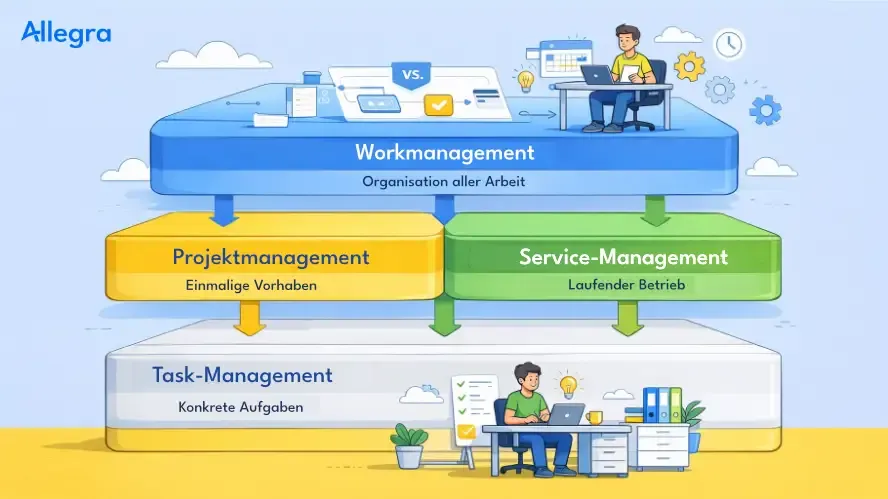
The relationship is hierarchical: work management is the roof under which the three specialized disciplines sit.
Task management forms the operational foundation. It is embedded in each of the other disciplines — tasks are distributed in projects too, and tickets are processed in services too. Task management is the smallest unit of organized work.
Project management and service management are parallel specializations that address different forms of work: the one-time (projects) and the ongoing (services). Both contain task management as a building block.
Work management creates the overarching perspective. It ensures that projects, services, and individual tasks do not exist in separate silos, but can be managed as a coherent whole.
In practice, this is clearly visible: an IT team is simultaneously working on a migration project (project management), running ongoing support (service management), and handling individual requests in between (task management). Without an overarching view — without work management — these forms of work compete for the same resources, with no one seeing the full picture.
Differences at a glance
| Criterion | Task Management | Project Management | Service Management | Work Management |
|---|---|---|---|---|
| Focus | Individual task | One-time endeavor | Ongoing service | All forms of work |
| Time horizon | Short-term | Time-limited | Ongoing | Cross-cutting |
| Repeatability | Variable | Low | High | All forms |
| Complexity | Low | High | Medium to high | High |
| Typical tool | To-do app, Kanban board | Project plan, Gantt chart | Ticketing system, ITSM tool | Work management platform |
| Control element | Priority, due date | Schedule, dependencies | SLAs, service levels | Total capacity, portfolio view |
Frequently asked questions
What is work management?
Work management is the overarching organization of all work within a company. It connects project management, service management, and task management into a holistic view and enables control across individual disciplines.
What is the difference between work management and project management?
Project management controls individual, time-limited endeavors. Work management additionally covers ongoing services, routine tasks, and ad-hoc activities — in other words, all the work of an organization, not just what is structured as a project.
What is the difference between task management and project management?
Task management handles individual tasks: who does what by when. Project management looks at the overall endeavor, including dependencies, resource planning, and risk management. Task management is often a building block within project management.
When do I need service management instead of project management?
Service management is the right fit when you are delivering an ongoing service — such as IT support or facilities management. Project management is suited to one-time endeavors with a defined beginning and end.
Do I need work management if I already have project management software?
That depends on how much work in your organization happens outside of projects. If services, routine tasks, and unplanned requests make up a significant share alongside projects, work management provides the holistic view that a pure project management tool cannot offer.

Senior Advisor
Jörg Friedrich is the original author of the project management software Allegra and continues to accompany its development to this day. He has many years of industry experience as a project and department manager. He also serves as a professor in the Faculty of Computer Science and Information Technology at Esslingen University of Applied Sciences.