Projects rarely fail because of insufficient effort — they more often fail because effort is misdirected. Unnecessary coordination loops, bloated documentation, unclear priorities: what is well-intentioned often holds teams back more than it helps. Lean project management addresses exactly this. It asks at every process step: does this create value for the customer — or is it just dead weight?
One important principle applies here: Lean does not mean eliminating planning and documentation. It means designing both so that they serve project success rather than becoming ends in themselves. This article explains where the Lean idea comes from, which principles underpin it, and how you can apply it to your projects.
What Is Lean Project Management?
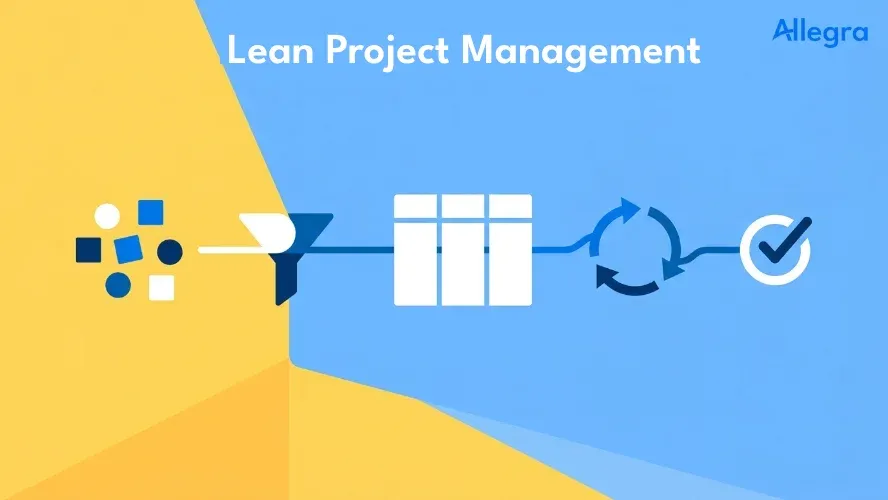
Lean project management is the application of the Lean philosophy to project work. The approach measures every process step by its contribution to customer value and eliminates anything that does not increase that value. Originally at home in industrial manufacturing, the concept can be transferred to any type of project — from software development to organizational projects.
Lean PM is not a single project management method with a fixed rulebook, but a thinking framework. It can be combined with Scrum, the waterfall model, or hybrid approaches.
The distinction from agile project management is straightforward: agile frameworks like Scrum or Kanban provide concrete practices and roles. Lean provides the overarching philosophy — the reason why those practices work. In many organizations, both approaches complement each other.
Origins — From Toyota to Project Management
The roots of Lean lie in the Toyota Production System (TPS), which Taiichi Ohno developed from the 1950s onward in post-war Japan. Toyota had neither the resources nor the markets of American automakers — and therefore had to achieve more with less. Two pillars supported the system: Just-in-Time (produce only what is needed, when it is needed) and Jidoka (build quality into the source rather than sorting out defects at the end).
In 1996, James Womack and Daniel Jones abstracted these ideas in their book Lean Thinking into five universal principles — detached from the automotive industry and applicable to any form of value creation. The transfer to knowledge work and projects followed around the turn of the millennium, driven primarily by Mary and Tom Poppendieck with Lean Software Development. Today, Lean is considered one of the most influential schools of thought in modern project management.
The 5 Lean Principles in the Project Context
The five principles according to Womack and Jones form the foundation of Lean project management. The key is not to understand them as abstract theory, but as guiding questions for everyday project work.
1. Define Value (Value)
Value is created exclusively from the perspective of the customer or client. In a project, this means: what results does the client actually need? Everything beyond that need — such as additional features nobody requested — is not diligence but waste (in Lean parlance: gold plating). Define value at the outset together with stakeholders and review it regularly.
2. Identify the Value Stream (Value Stream)
Map out the entire path a task travels from idea to delivery. In a software project, this might look like: requirement → specification → development → review → test → deployment. Every step is examined for whether it creates value, is necessary (e.g., for compliance), or can be eliminated. This value stream mapping makes invisible time-wasters visible.
3. Create Flow (Flow)
Work should flow without interruption. Bottlenecks — such as a single approver who becomes a chokepoint — slow down the entire process. Lean project management relies on small batch sizes, short cycles, and minimizing handoffs between people and departments. WIP limits from the Kanban approach are a proven tool for securing flow.
4. Apply the Pull Principle (Pull)
Instead of pushing work packages into a team (push), the team pulls new tasks for itself as capacity becomes available. This prevents overload and ensures that only as much work is in the system as can actually be handled. A Kanban board with WIP limits maps this principle directly.
5. Pursue Perfection (Perfection)
Perfection is not a state but a direction. Lean teams improve continuously — through retrospectives, the PDCA cycle (Plan-Do-Check-Act), and systematic lessons learned. Every identified error is an opportunity to improve the process, not a reason to assign blame.
The 7+1 Types of Waste in Projects
A central concept in Lean thinking is Muda — waste. Seven types were identified in industrial manufacturing, and they translate directly to project work. An eighth — unused talent — was added later.
| Type of Waste | Example in a Project |
|---|---|
| Overproduction | Developing features nobody requested; creating reports nobody reads |
| Waiting | Approval loops, blocked responsibilities, missing decisions |
| Transport | Unnecessary handoffs between teams, departments, or tools |
| Over-processing | Excessive documentation, redundant reviews, perfectionism on minor matters |
| Inventory | Half-finished work packages (WIP), neglected backlogs, accumulated technical debt |
| Motion | Constant tool-switching, searching for information, context switching |
| Defects | Rework caused by unclear requirements, missing tests, poor communication |
| Unused Talent | Not leveraging team skills, making decisions purely top-down |
Deliberately searching for these types of waste is the first step toward leaner processes. In practice, it helps to go through the table together as a team and collect concrete examples from your own project.
Methods and Tools in Lean Project Management
Lean project management uses a toolbox from which the right instruments are chosen situationally. The following are among the most important.
Kanban Board & WIP Limits
A Kanban board visualizes the flow of work in columns (e.g., To Do, In Progress, Done). WIP limits cap the number of parallel tasks per person or phase. This prevents multitasking, promotes focus, and makes bottlenecks immediately visible.
Value Stream Mapping
The value stream analysis maps the entire process from customer requirement to delivery graphically. Each step is labeled with its cycle time and waiting time. This makes it immediately apparent where the greatest improvement potential lies — often in the waiting times between process steps.
PDCA Cycle
The Plan-Do-Check-Act cycle is the standard tool for structured improvement. It suits both small process adjustments and larger changes:
- Plan — Analyze the problem, identify the root cause, plan a countermeasure
- Do — Implement the countermeasure (initially on a small scale)
- Check — Review the result: did the countermeasure work?
- Act — If successful: establish as a standard. If not: start a new cycle.
5-Why Method
Ask “Why?” five times when a problem arises, to move from symptoms to root causes. A meeting was postponed? Why? Because a deliverable was missing. Why? Because responsibility was unclear. This simple technique prevents teams from perpetually treating symptoms rather than eliminating the actual cause.
A3 Report
The entire problem-solving process is documented on a single A3 sheet: current state, root-cause analysis, goal, countermeasures, result. The constraint of a single page forces clarity and prevents bloated reports.
Lean Project Management in Practice — How to Get Started
Lean cannot be introduced by decree. It requires a step-by-step approach and a willingness to question familiar routines.
1. Choose a Pilot Project
Don’t start with the largest, most critical initiative. Choose a project of moderate complexity where improvements can be seen quickly and the team is open to new approaches.
2. Map the Value Stream
Draw out the path of a typical task from requirement to delivery together as a team. Where do waiting times arise? Where are there unnecessary handoffs? This exercise alone often yields surprising insights.
3. Identify Waste
Use the table of eight types of waste as a checklist. Collect concrete examples from everyday project work — without assigning blame, with the focus on the process.
4. Introduce Kanban
Make the flow of tasks visible. Set WIP limits that the team itself considers realistic. Start conservatively and adjust the limits based on experience.
5. Embed a Culture of Improvement
Introduce regular retrospectives — not just at the end of a project, but in short cycles. The jour fixe is well suited for discussing improvement ideas and tracking their implementation.
6. Measure Results
Track cycle times, throughput, and error rates. Only what is measured can be deliberately improved. Even simple metrics are sufficient to make progress visible and keep the team motivated.
Advantages and Limitations of Lean Project Management
Advantages
- Greater efficiency. The consistent focus on value creation eliminates idle time and shortens cycle times.
- Better quality. Defects are identified early and resolved at the root — not after the fact.
- Stronger team involvement. Lean empowers the team to actively shape processes and take ownership.
- Flexibility. The thinking framework can be combined with classic, agile, and hybrid approaches.
- Customer satisfaction. Working consistently on customer value delivers results that meet actual needs.
Limitations
- Cultural change required. Lean is a mindset, not a tool rollout. Without the willingness of everyone involved to question established routines, the approach remains ineffective.
- Management buy-in needed. If leadership doesn’t come along, a single project manager cannot implement Lean alone.
- No shortcut. “Lean” does not mean “less effort.” It means applying effort in the right places. Using Lean as a pretext to cut planning and documentation harms the project.
- Regulated environments. In industries with high compliance requirements, certain process steps are mandated — even if they do not generate direct customer value from a Lean perspective.
Supporting Lean Project Management with Software
Lean principles can be implemented with a whiteboard and sticky notes. But as soon as multiple projects, distributed teams, and more complex workflows enter the picture, digital support becomes necessary.
A suitable tool should offer you the following:
- Kanban boards with WIP limits — to visualize the flow of work and prevent overload
- Cycle time metrics — to make improvements measurable
- Flexible workflows — to adapt the process to your team, not the other way around
- Dashboards — to spot bottlenecks and trends at a glance
Common tools such as Jira, Asana, and Wrike cover parts of this need. Our project management software comparison provides an overview.
Allegra — as a European alternative — combines classic, agile, and hybrid project management in a single platform. Kanban boards with configurable WIP limits, Gantt charts, and real-time dashboards can be flexibly combined, in keeping with the Lean idea of adapting the process to the project. For organizations with high data-protection requirements, Allegra also offers a self-hosting option — GDPR-compliant and operated on your own servers.
Frequently Asked Questions
What is lean project management?
Lean project management applies the Lean philosophy to project work. The goal is to maximize customer value, eliminate waste, and continuously improve the project process. It is not a rigid method but a thinking framework that can be combined with various PM approaches.
What are the 5 principles of Lean thinking?
The five principles according to Womack and Jones are: define value (Value), identify the value stream (Value Stream), create flow (Flow), apply the pull principle (Pull), and pursue perfection (Perfection). In the project context, they help to examine every process step for its contribution to the project outcome.
How does Lean PM differ from agile project management?
Lean is an overarching philosophy — a thinking framework that asks: “Does this step create value?” Agile frameworks like Scrum or Kanban provide concrete practices, roles, and rituals. Lean can encompass agile methods and vice versa. In practice, both approaches often complement each other.
Which tools are suitable for lean project management?
Central are Kanban boards with WIP limits, tools for value stream mapping, and dashboards for measuring cycle times. Project management software such as Allegra, Jira, or Asana offers these features to varying degrees. The choice depends on team size, methodology, and data-protection requirements.
Can lean project management be combined with classic PM?
Yes. Lean is deliberately method-agnostic. You can apply Lean principles to a classically planned project — for example, by analyzing the value stream, identifying waste, and using the PDCA cycle for continuous improvement. Hybrid approaches also benefit from the Lean mindset.

CEO Alltena GmbH
Christoph Friedrich is a computer scientist and certified Project Management Professional. He has extensive experience in the introduction and integration of project management tools as well as the analysis and definition of processes in project and service management.