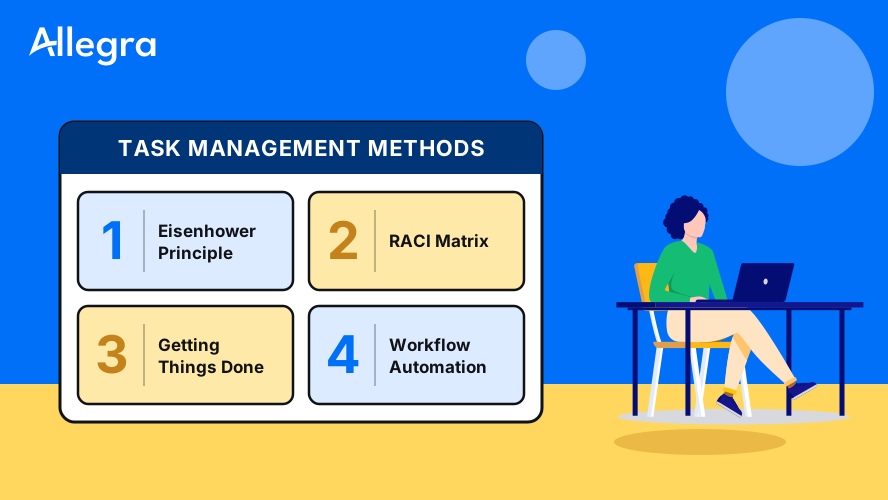
The list of task management methods is manageable, as long as we don’t also count project management methods among them. In this overview article, we explain which methods a good task management system should support.
1. The Eisenhower Principle
One of the most important tasks of a manager is prioritizing tasks — both their own and those they delegate to their team members. Managers often tend to assign only the highest priority to everything, since they feel they cannot afford to deal with low-priority items at all. It can sometimes be unclear what priority is actually supposed to mean and how to assign it. One of the most helpful task management methods is the approach of U.S. General and later President Dwight D. Eisenhower, known as the Eisenhower Principle.
Important or Urgent?
According to the Eisenhower Principle, we distinguish between the importance and urgency of a task. The combination of importance and urgency determines priority. The Eisenhower Matrix sorts pending tasks into four priority levels:
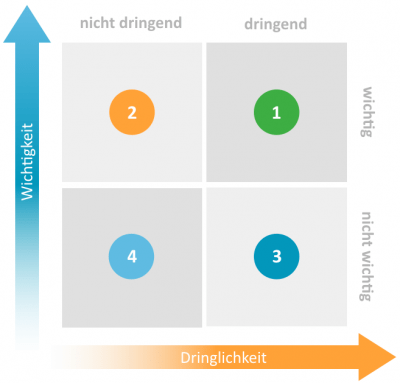
- important and urgent
- important and not urgent
- not important but urgent
- neither important nor urgent
Urgent means you have to take care of it immediately. Most people feel compelled to answer their phone when it rings. Most people would never think of telling the person on the phone to wait 15 minutes while they finish a conversation in person. Yet they often have no problem making the person in front of them wait 15 minutes while they attend to the caller.
Urgent tasks are usually highly visible. They jump out at us, and everyone understands when we turn our attention to them. They stand right in front of us, pressing us to get them done. Sometimes, however, they are completely unimportant.
Important tasks are generally important because their outcome matters. Ordering tasks by importance always has to do with results. If something is important, it contributes to achieving our goals. Important things that are not urgent are easily postponed or forgotten.
We tend to put off important things when they are not simultaneously urgent. While we respond to urgent tasks almost automatically, we must proactively tackle important but non-urgent tasks. This requires a certain amount of practice and mindset.
Quadrant 1 of the Eisenhower Principle describes what is both important and urgent. These are often “crises” or “problems.” Crisis managers and deadline-driven problem managers spend a large portion of their time on this type of task.
Quadrant 3 gives people the feeling that they are dealing with important things. Here, it is often the expectations of others — that something must be done quickly — that lend a task an air of importance. Through artificial urgency, unimportant tasks appear important, even though little or nothing depends on the outcome.
2. RACI Matrix
RACI Matrix: More Clarity and Better Communication
The RACI Matrix is one of the most underestimated task management methods. It extends the “assignee” role common in project management with three additional roles. This means a team member can have relationships to a task other than simply being responsible for it. This is helpful, for example, when team members need to know when a task is completed, or when their knowledge is required to complete a task.
Task-Specific Roles
For managing projects, the RACI method defines four task-specific roles through which project participants can be related to a task. Normally, roles are assigned for an entire project, not for individual tasks. For example, there is a project manager or a Scrum Master for the whole project. RACI gives us significantly more flexibility by enabling roles to be assigned at the task level.
The RACI method does not replace other techniques such as work breakdown structures, Gantt charts, or network diagrams, but complements them. The RACI Matrix is also called a “Responsibility Assignment Matrix” (RAM).
This method allows the responsibilities and accountabilities in a project or organization to be represented clearly, in a differentiated and concrete way. Many report that this technique has made their project management more efficient. Overall, processes became smoother and there were fewer misunderstandings, as everyone’s role and responsibilities within the project were clear. Project meetings involved fewer lengthy and unproductive discussions. Decisions were made faster, and workloads were distributed more fairly.
Better Management with the RACI Chart
In the RACI table, tasks or activities are listed in rows and project participants in columns. The intersection of a task and a team member shows the role that connects them to that task. There are four types of relationships or roles in the RACI system:
- the Responsible (assignee) — Who does the work?
- the Accountable (manager) — Who makes decisions and takes action for the task(s)?
- the Consulted (advisors) — Who is consulted on decisions and tasks and kept in the loop?
- the Informed (those to be notified) — Who is informed about decisions and actions during the project?
In the intersection fields, you enter an R, A, C, or I, or leave it blank. Each task should have only one R — meaning no more than one R should appear per row.
3. Getting Things Done
“Getting Things Done” is one of the most comprehensive task management methods for personal task management, developed by David Allen. Everything that appears in your thoughts, on your desk, or on your computer (referred to here as an “item”) is classified according to a defined schema.
Examples of such “items” include tasks, open points, bug reports, ideas, and customer requests. The recipient cannot directly control the flow of incoming items.
All incoming items are first collected in a personal inbox. In project management software, the “inbox” is a folder or other container. Items that arrive there are regularly reviewed.
Categorizing
There are three possible outcomes of this review:
- An item is “actionable” — meaning something needs to be done.
- An item is “not actionable” — meaning it only needs to be noted and possibly filed somewhere.
- An item requires a sequence of actions, possibly involving multiple people over a longer period of time. For this, “planned items” must be created or modified. “Planned items” could be, for example, a work breakdown structure for a project or a Scrum product backlog.
For non-actionable items there are three buckets in which they can be placed:
- Trash — items here are not considered further and are eventually deleted.
- Incubator — items that do not require action now or in the near future, but may be revisited later. These items serve as seeds for future work. Examples include ideas, wishes, improvements, etc.
- Reference/Favorites — this bucket contains material that may one day be important or is currently needed frequently, such as FAQs, requirements, standards, etc.
For actionable items you have three buckets:
- Next Actions — place items here that you want to work on in the near future. There is no real planning or deadline for next actions. If there are deadlines or appointments to consider, the items should be placed in the calendar bucket.
- Calendar — place all actions here that have a strict relationship to a date or time, such as an appointment, a meeting, or similar. The calendar contains three types of items: appointments, actions, and day- and day-specific information.
- Delegated/Waiting — this bucket contains actions that you have delegated to someone else.
The “planned items” bucket is reviewed on a regular basis. Some items in this bucket may be moved to one of the actionable buckets.
4. Workflow Automation
Workflow automation is among the important task management methods.

Editor and Writer
Gabriella Martin is a Yale University graduate and holds a Master's degree in German Literature from the University of Tübingen. She loves explaining complex things in simple terms.