What is Stakeholder Management?
Stakeholder management is the ongoing process through which a project team actively shapes relationships with all relevant interest groups. The goal: to understand stakeholder expectations, secure their support, and address resistance early.
The word “management” can be misleading here. This is not about controlling people — it is about deliberately shaping expectations, communication, and collaboration. Those who treat stakeholder management as a box-ticking exercise squander its potential. Those who take it seriously lay the foundation for lasting project success.
Stakeholder management and stakeholder analysis are often used interchangeably — incorrectly so. Stakeholder analysis is a sub-step within stakeholder management. It assesses the influence, interest, and attitude of identified stakeholders at a specific point in time. Stakeholder management goes further, encompassing the planning, execution, and ongoing adaptation of communication strategies across the entire project lifecycle.
Who are stakeholders?
Stakeholders are all individuals, groups, or organizations that can influence a project or are affected by its outcome. The Project Management Institute (PMI) and the International Project Management Association (IPMA) define the term similarly — both explicitly include the project team and project management themselves.
The Scrum Guide draws a narrower line: it defines stakeholders as only those with an interest in the project outside the Scrum team. In practice, the broader definition is more useful, because it prevents internal interests from being overlooked.
Why is Stakeholder Management Important?
Projects rarely fail for purely technical reasons. More often, it is overlooked interests, poor communication, or a lack of support from key individuals that stall an initiative. The numbers speak for themselves: PMI studies show that projects with active stakeholder management have a significantly higher success rate.
Securing support. Stakeholders who feel involved back decisions and actively champion the project. This is especially true for sponsors and executives, whose backing determines budget and resource availability.
Identifying resistance early. Not every stakeholder views a project favorably. Identifying opponents and skeptics early allows their concerns to be addressed before they escalate into project risks.
Improving communication. A structured communication plan ensures that the right information reaches the right people at the right time — no more, no less.
Protecting scope. Knowing stakeholder expectations makes it possible to define project scope realistically and prevent uncontrolled scope creep.
The flip side: absent or negligent stakeholder management leads to delays, budget overruns, and in the worst case project cancellation — not because the solution was wrong, but because the people involved did not support it.
Who are Typical Stakeholders in a Project?
Stakeholders can be distinguished along two dimensions:
Internal vs. external. Internal stakeholders — executive management, functional departments, the project team, works councils — operate within the organization. External stakeholders — clients, suppliers, regulatory authorities, partners — stand outside it but often have considerable influence over outcomes and boundary conditions.
Direct vs. indirect. Direct stakeholders are immediately involved in the project or affected by its results. Indirect stakeholders — such as the general public or industry associations — exert an influence that is easy to underestimate.
Typical stakeholders in practice:
- Project sponsor — approves budget and resources
- Executive management — sets strategic parameters
- Project team — executes the work operationally
- Functional departments — provide requirements and use the deliverables
- Clients / end users — determine acceptance and value
- Suppliers and partners — provide resources or services
- Works council — represents employee interests
- Regulatory authorities — enforce regulatory requirements
Completeness matters more than precision here: an overlooked stakeholder can cause more damage than one whose influence was initially misjudged. Hidden stakeholders — informal opinion leaders, long-tenured employees with strong networks — are the ones most commonly missed.
The Five Steps of Stakeholder Management
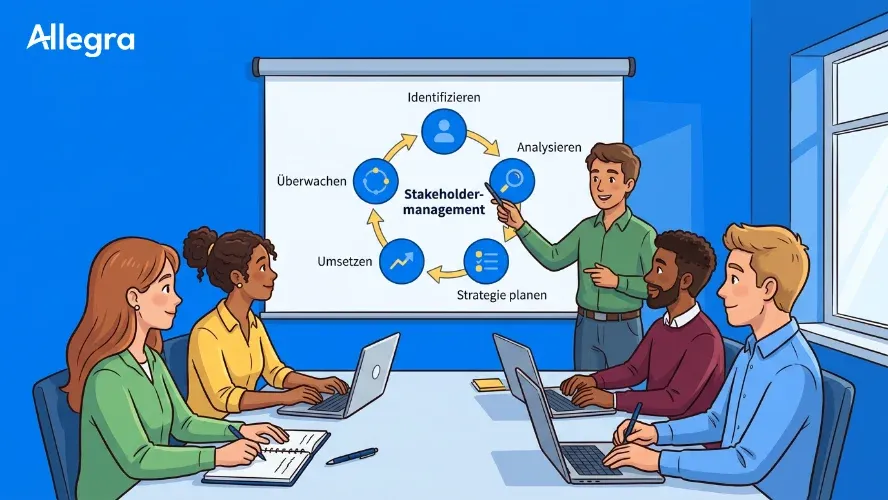
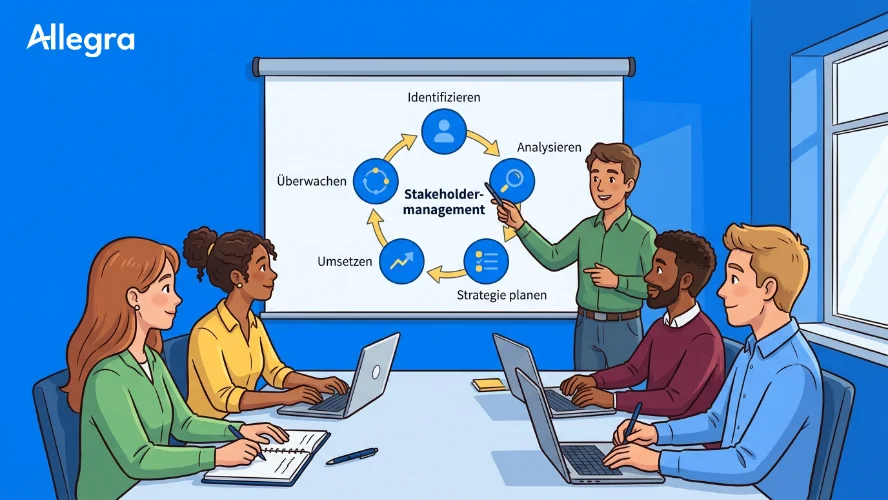
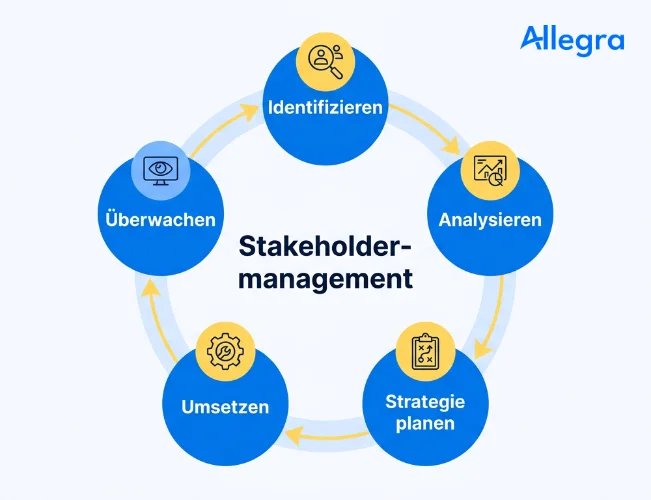
Stakeholder management is not a one-time act — it is a cycle of five steps that repeats throughout the entire project lifecycle.
1. Identify Stakeholders
In the first step, the project team collects all individuals and groups that influence or are affected by the project. The most proven method is a structured team brainstorming session, supplemented by interviews with experienced colleagues.
Three guiding questions help ensure completeness:
- Who has influence over the project — positively or negatively?
- Who is affected by the outcomes?
- Who provides resources, knowledge, or approvals?
The result is a stakeholder register: a list of all stakeholders with names, roles, and contact details. This list is the working foundation for all subsequent steps.
2. Analyze and Assess Stakeholders
Each identified stakeholder is assessed along three dimensions: influence (can they promote or block the project?), interest (how strongly are they affected?), and attitude (supporter, neutral, or opponent?).
The central tool is the influence-interest matrix — a two-dimensional representation that places stakeholders into four quadrants:
| Low Interest | High Interest | |
|---|---|---|
| High Influence | Keep Satisfied Inform regularly, involve in key decisions | Manage Closely Key players — actively involve in decisions |
| Low Influence | Monitor Minimal effort, reassess when things change | Keep Informed Regular updates, open communication channels |
The detailed process — with a template and a practical example — is described in the article Conducting Stakeholder Analysis.
3. Plan the Communication Strategy
From the analysis, the project team derives a communication plan. For each stakeholder or stakeholder group, four elements are defined:
| Dimension | Description | Example |
|---|---|---|
| Channel | Which medium is used for communication? | In-person meeting, email, status report |
| Frequency | How often does the exchange take place? | Weekly, monthly, event-driven |
| Content | What information is shared? | Strategic decisions, progress, risks |
| Owner | Who maintains the relationship? | Project manager, sub-project lead |
The key is differentiation: key players need personal dialogue and a say in decisions. Stakeholders in the “Keep Informed” quadrant receive regular project status reports. In the “Monitor” quadrant, a brief check-in at each milestone is sufficient.
The communication plan is a living document — it is reviewed and updated regularly in step five.
4. Implement Measures
In this step, the communication plan is put into action: meetings are scheduled, information channels are established, workshops are planned.
Three principles help with execution:
Build trust. Trust is built through reliability, not promises. Delivering agreed information on time, honoring commitments, and communicating problems openly — these matter more than any presentation.
Address resistance constructively. Not every objection is unfounded. Taking the concerns of skeptical stakeholders seriously and responding to them in a transparent way can turn opponents into neutral observers and neutral observers into supporters.
Make quick wins visible. Early, tangible results create trust and acceptance — especially with stakeholders who are critical of the project.
5. Monitor and Adapt Stakeholder Relationships
Attitudes and power dynamics shift over the course of a project. A stakeholder who was neutral at the start may become a decisive supporter or opponent after a reorganization. New stakeholders emerge; others lose relevance.
The project team should review the stakeholder register and communication plan regularly — at minimum at every milestone, whenever there are significant scope changes, and following changes in the project environment. The guiding questions:
- Have the influence, interest, or attitude of individual stakeholders changed?
- Have new stakeholders emerged?
- Is the chosen communication strategy working?
This fifth step closes the loop and leads back to the first — which is why stakeholder management is not a one-time document but a continuous process.
Methods and Tools at a Glance
Beyond the influence-interest matrix, several other proven tools are available:
Stakeholder register. The central documentation of all stakeholders, including assessments, strategies, and contact details. In its simplest form a spreadsheet, ideally maintained in project management software.
RACI matrix. Clarifies for each task or topic who is responsible (R), accountable (A), consulted (C), or informed (I). Particularly helpful when many stakeholders are involved in decisions.
Personas. Fictional profiles of representative stakeholders. They help the team empathize with the stakeholders’ perspective and make abstract groups tangible. Especially useful when developing products and services.
Force field analysis. In change projects, this tool places driving forces (supporters, incentives) against restraining forces (resistance, risks). The result shows whether support for a change is sufficient or whether targeted action is needed.
SWOT analysis per stakeholder. Assesses the strengths, weaknesses, opportunities, and risks of working with individual key stakeholders. More effort-intensive, but valuable for critical relationships.
For most projects, the combination of stakeholder register, influence-interest matrix, and communication plan is sufficient.
Stakeholder Management in Agile Projects
In agile projects, close stakeholder engagement is not an optional add-on — it is a core principle. The Agile Manifesto states it clearly: “Customer collaboration over contract negotiation” — collaboration with stakeholders takes precedence over formal agreements.
Agile frameworks put this into concrete practice:
- Sprint Reviews in Scrum are not mere presentation sessions — they are feedback loops with stakeholders. The team demonstrates working results, stakeholders provide input, and both sides jointly decide on the next priorities.
- The Product Owner acts as the central interface between the team and stakeholders. They consolidate requirements and prioritize them in the backlog.
- Transparency — a core agile value — means that stakeholders can see the current state at any time, for example through a public board or regular demos.
The challenge in agile projects lies not in insufficient engagement but in cadence: short iteration cycles require stakeholders to be regularly available and to provide timely feedback. Failing to ensure this stalls the agile process.
Practical Tips
Start early. Stakeholder management belongs in project planning — not just in execution. By the time resistance becomes noticeable, valuable time has already been lost.
Do it as a team. Individuals have blind spots. Different perspectives — project management, subject-matter experts, team members — combine to give a more realistic picture of the stakeholder landscape.
Keep results confidential. Stakeholder assessments are sensitive. A stakeholder who learns they have been classified as an “opponent” is unlikely to become more cooperative. Access to the stakeholder register should be restricted to the core team.
Stay authentic. Mistakes happen in every project. Communicating problems openly and taking responsibility strengthens stakeholder trust. Hiding them puts it at risk.
Prioritize rather than perfect. Not all stakeholders need equal attention. The influence-interest matrix provides the basis for an efficient allocation of limited communication resources.
Be willing to say no. Not every stakeholder expectation can be met — that is normal. What matters is that rejections are explained transparently and alternatives are offered.
Supporting Stakeholder Management with Software
In practice, stakeholder communication quickly spreads across emails, meetings, chat tools, and phone calls. The overview is lost, information slips through the cracks, and commitments are forgotten. This is exactly where digital tools help:
- Maintain stakeholder information centrally — contacts, assessments, and communication history in one place rather than scattered across files.
- Assign tasks and responsibilities — who is taking care of which stakeholder? Which action is due?
- Automate status reports — stakeholders in the “Keep Informed” quadrant receive regular updates without manual effort.
- Document feedback — input from Sprint Reviews, workshops, or one-on-one conversations flows directly into project documentation.
Allegra brings task management, project communication, and reporting together on one platform. Stakeholder communication stays transparent and traceable — and the transition from planning to ongoing management happens without any media breaks.
Frequently Asked Questions
What is stakeholder management, explained simply?
Stakeholder management is the process through which a project team systematically identifies, engages, and continuously manages all individuals and groups that influence or are affected by a project. The goal is to secure support, identify resistance early, and deliberately guide communication.
What is the difference between stakeholder analysis and stakeholder management?
Stakeholder analysis is a sub-step of stakeholder management. It assesses the influence, interest, and attitude of stakeholders at a specific point in time. Stakeholder management encompasses the entire ongoing process: identification, analysis, communication planning, implementation, and continuous adaptation across the full project lifecycle.
Who are the typical stakeholders in a project?
Typical stakeholders include the project sponsor, executive management, the project team, functional departments, clients, suppliers, works councils, and regulatory authorities. A distinction is made between internal and external, and direct and indirect stakeholders. The specific list varies from project to project — thoroughness during identification is critical.
How do you create a stakeholder communication plan?
The communication plan is derived from the influence-interest matrix. For each stakeholder or stakeholder group, the channel (e.g., in-person meeting, email), frequency (weekly, monthly), content (strategic, operational), and the responsible person are defined. Key players receive personal dialogue; less influential stakeholders receive regular status reports.
When should stakeholder management be updated?
At minimum at every milestone and whenever there are significant changes in the project environment — such as a new sponsor, a reorganization, or a scope change. Stakeholder attitudes and power dynamics shift during a project. An outdated stakeholder register gives a false picture of the support landscape.

CEO Alltena GmbH
Christoph Friedrich is a computer scientist and certified Project Management Professional. He has extensive experience in the introduction and integration of project management tools as well as the analysis and definition of processes in project and service management.