What are roles in project management?
A role in project management describes a functional task within a project — independent of job title or position in the line organization. Someone who works as a Senior Developer in their department can take on the role of sub-project lead in a project. And someone who is a team member in the next project may have been the Product Owner in the previous one.
Each role encompasses three dimensions:
- Tasks: What does the person need to do?
- Competencies: What decisions are they authorized to make?
- Responsibilities: What are they accountable for?
This three-part structure — formulated in DIN 69901 as “task, authority, responsibility” — creates clarity and prevents accountabilities from blurring in the day-to-day reality of a project. The project organization provides the structural framework in which roles are anchored.
Why clear role assignments are critical
In many organizations, projects start with enthusiasm — and stall after a few weeks because nobody knows exactly who decides what. Clear project management roles solve this problem at the root.
Avoid duplicate work. When two people work on the same task without knowing it, capacity is wasted. Defined roles ensure that every task is assigned to exactly one responsible person.
Accelerate decisions. In a matrix organization, employees report simultaneously to line managers and project leads. Without clear decision-making authority, a tangle of competing competencies develops that slows projects down. A clean role definition establishes who makes which decisions in the project — and when to escalate.
Minimize conflicts. “I thought you were handling that” is one of the most common phrases in poorly organized projects. Role clarity eliminates misunderstandings before they arise. This reduces friction and keeps collaboration productive.
Structure communication. The role assignment forms the basis for communication planning: who informs whom, at what frequency, through which channel? This framework makes the flow of information in a project predictable.
The classic roles in project management
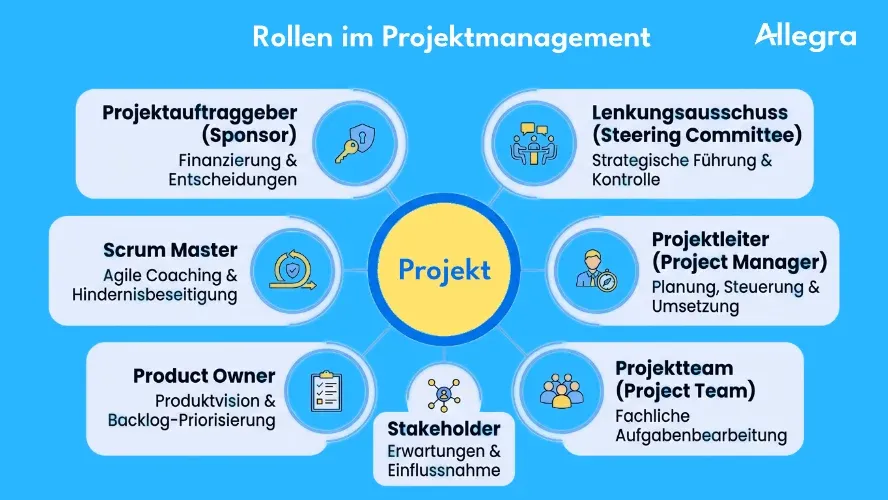
In traditionally managed projects — such as those following PRINCE2 or GPM standards — five core roles have become established. Depending on project size, individual roles may be merged or supplemented by additional ones.
Project sponsor
The project sponsor initiates the project, provides budget and resources, and is the ultimate decision-making authority. They represent the project to senior management and ensure it receives the necessary priority and backing.
Core tasks:
- Issue the project mandate and align goals with the project manager
- Make strategic decisions (scope, budget, termination)
- Secure resources and organizational framework conditions
- Represent project interests externally
In practice: the higher the sponsor sits in the organizational hierarchy, the stronger the backing for the project — and the faster escalations can be resolved.
Steering committee
A steering committee is established when multiple organizational units, departments, or external partners are involved in the project. Under the chairmanship of the sponsor, representatives from the participating areas make cross-functional decisions, set priorities, and accept project deliverables.
The steering committee is not an operational body. It does not intervene in the day-to-day work of the project team, but steers at the strategic level. It typically convenes at defined milestones or when escalation is needed.
Project manager
The project manager bears overall responsibility for achieving the project goals — in terms of scope, schedule, and budget. They plan, control, and monitor the project, and serve as the central interface between the team, sponsor, and stakeholders.
Core tasks:
- Project planning and control (scope, schedule, costs)
- Leading and coordinating the project team
- Operational project controlling and reporting
- Risk management and escalation when problems arise
- Shaping project communication
The role of project manager requires not only methodological know-how, but above all strong communication skills and the ability to assert decisions. A detailed look at the tasks can be found in the article Project Manager: Tasks and Responsibilities.
Project team (subject matter experts)
The project team forms the operational backbone. Team members bring specialized expertise and implement the defined work packages. They are responsible for the quality of their deliverables and contribute to planning and controlling.
The ideal team size is five to ten people. If the team grows larger, it is advisable to form sub-projects with their own sub-project leads to keep coordination manageable. Team building at the start of a project fosters collaboration and mutual understanding.
Stakeholders
Stakeholders are all individuals and groups who have an interest in the outcome of the project or are affected by it — end users, other departments, suppliers, works councils, and sometimes the public. They are not active project roles in the strict sense, but their influence on project success is considerable.
A stakeholder analysis at the start of the project identifies the relevant interest groups, assesses their influence, and derives appropriate communication strategies. If key stakeholders are brought in too late, resistance can develop that endangers the entire project.
Agile roles
Agile frameworks like Scrum define a deliberately lean role model. The classic separation between sponsor, project manager, and team is dissolved in favor of three specialized roles.
Product Owner
The Product Owner represents the interests of users and the organization. They decide the “what” — that is, which requirements are implemented and in what order. Their central tool is the Product Backlog, a prioritized list of all desired features and improvements.
Core tasks:
- Formulate and communicate the product vision
- Maintain, prioritize, and refine the backlog
- Accept or reject deliverables from the team
- Aggregate and translate stakeholder requirements
The Product Owner makes content prioritization decisions alone. This clear assignment prevents the team from being pulled in different directions by conflicting requirements from various stakeholders.
Scrum Master
The Scrum Master is not a traditional supervisor but a servant leader. Their task is to remove impediments, protect the agile process, and support the team in its self-organization.
Core tasks:
- Ensure adherence to the Scrum framework
- Identify and eliminate impediments
- Facilitate meetings (daily stand-up, Sprint Planning, retrospective)
- Shield the team from external disruptions
A common misconception: the Scrum Master is not a project manager in new clothes. They have no authority over the team and make no content decisions.
Development team
The agile development team is self-organized and cross-functionally composed. It decides independently how to implement the requirements prioritized by the Product Owner technically. There is no hierarchy within the team — all members share collective responsibility for the outcome of the Sprint.
The recommended team size is three to nine people. If the team is too small, the necessary breadth of competence is lacking; if it is too large, the coordination overhead increases disproportionately.
Additional roles in project practice
Beyond the core and agile roles, there are functions that arise depending on the project environment.
PMO (Project Management Office)
The PMO is a central organizational unit that provides standards, methods, and templates for project management. It supports project managers methodologically, ensures consistent reporting, and maintains an overview of the entire project portfolio in multi-project management. In large organizations, the PMO is often also responsible for capacity planning.
Quality manager
The quality manager defines the quality standards for project deliverables and monitors compliance. They establish quality gates — defined checkpoints before important milestones — at which results are either approved or sent back for rework.
Risk manager
The risk manager identifies, assesses, and monitors project risks. In smaller projects, the project manager handles this task themselves. For complex undertakings with high risk potential, a dedicated person is worthwhile. The methods are described in our article on risk analysis.
Defining and assigning roles correctly
The best role description does little good if it gathers dust in the project handbook. For role assignments to work in practice, a deliberate process is needed.
Clarify roles before the project starts. By the kick-off meeting at the latest, every team member should know what role they are taking on and what it entails. A verbal agreement is not enough — roles should be documented in writing.
Use a RACI matrix. The RACI matrix is a proven tool for defining, for every task, who is Responsible, Accountable, Consulted, and Informed. The matrix systematically surfaces gaps and overlaps in role assignments.
Avoid conflicts of interest. Certain role combinations are problematic. A developer should not also act as quality manager reviewing their own code. The sponsor should not simultaneously be the project manager, as this would mean they are controlling themselves.
Manage role consolidation consciously. In small projects, it is normal for one person to take on multiple roles. This works as long as the tasks are documented and no conflicts of interest arise. The crucial thing is that no role is “forgotten” — even if it is not independently filled.
Adjust roles as the project evolves. Projects change: new requirements emerge, phases shift, people leave the team. Role assignments should be reviewed regularly and adjusted as needed.
Overview: project roles compared
| Role | Primary task | Decision authority | Context |
|---|---|---|---|
| Project sponsor | Initiation, funding, strategic steering | Budget, scope, project termination | Classic |
| Steering committee | Cross-functional decisions, acceptance | Strategic direction decisions | Classic |
| Project manager | Planning, control, communication | Operational project decisions | Classic |
| Project team | Technical implementation of work packages | Technical decisions within scope | Classic |
| Stakeholders | Requirements, feedback, influence | No direct authority; influence via communication | Classic & Agile |
| Product Owner | Backlog prioritization, acceptance | Content prioritization | Agile |
| Scrum Master | Process guardian, impediment removal | No authority over team | Agile |
| PMO | Standards, methods, portfolio overview | Methodological guidelines | Organization-wide |
Making role assignments transparent with software
In theory, roles are quickly described. In practice, their effect only becomes visible when they are visible to everyone and embedded in the work process. This is precisely where project management tools demonstrate their strength:
- Responsibilities per task: Every task is assigned to a responsible person. At a glance, it is clear who holds the ball.
- Map escalation paths: Decision-making authority and approval processes can be integrated directly into workflows.
- Manage workload: Those who take on multiple roles risk being overloaded. A transparent workload overview makes bottlenecks visible early.
- Automate information flows: Notifications and status updates reach exactly the people who need to be informed according to the role assignment.
Allegra combines task, project, and team management in one platform. Roles and responsibilities are directly linked to tasks and workflows — for maximum transparency across the entire project team.
Frequently asked questions
What is the difference between a role and a position?
A position (e.g., “Senior Developer”) is the fixed job title in the employment contract. A role (e.g., “sub-project lead”) is a functional task in a specific project. The same person can be a team member in project A and a project manager in project B. Roles are temporary and project-specific; positions are permanent and organization-specific.
Does every role need to be filled by a separate person?
No. In smaller projects, one person frequently takes on multiple roles — for example, acting as both project manager and risk manager. This works as long as the tasks of each role are consciously performed and no conflicts of interest arise. As a general rule: it is better to explicitly assign a role and consciously consolidate it with another, than to silently overlook it.
What roles exist in Scrum?
The Scrum framework has only three roles: the Product Owner (defines the “what”), the Scrum Master (looks after the process), and the Development Team (implements). There is no classic project manager in Scrum. Responsibility is distributed across the three roles, with the team working in a self-organized way.
Who defines the roles in a project?
As a rule, the project manager drafts the role assignment in coordination with the project sponsor. The roles are documented in the project organization and presented at the kick-off meeting. In agile projects, the role assignment follows from the chosen framework (e.g., Scrum or Kanban).
How do roles and the RACI matrix relate to each other?
The RACI matrix makes role assignments operationally usable. While the project organization defines roles at the project level, the RACI matrix assigns a responsible, accountable, consulted, and informed person to each individual task. It is the tool that translates general role definitions into concrete accountabilities.

CEO Alltena GmbH
Christoph Friedrich is a computer scientist and certified Project Management Professional. He has extensive experience in the introduction and integration of project management tools as well as the analysis and definition of processes in project and service management.