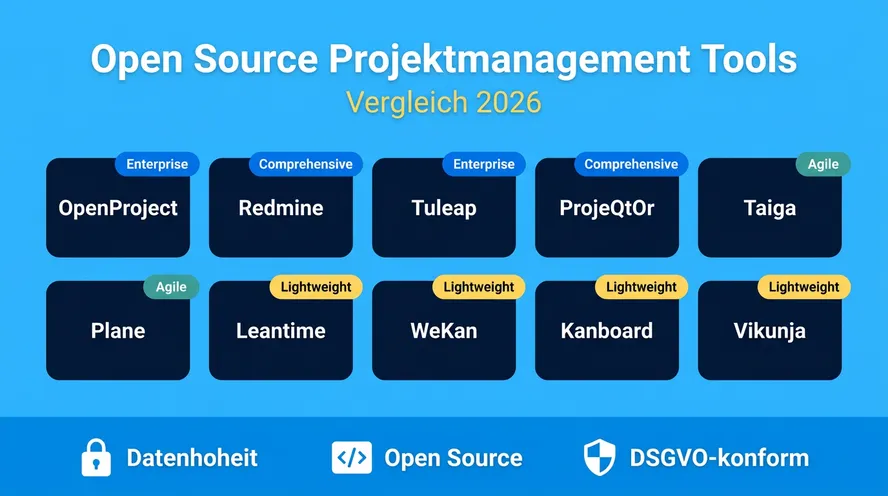
Open source project management tools promise data sovereignty, customizability, and vendor independence. But which solutions actually deliver on that promise? Here you'll find an honest assessment of the ten most relevant open-source solutions — with strengths, weaknesses, and interactive scorecards.
Why Open Source in Project Management?
Open source project management tools are attractive to many organizations because they offer advantages that proprietary software cannot. Anyone looking for the right project management tool should be aware of these arguments:
- Data sovereignty: With self-hosting, all project data stays on your own servers — a decisive factor for GDPR compliance and regulated industries.
- No vendor lock-in: Open formats and APIs allow switching or combining with other systems.
- Transparency: The source code is visible. Security vulnerabilities can be identified by your own teams or the community.
- Customizability: Your own developers or external service providers can adapt the tool to specific processes — without having to wait for the vendor.
- Cost: No licensing fees. However, costs arise for hosting, administration, and onboarding.
Open source is not a free ride, though. These tools require technical know-how for installation and operation. Support often comes only from the community, and user interfaces are not always on par with commercial SaaS solutions. Anyone expecting professional support and a polished interface should also consider commercial alternatives like the solutions evaluated in our project management tools comparison.
Overview: Open Source Project Management Tools
The following table gives you a quick overview of which open-source tools meet your basic requirements. Use the filters to narrow the list to your needs.
| Tool | License | Cloud | Self-hosted | Agile | Classical | GDPR | Ideal for |
|---|---|---|---|---|---|---|---|
| OpenProject | GPL v3 | ✔ | ✔ | ✔ | ✔ | ✔ | Government agencies, enterprises |
| Redmine | GPL v2 | ✘ | ✔ | ✔ | ✔ | ✔ | Developers, IT teams |
| Tuleap | GPL v2 | ✔ | ✔ | ✔ | ✔ | ✔ | Enterprise, ALM |
| ProjeQtOr | AGPL v3 | ✘ | ✔ | Partial | ✔ | ✔ | Classical PM, PMO |
| Taiga | MPL 2.0 | ✔ | ✔ | ✔ | ✘ | Partial | Agile teams, startups |
| Plane | AGPL v3 | ✔ | ✔ | ✔ | ✘ | Partial | Developers, Jira switchers |
| Leantime | AGPL v3 | ✔ | ✔ | ✔ | Partial | Partial | Strategy teams |
| WeKan | MIT | ✘ | ✔ | ✔ | ✘ | ✔ | Small teams |
| Kanboard | MIT | ✘ | ✔ | ✔ | ✘ | ✔ | Minimalists |
| Vikunja | AGPL v3 | ✔ | ✔ | Partial | ✘ | Partial | Task management |
All listed tools can be self-hosted — that is one of the key advantages of open source. With self-hosting, GDPR compliance is fundamentally ensured since the data remains under your own control. The “GDPR” column refers to the overall offering including any cloud services.
Evaluation Criteria
For a well-founded assessment we use the same criteria as in our project management tools comparison. For each tool there is an interactive scorecard whose weighting you can adjust in the first tool — the change is applied to all others.
| Category | Description |
|---|---|
| Feature scope | Task management, Gantt, Kanban, time tracking, resource planning, etc. |
| Ease of use | Intuitive operation, learning curve, UI/UX |
| Collaboration features | Communication, comments, @mentions, shared dashboards |
| Integrations | Connectivity to tools such as Slack, Microsoft Teams, Git, GitLab, Google Drive, etc. |
| Customizability | Custom workflows, fields, dashboards, user roles |
| Reporting & analytics | Reporting capabilities, dashboards, KPIs, export options |
| Support & help | Availability, quality of support, help articles, community |
| Value for money | Cost structure, fairness relative to feature scope |
| Security & privacy | GDPR compliance, hosting, encryption, access control, SSO, 2FA |
| Scalability & performance | Performance with large teams/projects, load times, reliability |
Open Source Project Management Tools in Detail
OpenProject — The Market Leader
OpenProject is the best-known open source project management tool in the German-speaking world. The Community Edition (GPL v3) already offers a solid feature set with work packages, Gantt charts, agile boards, time tracking, and an integrated wiki. OpenProject supports both classical and agile project management methods and is therefore well suited for hybrid approaches. The software comes from a Berlin-based company and can be operated in a GDPR-compliant manner on your own servers or in the EU cloud.
OpenProject evolved from Redmine and has advanced its core structure with a modern interface and expanded feature set. The tool is particularly strong for structured projects with clear roles, permissions, and traceable processes. For government agencies and companies with requirements around project documentation and compliance, this is a genuine argument.
However, many features — including multi-project management, advanced dashboards, and enterprise features — are found exclusively in the paid Enterprise editions. The user interface is functional but not particularly intuitive. New users require onboarding time, and the initial setup demands technical know-how.
| Category | Weight (%) | Score (1–10) | Weighted score |
|---|---|---|---|
| Feature scope | - | ||
| Ease of use | - | ||
| Collaboration | - | ||
| Integrations | - | ||
| Customizability | - | ||
| Reporting & analytics | - | ||
| Support & help | - | ||
| Value for money | - | ||
| Security & privacy | - | ||
| Scalability | - | ||
| Overall score | - | ||
OpenProject is the first choice for organizations looking for a mature open source project management tool with a focus on structure and data privacy. For teams that value a modern, intuitive interface or deep integrations, however, the solution can feel cumbersome.
Redmine — The Veteran
Redmine is one of the oldest open source project management tools and has been in use since 2006. The software is based on Ruby on Rails and offers classic features such as task management, Gantt charts, time tracking, a wiki, and a flexible roles-and-permissions system. The plugin ecosystem is large: hundreds of extensions cover almost every need — from agile boards to CRM modules to advanced reports.
Redmine’s greatest strength is simultaneously its greatest weakness: the software is extremely flexible, but the user interface looks outdated. Drag-and-drop, modern dashboards, or contemporary UX are nowhere to be found. New users need patience and a willingness to work through the configuration. The development pace of the core project has slowed in recent years, and innovative features emerge primarily through third-party plugins.
| Category | Weight (%) | Score (1–10) | Weighted score |
|---|---|---|---|
| Feature scope | - | ||
| Ease of use | - | ||
| Collaboration | - | ||
| Integrations | - | ||
| Customizability | - | ||
| Reporting & analytics | - | ||
| Support & help | - | ||
| Value for money | - | ||
| Security & privacy | - | ||
| Scalability | - | ||
| Overall score | - | ||
Redmine is a solid, proven solution for IT teams that need maximum customizability and are willing to invest in configuration. For organizations focused on a modern interface or agile methods, OpenProject or Taiga is the better choice.
Tuleap — Enterprise ALM from Europe
Tuleap is more than a pure project management tool: it is a complete Application Lifecycle Management platform. Developed by the French company Enalean, Tuleap supports Scrum, Kanban, and classical methods including the waterfall model. It also offers document management, test management, Git and SVN integration, and comprehensive tracker systems. For organizations that want to combine software development and project planning in a single tool, Tuleap is a serious candidate.
The Community Edition (GPL v2) covers the core functionality, while the Enterprise Edition provides additional features and professional support from Enalean. As a European product with a self-hosting option, Tuleap is well suited for GDPR-sensitive environments. However, the interface is complex and the learning curve is steep. Tuleap is aimed at technically proficient teams that want to map ALM processes — not at small teams looking for a simple task board.
| Category | Weight (%) | Score (1–10) | Weighted score |
|---|---|---|---|
| Feature scope | - | ||
| Ease of use | - | ||
| Collaboration | - | ||
| Integrations | - | ||
| Customizability | - | ||
| Reporting & analytics | - | ||
| Support & help | - | ||
| Value for money | - | ||
| Security & privacy | - | ||
| Scalability | - | ||
| Overall score | - | ||
Tuleap is an excellent fit for development teams and organizations that need an end-to-end ALM platform. For pure project management requirements without a software development component, the tool is oversized.
ProjeQtOr — The Methodologist
ProjeQtOr is one of the most feature-rich open source project management tools and offers almost everything that classical project management requires: Gantt charts, resource planning, budget management, risk management, quality management, and requirements management. The PHP/MySQL-based software can be installed on virtually any web server and covers the complete project lifecycle — from planning through project controlling to closure.
Particularly noteworthy is the depth of functionality: ProjeQtOr supports work breakdown structures (WBS), milestones, dependencies, effort estimation, and comprehensive reports. For organizations with a structured PMO working to standards such as PMBOK or PRINCE2, this is a strong offering — and completely free under the AGPL v3.
The downside: ProjeQtOr’s interface is dense and not particularly modern. The sheer number of menu items, forms, and options can overwhelm new users. Agile methods are supported only marginally, and the community is smaller than that of OpenProject or Redmine. Anyone looking for an intuitive, agile tool is in the wrong place here.
| Category | Weight (%) | Score (1–10) | Weighted score |
|---|---|---|---|
| Feature scope | - | ||
| Ease of use | - | ||
| Collaboration | - | ||
| Integrations | - | ||
| Customizability | - | ||
| Reporting & analytics | - | ||
| Support & help | - | ||
| Value for money | - | ||
| Security & privacy | - | ||
| Scalability | - | ||
| Overall score | - | ||
ProjeQtOr is ideal for organizations seeking classical project management with maximum functional depth — at no licensing cost. For agile or mixed teams with high UX expectations, there are more suitable alternatives.
Taiga — Agile and Elegant
Taiga stands out in the open source field through its modern, clean interface. The software focuses consistently on agile methods: Scrum with backlog, Sprints, and burndown charts, as well as Kanban with configurable boards. It also includes an integrated wiki, an issue tracker, and an appealing presentation of epics and user stories. Taiga originally came from the Spanish company Kaleidos and is released under the MPL 2.0.
For agile teams looking for a visually appealing, lightweight tool, Taiga is one of the best open-source options. Onboarding happens faster than with most competitors on this list. Limitations appear with classical project management: Gantt charts, resource planning, or structured project plans are not provided. The integration ecosystem is also modest — connections to Slack or GitLab work, but the selection is limited.
| Category | Weight (%) | Score (1–10) | Weighted score |
|---|---|---|---|
| Feature scope | - | ||
| Ease of use | - | ||
| Collaboration | - | ||
| Integrations | - | ||
| Customizability | - | ||
| Reporting & analytics | - | ||
| Support & help | - | ||
| Value for money | - | ||
| Security & privacy | - | ||
| Scalability | - | ||
| Overall score | - | ||
Taiga is the first choice for agile teams looking for an elegant open-source alternative to Jira or Trello. It is not designed for classical project methods or complex organizational structures.
Plane — The Modern Challenger
Plane positions itself as a modern open-source alternative to Jira and has been actively developed since 2022. The interface is contemporary and well-organized, with issues, Cycles (comparable to Sprints), Modules, and integrated Pages for documentation. The software uses a modern architecture with a Python backend and React frontend and offers both a cloud version and self-hosting under the AGPL v3.
The active development and growing feature set make Plane one of the most exciting projects in the open-source PM space. GitHub, GitLab, and Slack integrations are available, and the API enables custom extensions. However, Plane is still young: some features are under development, documentation has gaps, and the community is smaller than that of established projects. Classical project management with Gantt charts or resource planning is absent.
| Category | Weight (%) | Score (1–10) | Weighted score |
|---|---|---|---|
| Feature scope | - | ||
| Ease of use | - | ||
| Collaboration | - | ||
| Integrations | - | ||
| Customizability | - | ||
| Reporting & analytics | - | ||
| Support & help | - | ||
| Value for money | - | ||
| Security & privacy | - | ||
| Scalability | - | ||
| Overall score | - | ||
Plane is promising for developer teams looking for a fresh, modern alternative to Jira. For production-critical environments, the maturity of the project should be carefully evaluated.
Leantime — Strategy Meets Task
Leantime takes a different approach from most open source project management tools: it connects strategic planning with operational task management. OKRs, project portfolios, and milestones sit alongside Kanban boards and task lists. The interface is user-friendly and is deliberately aimed at teams outside of software development — such as marketing, operations, or strategy departments.
The PHP-based software (AGPL v3) is straightforward to self-host and also offers a cloud version. Leantime’s strength lies in its accessibility: project managers can get started without technical knowledge. However, it lacks depth for demanding project controlling, and the integration landscape is limited. The community is also considerably smaller than that of the established open-source heavyweights.
| Category | Weight (%) | Score (1–10) | Weighted score |
|---|---|---|---|
| Feature scope | - | ||
| Ease of use | - | ||
| Collaboration | - | ||
| Integrations | - | ||
| Customizability | - | ||
| Reporting & analytics | - | ||
| Support & help | - | ||
| Value for money | - | ||
| Security & privacy | - | ||
| Scalability | - | ||
| Overall score | - | ||
Leantime is suited for teams that want to link strategic goals with operational work — without having to dive deep into technical configuration. For complex, methodologically demanding projects, the functional depth is insufficient.
WeKan — The Trello Alternative
WeKan is a self-hosted Kanban solution that closely resembles Trello in appearance and functionality. Boards, lists, cards, checklists, labels, and swimlanes — everything you would expect from a Kanban board is there. The MIT license allows unrestricted use, and installation via Docker or Snap is straightforward.
For teams that need a simple, visual board for task control and want to retain full control over their data, WeKan is a good choice. Limitations become apparent with more complex requirements: project planning with Gantt charts, time tracking, reporting, or resource management are absent. Integrations are also scarce.
| Category | Weight (%) | Score (1–10) | Weighted score |
|---|---|---|---|
| Feature scope | - | ||
| Ease of use | - | ||
| Collaboration | - | ||
| Integrations | - | ||
| Customizability | - | ||
| Reporting & analytics | - | ||
| Support & help | - | ||
| Value for money | - | ||
| Security & privacy | - | ||
| Scalability | - | ||
| Overall score | - | ||
WeKan is the right solution when you need a self-hosted Kanban board without frills. For structured project management, OpenProject or ProjeQtOr offer significantly more.
Kanboard — Radically Minimalist
Kanboard consistently follows the “less is more” principle. The software limits itself to pure Kanban with boards, tasks, swimlanes, and WIP limits. It also includes simple time tracking and a plugin system. The MIT-licensed PHP application requires minimal server resources and can be installed in minutes.
Kanboard’s strength is its clarity: no feature bloat, no complex configuration. Teams that know they only need a Kanban board get exactly that. For anything beyond — whether Gantt charts, reports, role concepts, or broader collaboration — Kanboard is not designed.
| Category | Weight (%) | Score (1–10) | Weighted score |
|---|---|---|---|
| Feature scope | - | ||
| Ease of use | - | ||
| Collaboration | - | ||
| Integrations | - | ||
| Customizability | - | ||
| Reporting & analytics | - | ||
| Support & help | - | ||
| Value for money | - | ||
| Security & privacy | - | ||
| Scalability | - | ||
| Overall score | - | ||
Kanboard is perfect for minimalists who want a lean Kanban board under their own control. For real project management it is too stripped down.
Vikunja — Lightweight Task Management
Vikunja is a self-hosted alternative to Todoist or Wunderlist. The software, written in Go (AGPL v3), offers task lists, Kanban boards, a calendar view, and basic team features. The lean backend consumes few resources and can be set up quickly via Docker. There is also a small cloud option. Vikunja comes from a German developer, which is an interesting aspect for the GDPR topic.
Vikunja is well suited for personal task management or small teams with simple requirements. Labels, priorities, due dates, and CalDAV synchronization cover the basics. For professional project management, however, key features are missing: Gantt charts, resource planning, a roles-and-permissions system, and comprehensive reporting are not available.
| Category | Weight (%) | Score (1–10) | Weighted score |
|---|---|---|---|
| Feature scope | - | ||
| Ease of use | - | ||
| Collaboration | - | ||
| Integrations | - | ||
| Customizability | - | ||
| Reporting & analytics | - | ||
| Support & help | - | ||
| Value for money | - | ||
| Security & privacy | - | ||
| Scalability | - | ||
| Overall score | - | ||
Vikunja is a solid choice for personal or team-based task management with a self-hosting requirement. For professional project management, a more powerful tool is needed.
Conclusion: Which Open Source Tool Is Right for You?
The choice of the right open source project management tool depends heavily on the use case:
- Comprehensive project management with structure and GDPR: OpenProject is the most mature solution with the broadest feature scope.
- Classical PM with maximum functional depth: ProjeQtOr offers almost everything a PMO needs — for free.
- Enterprise ALM for development teams: Tuleap combines project management with software development in one platform.
- Agile work with a modern interface: Taiga impresses with elegance and a focus on Scrum/Kanban.
- Modern Jira replacement: Plane is the fastest-growing project in this space.
- Simple Kanban board: WeKan or Kanboard deliver exactly that — no more, no less.
One thing should not be forgotten with open source: “free” does not mean “effortless.” Hosting, maintenance, updates, and onboarding all require resources. Anyone looking for professional support, a modern interface, and comprehensive functionality without the operational overhead should also consider commercial solutions like Allegra. Allegra combines classical, agile, and hybrid project management in one platform — GDPR-compliant, hosted in Germany, and available either as cloud or self-hosted. A complete comparison of all relevant project management tools can be found in our project management tools comparison.
Further reading: Project management, Project management methods, Waterfall model, PRINCE2, PMBOK, Project planning, Creating a project plan, Work breakdown structure (WBS), Gantt chart, Project controlling, Milestone trend analysis, Earned value analysis, Capacity planning, Effort estimation, Matrix organization, Project documentation.
Frequently Asked Questions
Is open source project management software really free?
The software itself is free to use without licensing fees. Costs arise from hosting, administration, setup, and any training. For cloud-hosted versions (e.g., OpenProject or Tuleap), regular usage fees apply for the managed service.
Which open source PM tool is best suited for Scrum?
Taiga and Plane are optimized for agile methods and offer backlogs, Sprints, and burndown charts. OpenProject and Tuleap also support Scrum, though as part of a broader feature scope.
Can I use open source PM tools in the cloud?
Yes, several providers offer hosted versions: OpenProject, Taiga, Plane, Leantime, and Tuleap are also available as cloud services. For self-hosting-only tools such as Redmine, Kanboard, or WeKan, you have to provide the infrastructure yourself.
Which open source tools offer Gantt charts?
OpenProject, Redmine, ProjeQtOr, and Tuleap offer native Gantt charts. For Redmine, a plugin is sometimes required.
Is open source software more secure than proprietary solutions?
Open source code enables independent security audits and faster bug fixes by the community. However, actual security depends on the maintenance of the project, the currency of the instance, and your own operational practices.
Which tool is suitable for small teams without an IT department?
Leantime and Vikunja are the easiest to install and use. For teams without technical knowledge, a hosted version of OpenProject or Taiga can also be a sensible option.
Which open source PM tools support classical project management?
OpenProject, ProjeQtOr, Tuleap, and Redmine offer features for classical project management such as Gantt charts, milestones, resource planning, and structured project plans.
Can an open source PM tool be integrated with Jira or Slack?
Plane and Taiga offer direct integrations with GitHub, GitLab, and Slack. OpenProject supports connections to Nextcloud and various CI/CD tools. Integration depth is generally lower with open source than with commercial SaaS solutions.
Are there open source project management tools with German-language support?
OpenProject, as a Berlin-based company, offers German-language enterprise support. For most other tools, support is limited to English-language community forums.
What are the key differences between OpenProject and Redmine?
OpenProject evolved from Redmine and offers a more modern interface, better agile support, and a commercial support model. Redmine scores with its large plugin ecosystem and maximum customizability, but has an outdated user interface.

Senior Advisor
Jörg Friedrich is the original author of the project management software Allegra and continues to accompany its development to this day. He has many years of industry experience as a project and department manager. He also serves as a professor in the Faculty of Computer Science and Information Technology at Esslingen University of Applied Sciences.