What are typical mistakes in project management?
Mistakes in project management are rarely a single event. Usually, small gaps in goal-setting, planning, steering, and collaboration add up — until deadlines slip, budgets tighten, or stakeholders feel they’ve received “something different” from what they expected. Experienced teams recognize these patterns early; less seasoned project leads often repeat them, because operational pressure outweighs the time available for clear rules.
The sections below describe common sources of failure that appear across many industries — from IT and product projects to internal change initiatives. Practical guidance comes from recurring themes: clear goals, appropriate leadership of the initiative, transparent communication, and an appropriate balance of structure and flexibility.
What matters less is whether you work classically, agile, or in a hybrid approach: mistakes in project management often arise where the framework and the method don’t match — for example, when a small team is slowed down by heavy governance rituals, or when a large regulated project is managed without solid planning artifacts. It makes sense to consciously adapt project management methods to size, risk, and culture rather than copying a label. For further reading on planning failures and lessons learned, it’s worth looking into how to embed a learning culture in your organization.
Why mistakes in project management have such a strong impact
Projects are time-limited and operate with fixed or at least expected resources. What is neglected at the start — such as a solid goal definition or realistic estimates — can only be corrected later with additional effort. At the same time, the cost of changes typically rises over the project lifecycle. That’s why it pays to know recurring mistakes in project management and address them early, rather than accepting them as “normal project dynamics.”
A second effect is political: unclear goals and opaque decisions generate frustration within the team and among stakeholders. Even technically good work can look like failure when expectations and deliverables diverge.
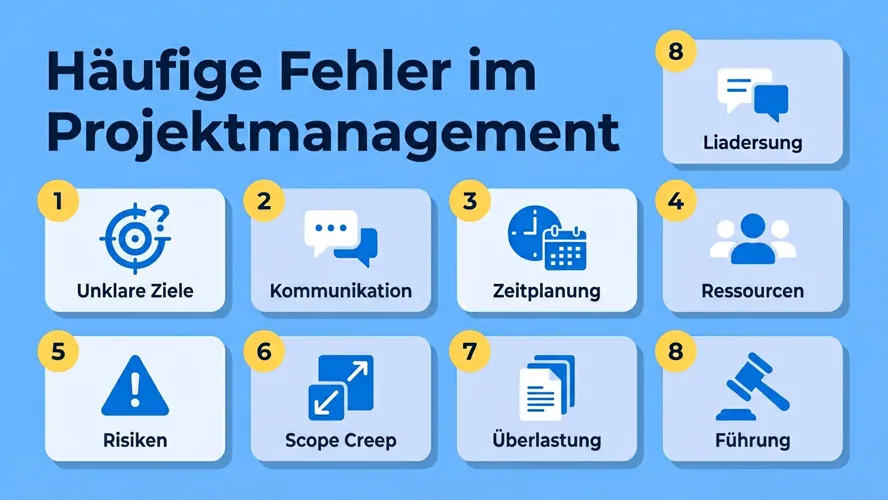
1. Unclear, contradictory, or unmeasurable project objectives
Symptoms: Debates about when the project is “done”; differing notions of success; tasks whose contribution to the overall outcome no one can clearly justify.
Why it goes wrong: Without a shared goal picture, every role prioritizes according to its own criteria. Project objectives then feel like platitudes rather than actionable criteria.
Typical consequences: Late scope discussions just before sign-offs, duplicate work on “optionally” important topics, and ongoing renegotiation of the project management triangle trade-offs — because it was never clear which goal takes precedence in a conflict.
Countermeasures:
- Formulate objectives specifically and back them with measurable or verifiable criteria (see also SMART goals).
- Document a Definition of Done or comparable completion criteria for key deliverables.
- Make stakeholder expectations visible and explicitly resolve conflicting requirements — don’t just talk them away.
2. Project leadership without the right experience or mandate
Symptoms: The project lead is assigned based on availability; decisions are constantly escalated or reversed; no one feels responsible for the overall outcome.
Why it goes wrong: Project manager responsibilities include coordination, steering, and often conflict and stakeholder management as well. When experience or authority is lacking, the initiative loses direction — regardless of the method chosen.
Typical consequences: Fluctuating priorities, delayed approvals, and a team that spends more energy on coordination than on deliverables. Roles in project management remain filled on paper but vacant in practice.
Countermeasures:
- Match the appointment to the complexity and risk of the initiative, not just the calendar.
- Clarify decision-making rights and escalation paths in writing (e.g., in the project handbook or a brief governance overview).
- Where needed, define coaching arrangements or a stronger role for the client or sponsor.
3. Weak communication and undocumented decisions
Symptoms: Information flows bilaterally rather than reaching all relevant roles; later discussions revolve around “what was agreed back then”; changes seem arbitrary.
Why it goes wrong: Communication in project management is the glue between plan and reality. Without a shared information baseline, error rates in implementation and sign-off increase.
Typical consequences: The project status report shows “green” while the team is internally talking about blockers; stakeholders only learn about critical issues at the steering committee.
Countermeasures:
- Set a cadence: recurring status formats, clear channels, binding timeslots.
- Document decisions and their rationale — especially around scope, timelines, and budget.
- Design the reporting system so that it supports steering rather than just producing “reports for the sake of reports.”
4. Overly optimistic scheduling and missing buffer time
Symptoms: The first project schedule looks elegant but fails at the first unforeseen event; milestones slip without any structured root-cause analysis.
Why it goes wrong: Underestimated complexity, unplanned coordination, and dependencies on third parties are normal. Without buffer time and regular updates, the plan becomes a facade.
Typical consequences: Permanent “firefighting” mode, overtime just before milestones, and a target-actual comparison that only reveals the true gap when it’s too late.
Countermeasures:
- Make estimates transparent and ideally validate them with multiple sources (see effort estimation).
- Plan buffer time visibly rather than hiding it invisibly inside work packages.
- When deviations occur, analyze the schedule delay early and document measures — don’t just set new end dates.
5. Resource conflicts, multi-project load, and overload
Symptoms: The same people are scheduled across many initiatives simultaneously; priorities change weekly; quality suffers; sick days and absences are not factored in.
Why it goes wrong: In multi-project environments, competition for capacity arises. Without clear organizational priority-setting, project leads are left alone with appeals.
Typical consequences: Constant context-switching, rising error rates, and reliable commitments become impossible — even among highly capable individuals.
Countermeasures:
- Map capacity and availability realistically; resource planning is not a side issue.
- Agree on per-person WIP limits or equivalent rules with line managers.
- Make workload and bottlenecks visible — for example, through capacity views and escalation when overload is structural.
6. Scope creep and unregulated change management
Symptoms: Scope grows gradually; “small additions” accumulate; budget and timeline are not adjusted; the team is always working on “just one more quick thing.”
Why it goes wrong: Without a clear project scope and a process for changes, project leads lose control over the delivery scope and stakeholder expectations.
Typical consequences: The originally planned minimum becomes an ongoing construction site; project controlling exposes cost and schedule drivers without any political prioritization happening.
Countermeasures:
- Manage requirements and scope in writing and align with stakeholders (see requirements specification / functional specification as appropriate).
- Establish a change process that evaluates effort, risk, and priority — including documented approvals.
- Communicate clearly what is in and what is out of the current delivery.
7. Neglected risk and quality management
Symptoms: Surprises are treated as “inevitable”; quality is deferred to the end; technical debt and rework dominate the final phase.
Why it goes wrong: Risk management and early quality assurance reduce the likelihood of costly corrections. Skipping them saves time in the short term and usually costs more later.
Typical consequences: Large integration crises at the end, expensive project costs from rework, and reputational damage with clients or internal users.
Countermeasures:
- Maintain a lean risk register and actually use it in status reviews.
- Prioritize risks and measures (see risk matrix).
- Connect quality criteria and testing early — not just as a closing ritual.
8. Lack of support from management or the team
Symptoms: The project is seen internally as a “side issue”; departments deliver late or half-heartedly; management decisions are missing or arrive too late.
Why it goes wrong: Projects need sponsorship and buy-in — for software rollouts and organizational changes just as much as for product development. Without it, even a motivated core team works against resistance.
Typical consequences: Delayed deliveries due to missing domain expertise or test data, passive blockades (“we don’t have capacity”), and escalations that only take effect once the damage is already visible.
Countermeasures:
- Establish a named sponsor with a clear mandate.
- Communicate expectations and benefits early; involve participants in relevant decisions.
- When conflicts arise, use conflict management and clear escalation paths rather than waiting things out.
9. Knowledge silos and insufficient documentation
Symptoms: Knowledge resides with individuals; when someone goes on vacation or leaves, progress stalls; the same questions are discussed multiple times.
Why it goes wrong: Projects depend on shared context. Without project documentation and a traceable filing structure, coordination costs rise.
Typical consequences: Onboarding new team members takes weeks; the same risks are “newly discovered” multiple times; dependencies between work packages remain implicit and break under pressure.
Countermeasures:
- One authoritative filing location and naming conventions — not five parallel channels.
- Document important decisions, interfaces, and lessons learned.
- Plan handovers and backup coverage in advance for critical roles that are single points of failure.
10. Too many meetings, micromanagement, or both
Symptoms: The calendar consumes working time; meanwhile, team members don’t feel trusted but are still controlled on details.
Why it goes wrong: Meetings without a clear decision or alignment function drain progress. Micromanagement demotivates and prevents ownership — especially among skilled professionals.
Typical consequences: Fully booked calendars with mediocre output; at the same time, employees don’t feel led because strategic decisions are absent or arrive too late.
Countermeasures:
- Run every meeting with a goal, agenda, and outcome record (see writing meeting minutes).
- Steer through milestones and visible deliverables rather than through constant micromanagement.
- Combine trust with clear expectations around reporting and quality.
11. Rigid or ill-fitting methodology instead of adapted lightness
Symptoms: Many ritual obligations, little benefit; or the opposite: no structure at all because “we’re agile.” The work breakdown structure (WBS) is missing even though interfaces are complex — or it’s over-maintained for a five-person team.
Why it goes wrong: Methods are tools. Applying them without context creates friction: too much process slows things down, too little creates chaos. Project phases and steering cadence should match the complexity.
Typical consequences: Checklists formally completed while actual delivery status remains unclear; or constant re-prioritization without a reliable planning baseline.
Countermeasures:
- Define a minimum standard: what is always necessary (goals, scope, accountability, communication cadence, change path).
- Start methods lean and scale up as complexity grows — not the other way around.
- Where needed, align project steering and controlling specifically to decision-making needs, rather than introducing all artifacts at once.
Quick checklist against typical mistakes in project management
Before the next project kickoff or in the next steering round, you can use a few questions to check whether the most common traps have already been addressed:
- Goals: Do the client, the team, and key stakeholders agree on when the project is “done” — including measurable or verifiable criteria?
- Scope & changes: Is there a documented scope and an agreed process for changes, including effort assessment and sign-off?
- Capacity: Are the people assigned truly available — or only nominally fully booked across multiple projects simultaneously?
- Risks: Have the most important risks been named, prioritized, and assigned to owners with deadlines — or only discussed “at some point”?
- Communication: Is it clear who receives which information when and in what form — and where decisions can be looked up?
- Learning: Is there a fixed slot for lessons learned or retrospectives, so that patterns don’t repeat?
If several items remain unanswered, that’s an early signal: this is often where mistakes in project management originate — the kind that become expensive later.
Conclusion: Recognizing — and avoiding — mistakes in project management
Mistakes in project management recur because the underlying patterns are often the same: unclear goals, weak communication, unrealistic planning, uncontrolled scope, and missing organizational backing. Addressing these points at the start and continuously improves not only schedule and budget adherence, but also collaboration and stakeholder trust.
In practice, a brief project kickoff checklist helps: goals and scope documented in writing, roles and decision paths clarified, communication and change processes agreed upon, first risks and dependencies made visible — ideally at the kickoff meeting or immediately afterward. Once that habit is established, it significantly reduces the likelihood that mistakes in project management pile up only in the critical final phase.
Consistent digital support doesn’t replace clear rules — but it can help create a shared data foundation for tasks, timelines, documents, and status, and reduce duplicate work. For those who want to go deeper, software for project management and best practices in project management offer further orientation. It’s also worth looking at successful projects — where teams combine clarity, cadence, and a willingness to learn, typical pitfalls rarely become showstoppers.
For day-to-day implementation, the best lever remains: create clarity early and consistently learn from past initiatives — so that the same mistakes in project management don’t become a permanent state.
Frequently asked questions
What are the most common mistakes in project management?
Typical ones are unclear goals, poor communication, overly optimistic planning, overload from parallel initiatives, scope creep without a change process, and absent or merely formal risk management. Several of these often occur simultaneously.
Can mistakes in project management be entirely avoided?
Not every risk is foreseeable. The sensible approach is to know recurring sources of failure and cushion them with clear processes, transparency, and realistic buffer time. That makes surprises more manageable and correctable.
How does software help against typical project management mistakes?
Tools primarily support transparency, traceability, and consistent data — for example, around tasks, timelines, and documentation. But they don’t replace goal clarification, prioritization, and leadership of the initiative. The right combination is a clear process paired with a fitting tool landscape.

CEO Alltena GmbH
Christoph Friedrich is a computer scientist and certified Project Management Professional. He has extensive experience in the introduction and integration of project management tools as well as the analysis and definition of processes in project and service management.